
On this page
A visitor lands on your pricing page at 9 p.m. The bot answers two setup questions well, then the visitor types "can someone explain the enterprise SSO limits before I bring this to my team?" The bot pastes a help-center link. The visitor closes the tab.
That is a handoff that never happened, and it is more expensive than any support ticket. The bot did the easy 70 percent and then stalled on the 30 percent that carried the deal. The skill that separates a useful AI assistant from an annoying one is knowing the exact moment to step aside and put a person in the chair.
This post covers why the handoff matters, the signals that mean a human should take over, the difference between a warm and a cold transfer, how to design the moment so it feels smooth, the failures that break it, how to measure whether it is working, and the practices that hold up in production.
Why does the bot-to-human handoff matter?
The handoff matters because it is where trust is won or lost, and buyers still reserve their trust for people on the decisions that count. In a 2026 SurveyMonkey study, 54 percent of customers said they trust human agents more than AI for product and service recommendations, against 32 percent who trust AI more, and 64 percent said they would prefer companies did not use AI for customer service at all. Those numbers do not mean bots have no place. They mean the bot has to know when it is out of its depth and route cleanly to someone who is not.
Service leaders are landing in the same spot. Gartner reported in April 2026 that 85 percent of service and support leaders are expanding human agent responsibilities, even as they automate routine work, because the hard cases still need a person. The bot clears volume. People carry the moments with money and emotion in them.
On the sales side the stakes are sharper still, because a stalled handoff is a lost deal rather than a reopened ticket. When a high-intent visitor asks a question the bot cannot close, speed to a person is everything. The classic MIT and InsideSales.com lead response study found that reaching a lead within five minutes rather than thirty makes you roughly 100 times more likely to connect and 21 times more likely to qualify it. A bot that hands a hot buyer to a rep in seconds captures that window. A bot that dead-ends the buyer hands it to your competitor.
What signals mean a human should take over?
A human should take over when the visitor asks for one, when frustration shows, when the bot has failed twice, when the topic carries real risk, when the model's confidence falls, or when the account is worth a person's time. Those six signals cover most real escalations, and each one can be detected and wired into your bot.
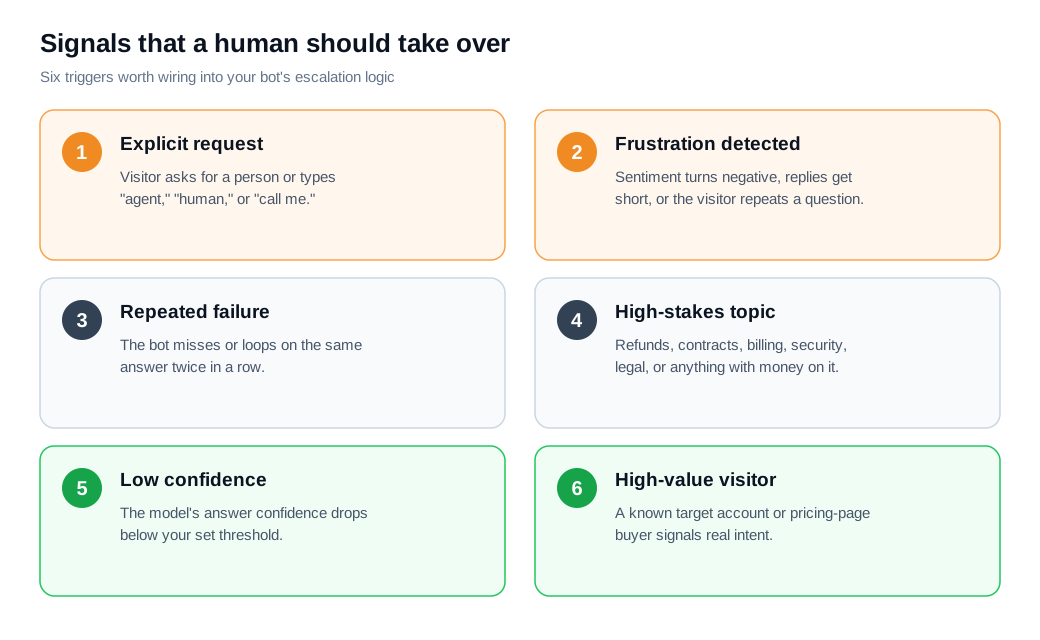
- Explicit request. The visitor types "agent," "human," "talk to someone," or "call me." This is the clearest signal there is, and it should trigger an instant handoff with no friction and no upsell loop.
- Frustration detected. Sentiment turns negative, replies get short, or the same question comes back a second time. Frustration compounds fast, so catch it early rather than after the visitor has given up.
- Repeated failure. The bot misses the answer or loops on it twice. A common rule is to escalate by the second or third failed response instead of letting the visitor keep hitting a wall.
- High-stakes topic. Refunds, contracts, billing disputes, security, legal questions, eligibility, or anything with money on it. These carry real consequences if the model guesses, so route them to a person by default.
- Low confidence. The model's own answer confidence drops below a threshold you set. When the bot is not sure it is right, a quiet handoff beats a confident wrong answer.
- High-value visitor. A known target account, a returning big spender, or a buyer parked on the pricing page. On the sales floor this is a signal to greet and route to a rep, not to make the buyer work through a script.
Two of these deserve a note. High-stakes topics can be handled with a keyword list ("fraud," "cancel," "refund," "outage," "breach") that forces an escalation regardless of what the bot thinks it knows. Low confidence needs a real threshold in your AI chat assistant, tuned against transcripts, so the bot escalates on genuine uncertainty rather than on every unusual phrasing.
What is a warm handoff versus a cold handoff?
A warm handoff passes the conversation history and intent to the agent before they connect, while a cold handoff drops the customer on an agent who knows nothing and has to start over. The difference is the single biggest lever on whether the moment feels smooth or infuriating.
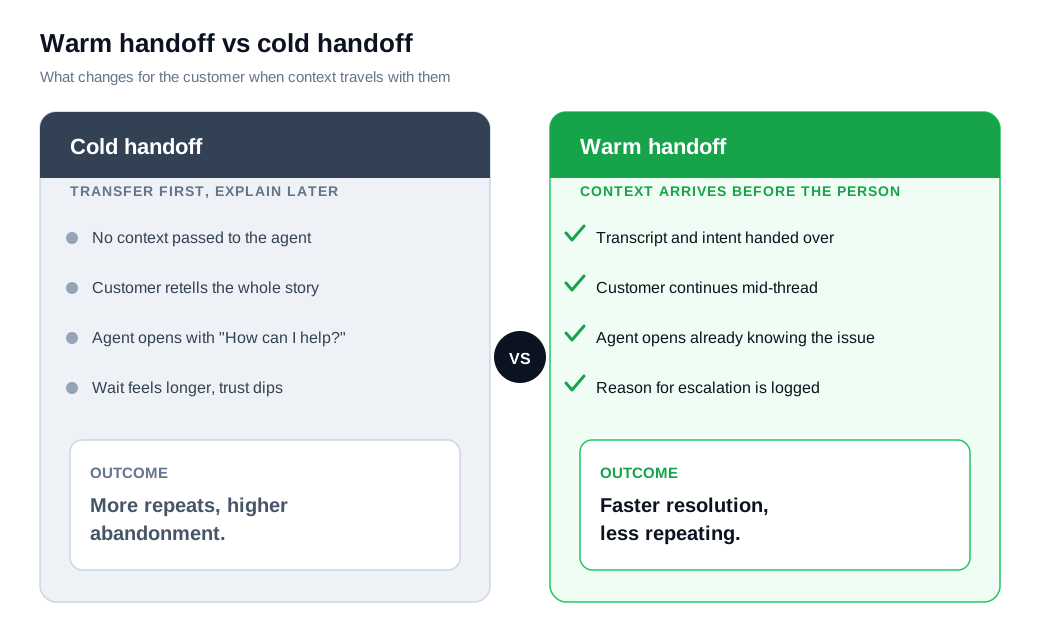
In a cold handoff, the agent opens with "How can I help you today?" after the customer already spent five minutes explaining the problem to the bot. The customer repeats everything, the wait feels longer, and the business has signaled that it did not bother to carry the thread across. Practitioner guides on escalation consistently tie cold transfers to higher abandonment and lower satisfaction for exactly this reason.
In a warm handoff, the transcript, the extracted details, the actions the bot already tried, and the reason for escalation all land on the agent's screen before the first human message. The agent opens already knowing the issue. Support teams that run warm transfers report faster first-contact resolution because the agent skips the discovery that the bot already did. The rule is simple. Context should arrive before the person does, every time.
How do you design a smooth handoff?
Design the handoff as a continuation of one conversation, so the visitor never feels dropped, restarted, or left waiting without a word. The mechanics come down to four moves.
First, detect the trigger and act on it in the moment. Whichever of the six signals fires, the bot should acknowledge the shift plainly: "Let me bring in a specialist who can pull up your account." Silence between the bot and the human is where visitors leave.
Second, pass the full context. Microsoft's Bot Framework models this with a formal handoff initiation event that carries a transcript of the conversation plus the data needed to route it to the right agent. You want the same payload regardless of platform: who the visitor is, what they asked, what the bot tried, and why it is escalating.
Third, route to the right person, not just any person. A billing question and a security question should not land in the same queue. On a sales team, a demo request from a mid-market account and a support question from a free user go to different people. Getting this right is the job of your routing and notifications setup, which decides who gets pinged and how fast.
Fourth, set expectations while the visitor waits. Tell them a person is joining, give a rough time, and keep the thread open. For a sales conversation the strongest version of this drops the buyer straight into live chat with the rep, or escalates the channel itself to a live video call or screen share when the question is easier to show than to type. The visitor moves from bot to human inside the same window, with the history intact.
Here is the sequence in one line: detect the signal, tell the visitor, pass the transcript, route to the right rep, and keep the conversation in one place.
What are common handoff failures?
The most common failure is the dead-end loop, where the bot has no human option and the visitor gets stuck answering the same prompts with no way out. It is the fastest way to burn goodwill, and it is entirely avoidable.
A few others show up again and again:
- Context loss. The bot escalates but passes nothing, so the customer repeats the whole story and the agent starts from scratch. This is the cold-transfer problem, and it is the top complaint about bot-to-human transfers.
- Handoff to nobody. The bot promises a person, then routes to an empty queue, an after-hours void, or a contact form. A promise of help that resolves to a web form reads as a broken promise.
- Escalating too late. The bot fights to avoid the handoff, retries its own failed answer three times, and only gives up once the visitor is already angry. By then the escalation is damage control.
- Escalating too early. The opposite failure. The bot punts every slightly unusual question to a human and drowns the team, which trains agents to distrust the escalations that matter.
- No transparency. The visitor cannot tell whether they are talking to a bot or a person, so they never know whether to rephrase for a machine or wait for a human. Say which is which.
- A one-way door. The visitor gets moved to a human but cannot get answers to the quick follow-ups the bot handled fine. Good systems let the conversation flow both ways.
Most of these trace back to one design decision: treating the handoff as an edge case rather than a core path. It is a core path. A meaningful share of your best conversations will run through it.
How do you measure a good handoff?
Measure the handoff on resolution quality and satisfaction, not on how rarely it happens. A low escalation rate looks efficient on a dashboard and can quietly mean customers are trapped in automation with no way to a person.
Guidance on chatbot metrics makes the point directly: the goal is the right escalations, and not all escalations are failures. Some are the bot correctly recognizing that a case needs human judgment. Track escalation reasons separately so you can tell an appropriate handoff (a refund, an angry customer, an explicit request) from a lazy one, and watch CSAT specifically for the conversations that were escalated.
Here is a worked example with round numbers. Two chatbot configurations handle the same 4,000 chats a month.
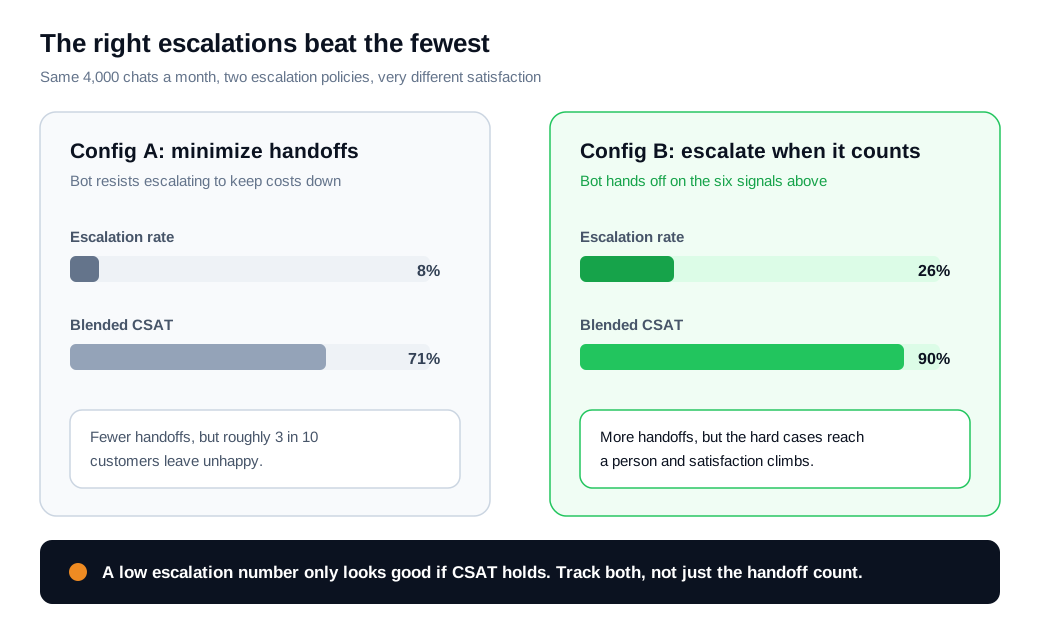
Config A is tuned to minimize handoffs. It escalates 8 percent of chats, about 320, and posts a blended CSAT of 71 percent. It looks cheap and self-sufficient. But roughly 3 in 10 customers leave unhappy, many of them stuck in a loop they could not escape.
Config B escalates on the six signals above. It hands off 26 percent of chats, about 1,040, and posts a blended CSAT of 90 percent. It costs more agent time. It also sends far fewer customers away frustrated, and on the sales side it puts a person in front of the buyers who were ready to talk. The escalation rate tripled and the business got healthier. That is the trade you are optimizing, and you can only see it if you measure both numbers together.
What are the AI to human handoff best practices?
The core practice is to keep a human option visible at all times and hand off the moment one of your defined signals fires, with full context attached. Everything else supports that.
- Always offer a way to a person. A visible "talk to a human" option raises trust in the bot rather than lowering it, because people engage more freely when they know they will not get stuck. Hiding the exit does the opposite.
- Send context ahead of the person. Pass the transcript, the intent, and the reason for escalation so the agent opens already informed. Warm beats cold every time.
- Route by topic and value. A refund, a security question, and a demo request are different jobs for different people. Match the signal to the right queue, and for sales route high-intent visitors to a rep fast, the way an inbound sales motion built on speed depends on.
- Be honest about who is talking. Label the bot as a bot and the human as a human. Clarity beats a convincing impostor.
- Tune the thresholds against real transcripts. Read the escalations weekly. Move the confidence threshold and keyword list based on what the bot got wrong, not on a guess set once at launch.
- Judge the program on outcomes. Resolution rate and CSAT, including CSAT on escalated chats, tell you whether the handoff works. Escalation rate alone does not.
Get these right and the bot stops being a gate in front of your team. It becomes the fast first layer that clears the easy questions and knows exactly when to bring in a person for the ones that matter.
Key takeaways
- The handoff is where trust is decided, and buyers still trust people more on high-stakes calls, with 54 percent trusting human agents over AI for recommendations in 2026 research.
- Six signals should trigger a handoff: an explicit request, detected frustration, repeated bot failure, a high-stakes topic, low model confidence, or a high-value visitor.
- Warm handoffs beat cold ones, because passing the transcript and intent before the agent connects spares the customer from repeating themselves and speeds resolution.
- Design it as one continuous conversation, which means detecting the signal, telling the visitor, passing full context, routing to the right rep, and keeping everything in one window.
- Avoid the dead-end loop and context loss, the two failures that do the most damage, and never promise a person you cannot actually deliver.
- Measure resolution and CSAT, not just escalation rate, since a low handoff count can hide customers trapped in automation with no way out.

Written by
Nilas MylerCo-founder & CTO, Glimpze
Nilas is the co-founder and CTO of Glimpze, an inbound sales tool that turns high-intent website visitors into live conversations. A former SEO consultant for some of the largest companies in Denmark, he writes about speed-to-lead, inbound sales, and conversion rate optimization — the technical and operational mechanics of turning traffic into pipeline.


