
On this page
A visitor from a paid ad lands on your product page, reads the security section twice, and opens the chat widget. The widget says what it says to everyone: "Hi, how can I help?" That greeting throws away everything the page already knew about why they came.
Personalized website conversations close that gap. The idea is plain: use what you already know about a visitor (the page they are on, how they arrived, what they have done before) to open with a message that fits, then let the exchange adapt as it runs. Done well, it reads as attentive service. Done carelessly, it reads as surveillance, and people leave.
This guide covers what it means to personalize a conversation, the data that makes it possible, how to tailor greetings by segment, what personalization does to conversion, how to scale it without crossing into creepy, and the mistakes that quietly waste the channel.
What does it mean to personalize a website conversation?
Personalizing a website conversation means adapting the greeting, the questions, and the routing to the specific visitor in front of you, using signals you have permission to use, so the exchange feels written for them rather than broadcast to everyone.
There are two ways to do it, and the difference matters more than any tactic below. Passive personalization infers things about a visitor from data they did not knowingly hand over, then acts on it. Active personalization uses what the visitor plainly volunteered: the page they chose, an answer they typed, an account they logged into. Gartner's 2025 research found that active personalization reduces the apprehension people feel about the creepiness of passive personalization, and that customers reached through active personalization were 2.3 times more likely to confidently complete a critical purchase decision.
A personalized conversation has three moving parts. The opener is the first line, matched to context. The middle is the set of questions and answers shaped by what you learn. The handoff is the routing to the right person or resource. Personalization can touch any of the three, and the cheapest, safest place to start is the opener, because page context alone (which URL the visitor is on) tells you a great deal without touching a single piece of personal data. A live chat widget that greets a pricing-page visitor differently from a blog reader is already personalizing, using nothing but the address bar.
What data enables personalized chat?
Personalized chat runs on four layers of data: page and referral context, on-page behavior, first-party account data, and firmographic enrichment, ordered from the least sensitive and most available to the most powerful and most regulated.
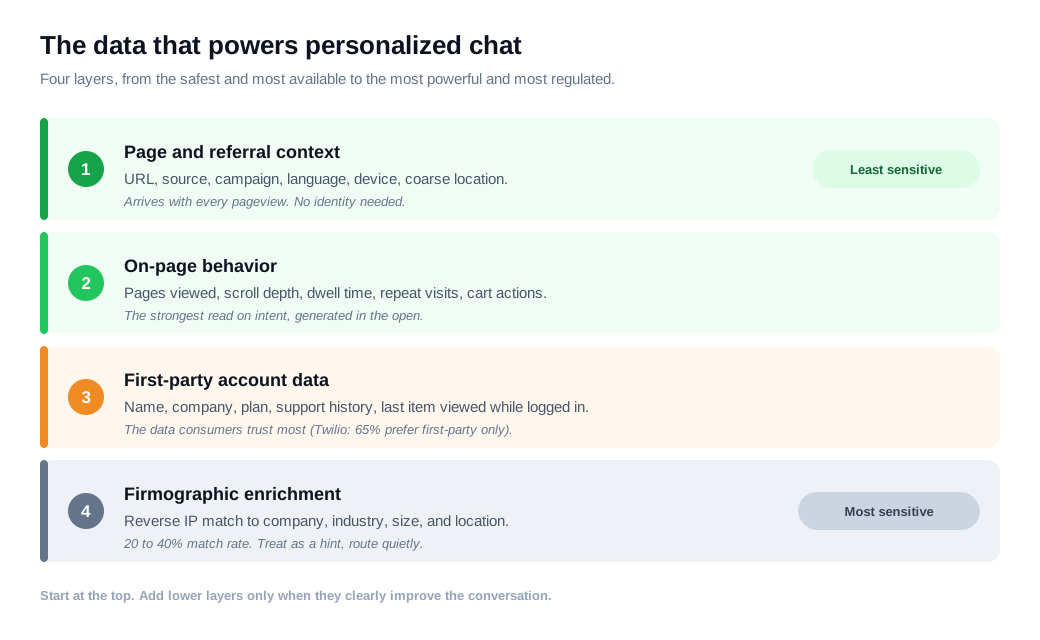
Page and referral context arrives with every pageview. The URL, the referring source (a Google ad, a comparison page, an email link), the visitor's language, device, and coarse location all show up without knowing a name. A pricing-page visitor coming from a competitor comparison search is a different conversation than a first-time blog reader, and you can tell them apart before either has typed a word.
On-page behavior is what the visitor does once they are on the site: pages viewed, scroll depth, time on a page, repeat visits, a plan configured or an item added to a cart. Behavior is the strongest read on intent, and the visitor generates it in the open.
First-party account data is what a known visitor has already told you, held in your CRM or product: name, company, plan, support history, the last thing they viewed while logged in. This is the data consumers are most comfortable with. Twilio's research found 65 percent of consumers would prefer brands use only first-party data to personalize their experiences.
Firmographic enrichment is the B2B extra. A reverse IP lookup can match an anonymous visit to a company and append industry, size, and location. Company-level match rates typically land in the 20 to 40 percent range and degrade on mobile and home networks, so treat the result as a helpful hint, not a certainty. Start with the data the visitor can see you have, and add heavier layers only when they clearly improve the conversation. An AI chat assistant can read most of these signals in real time and draft an opener that matches, which is what makes per-visitor personalization workable at volume.
How do you tailor greetings by segment?
Tailor greetings by mapping each meaningful visitor segment to a signal you can actually detect and a specific opener that speaks to why that segment is there, then falling back to a neutral greeting when no segment applies.
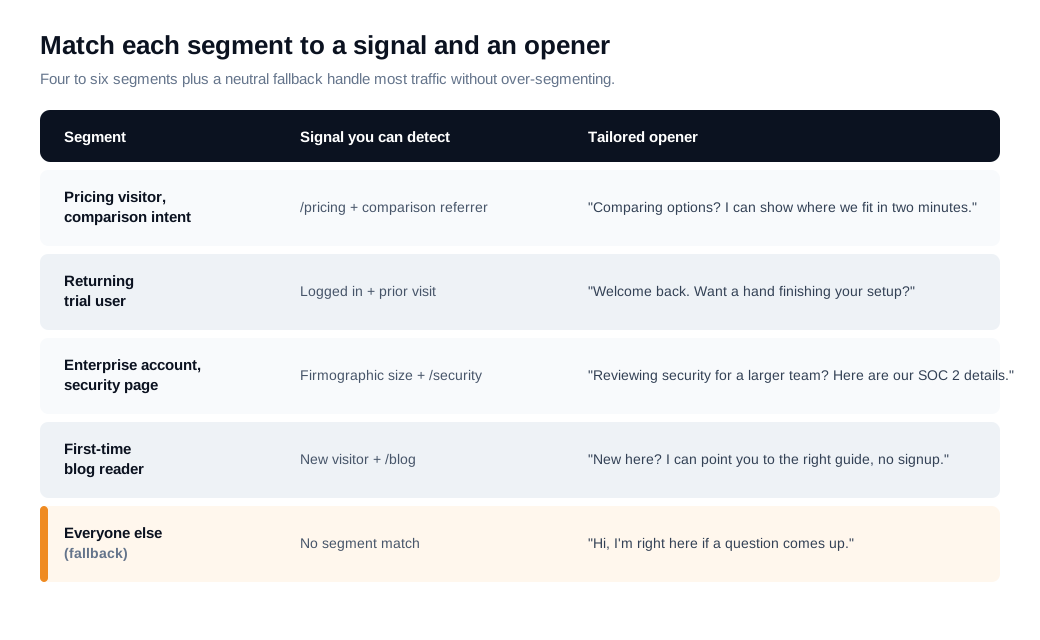
A segment is only useful if you can both detect it and say something different to it. A pricing-page visitor from a comparison search can hear "Comparing options? I can show where we fit in about two minutes." A returning trial user can hear "Welcome back. Want a hand finishing the setup you started?" An enterprise-sized company on the security page can hear "Reviewing security for a larger team? I can share our SOC 2 details and connect you with someone in solutions." A first-time blog reader can hear "New here? I can point you to the right guide, no signup needed."
Notice what each opener does. It leads with the visitor's context rather than your product, it stays to one helpful sentence, and it never implies you know more than the visitor volunteered. A guide to welcome messages and flows covers how to sequence the follow-up questions once the opener earns a reply.
Keep the list short. Four to six segments handle most traffic, and a documented fallback greeting for everyone else keeps the widget from going silent when nothing matches. The failure mode is over-segmentation. Twenty micro-segments with slightly different greetings are harder to maintain than they are worth, and each one multiplies the chance of a mismatched, awkward message. Start with the two or three segments that carry the most high-intent traffic and earn the right to add more.
How does personalization affect conversions?
Personalization reliably lifts conversion when it raises relevance, and the largest published benchmark is HubSpot's finding that personalized calls to action convert 202 percent better than generic ones across more than 330,000 CTAs measured over six months.
That study is worth understanding, because it isolates the effect. The personalized CTAs sat in the same spot on the page as the default ones. The only thing that changed was that the message and offer matched the visitor's profile or stage. Most of the friction in a conversion funnel turns out to be about relevance, not button color, and a chat opener is a CTA that happens to talk back.
The pattern holds at the business level too. McKinsey found that faster-growing companies derive 40 percent more of their revenue from personalization than their slower-growing peers, and that personalization can reduce customer acquisition costs by as much as 50 percent, lift revenues by 5 to 15 percent, and raise marketing ROI by 10 to 30 percent.
Here is the math on a single site. Take 10,000 monthly visitors and one generic greeting. Say 4 percent engage (400 conversations), 8 percent of those qualify (32), and 20 percent of the qualified book a meeting, giving about 6 meetings. Now split the same traffic across four segmented greetings tuned to page and intent. Engagement climbs to 9 percent (900 conversations), qualification to 12 percent (108), and booking to 22 percent, giving about 24 meetings. Same traffic, roughly four times the meetings, driven by relevance rather than more spend.
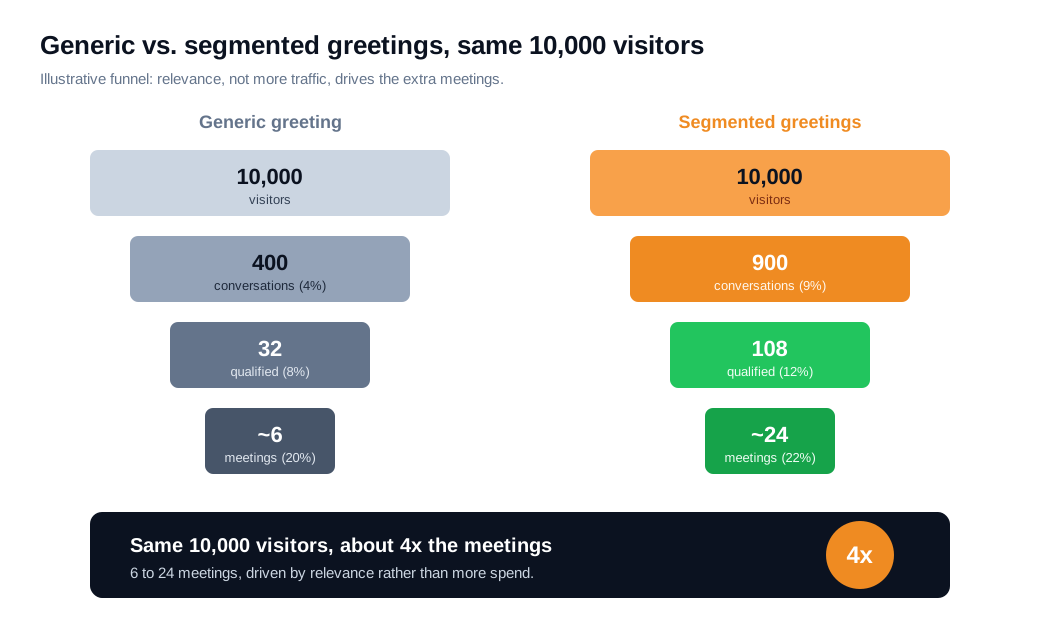
Those figures are illustrative, but the direction matches HubSpot's 202 percent CTA lift and McKinsey's revenue findings. The important caveat is that personalization lifts conversion only when the match is accurate. Greet a small-business visitor as an enterprise buyer, or name the wrong company, and the effect flips, which is the subject of the next two sections.
How do you scale personalization without feeling creepy?
You scale personalization without feeling creepy by leaning on active personalization over passive inference, using first-party and contextual data instead of purchased profiles, and being transparent about what you know and why.
The discomfort is real and it is measurable. Accenture found that 41 percent of consumers find it creepy to receive a text from a brand as they walk past a store, and among those who felt a brand's personalization was too invasive, 64 percent said the discomfort came from data they did not knowingly provide. Gartner found that more than half of consumers will unsubscribe from a company's communications, and 38 percent will stop doing business with it, if they find its personalization creepy. Its 2025 survey went further: negative personalization experiences left customers 3.2 times more likely to regret a purchase and 44 percent less likely to buy again.
The line runs through one idea. Discomfort comes from the gap between what you obviously have and what you reveal you have. Naming the page a visitor is on feels natural, because they chose it. Naming their employer, their name, or a page they viewed on a different site three days ago feels like surveillance, because they never handed that over in this conversation.
Five rules keep personalization welcome as it scales. First, prefer context and behavior over identity, because the URL and on-page behavior carry most of the value and none of the creep. Second, surface only what the visitor volunteered, and use enrichment to route internally or set tone rather than to open with a company name. Third, get consent and honor it; Twilio found 63 percent of consumers are fine with personalization when brands use their own first-party data. Fourth, let the assistant apply that judgment per visitor, because scale comes from software making these calls 900 times a day, which no rep could hand-tune. Fifth, give an easy exit, since a visitor who can dismiss or mute the chat without friction rarely files it under creepy. The proactive outreach settings are where you tune how aggressively a personalized message fires, and restraint there is what keeps the channel welcome.
What mistakes make personalized chat backfire?
Personalized chat backfires when the match is wrong, when the personalization outruns the accuracy of the data, or when it announces data the visitor never shared, and each of those costs more trust than a generic greeting ever would.
Acting on a low-confidence match is the common one. Firmographic enrichment is right 20 to 40 percent of the time at best, so opening with a company name you inferred means being wrong most of the time. Use uncertain data to route quietly in the background, not to greet.
Over-personalizing the opener is the subtler mistake. Referencing a specific past action, such as "I see you looked at the enterprise plan on Tuesday," crosses into surveillance even when it is accurate. Keep the visible personalization anchored to the current context the visitor can see they created.
Firing too often or too early undoes good targeting. A personalized message that pops on every page after two seconds trains people to close the bubble on sight, and no amount of relevance survives that habit. Personalizing and then abandoning the visitor is just as costly. A greeting tuned to a high-intent buyer that then leaves them waiting for a reply wastes the whole setup, because speed of response is part of personalization, and a fast plain answer beats a tailored greeting followed by silence. Teams building this into an inbound sales motion route the raised hand to an available rep the moment it goes up.
The last mistake is segmenting for its own sake. Twenty segments that each convert about the same as the default add maintenance and risk without adding revenue, so measure each segment against pipeline and prune the ones that do not move it. The through-line is that personalization is a promise that you understand the visitor. Break it with a wrong guess or an unstaffed widget and you are worse off than a plain "How can I help?" that at least kept the promises it made.
Key takeaways
- Personalization is relevance you have permission to use. Adapt the opener, the questions, and the routing to the visitor in front of you, and begin with the opener, because page context alone carries most of the value at none of the risk.
- Four data layers power personalized chat. Page and referral context, on-page behavior, first-party account data, and firmographic enrichment, ordered from safest and most available to most powerful and most regulated.
- Map a few segments to specific openers. Four to six segments, each tied to a signal you can detect and a one-sentence opener, plus a neutral fallback, handle most traffic without over-segmenting.
- Relevance lifts conversion, and accuracy protects it. HubSpot found personalized CTAs convert 202 percent better, but a wrong guess reverses the gain, so personalize only on data you can trust.
- Active personalization scales without the creep. Lean on what visitors volunteer and on first-party data, keep inferred data behind the scenes, and get consent; Gartner found active personalization made buyers 2.3 times likelier to decide with confidence.
- The biggest risk is a broken promise. A wrong match, an over-personalized opener, or an unstaffed widget costs more trust than a generic greeting, so measure segments against pipeline and cut the ones that do not pay.

Written by
Daniel SemeckyCo-founder & CEO
Daniel is the co-founder and CEO of Glimpze. He spends his days talking to revenue teams about how to catch high-intent visitors before they bounce, and writes about inbound sales, lead conversion, and building a motion where marketing and sales actually share a number.


