
On this page
A B2B software company runs a one-week experiment. It hands its AI sales assistant the entire inbound queue: every chat, every form, every pricing question, for seven straight days. The assistant answers around 900 conversations, books 40 meetings, and updates every CRM record without a break. Then it tries to move a $60,000 deal past a nervous three-person buying committee, and the conversation stalls inside an hour.
That week is the whole argument about AI versus human sales reps, compressed into seven days. The assistant handled a volume of routine work no team could touch, and it stumbled on the part that needed a person in the room. The useful question is narrower than "can AI sell." It asks which parts of the job each side does better, and how to split the work so neither one is stuck doing the other's job badly.
This guide covers the tasks AI does well, where human reps still win, how to divide the work between them, how that split shifts over the next few years, and the risks of leaning on AI too hard.
Will AI replace human sales reps?
No. The current data points to AI replacing tasks inside the sales job while the reps who hold it stay employed. The desk stays occupied, and the work sitting on it changes.
Gartner predicts that by 2028 AI agents will outnumber human sellers by 10 times, and in the same forecast it warns that fewer than 40% of sellers will report those agents improved their productivity, per its Predicts 2026 research. Gartner analyst Melissa Hilbert describes a "value ceiling," where past a certain point more AI stops adding productivity and starts overwhelming reps. So the growth in agents changes what reps do far more than how many of them there are.
Buyers pull in the same direction. In a Gartner survey of 645 B2B buyers, 69% said they turn to sales reps to validate AI-generated insights before they act on them. The same survey found buyers now lean on an average of seven information sources during a purchase, and 45% used generative AI along the way, mostly to research vendors and products. AI is one input among several. The rep is where those inputs get pressure-tested. The machine drafts the answer, and a person still gets asked to confirm it.
What sales tasks does AI do well?
AI does its best work on the repetitive, structured, high-volume parts of selling: instant lead response, answering product questions, qualifying interest, routing, scheduling, follow-up, and CRM data entry. These tasks share a shape. They repeat, they follow patterns, and a correct answer looks the same every time.
Speed is the clearest win. Harvard Business Review's audit of 2,241 U.S. companies found the average response to a web lead took 42 hours, and firms that reached a lead within an hour were nearly seven times more likely to qualify it. No human team answers every inbound message in seconds at 2 a.m. An AI chat assistant does, which is why speed-to-lead is the task AI most obviously owns.
The volume win frees rep time that is currently wasted. Salesforce's 2026 State of Sales research reports that sellers spend under 30% of their time actually selling, with the rest lost to research, admin, and data entry. HubSpot's 2026 data on AI in B2B sales found 64% of reps save one to five hours a week through AI automation, and teams running five or more AI tools save roughly 12 hours per rep per week. HubSpot's reps reported the biggest wins on CRM data entry, meeting notes, and scheduling, the structured tasks that eat a workday without closing anything.
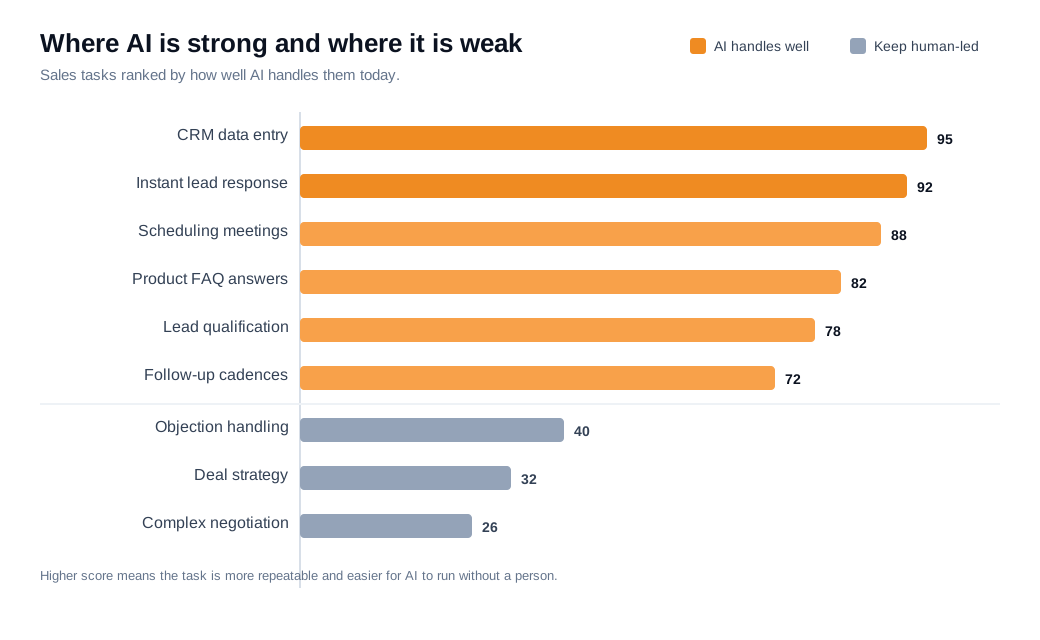
The pattern holds across the research: the more a task repeats and the clearer its right answer, the better AI performs it. That same boundary is where AI starts to fall short.
Where do humans still win?
Humans still win wherever the sale turns on trust, judgment, and reading a room: genuine objections, multi-stakeholder deals, negotiation, and the moment a buyer decides to commit. These are the tasks HubSpot's reps ranked as AI's weakest, and buyers back them up.
Trust is the core of it. PwC's customer experience research found that 82% of U.S. consumers want more human interaction as technology improves, and that 59% feel companies have lost touch with the human element. That preference has teeth in a buying decision. Research covered by CX Dive found 41% of customers are less likely to buy from a company that uses AI for service, rising to 53% when there is no way to reach a human.
Skepticism about machine answers is already priced in. In the Gartner buyer survey, 51% said they were more likely to encounter misleading information from generative AI, against 49% who said the same of a sales rep. That is a near-even split on distrust, and it tips toward the human at exactly the moment a buyer is deciding whether to spend real money. When the stakes are a large purchase, buyers want a person to check the work, which is the 69% validation figure from earlier showing up as behavior.
Judgment is the second thing machines miss. An AI follows patterns, so when a prospect hedges, hints that the real decision-maker is elsewhere, or raises an objection that does not fit the script, it tends to push the next step instead of reading the hesitation. Sarcasm, competing agendas across a buying committee, and the emotional weight of spending real money all sit past what current models handle well. That ground still belongs to human reps.
How do you divide work between them?
Divide the work by giving AI the first layer of volume and speed, then handing every high-intent, high-stakes conversation to a person who carries it to close. AI covers everyone instantly and qualifies at a scale no team can match. The rep takes the conversations where trust and judgment decide the outcome.
Here is a worked example. Say 700 inbound leads arrive in a month and you have four reps. Left to work the list by hand, four reps might reach half of it, around 350 leads, before the rest go cold, and they spend most of the week qualifying rather than closing. Put an AI layer in front and all 700 get a real-time greeting and a qualifying pass. Suppose 20% clear the bar for a live human conversation. That is 140 qualified leads, about 35 per rep for the month, each arriving with context and a reason to talk. The other 560 still get a fast, useful answer instead of silence, and the ones who warm up later re-enter the queue. The AI closed nothing. It made sure the 140 conversations worth a rep's time actually happened.
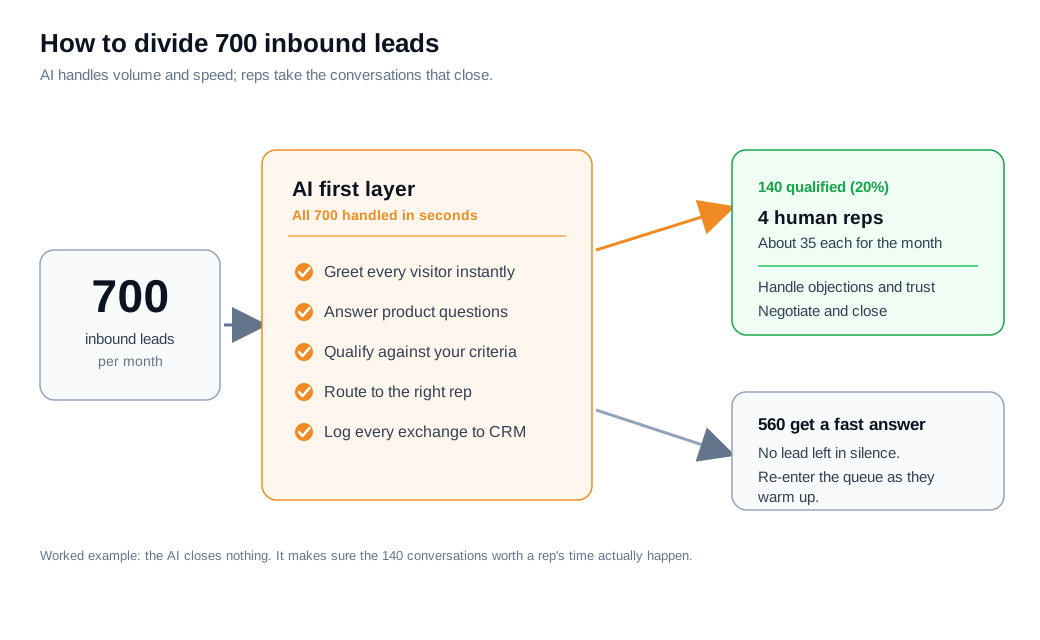
The dividing line is intent and stakes. Low-stakes, high-volume work (greeting, FAQs, qualification, scheduling, CRM updates) sits with the machine. High-stakes, relationship-heavy work (pricing, negotiation, a named account) sits with the person. This is the core of an inbound sales motion built on speed: catch every visitor, then route the qualified ones to a rep fast. When a high-intent buyer is on the pricing page, the win is a quick jump to a person over live video chat, backed by a routing and notifications setup that gets the lead to the right rep in seconds.
How does the mix change over time?
The mix shifts steadily toward AI on routine top-of-funnel work, while the human share concentrates into fewer, higher-value conversations. The total number of sales interactions handled by software climbs every year. The number a rep personally runs falls, and each one that remains carries more weight.
The adoption curve is steep. Salesforce found that 54% of sellers say they have already used AI agents, and nearly 9 in 10 plan to by 2027. Gartner's projection that AI agents will outnumber human sellers 10 to 1 by 2028 sits at the end of that same curve. Reps still hold their place on the chart while the agents around them multiply.
Reps mostly welcome the shift rather than resisting it. In the same Salesforce research, 89% of sellers said AI deepens their understanding of customers and 87% said it makes their job less stressful, which is part of why adoption keeps climbing instead of stalling. Once the software absorbs the research, the drafting, and the data entry, sellers expect it to cut prospect research time by 34% and email drafting by 36% when fully in place, and that recovered time flows toward conversations a machine should not be having on its own.
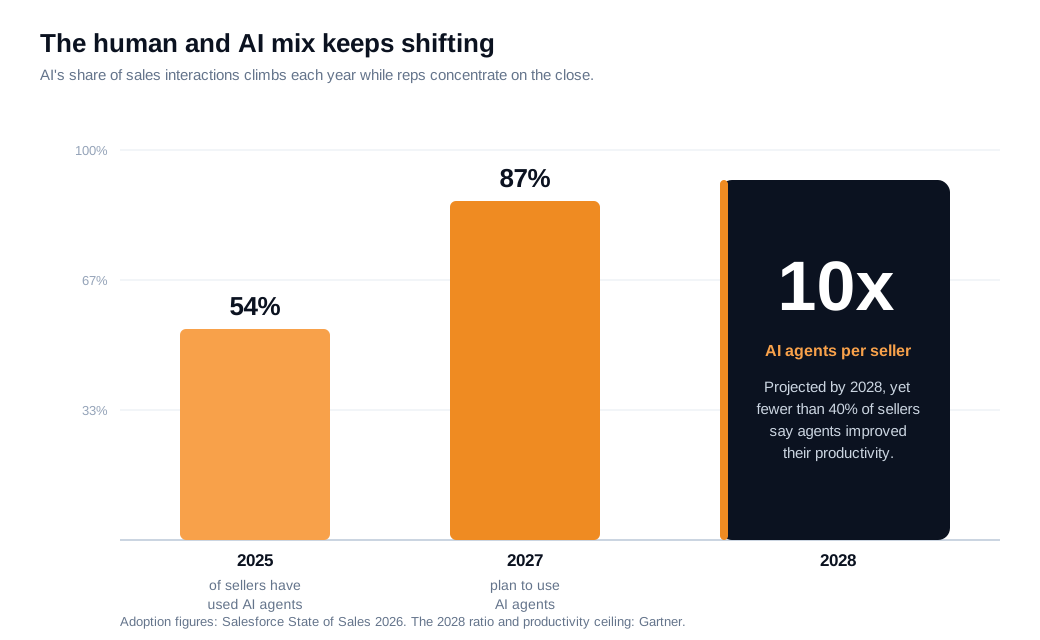
What changes with it is the rep's job description. As AI takes the first email, the qualification pass, and the CRM update, the human role tilts toward the parts buyers still insist on a person for: validating the AI's answer, handling the real objection, and closing. The value ceiling Gartner flagged is the guardrail here. Piling on more agents past the point of useful return burns rep time instead of saving it, so the teams that win keep tuning the split rather than automating for its own sake.
What are the risks of over-relying on AI sales reps?
The main risks are eroding buyer trust, generic outreach that buyers tune out, and confident wrong answers that create promises you never meant to make. Each one gets worse at the volume AI is built to produce.
Trust is the first casualty. The CX Dive finding, 41% less likely to buy with AI service and 53% with no human path, means an AI layer with no visible exit to a person can cost you the sale before a rep ever sees it. To a buyer, hiding the human reads as a company that would rather not talk to them.
Accuracy is the second. A language model can state a price, a policy, or a feature that does not exist and present it as fact, and in sales that fabrication can become a commitment you are on the hook for. The fix is grounding the assistant in verified product docs and having it decline when it lacks a source. A careful AI assistant setup tied to a real knowledge base keeps its answers honest, and anything it says about price or terms still deserves a human check.
The third risk is blandness. Autonomous outreach at scale drifts toward shallow personalization that buyers pattern-match as machine-written within seconds, and 71% of buyers already told HubSpot they would rather research on their own than talk to a salesperson. Pushing more generic AI messages at people who are avoiding contact only speeds up the tune-out. The fix for all three risks is the same move: keep a person in the loop on anything that carries trust, money, or a specific relationship, and let AI own the volume behind them.
Key takeaways
- AI replaces tasks, not reps. Gartner expects AI agents to outnumber human sellers 10 to 1 by 2028, yet fewer than 40% of sellers say those agents improved their productivity, so the role changes while the headcount holds.
- AI wins on volume and speed. Instant lead response, qualification, scheduling, follow-up, and CRM data entry are its strongest tasks, and HBR found reaching a lead within an hour makes qualifying it nearly seven times more likely.
- Humans win on trust and judgment. Objections, multi-stakeholder deals, negotiation, and the close stay human, and 69% of B2B buyers still validate AI-generated insights with a rep before they commit.
- Divide by intent and stakes. Give AI the high-volume first layer and hand every high-intent, high-stakes conversation to a person, the way one agent turns 700 raw leads into 140 qualified rep conversations.
- The split keeps shifting toward AI. With 54% of sellers already using agents and nearly 9 in 10 planning to by 2027, the human share concentrates into fewer, higher-value conversations each year.
- Over-relying on AI has a cost. Buyer trust drops when there is no human path, with 41% less likely to buy from a company using AI for service, so keep a person on anything touching money or a relationship.
TAGS

Written by
Nilas MylerCo-founder & CTO, Glimpze
Nilas is the co-founder and CTO of Glimpze, an inbound sales tool that turns high-intent website visitors into live conversations. A former SEO consultant for some of the largest companies in Denmark, he writes about speed-to-lead, inbound sales, and conversion rate optimization — the technical and operational mechanics of turning traffic into pipeline.


