
On this page
- What does an AI hallucination look like in support?
- What causes AI chatbot hallucinations?
- How does grounding reduce AI chatbot hallucinations?
- How do you write a prompt that keeps the bot from guessing?
- How do you set escalation fallbacks?
- How do you monitor for bad answers in production?
- Can you eliminate AI chatbot hallucinations completely?
- Key takeaways
- Sources
A visitor asks a support bot whether their plan includes phone support. The bot answers yes, in a clean, friendly sentence. The plan does not include phone support. The customer upgrades anyway to get the feature they were promised, finds out three weeks later on a call that never connects, and now a rep is writing an apology and processing a refund for a benefit that was never real.
The sentence that caused it was fluent, confident, and made up. That is a hallucination: a plausible answer the model states as fact with no source behind it. In casual chat it is a harmless quirk. In support, where people act on what the bot tells them, a made-up answer can cost a sale, a refund, or a customer. The reassuring part is that hallucinations follow patterns, and patterns can be engineered against. You can cut them sharply without waiting for the next model release.
This guide covers what a support hallucination looks like, what causes them, how grounding reduces them, how to write a prompt that stops the bot guessing, how to set escalation fallbacks, how to monitor for bad answers in production, and whether you can remove them for good.
What does an AI hallucination look like in support?
An AI hallucination in support is a reply the bot presents as fact that its sources do not back up, whether that is an invented policy, a feature that does not exist, or a confident wrong number. The tone is the trap. The bot sounds exactly as sure when it is wrong as when it is right, so nothing in the wording warns the customer to double-check.
The failures cluster in a few places. A bot invents a refund window ("you have 60 days") when the real policy says 30. It describes an export button that was removed two releases ago. It quotes a price from an old pricing page it half-remembers. Each one reads well, and each one sends the customer off to act on something false.
The cost is not abstract. Forbes, citing consumer research, reported that 30 percent of customers will abandon a purchase, switch brands, or warn their friends after a single bad chatbot experience. A wrong answer delivered with confidence is one of the fastest ways to set that off, because the customer trusted the bot and the bot let them down.
What causes AI chatbot hallucinations?
AI chatbot hallucinations come from how language models are trained and graded: they generate the most likely-sounding next words, and standard evaluation rewards a confident guess over an honest admission of uncertainty. The model is behaving as designed when it fabricates. It was optimized to always produce an answer, and nothing in that training taught it to stop.
An OpenAI research team laid this out in a September 2025 paper, Why Language Models Hallucinate. Their argument is that most benchmarks score answers as simply right or wrong and give no credit for saying "I do not know." Under that rule, guessing is the winning strategy. Their example is a birthday: a model asked for a date it does not know has a 1-in-365 chance of scoring a point if it guesses, and a guaranteed zero if it abstains. Trained on thousands of tests like that, the model learns to always answer, even when the answer is fabricated.
That is the incentive. The trigger, in a support setting, is a gap. The bot reaches for a guess when the answer is missing from its knowledge, when the knowledge is stale, when the right passage exists but retrieval did not pull it in, or when the question is vague enough that a plausible story fills the space. A model given no permission to refuse will refuse nothing.
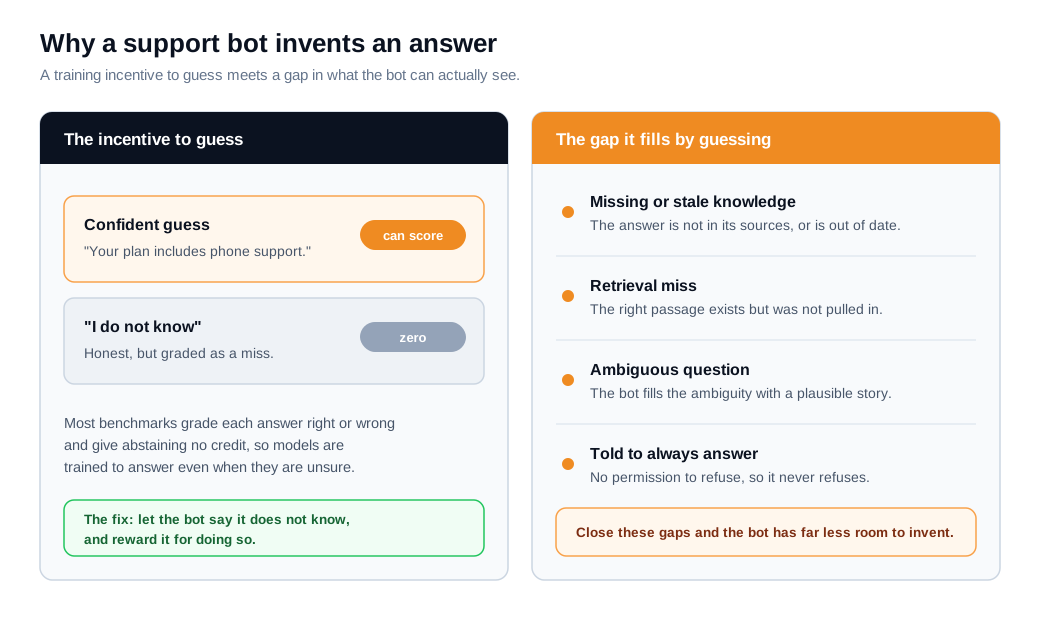
The practical read is encouraging. If hallucinations come from an incentive to guess and a gap to guess into, you reduce them by removing the gap and by giving the bot a way to opt out. The rest of this guide is those two moves, built out into four layers.
How does grounding reduce AI chatbot hallucinations?
Grounding reduces hallucinations by handing the model the relevant facts from your own sources at the moment it answers, so it summarizes a real passage instead of filling the gap from memory. Google Cloud describes grounding as providing a model with external information to root its response in reality, which lowers the chance it makes something up.
The mechanism is straightforward. Before the model writes, the system searches your help center, docs, and policies for the passages that match the question, then places those passages in the prompt as context. The model answers from what is in front of it. This is the technique known as retrieval-augmented generation, walked through in the AI knowledge base guide, and it is the single most effective change most teams can make.
Grounding is the base layer because it attacks the most common cause head-on. The gap the model would otherwise guess into gets filled with a real answer, so there is far less to invent. Point an AI chat assistant at a clean, current knowledge base and the questions it used to fabricate on now have a source sitting in the prompt.
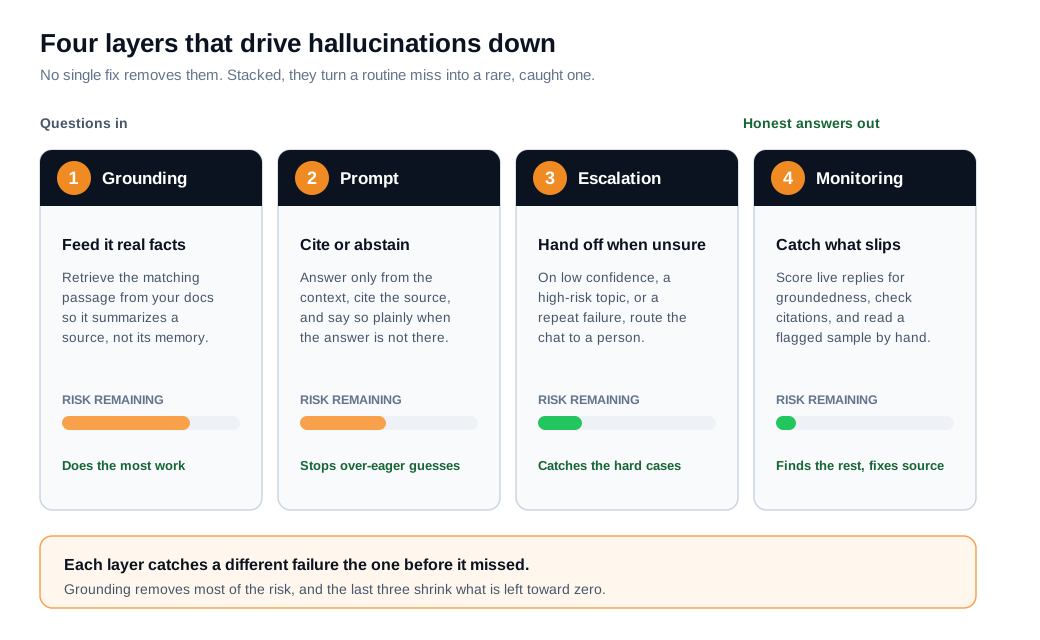
Grounding narrows the gap without closing it completely. Retrieval can miss the right passage, the knowledge base can hold a stale article, and a model can still answer past its context if you let it. That is why grounding is layer one of four, and why the next three exist to catch what it misses.
How do you write a prompt that keeps the bot from guessing?
Write a prompt that keeps the bot from guessing by instructing it to answer only from the provided context, to cite the source it used, and to say plainly when the answer is not there, which turns "always answer" into "answer or abstain." This is where you undo the training incentive from earlier, at least inside your own system.
Three instructions carry most of the weight. First, restrict the model to the retrieved context and forbid it from using outside knowledge for facts about your product. Second, require a citation, so every claim points back to a passage a human can check. Third, and most important, give the model explicit permission to refuse: tell it that "I do not have that in our docs, let me get you to someone who does" is a correct and preferred answer when the context does not cover the question.
That third instruction matters because, as the OpenAI paper argues, models default to guessing precisely because nothing ever rewarded them for holding back. Your system prompt is where you reward it. Add guardrails around the risky specifics too, and instruct the bot not to state prices, dates, or policy numbers that are absent from the retrieved text, since those are the fabrications that cost the most.
Here is the change in one exchange. A visitor asks about a discount the bot has no source for. The default bot invents a plausible "15 percent off your first year." The constrained bot replies that it cannot confirm a discount from the current docs and offers to connect a person. The wiring for these rules, including what the assistant may and may not do, lives in the AI assistant setup guide.
How do you set escalation fallbacks?
Set escalation fallbacks by defining the exact conditions under which the bot must stop answering and hand the conversation to a person: low confidence, a high-risk topic, a repeated failure to help, or a direct request for a human. Escalation is the safety net for every question grounding and the prompt did not fully solve.
Confidence is the first trigger, and it is worth tuning by stakes. A practitioner guide from eesel AI on escalating when unsure recommends letting the bot answer routine questions at a moderate confidence bar and raising that bar sharply for anything sensitive. A common starting point is around 0.6 confidence to answer a general question, and 0.8 or higher before the bot answers anything about billing, account access, or cancellations, where a wrong answer is expensive.
The other triggers are simpler. Escalate on any high-risk topic regardless of confidence. Escalate after the bot has failed to help twice, on the third turn, rather than letting it loop. And always hand off the moment a visitor asks for a person. When the handoff happens, pass the agent a summary of the chat so the customer never has to repeat themselves, a piece of plumbing covered in the routing and notifications guide.
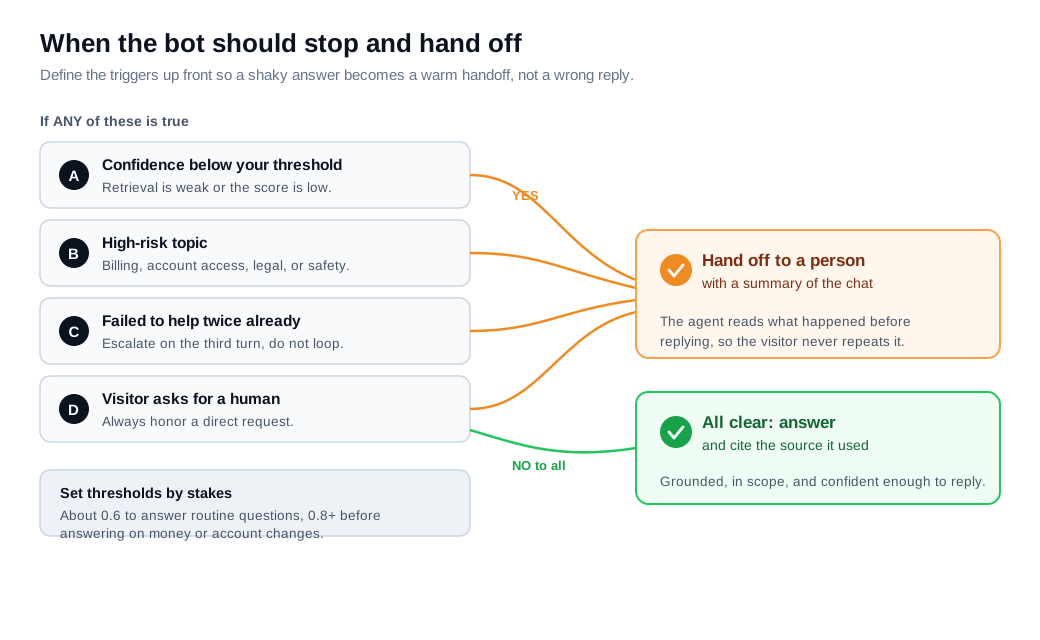
Work an example. A store runs 1,000 bot chats in a week. Suppose 120 touch billing or account changes and the bot escalates all of them, another 60 come back low-confidence after retrieval, and 40 visitors ask for a human outright. That is 220 chats routed to a person by design, each one a hallucination that never happened because the bot handed off instead of guessing. On a sales site, a strong buying signal is itself a reason to escalate, since the goal there is to reach a rep through live chat while interest is high.
How do you monitor for bad answers in production?
Monitor for bad answers by scoring every live reply for groundedness, checking that each claim maps to a cited source, and having a person read a small random sample plus everything the automated checks flag. Offline tests prove the bot works on questions you imagined. Monitoring catches the ones real customers bring.
The workhorse check is groundedness, also called faithfulness: does every claim in the answer trace back to the retrieved context? Datadog's guide to hallucination detection describes running this with an LLM acting as a judge, which breaks the answer into individual claims and verifies each one against the source passages, then flags any claim the sources do not support. Citation validation adds a second pass and catches the case where the bot cites a source but the cited text does not actually back the claim.
Automation has a ceiling, so a person closes the gap. Read a small random sample of chats against their sources each day, and always read whatever the automated checks flagged. Add the passive signals your product already collects: a thumbs-down, a customer re-asking the same question, a spike in one topic bouncing back to a human.
Put numbers on it. A bot handles 800 chats a day. Score all of them for groundedness, audit a random 2 percent (16 chats) plus the 10 the groundedness check flags, and a reviewer reads 26 conversations against source. Find three ungrounded answers in the flagged set and you have both an error rate to track and three concrete gaps to fix, well before those errors turn into complaints.
Can you eliminate AI chatbot hallucinations completely?
You cannot eliminate hallucinations completely, but a layered defense can push them from a routine event to a rare, caught one. Even the strongest models still make things up on hard inputs, so the realistic goal is to drive the rate down and catch what remains.
The benchmarks make the ceiling concrete. Vectara's hallucination leaderboard, which tests how faithfully models summarize a source document, put its best performer around a 3.3 percent hallucination rate on a fresh, harder dataset, while several popular reasoning models scored above 10 percent. Those numbers come from clean documents, and your production traffic is messier, so treat any single-digit figure as a best case rather than a promise.
That is why the four layers work together. Grounding removes most of the risk by giving the model real facts. A cite-or-abstain prompt stops it from answering past those facts. Escalation catches the questions it should not answer at all. Monitoring finds the ones that slipped and feeds them back into the knowledge base so the same miss does not repeat. Each layer covers a failure the one before it let through. Stack all four and a support bot moves from confidently wrong on a routine basis to occasionally uncertain, honestly so, and quick to reach for a person when it is.
Key takeaways
- Hallucinations come from how models are built. Models are trained to produce a likely answer and graded in ways that reward guessing over saying "I do not know," so they fabricate when a fact is missing.
- Grounding removes the most risk. Feeding the model the matching passage from your own docs at answer time fills the gap it would otherwise guess into, and it lets the bot cite its source.
- A cite-or-abstain prompt undoes the guessing incentive. Restrict the model to the retrieved context, require citations, and give it explicit permission to refuse and hand off.
- Escalation is the safety net. Route to a person on low confidence, high-risk topics like billing, a second failed attempt, or a direct request, and pass along a summary of the chat.
- Monitoring catches what slips through. Score live replies for groundedness, validate citations, read a flagged sample by hand, and feed every miss back into the knowledge base.
- You reduce hallucinations, you do not erase them. Even top models hallucinate on hard inputs, so stack grounding, prompt guardrails, escalation, and monitoring to make errors rare and caught.
TAGS

Written by
Nilas MylerCo-founder & CTO, Glimpze
Nilas is the co-founder and CTO of Glimpze, an inbound sales tool that turns high-intent website visitors into live conversations. A former SEO consultant for some of the largest companies in Denmark, he writes about speed-to-lead, inbound sales, and conversion rate optimization — the technical and operational mechanics of turning traffic into pipeline.


