
On this page
A visitor types "does this work with Salesforce?" into your chat window. Before anything useful can happen, some piece of software has to understand that the person is asking about an integration, not about pricing, not about a bug, and not about a job opening. That single reading is intent detection, and every other move the assistant makes rides on getting it right.
Intent detection is the classification step at the front of every conversational AI system. It takes a raw message and decides which goal, from a fixed list the system knows, the person is trying to reach. Get it right and the bot answers, routes, or escalates cleanly. Get it wrong and a ready buyer receives a canned FAQ about the wrong topic while a competitor answers first.
Here is the path: what intent detection is, how a model actually classifies intent, how it differs from entity extraction, why intent drives routing, what happens when the model is unsure, and how teams push accuracy higher.
What is intent detection in conversational AI?
Intent detection is the process a conversational AI uses to identify the goal behind a message, independent of the exact words the person chose. It reads meaning rather than matching keywords, so "where is my stuff," "I never got my package," and "my order still has not shipped" can all resolve to the same intent even though they share almost no vocabulary.
The work runs on natural language processing and machine learning trained on real conversations. When a customer types "I never got my package," the words describe a situation, but the intent is a delivery inquiry, and detecting that lets the assistant retrieve the right information and take the right action, as Bluetweak lays out in its walkthrough of customer intent. The model is not reading the sentence for grammar. It is sorting the sentence into a bucket.
Those buckets are defined ahead of time. A support bot might carry intents like track_order, request_refund, report_bug, and talk_to_human. A sales assistant might carry pricing_question, book_demo, check_integration, and compare_plans. Intent detection is the layer that maps any incoming message to one of them, which is why Decagon calls it the foundation of every decision the system makes, from routing to resolution to escalation. Nothing downstream works until this label is set.
How does the AI classify intent?
The model classifies intent by turning the message into numbers, scoring every intent it knows against that message, and picking the highest score if it clears a set confidence threshold. The output is a probability distribution: a list of every candidate intent with a score, and the scores across all intents sum to one.
The steps are consistent across most systems. The text is cleaned and tokenized, then converted into a vector, a dense list of numbers that captures meaning. A classifier compares that vector against what it learned from training examples and assigns a probability to each intent, per Genesys guidance on building and testing natural language understanding. The top-scoring intent wins, but only if its score beats a confidence threshold you set, a tunable number between zero and one that SmartWeb describes as the minimum score required to trigger an intent. Fall below it and the system routes to fallback instead of guessing.
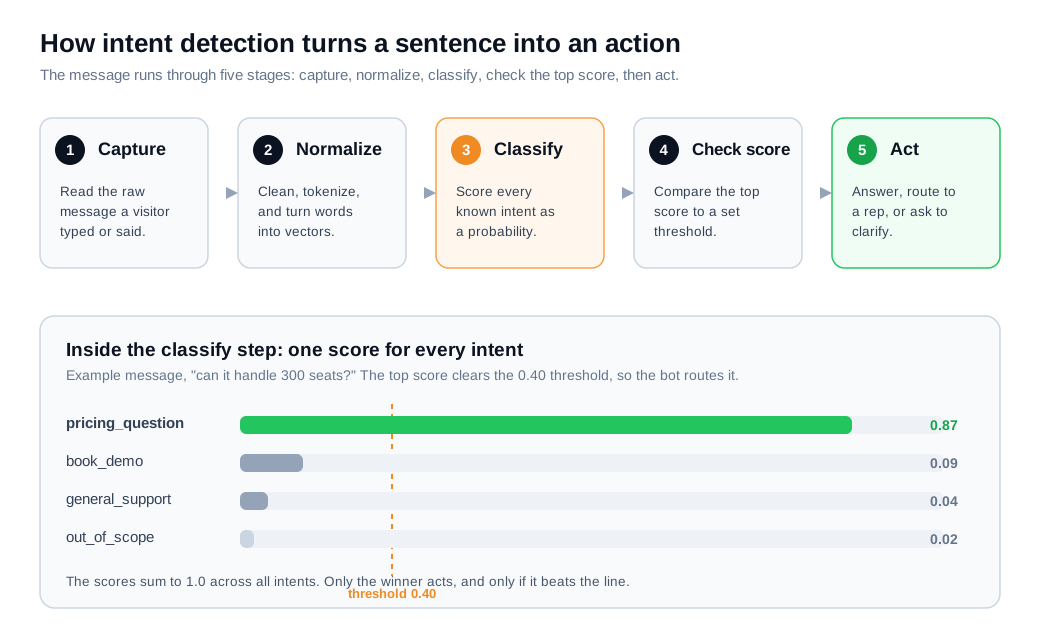
Here is a worked example. A visitor types "can it handle 300 seats?" The classifier scores pricing_question at 0.87, book_demo at 0.09, general_support at 0.04, and out_of_scope at 0.02. With a threshold of 0.40, only pricing_question clears the bar, so the assistant treats this as a pricing conversation and routes it toward sales. Change the message to something vague like "hey, quick thing," and every score might land under 0.40, at which point the correct move is to ask what the person needs rather than force a match.
Two families of model do this classification. Fine-tuned sentence encoders are small and fast; large language models are slower but read context better. A 2024 Amazon study tested both on intent detection and built a hybrid that routes only the uncertain cases to an LLM, landing within 2% of full LLM accuracy at half the latency. That is the tradeoff most production systems, including an AI chat assistant on a website, are quietly balancing: speed against nuance.
What is the difference between intent detection and entity extraction?
Intent detection finds the one goal of a message, while entity extraction pulls the specific values needed to act on that goal. Intent is a single label for the whole sentence. Entities are the details inside it. Both read the same text, and they answer different questions.
Take the message "Book a demo for our 40-person team next Tuesday." Intent detection classifies the whole thing as book_demo. Entity extraction tags the pieces that make the booking possible: team_size is 40 and demo_date is next Tuesday. Without the intent, the system does not know what to do. Without the entities, it knows the goal but cannot fill in the scheduling or sizing.
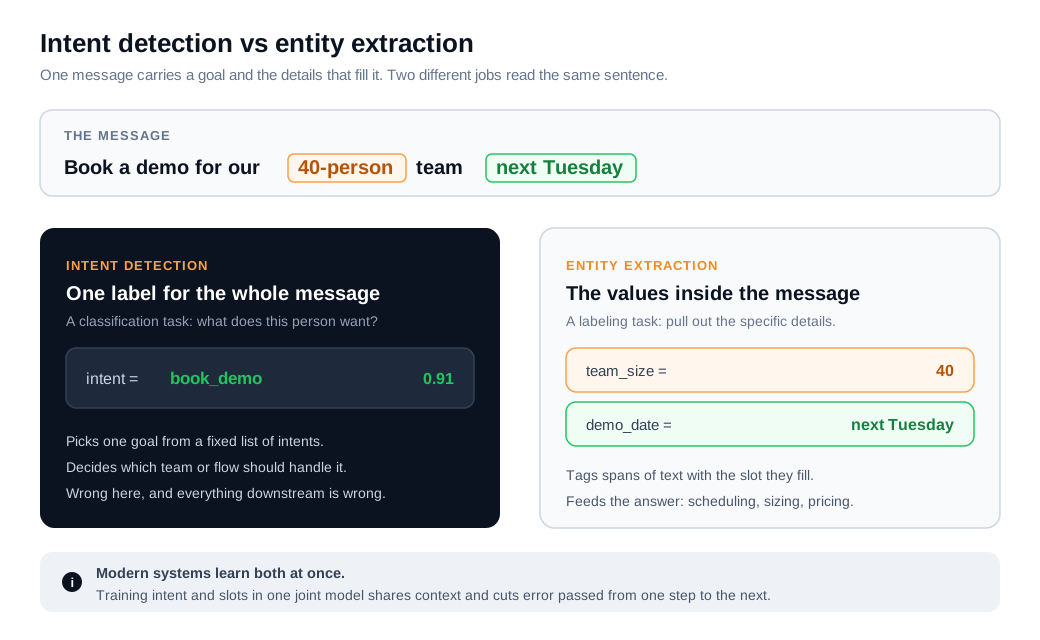
The two are different technical jobs. Intent detection is a classification task, choosing one label from a fixed set. Entity extraction, also called slot filling, is a sequence labeling task, tagging spans of text with the slot they fill. A survey of joint intent and slot models in ACM Computing Surveys notes that training the two together, in one joint model, lets them share context and reduces the errors that pass from one step to the next when they run as a pipeline. In practice, that means a good assistant reads the goal and the details in the same pass, so it can act on the whole message at once.
Why does intent matter for routing?
Intent matters for routing because the detected label is what tells the system which team, workflow, or person should handle the conversation, so a wrong label sends the visitor to the wrong place. Routing is where a classification mistake turns into a customer-facing failure. A misread pricing_question that lands in a support queue means a buyer waits behind refund tickets while their interest cools.
The failure is common enough to measure. One engineering guide reports that intent misclassification accounts for 42% of core chatbot error types across 85% of deployments, which makes intent the single largest source of routing breakage. When the label is right, routing is simple. When it is wrong, everything after it inherits the mistake.
Consider a site that handles 400 chats a day. If 15% of messages are misclassified, that is 60 conversations a day sent to the wrong queue or answered with the wrong information. Cut misclassification to 5% through better training and threshold tuning, and the daily misroute count drops to 20. The volume did not change. The reading did, and 40 more people a day reached the right destination.
Good routing also carries the intent forward. The strongest handoffs perform a warm transfer, passing the full transcript, the detected intent, and the caller's sentiment to a human so the person never repeats their issue, as Twig describes in its breakdown of escalation quality. That is exactly the job a routing and notifications setup does: the intent decides who gets pinged, and the context travels with the lead so the rep opens already informed.
How does the AI handle intents it is not sure about?
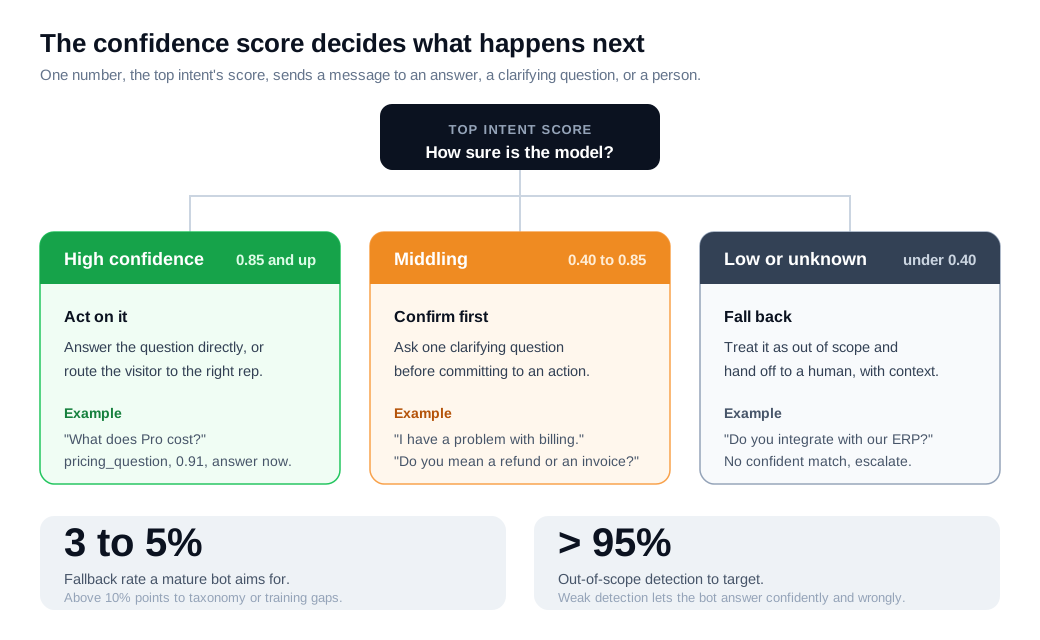
When the top intent's score falls below the confidence threshold, the AI treats the message as out of scope and falls back, usually by asking a clarifying question or handing the conversation to a human. This is the safety valve that keeps a model from acting confidently on a guess, and it is as important as the classification itself.
The behavior follows the score. A high top score means act. A middling score means confirm before acting. A low score, or no confident match at all, means fall back. Out-of-scope detection deserves its own attention here, because a system that answers questions it cannot handle produces hallucinations, confident wrong answers to unknown queries, which is why Hamming AI recommends targeting above 95% out-of-scope detection before trusting a bot in production.
Serious benchmarks build this in. The widely used CLINC150 dataset covers 150 intents across 10 domains, and it deliberately includes 1,200 out-of-scope queries alongside 22,500 in-scope ones, as documented in Google's uncertainty-baselines reference for the dataset. The point of those out-of-scope examples is to test whether a model knows when to stop, because a real assistant cannot assume every message maps to something it was built to handle.
Grounding the fallback in real answers keeps it useful. When the model is unsure but the question is still on-topic, an assistant connected to your AI knowledge base can pull a documented answer instead of inventing one, and only escalate when nothing matches. That turns "I am not sure" into a helpful next step rather than a dead end.
How do you improve intent accuracy?
You improve intent accuracy by tightening the intent taxonomy, giving each intent enough varied training examples, tuning the confidence threshold, and reviewing the messages the model gets wrong. Accuracy is a maintenance habit more than a one-time setup, and most of the gains come from unglamorous cleanup.
Start with the taxonomy. Overlapping intents confuse the model, so if two intents are too similar, the fix is to merge them or sharpen their boundaries, per Talkdesk best practices for training intents. The same guidance recommends 10 to 20 diverse examples per intent to start, with varied phrasing, synonyms, and realistic typos, and a balanced count across intents so the model does not lean toward whichever one has the most data.
The confidence threshold is a dial worth watching. A mature system generally aims for a fallback rate around 3% to 5%, and a rate above 10% usually signals a taxonomy, training-data, or threshold problem, according to a diagnostic playbook from Chatbotscape. The same source notes that most bots running weekly tuning cycles move from a 15% to 20% fallback range into single digits within a month, which shows how much low-hanging fruit sits in the logs of a fresh deployment.
Here is a worked example of that loop. Say a new assistant launches with eight intents and an 18% fallback rate. A week of reading fallback logs shows two intents, pricing_question and compare_plans, catching each other's messages, plus a batch of "how do I cancel" phrasings with no matching intent at all. Merge the overlapping pair, add a cancel_account intent with 15 examples, and nudge the threshold from 0.30 to 0.40. The next week's fallback rate drops to 9%, then to 6% after one more pass. No model was retrained from scratch; the taxonomy and the data got cleaner.
Model-side techniques help too. The Amazon study found that adding negative training examples, messages that look plausible but belong to no intent, improved its sentence-encoder accuracy by more than 5% across datasets. Whichever model you run, the durable pattern is the same: launch a small set of well-separated intents, watch what the model misses, and feed those misses back in. Setting the assistant up on solid ground first, following an AI assistant setup that grounds it in your real docs, keeps the accuracy work focused on real gaps instead of invented answers.
Key takeaways
- Intent detection reads the goal, not the words, sorting any message into one of a fixed set of intents so the assistant knows whether the person wants pricing, support, or a human.
- Classification is a scored decision, where the model assigns a probability to every intent and only acts on the top one when it clears a tunable confidence threshold, commonly around 0.40.
- Intent and entities are two jobs on one sentence, with intent choosing the single goal and entity extraction pulling the values that make the goal actionable, often learned together in a joint model.
- Routing lives or dies on the label, because intent misclassification drives an estimated 42% of chatbot error types, and a wrong intent sends a ready buyer to the wrong queue.
- A low score should trigger a fallback, so aim for above 95% out-of-scope detection and hand off with context rather than letting the bot answer a question it cannot handle.
- Accuracy is a weekly habit, where merging overlapping intents, adding varied examples, and tuning the threshold can pull a fresh bot from a 15% to 20% fallback rate into single digits within a month.
TAGS

Written by
Nilas MylerCo-founder & CTO, Glimpze
Nilas is the co-founder and CTO of Glimpze, an inbound sales tool that turns high-intent website visitors into live conversations. A former SEO consultant for some of the largest companies in Denmark, he writes about speed-to-lead, inbound sales, and conversion rate optimization — the technical and operational mechanics of turning traffic into pipeline.


