
On this page
A visitor reaches your demo page ready to talk. The page hands them a form: name, company, work email, phone, team size, and a free-text box asking how you can help.
Six fields stand between a warm buyer and your sales team. Plenty of people type two, reconsider, and close the tab.
A conversation handles that same moment differently. It asks for one thing at a time, gives an answer back at each step, and reads what the person actually wants before it asks for a phone number. Same buyer, same intent, a very different outcome.
This post compares the two approaches head to head, using research rather than vendor promises: how they compare for capture, why forms leak, when a form is still the right call, and how to test one against the other on your own traffic.
What is the difference between conversational marketing and a lead form?
A lead form collects a fixed set of fields in a single submission and hands the record off for follow-up later, while conversational marketing gathers the same information through a real-time exchange that answers the buyer's questions as it goes.
One is a task the visitor completes alone and then waits on. The other is a dialogue that adapts to each reply.
A form is a one-way request. It shows the visitor every field at once, asks them to give before they get, and offers nothing until they submit and someone responds. The design assumes a patient buyer who will fill in their details and wait for outreach.
Conversational marketing inverts the order. It opens with a relevant prompt, answers the first question the visitor actually has, and earns each piece of qualifying information in exchange for something useful.
The category that Drift named in the mid-2010s framed the loop as three moves: engage the visitor, understand who they are through a short back-and-forth, then recommend a next step.
Both approaches try to turn a visitor into a qualified lead. They just disagree on whether that happens in one submission or across a short conversation.
How do chat and forms compare for capture?
Chat and forms capture leads in opposite ways: a form asks for everything up front and filters out anyone unwilling to hand it over, while chat earns each detail in exchange for an answer. The trade is friction now versus friction spread out.
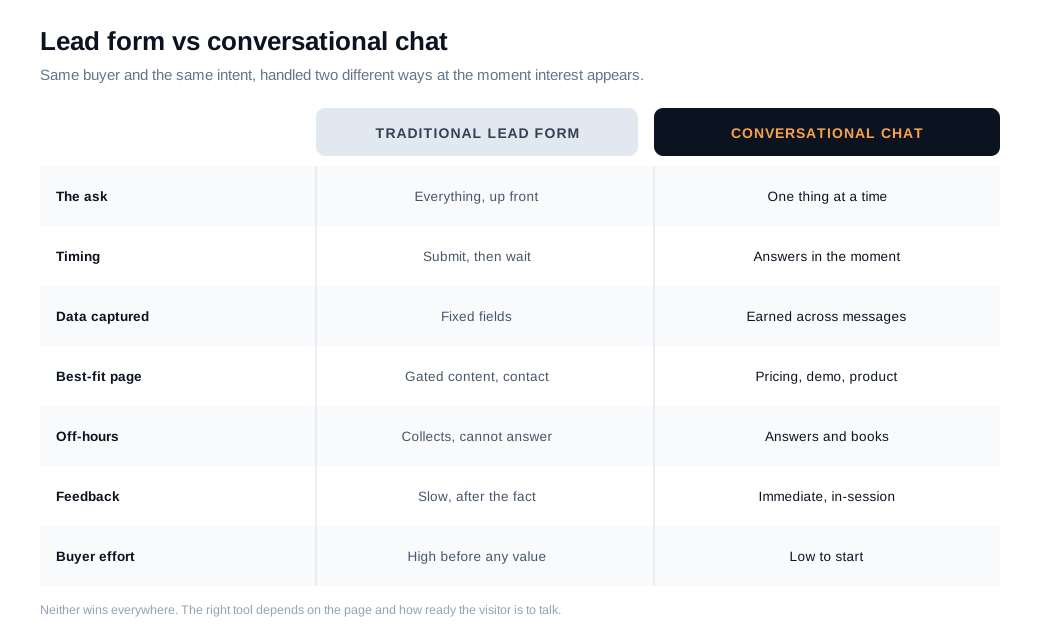
The form's strength is structure. When someone does submit, you get clean, predictable fields in the exact shape your CRM expects, and the visitor did the data entry for you.
The weakness is that the ask comes before any value, so most of the audience never gets far enough to hand anything over. HubSpot's analysis of landing pages across more than 40,000 customers found that forms with three fields converted at slightly over 25 percent, and conversion slid as fields were added, per HubSpot's guidance on form optimization. A short form is the best version of a demanding tool.
Chat's strength is that it starts the relationship before it asks for anything. A visitor can get a real answer to "does this do single sign-on" and only then be asked who they are, which lowers the bar to that first interaction.
The cost is that a conversation qualifies gradually, so a raw chat count is not the same as a stack of completed forms. The useful comparison is not conversations versus submissions, but qualified leads and, eventually, revenue from each.
Here is a rough capture picture with round numbers. Suppose a demo page draws 4,000 visits a month:
- A six-field form converting at 6 percent yields about 240 submissions, some of which bounce on the phone-number field or never get a fast reply.
- A conversation on the same page that engages 15 percent of visitors, or 600 people, and qualifies 40 percent of those, produces 240 real, pre-screened leads with their questions already answered.
The two can land near the same qualified number while producing very different experiences and very different close rates downstream, which is exactly why you test rather than assume.
Why do forms lose leads?
Forms lose leads because they front-load the cost before delivering any value, and then often go silent after the visitor pays it. Every extra field, every demand for a phone number, and every hour of no reply hands the buyer another reason to quit.
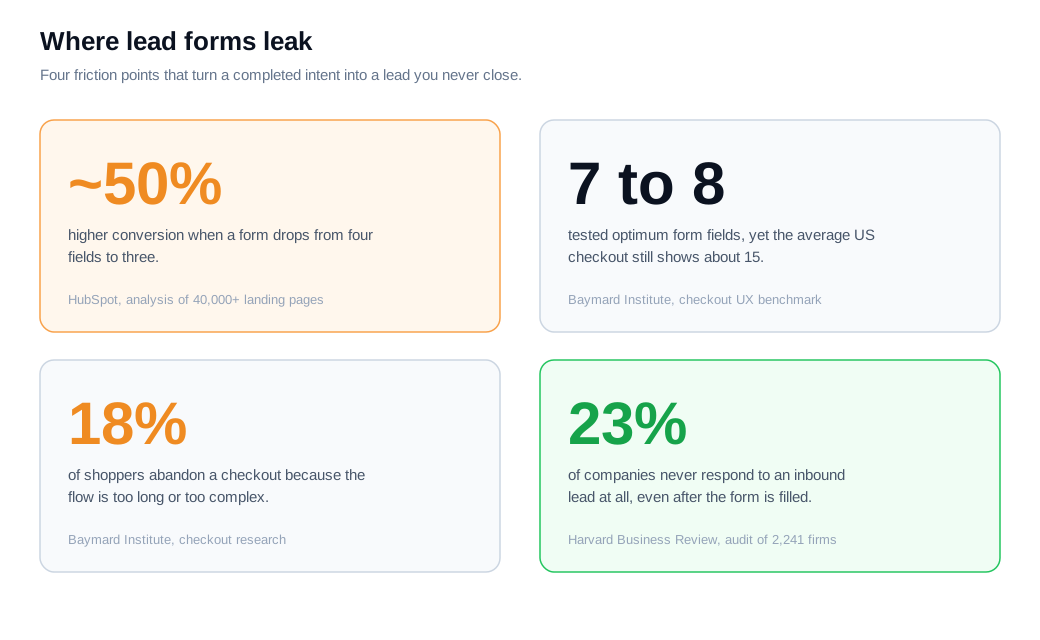
The first leak is length. Baymard Institute's checkout research found that the average US checkout flow shows roughly 15 form fields when the tested optimum sits at 7 to 8, and that 18 percent of shoppers who abandon do so specifically because the flow is too long or complicated, from Baymard's checkout benchmark work.
The lead-gen version is the same story at smaller scale: HubSpot found that trimming a form from four fields to three lifted conversions by close to 50 percent. Fields are not free. Each one is a small toll, and some fields, like phone number, cost far more than others.
The second leak is silence. A completed form is only a lead if someone answers it fast, and most companies do not. A Harvard Business Review audit of 2,241 firms found an average first-response time of 42 hours, with 23 percent that never responded at all.
Speed is not a nicety here. The MIT Sloan and InsideSales.com Lead Response Management study found that reaching a lead within five minutes rather than thirty made a rep about 21 times more likely to qualify it, across six companies and more than 15,000 leads. A form that sits in a queue overnight has already lost most of its value by morning.
The third leak is timing. Buyers do not keep office hours. Analyzing more than 30 million conversations, Drift, now a Salesloft company, found that 39 percent of conversations happened outside normal business hours and 41 percent of meetings were booked outside them, per the Salesloft conversational marketing trends research.
A static form can at least collect a detail at 11 p.m., but it cannot answer the question that would have moved the deal, and it cannot book the meeting while the interest is live.
When are forms still better?
Forms are still the better tool when you need structured, verifiable data, when the interaction is legally or procedurally rigid, or when there is nobody available to hold up the other end of a conversation. Chat wins on high-intent, high-touch moments, and that is not every moment.
- Gated content is the clearest case. When someone trades an email for an ebook or a webinar seat, a short name-and-email form is appropriate friction for a low-stakes exchange, and dropping a chat window on top of it usually adds work without adding value.
- Applications, registrations, and detailed submissions are another. A job application, a support ticket with attachments, or an order that needs an exact billing address is a structured-data problem, and a well-built form collects those fields in the right format the first time. Trying to gather a shipping address through free-text chat invites errors a form would have caught.
- Compliance can force the choice. Some industries require specific consent and disclosure fields presented in a fixed, auditable way, and a structured form with explicit checkboxes is easier to defend than a transcript.
- Staffing is the practical limit. A conversation only beats a form when someone, or a capable assistant, is there to answer it.
A chat widget that promises a fast reply and then goes quiet does more damage than a plain form, because it raised an expectation and broke it. If you cannot cover a page with live people or a reliable AI chat assistant, a form that sets honest expectations is the safer default.
How do you test chat against forms?
You test chat against forms by splitting traffic on the same high-intent pages, holding everything else constant, and comparing qualified leads and closed revenue per variant rather than raw captures.
A conversation almost always starts more interactions than a form, so a volume win proves little on its own. What matters is whether those interactions become pipeline.
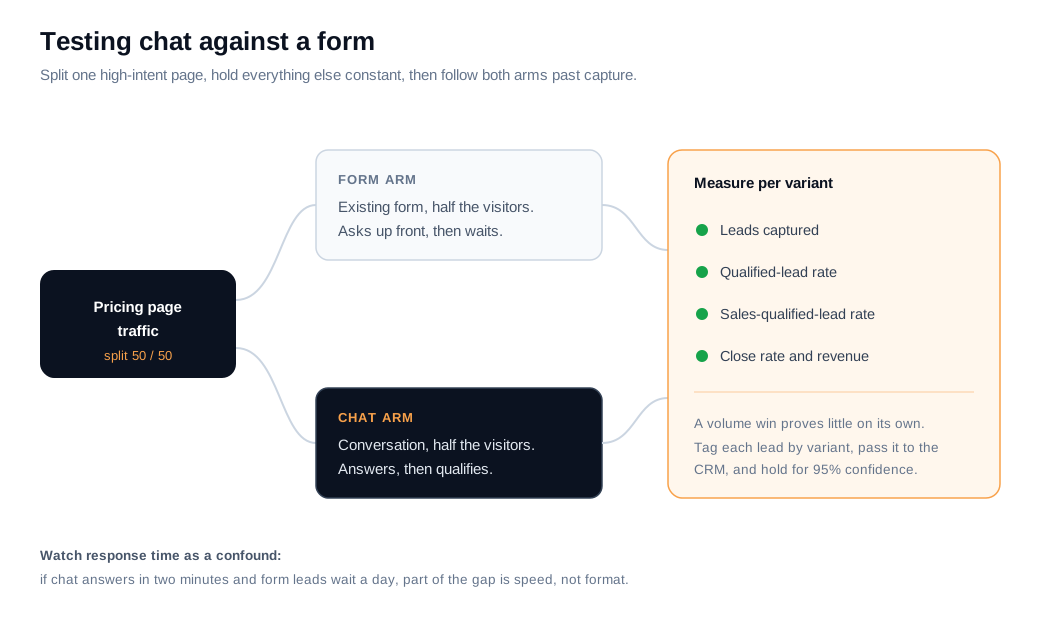
Set it up as a clean split. Take a page where intent is high, a pricing, demo, or product page, and send half the visitors the existing form and half a conversation, with the same headline, offer, and layout around it.
Tag every lead with its variant and pass that tag to your CRM so you can trace it past the capture point. The mistake to avoid is calling a winner at the lead stage, because chat and forms often attract different lead quality, and the arm with more leads can produce fewer deals.
Give the test enough traffic and time to mean something. A rough rule is to run for at least two full weeks to cover weekly cycles, and to gather on the order of a thousand conversions per variant before trusting a small difference, then check for 95 percent confidence before declaring anything. Underpowered tests on a low-traffic page will swing week to week and tell you nothing.
Here is a worked example. Say a pricing page gets 8,000 visits a month, split evenly:
- The form arm sees 4,000 visits and converts 6 percent into 240 leads.
- The chat arm sees 4,000 visits, engages 15 percent into 600 conversations, and qualifies 40 percent into 240 qualified leads.
At the lead stage it looks like a tie. Now follow both downstream: if the form's 240 leads close at 4 percent for about 10 customers, and the chat arm's pre-qualified leads close at 7 percent for about 17, the conversation wins on the only number that pays the bills, even though the top-line count matched.
Run the same split on a gated ebook and the form may well win, which is the point of testing per page rather than adopting a blanket rule.
Watch response time while you test, because it is a confound hiding in plain sight. If the chat arm answers in two minutes and the form arm's leads wait a day, you are partly measuring speed, not format. Wiring up routing and notifications so a rep is pinged the moment a lead qualifies keeps that variable honest, and it is worth fixing for the form arm too.
Should you run chat and forms together?
Most teams get the best result by running both, using forms where structure and self-service matter and conversation where intent is high and speed decides the deal. The choice is per page and per moment, not a company-wide verdict.
A common split works well:
- Keep short forms on gated content, event signups, and the contact page, where a structured record is the whole point.
- Put live chat and an assistant on the pricing, demo, and product pages, where a buyer with a live question is worth a real-time answer.
- Let a form hand off to a conversation, so a submitted demo request opens a chat window instead of a thank-you page and a wait.
The off-hours gap is where the two reinforce each other. An assistant can greet the 39 percent of visitors who show up after hours, answer what it can, qualify intent, and book a meeting for the morning, while a plain form quietly captures anything the assistant cannot resolve.
Glimpze is one of the tools built for this pattern, and like many in the category it offers a free plan so you can put a conversation on one high-intent page and measure it against the form already there before committing. Start with a single page, instrument both arms, and let the downstream numbers decide how far to roll it out.
Key takeaways
- Forms and conversations disagree on when the buyer pays. A form asks for everything up front and filters out anyone unwilling, while chat earns each detail in exchange for an answer and qualifies over a short exchange.
- Length and silence are why forms leak. HubSpot found trimming a form from four fields to three lifted conversions by nearly 50 percent, and Harvard Business Review found 23 percent of companies never respond to an inbound lead at all.
- Speed is doing half the work. MIT's research found a five-minute response was 21 times more likely to qualify a lead than a thirty-minute one, and 39 percent of conversations happen outside business hours.
- Forms still win real jobs. Gated content, applications, structured or regulated data, and any page you cannot staff are all better served by a short, honest form than a chat widget that goes quiet.
- Test on downstream revenue, not lead counts. Split traffic on one high-intent page, tag every lead by variant, gather enough volume for 95 percent confidence, and compare qualified leads and close rate rather than raw captures.
- Running both usually beats picking one. Forms for structure and self-service, conversation for high-intent pages and off-hours coverage, with the split decided page by page.

Written by
Daniel SemeckyCo-founder & CEO
Daniel is the co-founder and CEO of Glimpze. He spends his days talking to revenue teams about how to catch high-intent visitors before they bounce, and writes about inbound sales, lead conversion, and building a motion where marketing and sales actually share a number.


