
On this page
A single ebook can be published two ways. Behind a form, it becomes a lead-capture asset that a handful of people trade their email address for. Out in the open, it becomes a page thousands of people read and almost none of them identify themselves on. Same words, two completely different jobs.
The gated-versus-ungated choice sits under most B2B content programs, and teams usually make it out of habit rather than math. That habit leaks pipeline in both directions. Gate the wrong asset and you throttle reach for a trickle of leads. Ungate the wrong one and you give away contacts you needed to hit quota.
This guide covers what gated and ungated content actually are, how gating trades volume for quality, which assets belong on each side, when a gate earns its place, how to test the decision instead of guessing, and how to capture high-intent visitors without a form at all.
What is gated vs ungated content?
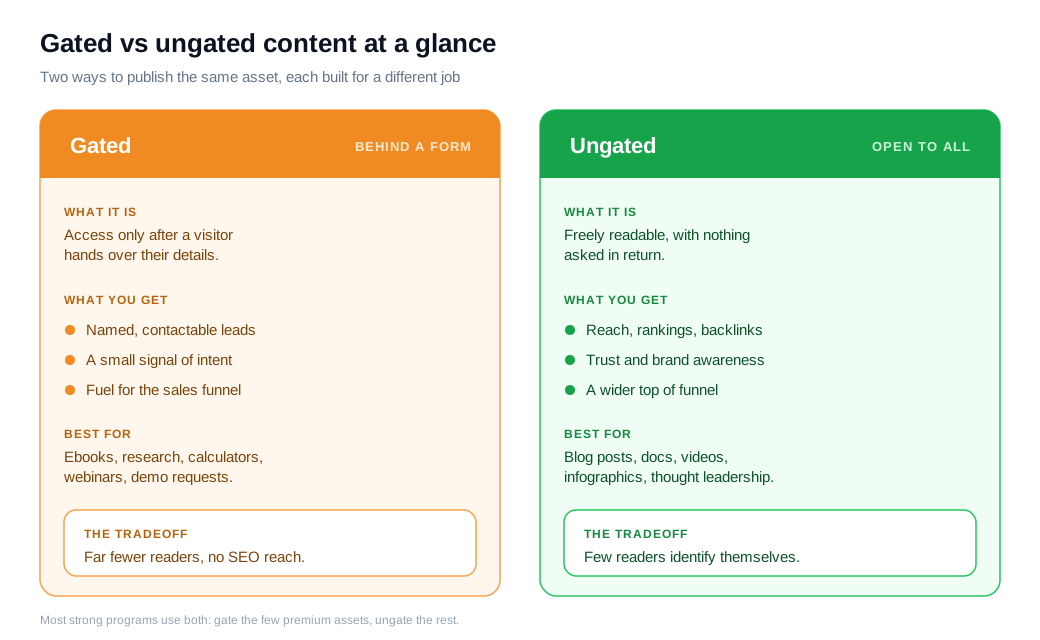
Gated content is any asset a visitor can only reach after handing over information, usually through a form, while ungated content is freely readable with nothing asked in return. The gate is the trade: your material in exchange for their contact details and a small signal of intent.
Gated assets tend to be the ones a company put real effort into. Ebooks and whitepapers, original research reports, webinars and recordings, templates and spreadsheets, ROI calculators, and demo requests all sit behind forms on most B2B sites. The form is the point. It converts an anonymous reader into a known lead your team can follow up with.
Ungated assets are built to be found and shared. Blog posts, most videos, product documentation, infographics, podcast episodes, and thought-leadership articles usually live in the open so that search engines can rank them, other sites can link to them, and readers can pass them around without hitting a wall.
The two are not rivals so much as different tools. Gated content exists to capture leads and feed the funnel. Ungated content exists to build reach, earn trust, and pull strangers toward you in the first place. Most of the tension in this debate comes from asking a single asset to do both jobs at once.
How does gating affect lead volume vs quality?
Gating trades raw reach for identified leads: a form cuts the number of people who consume your content by a wide margin, and in return it hands you a name, an email, and a hint of intent from the people who stay. More gates mean fewer readers and more captured contacts. Fewer gates mean the opposite.
The form itself is the lever, and its friction matters a lot. HubSpot's analysis of its customers' landing pages found that shorter forms convert better, with three-field forms among the top performers, and that a widely cited rule of thumb is that trimming a form from four fields to three can lift conversions by roughly half (per HubSpot's form optimization guidance). Every extra field you demand is another reason a reader closes the tab.
Volume also depends on where the traffic came from. Landing pages convert in the low-to-mid single digits on average, with median rates sitting around the mid single digits and only the top performers clearing 10% or more (per ZoomInfo's landing page benchmarks). Warm traffic from an engaged email list converts far higher than cold traffic from a paid ad, so the same gate performs very differently depending on who hits it.
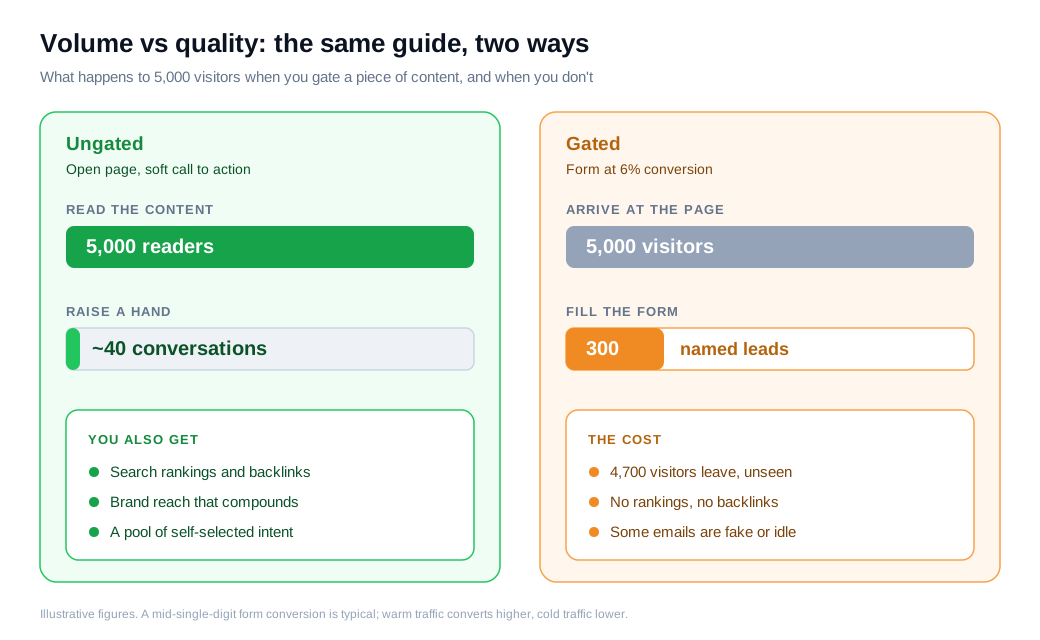
Here is the tradeoff with numbers. Take a guide that would draw 5,000 readers if you left it open. Put a form in front of it and expect a mid-single-digit conversion, say 6%. That is 300 leads and 4,700 people who never see the content. Leave the same guide ungated and all 5,000 read it, your brand compounds, backlinks accrue, and perhaps 40 of them click a soft call to action to talk to sales. The gated path produces more named leads this month. The ungated path produces more reach and a smaller pool of self-selected, higher-intent hand-raisers.
One caution on the word quality. A form is a low bar. People type fake emails, use a personal address, or fill it out for a competitor's research. A captured contact is a lead, not a buyer, and gated leads are not automatically better than the person who read your post and booked a call. Treat the form as a filter that adds volume, and let real behavior tell you who is actually worth a rep's time.
Which content should you gate, and which should you ungate?
Gate content that a serious buyer would happily trade their details for and that maps to a buying decision, and ungate everything whose main job is to be found, read, and shared. The split follows the funnel.
Good candidates to gate are high-effort, high-value, and hard to get elsewhere. Original research and benchmark reports, ROI or pricing calculators, detailed implementation templates, in-depth webinars, and product demos all clear that bar, because a prospect evaluating a purchase sees enough value to justify the form. These assets tend to sit in the middle and bottom of the funnel, where a visitor is already weighing options and identifying themselves costs them little.
Good candidates to ungate are the pieces that earn attention. Educational blog posts written for search, product documentation, most videos, infographics, and thought-leadership articles work harder in the open, where they can rank, collect links, and get forwarded. Gating a top-of-funnel explainer usually just buries a page that could have brought you thousands of visitors and dozens of downstream conversations.
Most teams have landed on a hybrid: keep the bulk of content open to build an audience, and gate only the small set of premium assets a buyer genuinely wants. That structure lets reach and lead capture each do the job it is good at instead of fighting over the same page.
When should you gate content?
Gate content when its perceived value clearly exceeds the friction of the form, and when capturing that lead is worth more to you than the reach you give up. If either half of that sentence is false, leave the gate off.
A few questions make the call concrete. Is the asset unique or high-effort enough that a buyer would trade an email for it, or is it something they could find free in ten other places? Is it aimed at someone near a decision, or someone just starting to learn? Do you need named leads for the sales team right now more than you need traffic, links, and brand awareness? A practical decision framework runs through exactly these tradeoffs before defaulting to a form (RightHello lays one out here).
The SEO cost is easy to forget. A gated asset behind a form does not get read by search crawlers, rarely earns backlinks, and cannot rank for the terms buyers search. If discovery matters for a piece, gating it quietly caps its ceiling. When the goal is reach, the gate works against you no matter how good the content is.
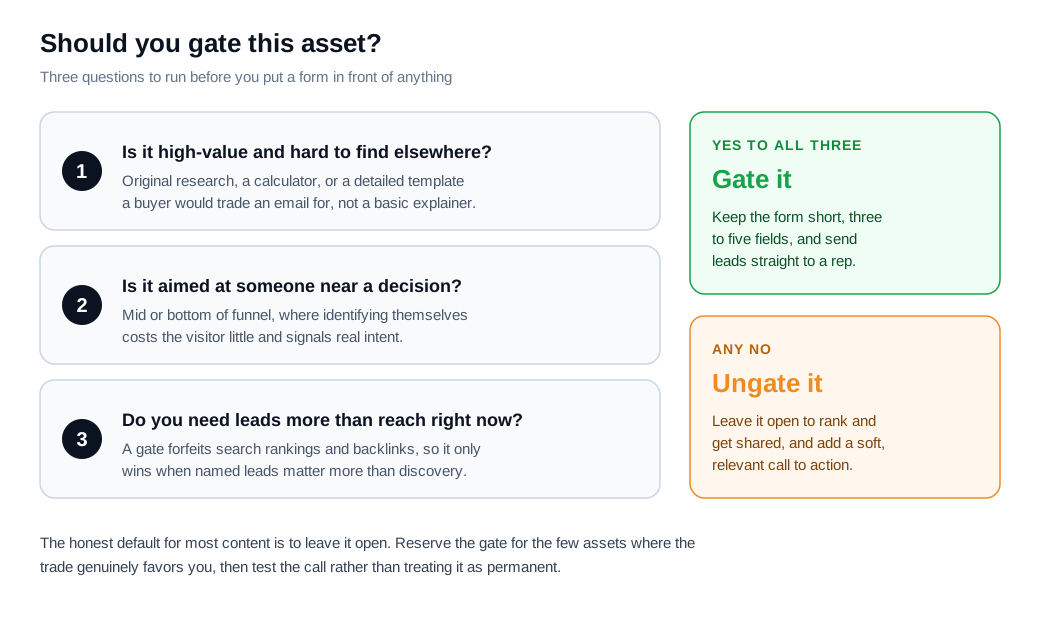
The honest default for most content is to leave it open and add a soft, relevant call to action. Reserve the gate for the assets where the trade genuinely favors you.
How do you test gating decisions?
You test a gating decision by running the same asset both ways and comparing full-funnel outcomes rather than the lead count alone. Counting form fills by itself will always flatter the gated version, because it ignores everything the open version earns.
The cleanest method is a split test: serve the gated version to half your traffic and the ungated version to the other half, then compare. If a split is impractical, gate the asset for a set period, ungate it for an equal period, and measure both windows. For the ungated version, track pageviews, time on page, shares, backlinks earned, and assisted pipeline. For the gated version, track conversion rate, lead quality, and the pipeline those leads actually produced.
The metric that settles most arguments is cost per opportunity, not cost per lead. A gate can win on leads and still lose on opportunities if those leads rarely turn into deals.
Here is a worked example over one quarter for a benchmark report, using the same 5,000 visitors both ways. Gated: a 6% form conversion yields 300 leads, and if 8% of those become real sales opportunities, that is 24 opportunities. Ungated: no form, but 1.5% of readers click a talk-to-sales call to action, giving 75 conversations, of which perhaps 20% are real opportunities, so 15 opportunities. The gated version wins this quarter, 24 to 15. Then change one input. Bloat the gated form from three fields to seven and conversion drifts toward 3%, halving leads to 150 and opportunities to 12, so the ungated version now wins. The test tells you which lever actually moves pipeline, and stops you defending a form that is quietly costing you deals.
Run the comparison on a handful of assets before you set a policy. The right answer differs by piece, by funnel stage, and by where the traffic comes from.
Does gated content still work in 2026?
Yes, gated content still works, but the all-or-nothing gate has given way to hybrid programs that ungate for reach and gate only the highest-value assets. The market moved away from gating everything a while ago.
The clearest example is Drift, which removed the forms in front of its content and started conversations on the page instead, then built a public position around the idea of selling without traditional lead-gen forms (recounted in this look at Drift's content strategy). The point was not that gates are worthless. The point was that a form is a poor way to meet a visitor who is ready to talk right now.
Gating still earns its place for bottom-of-funnel assets a buyer wants, like calculators, benchmark data, and demos. What changed is the surrounding strategy. The strongest programs now open most of their library to grow an audience, gate the few premium pieces worth a form, and add a real-time way for high-intent visitors to reach a person. That third path is where a lot of teams are quietly picking up the leads a gate would have scared off.
How can you capture leads without a form?
You capture leads without a form by giving visitors a way to start a conversation on the page the moment their interest peaks, so intent turns into a lead directly instead of being filtered through a gate. The form was always a proxy for interest. A live conversation measures interest itself.
In practice that means keeping your best content open and putting a low-friction path to a human right next to it. A reader on a pricing page, a case study, or a detailed guide is already showing intent, and letting them start a live chat or a video call in the moment captures far more of that intent than a callback form ever will. For the assets where you would otherwise gate a demo, a live video call or screen share on the page collapses the wait between interest and conversation entirely.
The two approaches stack. Gate the handful of premium assets where a form genuinely pays off, ungate the rest to build reach, and route the high-intent visitors who show up on your open pages straight into a real-time inbound sales conversation. You can even trigger a proactive nudge when someone lingers on a high-intent page, so the offer to talk arrives at the peak of interest rather than after it has passed. A tool like Glimpze is built for that last path: turning an anonymous reader on an open page into a named conversation without asking them to fill out anything first.
Key takeaways
- The gate is a trade, not a default. Gating swaps reach for named leads and a hint of intent. Leave it off unless the asset's value clearly beats the friction of the form.
- Volume and quality pull against each other. A form cuts your readership sharply and hands you contacts in return. Every extra field costs conversions, so keep forms short where you do gate.
- Gate by funnel stage. Reserve gates for high-value, bottom-funnel assets a buyer wants, like calculators, research, and demos, and keep top-of-funnel content open so it can rank and get shared.
- Test the decision, do not assume it. Run the same asset both ways and compare full-funnel outcomes, judging on cost per opportunity rather than cost per lead.
- Hybrid beats all-or-nothing. Open most of your library to grow an audience and gate only the few premium pieces where a form pays off, the model most strong B2B programs now use.
- A conversation can replace the form. Keeping content open and letting high-intent readers start a live chat or video call captures intent directly, without a gate scaring anyone off.
TAGS

Written by
Daniel SemeckyCo-founder & CEO
Daniel is the co-founder and CEO of Glimpze. He spends his days talking to revenue teams about how to catch high-intent visitors before they bounce, and writes about inbound sales, lead conversion, and building a motion where marketing and sales actually share a number.


