
On this page
- What is the cost per lead formula?
- What costs should you include in cost per lead?
- What is a good cost per lead?
- How does cost per lead vary by channel?
- What is the difference between cost per lead and CAC?
- Should you optimize for cost per lead or cost per qualified lead?
- How do you lower your cost per lead?
- Cost per lead FAQs
- Key takeaways
- Sources
A marketing team reports a $32 cost per lead in the first quarter and everyone nods. The next quarter it climbs to $58, and the same people start asking whether the channel is broken. Nobody checks whether the two numbers were built the same way.
Most of the time they were not. One quarter counted only ad spend. The next quietly folded in a new tool subscription and part of a salary. Cost per lead is one line of arithmetic sitting on top of a stack of choices about what counts as a cost and what counts as a lead, and those choices move the number more than your campaigns do.
This post covers the formula, which costs belong in it, what a good cost per lead looks like by industry, how the number shifts by channel, how it differs from customer acquisition cost, why the qualified version matters more, and the levers that actually bring it down.
What is the cost per lead formula?
The cost per lead formula is your total marketing spend divided by the number of new leads that spend produced: marketing spend ÷ new leads = cost per lead. That single division is the entire calculation, and every variation you will read about is just a change to what you count in the numerator or the denominator.
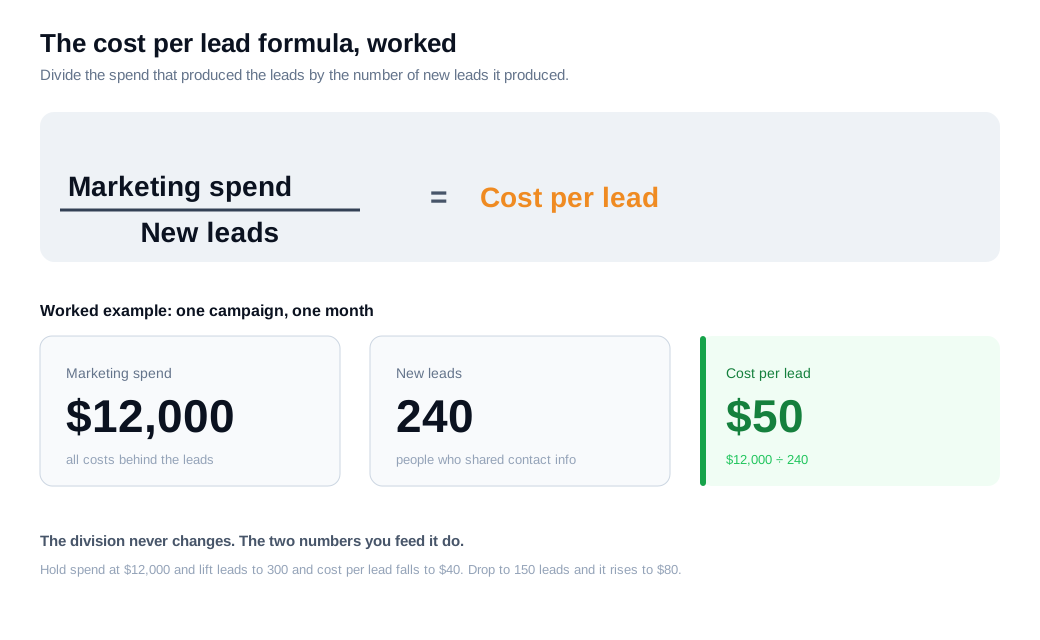
Here is a worked example. Suppose a campaign spends $12,000 in a month and brings in 240 new leads. Divide 12,000 by 240 and each lead cost you $50. If the next month holds spend at $12,000 but produces 300 leads, the cost per lead falls to $40, because the same budget worked harder. If leads drop to 150 on the same spend, cost per lead jumps to $80.
The arithmetic stays the same whether a lead is a demo request, a downloaded guide, a booked call, or a form fill. What changes is the pair of numbers you feed it, and getting those two definitions right is where the real work sits. HubSpot's guide to cost per lead and Wall Street Prep's CPL breakdown state the formula the same way, so there is no argument about the math. The argument is always about the inputs.
What costs should you include in cost per lead?
Include every cost that helped produce the leads: ad spend, the software you used, agency or freelancer fees, content production, and the prorated salaries of the people who ran the work. Ad spend is the obvious line, and it is usually the smallest one. A cost per lead built from ad spend alone will always read lower than the real figure, sometimes by half.
Teams usually calculate two versions. A media-only cost per lead divides just the ad or channel spend by leads, which is useful for judging a single campaign in isolation. A fully loaded cost per lead adds the indirect costs, which is what you need before you compare channels or forecast a budget. UpLead's breakdown of lead costs walks through the components most teams forget, and salaries are the biggest of them.
Prorate anything that is not fully dedicated to the campaign. If a marketing manager spends 40 percent of their time on a lead generation program, 40 percent of their salary belongs in the calculation. The same logic applies to a shared analytics seat or a designer who touches the landing page for a week.
Work the gap through with numbers. Take that same month: $10,000 in ad spend and 200 leads reads as a tidy $50 media-only cost per lead. Now add $2,000 in tool subscriptions, $3,000 for the prorated share of the people who ran it, and $1,500 in content production. Total spend becomes $16,500, and the fully loaded cost per lead is $82.50. Nothing about the campaign changed. The honest number is 65 percent higher than the one on the ad dashboard.
What is a good cost per lead?
There is no universal good cost per lead, because the right figure depends on your industry, your channel, and the value of a closed deal, though broad benchmarks give you a floor to check against. Paid search leads average around $70, while B2B industry averages scatter from roughly $150 to $500 per lead.
For paid search specifically, WordStream's 2025 Google Ads benchmarks put the cross-industry average cost per lead near $70, with legal and finance running far higher because the clicks themselves cost more (attorneys and legal services average about $8.58 per click). At the industry level, Sopro's B2B cost per lead benchmarks show healthcare, financial services, and software commonly landing in the hundreds of dollars per lead, and HubSpot Research's CPL and CAC benchmarks report similar spreads once industry and channel are held apart.
Deal value moves these figures more than any benchmark. A page selling a $40,000 annual contract can thrive at $500 per lead if a healthy share of those leads close, while a low-priced consumer product needs leads in the single digits to survive. Treat public averages as a sanity check, measure your own baseline, and judge every cost per lead against the revenue a lead is worth rather than against a chart.
How does cost per lead vary by channel?
Cost per lead varies widely by channel because each one reaches a different audience at a different level of intent, so organic search and referrals usually cost far less per lead than paid search or paid social. A lead who found you through a Google search for your category wants something specific. A lead served an interruptive social ad may have wanted nothing at all.
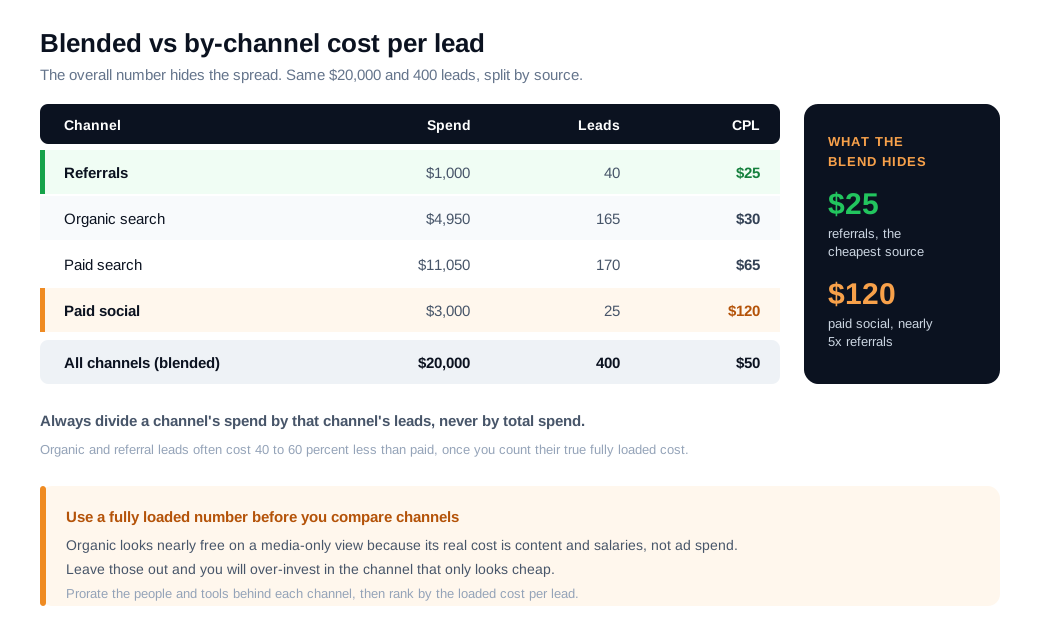
Here is a worked example. Say a month spends $20,000 across four channels and produces 400 leads, a blended cost per lead of $50. Split by source, the spread is wide: referrals come in around $25 each, organic content near $30, paid search about $65, and paid social close to $120. The blended $50 hid both your cheapest source and your most expensive one, and it would never tell you that paid social costs almost five times what referrals do.
Organic channels tend to sit well below paid ones once they mature, often 40 to 60 percent cheaper per lead, according to the industry data in Sopro's benchmark set, though they carry an upfront cost in content and time that a media-only view ignores. The practical rule mirrors the one for conversion rate: always divide a channel's spend by that channel's leads, never by total spend, and use a fully loaded number so an organic channel's true cost is not flattered by leaving out the salaries behind it.
What is the difference between cost per lead and CAC?
Cost per lead measures what you pay to get someone into the funnel, while customer acquisition cost measures what you pay to turn them into a paying customer, so CAC is always higher and folds in the sales costs that cost per lead leaves out. Cost per lead gets a prospect in the door. CAC covers the whole building, including the sales rep's time, the demo, and the contract.
The two connect through your conversion rate. If leads cost $50 each and 4 percent of them become customers, then it takes 25 leads to win one, so the lead cost alone inside each new customer is $1,250 ($50 multiplied by 25). Add the salary of the salesperson who closed the deal and the tools they used, and the true CAC climbs from there.
This is why a falling cost per lead can hide a rising acquisition cost. Push cost per lead down by chasing cheaper, lower-intent traffic, and the conversion rate to customer often falls faster than the lead price does, which quietly pushes CAC up even as the headline metric looks better. Read the two numbers together, and never celebrate a cheaper lead until you know what it converts at.
Should you optimize for cost per lead or cost per qualified lead?
Optimize for cost per qualified lead, because a cheap raw lead that rarely converts can cost far more per customer than an expensive lead that closes. The raw number rewards volume. The qualified number rewards revenue, and only one of them pays the bills.
The math is stark once you fold in conversion rates. WhatConverts' analysis of cost per qualified lead shows a referral lead that costs $25 and qualifies 56 percent of the time works out to about $45 per qualified lead, while a webinar lead that costs $267 but qualifies only 19 percent of the time actually costs roughly $1,405 for each qualified lead. The webinar lead looked ten times more expensive at the top. It turned out more than thirty times more expensive where it counted.
To calculate it, divide the same spend by the number of leads that met your qualification bar instead of by every raw lead. Define that bar in advance (company size, job title, budget signal, or a genuine buying question), and hold it steady so the metric measures your funnel and not a shifting definition. A $150 lead that qualifies and closes will beat a $3 lead that never does, every time.
How do you lower your cost per lead?
Lower cost per lead by improving the conversion rate of traffic you already pay for, tightening targeting so fewer wasted clicks enter the funnel, and responding fast enough that more of the leads you capture turn into real conversations. All three pull the same lever, which is getting more qualified leads out of the spend you have already committed.
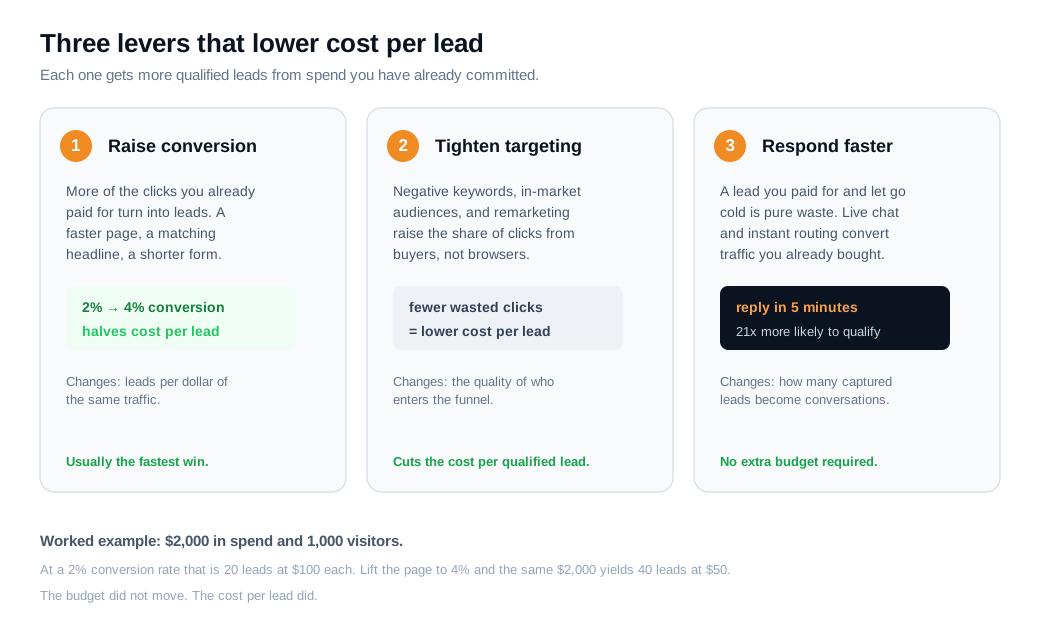
Start with conversion rate, because it is usually the fastest win. A slow page, a headline that does not match the ad, or a long form all leak paid traffic, and Heyflow's guide to lowering CPL points to page and form friction as the most common culprit. Run the numbers: $2,000 in spend that draws 1,000 visitors at a 2 percent conversion rate yields 20 leads and a $100 cost per lead. Lift that page to 4 percent and the same $2,000 produces 40 leads at $50 each. You halved the cost without touching the budget.
Targeting is the second lever. Negative keywords, in-market audiences, and remarketing to people who already visited all raise the share of clicks that come from buyers rather than browsers, which lowers cost per qualified lead even when the raw click price holds. Cheap clicks that never convert are the most expensive traffic you can buy.
Speed is the third, and it is the one most teams underuse. The classic MIT and InsideSales lead response study found that contacting a web lead within five minutes rather than thirty makes you 21 times more likely to qualify it, a pattern still cited across InsideSales' lead response research. A lead you already paid for and then let go cold is pure waste. Answering while the visitor is still on the page, through live chat or a quick call, converts traffic you have already bought, which is the cheapest lead source you own. For teams running inbound sales off paid traffic, wiring up fast lead routing so the right rep sees a hot lead in seconds does more for cost per lead than another round of bid tuning.
Cost per lead FAQs
How do you calculate cost per lead in Google Ads?
Google Ads reports it directly when you set up conversion tracking, dividing the cost of a campaign by the number of conversions you flagged as leads, such as form fills or calls. For a fully loaded figure, take that platform number and add the tools, management time, and content behind the campaign, since the ad account only knows about media spend.
What is a reasonable cost per lead for a small business?
A reasonable cost per lead is any figure that leaves room for profit after the lead converts, which for many small businesses means keeping it well below a small fraction of the revenue a customer brings in. A local service business closing $2,000 jobs can pay $50 to $150 per lead and still profit, while the same price would sink a business selling a $30 product.
Does a lower cost per lead always mean better marketing?
No, a lower cost per lead can signal worse marketing if the cheaper leads convert at a lower rate, because the metric that pays your salary is cost per customer, not cost per lead. Always check what a cheaper lead converts at before treating the drop as a win.
Key takeaways
- The formula is one division, but the inputs decide the answer. Cost per lead is marketing spend divided by new leads, and every disagreement about the number traces back to what you counted as a cost and what counted as a lead.
- Fully loaded beats media-only for real decisions. Adding tools, agency fees, content, and prorated salaries can push the honest figure well above the ad dashboard number, often by more than half.
- Benchmarks are a floor, not a target. Paid search averages near $70 per lead and B2B industries run from about $150 to $500, but deal value matters more than any external average.
- Split cost per lead by channel and never blend it. Organic and referral leads usually cost a fraction of paid ones, and a blended number hides both your cheapest and most expensive source.
- Optimize for the qualified lead, not the raw one. A cheap lead that rarely converts can cost far more per customer than an expensive lead that closes, so measure cost per qualified lead and read it alongside CAC.
- The fastest way down is more from the spend you have. Higher landing page conversion, tighter targeting, and faster follow-up lower cost per lead without adding a dollar to the budget.
TAGS

Written by
Daniel SemeckyCo-founder & CEO
Daniel is the co-founder and CEO of Glimpze. He spends his days talking to revenue teams about how to catch high-intent visitors before they bounce, and writes about inbound sales, lead conversion, and building a motion where marketing and sales actually share a number.


