
On this page
- What is the difference between guest checkout and account checkout?
- How does guest checkout affect conversion?
- What are the benefits of account creation?
- How do you offer both without adding friction?
- Should you make guest checkout the default?
- How do you test guest checkout vs account checkout?
- How does live help fit into the checkout decision?
- Key takeaways
- Sources
A first-time shopper fills a cart, taps checkout, and the first thing the store asks for is a password. Some of them create the account. A meaningful share close the tab. That one design choice, whether you let people buy as a guest or make them register first, quietly decides how many ready-to-buy visitors actually pay.
The tension is real. Guest checkout wins more first purchases, and accounts are worth more over time. Plenty of stores treat this as an either-or fight, when the data points to a specific way to get both.
This post covers what each option really is, what it does to conversion, what an account is actually worth, how to offer both without slowing anyone down, whether guest should be the default, and how to test it on your own traffic.
What is the difference between guest checkout and account checkout?
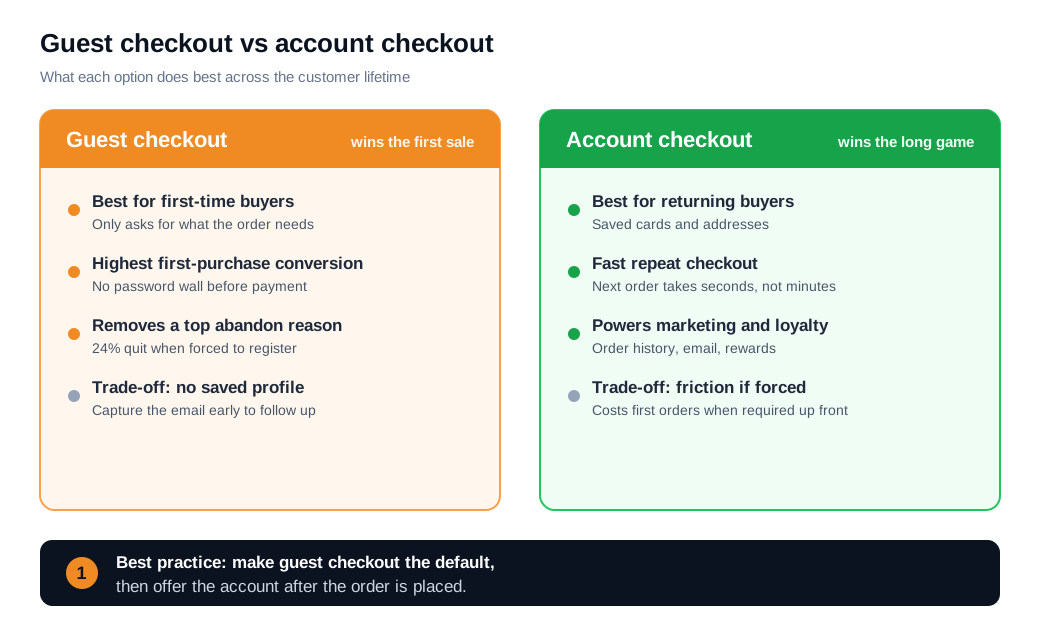
Guest checkout lets a shopper complete a purchase with only the details needed to fulfill the order, while account checkout asks them to also create a login before or during the purchase. Both collect an email and a shipping address. The difference is the password step and everything it implies: a saved profile, order history, and a login to come back to.
That difference sounds small, yet it changes what the shopper has to decide at the exact moment they are trying to pay. A guest is deciding whether to buy. A registrant is deciding whether to buy and whether to start a relationship with your store, remember another password, and hand over more data. Two decisions are harder than one.
Account checkout also splits into two cases worth separating. A brand-new visitor forced to register is the friction case. A returning customer who logs in and sees saved cards and addresses is the fast case. When people say accounts convert better, they usually mean that second group, which is a returning-customer effect rather than proof that registration helps a first-time buyer.
How does guest checkout affect conversion?
Guest checkout lifts first-purchase conversion because it removes one of the most common reasons people abandon a cart. In the Baymard Institute's research on why shoppers leave checkout, 24% who abandoned an order did so because the site wanted them to create an account, which makes forced registration one of the top non-cost reasons for walking away.
That 24% is not window shoppers. Baymard measures it among people who had an item in the cart and started to check out, so it is demand you already earned and then lost at the door. Removing the requirement gives that quarter of hesitant buyers a straight path to payment.
The most cited proof is ASOS. After the retailer reworked its checkout so first-time shoppers were no longer forced to register before paying, abandonment at that step fell by about 50%, as documented by Econsultancy. The change did not touch price, product, or shipping. It only took down a login wall.
Put numbers on it. Say 6,000 shoppers reach your checkout in a month and 55% complete under forced registration, which is 3,300 orders. Switch on guest checkout and suppose completion climbs to 62%. You now ship 3,720 orders from the same traffic, 420 more per month. At an $80 average order value, that is roughly $400,000 a year in additional revenue with no extra ad spend.
Guest checkout does carry one trade-off. You still need the email to send a receipt and to recover the cart, so capture it near the top of the flow. What you give up is the saved profile, and the next section is about why that matters.
What are the benefits of account creation?
Account creation pays off after the first order, because a saved profile is what makes repeat buying fast and marketing possible. A logged-in customer has saved addresses and payment details, so their next checkout can take seconds instead of minutes, and you hold the email, order history, and consent needed to bring them back.
The economics favor retention. Returning customers tend to spend more per order and buy more often than first-time buyers, and a large share of ecommerce revenue comes from the minority of shoppers who come back, as Yotpo's benchmark data shows. An account is the mechanism that turns a one-time guest into that repeat buyer. It stores the details, powers order tracking, feeds loyalty programs, and lets you send a relevant follow-up instead of a cold ad.
Accelerated wallets show how much speed matters for returners. Shopify reports that Shop Pay, which saves a shopper's details behind a one-tap login, can lift conversion by up to 50% compared with a standard guest checkout and converts at up to 1.72 times the guest rate, especially on mobile. The value of an account lands on the second visit and every one after it.
So the honest summary is short. Guest checkout maximizes the first sale, and accounts maximize everything that follows it. You want the first without giving up the second, which is a sequencing problem more than an either-or choice.
How do you offer both without adding friction?
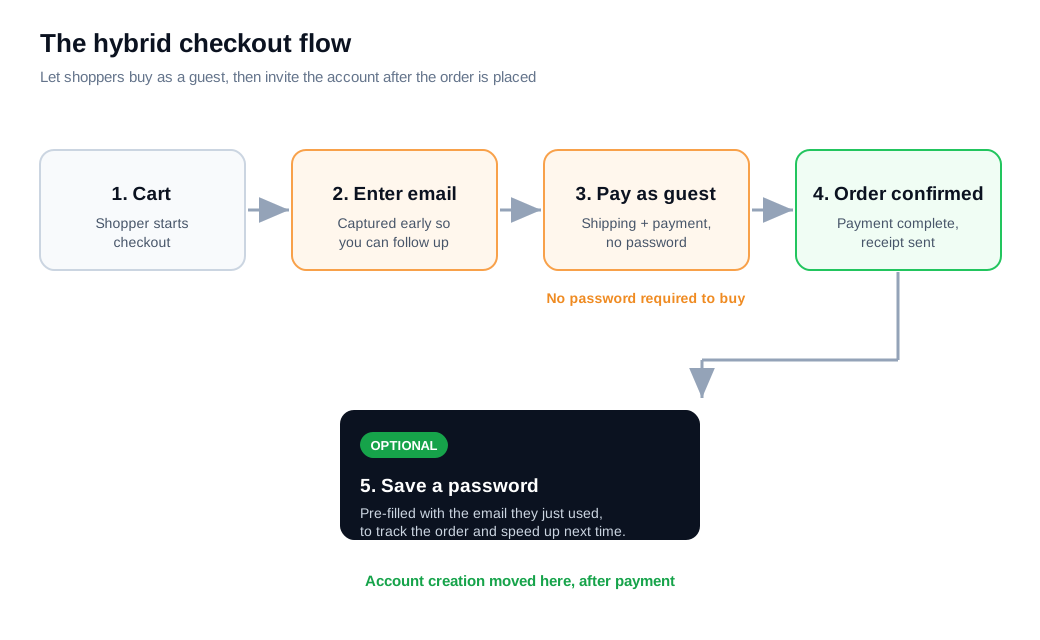
You offer both by making guest checkout the default path and moving account creation to after the order is placed. The shopper buys as a guest, and on the confirmation page you offer a one-click way to save their details, usually "Set a password to track your order," pre-filled with the email they just entered. They already trust you at that point because they just paid, and the password costs them nothing toward completing the purchase.
Baymard backs this ordering. Its testing found that saving the account invitation for the confirmation step performed better than showing it at the start of or during checkout, yet 42% of sites still interrupt shoppers before or during checkout to push registration. Every one of those interruptions asks the buyer to weigh the pros and cons of an account before they have finished the thing they came to do.
A few implementation details keep the both-options path clean:
- Put "Continue as guest" at least as prominent as "Sign in," ideally more so. Many stores bury the guest option and lose people who never notice it.
- Offer express wallets like Shop Pay, Apple Pay, PayPal, and Google Pay up top, so returning and new shoppers can skip typing entirely.
- Create the account quietly from the guest details where it is legal to do so, then invite the shopper to set a password later, so their order history exists if they return.
- Ask for the email first, so you can still recover the cart even if they leave after that point.
The result is one flow that reads as guest checkout to a first-timer and as a fast saved-profile checkout to a returner. Nobody is forced to choose up front.
Should you make guest checkout the default?
Yes, guest checkout should be the default for almost every store, because the cost of forcing registration is immediate and measurable while the benefit of an account can be captured later at no cost to conversion. The common exception is a store whose product genuinely requires an account to work, such as a subscription, a digital service with a login, or a wholesale site with account-specific pricing.
Even then the friction principle holds. Collect only what the order needs to go through, and defer the rest. A membership site can still let a buyer pay first and set credentials on the confirmation screen. Forcing the account before payment rarely helps and reliably costs you a share of ready buyers.
How do you test guest checkout vs account checkout?
You test it with a controlled A/B experiment that splits checkout traffic between the two flows and compares completion rate at a set confidence level. Send half your checkout visitors to the current flow (the control) and half to the guest-first flow (the variant), keep everything else identical, and measure the share of each group that completes an order.
Set the test up properly before you read anything into it:
- Pick one primary metric, checkout completion rate, and one guardrail, revenue per visitor, so a lift in orders that quietly lowers order value cannot fool you.
- Decide the sample size in advance from your baseline conversion rate and the smallest lift worth acting on, the minimum detectable effect. Small effects need more traffic.
- Run for full weeks, not days, so weekday and weekend behavior both land in the sample, and use the standard 95% confidence threshold before calling a winner.
- Watch downstream metrics too. Guest checkout can raise first orders while lowering account signups, so track repeat purchase rate over the following weeks to see the whole picture.
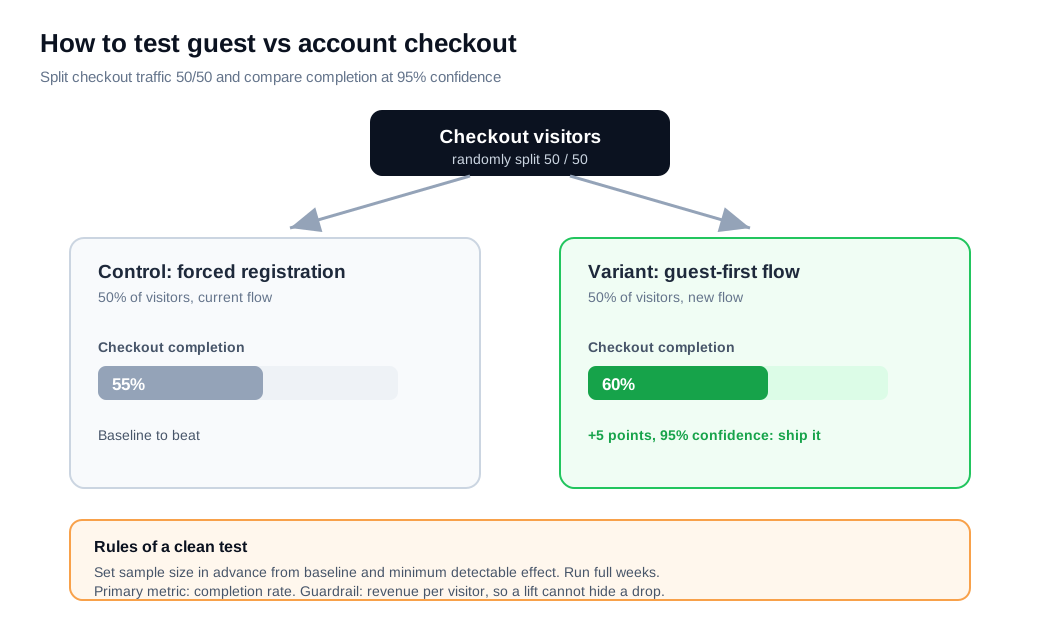
Here is a concrete run. Suppose your checkout gets 8,000 visitors a month and completes at 55%, and you want to detect at least a 3-point lift. Running a 50/50 split, you let the test collect a few thousand visitors per variant across two to three full weeks, then check significance. If the guest-first variant completes at 60% with 95% confidence, ship it. If it lands at 56% and the tool says the result could be noise, keep collecting or call it flat.
If you cannot run a clean A/B test, a before-and-after comparison against the same season last year is a weaker but usable check. Just remember that traffic mix, promotions, and seasonality can move the number as much as the checkout change did, so treat the result as a signal rather than proof.
How does live help fit into the checkout decision?
Live help matters here because the account-versus-guest choice is really about removing doubt at the moment of payment, and some doubts are questions no checkout layout can answer. A shopper stalling over whether to register is often stalling over something else too: a delivery date, a return policy, whether their discount applied, or a payment that keeps failing.
For those moments, a well-timed offer of help beats another form-field tweak. A tool like live chat that appears when someone hesitates on the payment step lets a rep or an assistant answer the blocking question in seconds, and a proactive nudge tied to that hesitation can reach the shopper before they reach the exit. For higher-value or more complex orders, this is where inbound sales teams recover revenue that a guest-versus-account test alone never will, by treating a stalled high-intent checkout as a live signal rather than a lost cart.
Keep it low-key. The goal is to clear the one thing standing between a ready buyer and a finished order, whether that is a password prompt or a shipping question.
Key takeaways
- Guest checkout wins the first sale. Baymard finds 24% of shoppers abandon when forced to register, and ASOS cut abandonment at that step by about 50% after dropping the requirement.
- Accounts win the long game. Saved profiles make repeat checkout fast and power email, loyalty, and personalization, which is where returning customers and their higher spend come from.
- You do not have to choose. Make guest checkout the default and offer account creation on the confirmation page, the ordering Baymard found performs best.
- Make the guest path obvious. 42% of sites still push registration mid-checkout, so put "Continue as guest" and express wallets front and center instead.
- Test on your own traffic. Split checkout 50/50, track completion rate and revenue per visitor, and wait for full weeks and 95% confidence before shipping.
- Answer the real blocker in the moment. Live help clears the question freezing a high-intent shopper, whether it is the account prompt or something else entirely.

Written by
Nilas MylerCo-founder & CTO, Glimpze
Nilas is the co-founder and CTO of Glimpze, an inbound sales tool that turns high-intent website visitors into live conversations. A former SEO consultant for some of the largest companies in Denmark, he writes about speed-to-lead, inbound sales, and conversion rate optimization — the technical and operational mechanics of turning traffic into pipeline.


