
On this page
- How does live chat lift ecommerce sales?
- Does live chat reduce cart abandonment?
- When should you trigger chat on a store?
- How do you answer pre-purchase questions fast?
- What is a good chat-to-conversion rate for ecommerce?
- How do you measure chat-driven revenue?
- What live chat mistakes cost online stores sales?
- Key takeaways
- Sources
A shopper has a jacket in the cart. They want to know two things before they pay: does it run small, and are returns free. The size guide is vague and the returns policy is three clicks away, so they decide to come back later once they have checked. They will not come back.
That moment repeats thousands of times a day across ecommerce stores, and it is where live chat earns its keep. A visitor who can ask one question and get an answer in seconds stays in the funnel. The Baymard Institute puts the average documented cart abandonment rate at 70.22%, and a meaningful slice of that traces back to unanswered questions and surprises at checkout. Chat is one of the few tools that reaches a buyer in the seconds before they leave.
This guide covers how live chat lifts ecommerce sales, whether it really cuts cart abandonment, when to trigger chat on a store, how to answer pre-purchase questions fast, what a good chat-to-conversion rate looks like, how to measure chat-driven revenue, and the mistakes that quietly cost sales.
How does live chat lift ecommerce sales?
Live chat lifts ecommerce sales by clearing the small doubts that stall a purchase at the exact moment a shopper feels them, so more sessions end in an order and the orders tend to run larger. The channel wins on timing. The person is already on the product page, already interested, and one answer away from a decision.
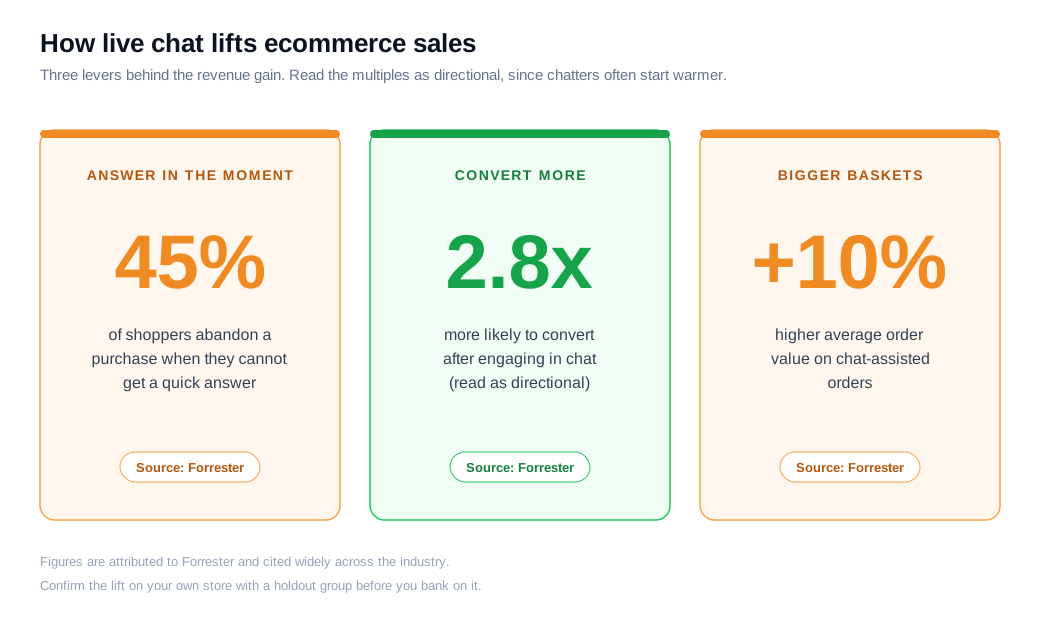
Three mechanisms do the work. The first is speed of answer. Forrester has reported that around 45% of US online adults will abandon a purchase if they cannot find a quick answer to a question, and a live reply closes that gap while the tab is still open. The second is rescue. A shopper stalling at shipping or hesitating over fit is exactly the visitor a well-timed message can save. The third is basket size, because a rep who reassures a buyer can also point them to the right bundle, the better size, or the item that completes the order.
The most cited numbers come from Forrester's work on proactive chat. Shoppers who engage in a chat are commonly reported as 2.8 times more likely to convert than those who do not, and chat-assisted orders tend to carry a higher average order value, with the lift usually put near 10%. Read the multiple as directional rather than a guarantee, since people who start a chat were often warmer to begin with, so some of the gap is selection rather than the chat itself.
Put rough numbers on it. Say a store draws 50,000 sessions a month and converts 2% of them, which is 1,000 orders at an $80 average, or $80,000. Add live chat that engages 5% of sessions, so 2,500 real conversations a month. If those engaged shoppers buy at 10%, that is 250 orders touched by chat. Even if you credit chat with only the portion of that group who would have left without an answer, you are recovering orders that the store was otherwise losing at the shipping and fit questions. For an inbound sales mindset applied to a storefront, each of those conversations is a chance to move a sale, not a ticket to close.
Does live chat reduce cart abandonment?
Live chat reduces cart abandonment for the share of shoppers who leave because of doubt, though it cannot recover the ones who were only browsing. The distinction matters, because it tells you where chat pays and where it does not.
Baymard's research on why people abandon during checkout is the useful map here. The top reasons include extra costs like shipping and tax appearing too high (cited by roughly 48% of abandoners), being forced to create an account (about 26%), a checkout that felt too long or complicated (around 22%), and not trusting the site with card details (near 18%). Several of those are conversations. A shopper worried about shipping cost, unsure about the return window, or nervous about payment security can be reassured in one chat exchange before they close the tab.
Two limits keep this honest. Chat cannot fix a checkout that is genuinely broken or bloated, so if forced account creation or a six-field form is driving people away, the fix is the form, not a chat widget on top of it. Chat also cannot convert someone who was never ready, and a large portion of all abandoned carts are simply people comparing options or window shopping. Aim chat at the doubt-driven abandonment and let the checkout redesign handle the structural leaks.
A quick illustration. Of 100 shoppers who abandon a cart, assume 55 were browsing or not ready, which no chat will save. That leaves 45 who left over a real question or a trust concern. If chat reaches even a third of them in time and converts half of those, you recover about seven or eight orders from a group you were writing off entirely.
When should you trigger chat on a store?
Trigger chat on hesitation signals at high-intent moments, not on a timer that fires on every page, so the invitation reaches shoppers weighing a decision and leaves browsers alone. A generic pop-up that greets everyone after five seconds trains people to dismiss chat on reflex, and it can convert worse than showing nothing.
Good triggers key off behavior. A shopper who lingers on a product page for 40 to 60 seconds, or returns to the same product a second time, is showing interest that a quick fit or sizing answer could turn into an order. An item sitting in the cart while the visitor goes idle is a nudge point. A stall on a checkout step for a minute or more is the highest-value moment on the whole site, and a message offering to sort out shipping or a coupon code lands right when it is needed. Exit intent on the cart or checkout is the last catch before the session ends.
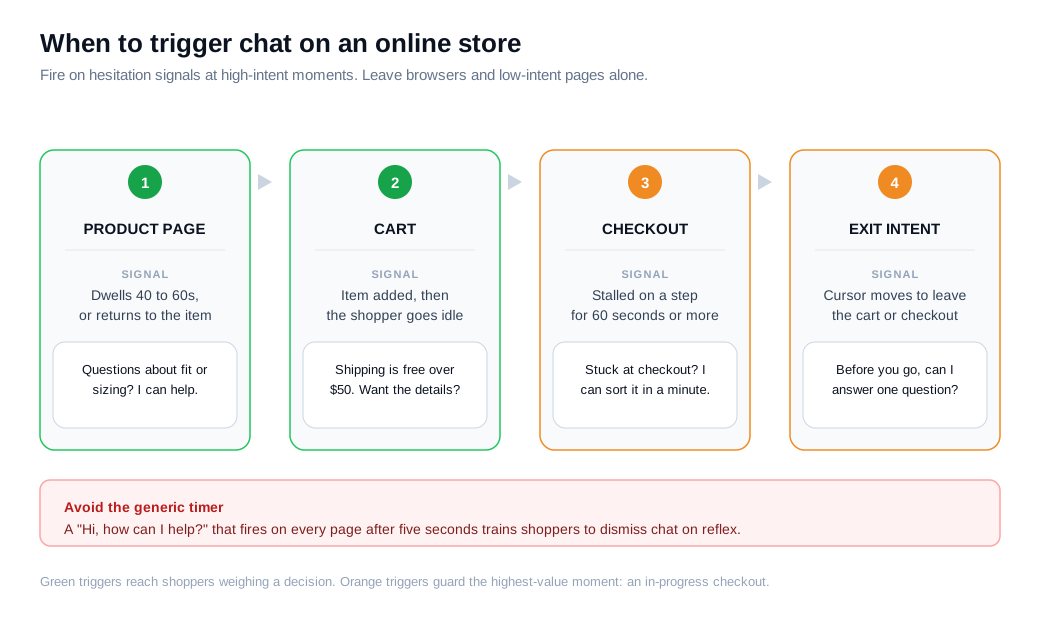
The message has to name the situation to work. "Comparing sizes? I can tell you how this one fits" beats a wave from a stranger, and "Stuck at checkout? I can sort it in a minute" beats "How can I help?" Zendesk's summary of Forrester's six elements of proactive chat makes the same point: the invitation has to be relevant to what the visitor is doing, or it becomes noise. Tuning these proactive outreach rules to real behavior, then leaving low-intent pages quiet, is most of the setup work.
How do you answer pre-purchase questions fast?
Answer pre-purchase questions fast by putting answers where the question forms, staffing chat during your traffic peaks, and letting an AI assistant handle the repetitive ones instantly so a human stays free for the complicated sales. Speed is the whole game here, because a question that goes unanswered for hours is a sale that already left.
Start by learning your top questions. On most stores the same handful repeats: fit and sizing, shipping cost and delivery time, stock and restock dates, the return policy, product compatibility, and payment security. Write a short, personal snippet for each one so a rep can send an accurate answer in seconds instead of typing it fresh every time. Keep the snippets as a starting point that gets personalized, not a wall of boilerplate, or shoppers feel handled by a script.
Layer automation under the humans. An AI chat assistant trained on your shipping, returns, and product data can answer the routine questions the instant they are asked, at 2 a.m. or during a flash sale when the team is swamped, then hand off to a person the moment a question gets specific or a cart gets valuable. For high-consideration products, where a buyer is weighing a $400 decision on specs they do not fully understand, text sometimes stalls, and offering live video and screen share in the same thread turns a stuck chat into a working walkthrough. Carry the full transcript into every handoff so nobody repeats themselves.
What is a good chat-to-conversion rate for ecommerce?
A good chat-to-conversion rate for an online store sits around 10% to 25% of engaged conversations ending in a sale, with high-intent pages like the cart and checkout at the top of that range. Chat-to-conversion rate is the share of real chats (not bounced pop-ups) that lead to the outcome you care about, usually a completed order within a short window.
Reported benchmarks land in that band. Aggregated figures put engaged chat conversion in roughly the 10% to 20% range across industries, and ecommerce often runs at the higher end because the visitor is already mid-purchase rather than researching. Where the chat happens changes the number a lot, so a chat that starts on a product page converts differently from one that starts on checkout.
The practical move is to segment. Measure chat-to-conversion separately for product pages, cart, and checkout rather than as one blended average, because the blended number hides which trigger is actually earning its keep. A store might see 12% on product pages and 30% at checkout, which tells you exactly where to concentrate staffing and proactive invites.
How do you measure chat-driven revenue?
Measure chat-driven revenue by tagging chat sessions, tying them to orders in your analytics, and comparing chatters against a non-chat control so you separate the sales chat actually added from the sales that would have happened anyway. The tagging is the easy part. The control group is what makes the number defensible.
Set up the tracking first. Fire events like chat started and chat engaged into GA4 or your analytics tool, attach a session or user ID, and attribute orders that follow within a window of 24 to 48 hours, as guides like Ruler Analytics lay out. That gives you chat-touched revenue, which you can compute as engaged chats multiplied by chat conversion rate multiplied by average order value.
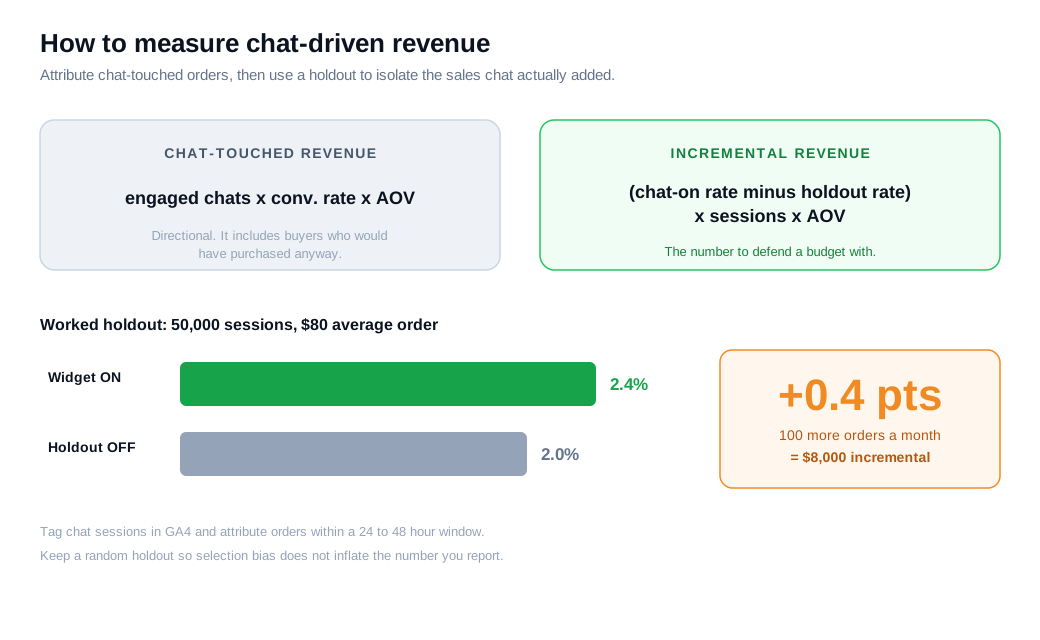
Chat-touched revenue overstates the impact, though, because it includes buyers who would have purchased regardless. To get the incremental number, run a holdout. Show the widget to most of your eligible traffic and hide it from a random slice, then compare the overall conversion rate of the two groups. The difference is what chat added.
Here is the arithmetic. Take the same 50,000 sessions and $80 average order. Split eligible traffic so 25,000 sessions see the widget and 25,000 do not. Say the widget group converts at 2.4% overall and the holdout at 2.0%. That 0.4 point difference on 25,000 sessions is 100 extra orders a month, worth $8,000 in incremental revenue, and that figure holds up in a budget conversation in a way a vendor's headline multiple never will. Run the test long enough to reach a stable result, then keep chat-touched revenue as a directional read and the holdout number as the truth.
What live chat mistakes cost online stores sales?
The mistakes that cost stores the most are an unstaffed widget that promises help and delivers a wait, generic pop-ups that fire on every page, replies that arrive too slowly to matter, and never checking whether chat pays for itself. Each one caps the return before the channel gets a fair test.
An unstaffed widget is the worst of them, because it advertises help and then leaves a shopper typing into silence. If you cannot cover a time slot, switch the widget to an honest offline state that captures the question and email, or let the AI assistant answer and route the lead so it never goes cold. Generic pop-ups are the second trap, fixed by the behavior-based triggers above. Slow replies are the third, since a two-minute wait on a high-intent question loses the shopper you were closest to converting. Flying blind on metrics is the fourth, and it keeps the other three alive by hiding the damage. Most platforms, including Glimpze, offer a free tier, so you can test staffing and triggers against your own traffic before committing budget.
Key takeaways
- Chat lifts sales by answering doubt in the moment. Around 45% of shoppers abandon a purchase without a quick answer, and a live reply catches them while the tab is still open.
- It cuts the doubt-driven part of cart abandonment, not all of it. Chat rescues shoppers stalling on shipping, fit, returns, or trust, but it cannot fix a broken checkout or convert a pure browser.
- Trigger on behavior, not a timer. Fire on product-page dwell, an idle cart, a stalled checkout, or exit intent with a message that names the situation, and leave low-intent pages quiet.
- Answer fast with snippets plus an assistant. Keep short personal replies for your top questions, let an AI assistant handle the routine ones instantly, and escalate to video for high-consideration products.
- Expect 10% to 25% chat-to-conversion, measured by page. Segment product page, cart, and checkout instead of blending, since the blended average hides which trigger earns its keep.
- Prove revenue with a holdout, not a headline stat. Compare a widget group against a random control to isolate the incremental sales chat added, and defend the budget on that number.

Written by
Nilas MylerCo-founder & CTO, Glimpze
Nilas is the co-founder and CTO of Glimpze, an inbound sales tool that turns high-intent website visitors into live conversations. A former SEO consultant for some of the largest companies in Denmark, he writes about speed-to-lead, inbound sales, and conversion rate optimization — the technical and operational mechanics of turning traffic into pipeline.


