
On this page
- What is tech-touch customer success?
- How is tech-touch different from high-touch and low-touch?
- How does automation deliver tech-touch customer success?
- When is tech-touch customer success appropriate?
- How do you measure tech-touch customer success?
- What are the common mistakes with tech-touch customer success?
- Key takeaways
- Sources
A SaaS company with 4,000 customers cannot give each one a dedicated manager. Say a single manager can genuinely stay close to 25 accounts. Covering the base would take 160 people, and since most of those customers pay a few hundred dollars a month, the salary bill would swallow the revenue whole.
So the accounts get triaged. A small number of large customers get a human who knows their name and their roadmap. Everyone else gets served by software: onboarding emails that fire on signup, in-app checklists that appear at the right screen, usage alerts that catch a stalling account before it cancels. That second model has a name, tech-touch, and for most SaaS businesses it now covers the majority of the customer base.
This post covers what tech-touch customer success means, how it differs from high-touch and low-touch, how automation actually delivers it, when it is the right choice, the metrics that tell you whether it works, and the mistakes that make it feel cold.
What is tech-touch customer success?
Tech-touch customer success is a way of driving onboarding, adoption, and retention through automated digital channels instead of dedicated human managers, so one team can serve thousands of accounts at once. It runs on in-app messages, triggered emails, self-service content, and product data rather than scheduled calls and quarterly business reviews.
Two ideas hold the definition together. First, the engagement is triggered by behavior rather than by a calendar. A high-touch manager books a check-in for next Tuesday; a tech-touch program sends a nudge the moment a customer stalls halfway through setup. Second, it is built to scale without adding headcount, so the cost of serving one more customer stays close to zero. Vitally describes tech-touch as using automation and digital tools to manage large customer volumes without direct human involvement, which captures both halves of the idea.
Humans do not vanish under this model. Good programs keep a clear path to a person for the moments that need one, a billing dispute, a stuck integration, a customer waving a renewal question. The automation handles the routine and the repetitive so the humans are free for the few interactions where their time actually changes the outcome.
How is tech-touch different from high-touch and low-touch?
The difference is how much human attention each customer gets, along a spectrum that runs from a dedicated manager to pure software. High-touch assigns a named customer success manager to each account. Low-touch blends light human contact with automation across a pooled team. Tech-touch removes the scheduled human layer for most customers and leans on digital channels to carry the relationship.
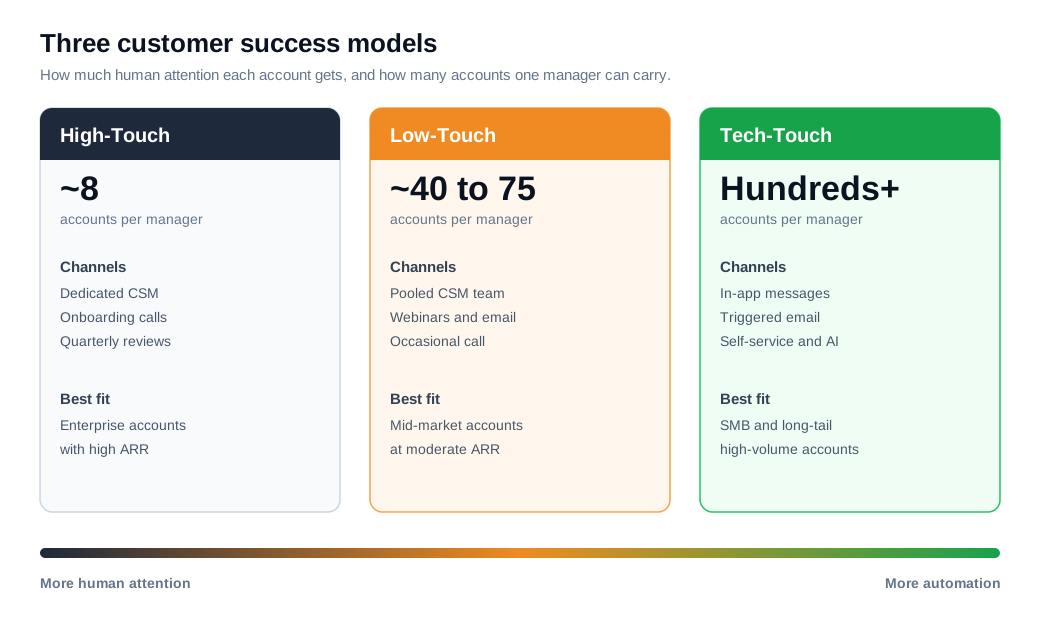
The account load makes the gap concrete. Drawing on TSIA data, EverAfter reports that CSMs are being asked to manage dramatically higher volumes, from an average of just 8 accounts in high-touch models to as many as 75 in low-touch or tech-touch programs, and pooled digital models can push the ratio far higher still. A manager carrying 8 accounts can learn each business in depth. A pooled team covering thousands cannot, so the product and the messaging have to do that work.
A worked distinction helps. An enterprise customer paying $120,000 a year sits in a high-touch book, because one saved renewal covers the manager's salary many times over. A small business paying $600 a year sits in tech-touch, because a single hour of a manager's time each month would erase the account's whole annual margin. Low-touch is the middle band, a mid-market customer who gets automated onboarding plus a shared team available for the occasional call, without a manager dedicated to them alone.
There is a hard reason to draw these lines carefully. Each model has a break-even, and putting a customer in the wrong band either wastes expensive human time or starves a valuable account of it.
How does automation deliver tech-touch customer success?
Automation delivers tech-touch by watching what each customer does in the product and firing the right message, at the right moment, through the right channel, with nobody pressing send. The engine underneath is behavioral data. Events like "signed up," "invited a teammate," or "reached day 14 with no active project" each get wired to a response, so the program reacts to the actual account rather than to a fixed schedule.
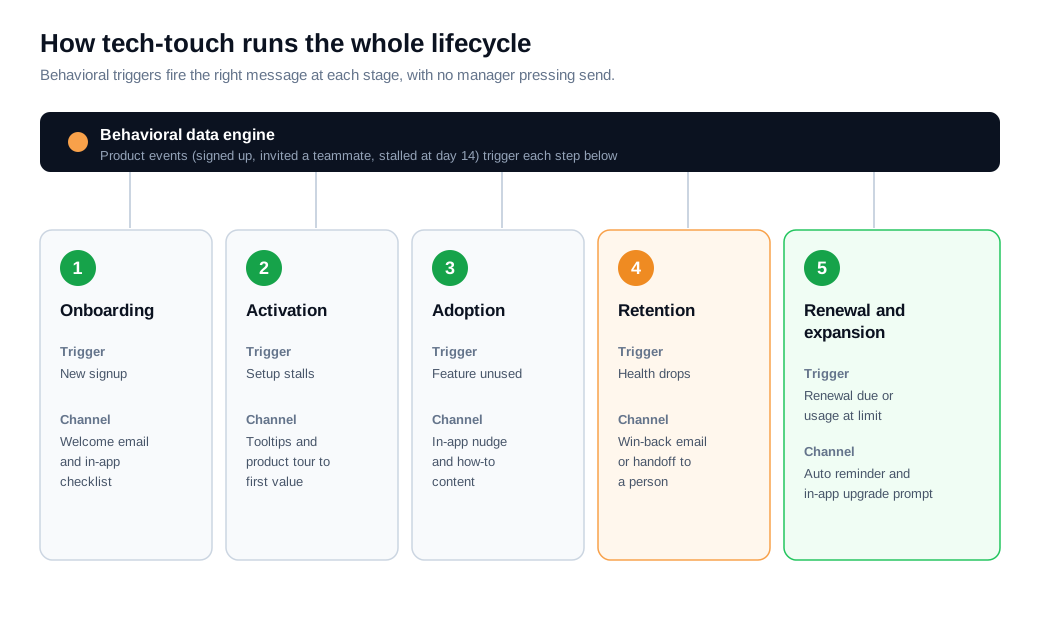
Walk the lifecycle stage by stage:
- Onboarding. A welcome email sequence and an in-app checklist guide new users through the first setup steps. Userpilot notes that in-app checklists let customers tick off tasks such as connecting data or completing a short training, which turns a blank first session into a guided one.
- Activation. Tooltips and a short product tour steer users toward the action that delivers first value, the moment they see why they signed up.
- Adoption. When a customer has never touched a feature that correlates with retention, a targeted in-app nudge or a how-to points them at it.
- Retention. A falling health score triggers a win-back email, or hands the account to a person if the risk is high enough to justify it.
- Renewal and expansion. Automated reminders handle the renewal, and in-app prompts surface an upgrade when usage bumps against a plan limit.
Self-service is the backbone underneath all of it. A searchable knowledge base and an AI chat assistant answer the common questions instantly, so the volume that would otherwise flood a support queue never becomes a ticket. Setting up that content well, covered in a knowledge base guide, is what lets a small team stand behind thousands of accounts. Layer proactive in-app nudges on top and the program starts reaching customers before they think to ask.
Here is a worked example. Take a SaaS product with 3,000 customers where onboarding completion sits at 55%, so about 1,650 accounts finish setup and 1,350 stall. The team ships three automated pieces: a four-email onboarding sequence, an in-app checklist, and a trigger that fires a reminder when an account goes quiet for three days mid-setup. Completion climbs to 72%, moving roughly 510 more accounts into an activated state. Because activated customers renew at a much higher rate than those who never finish setup, that single automation shift protects a meaningful slice of next year's revenue, and it did not require hiring one more person.
When is tech-touch customer success appropriate?
Tech-touch is the right model when revenue per account is too low to justify a dedicated human, the customer count is high, and the product is something people can succeed with largely on their own. The rough test is cost to serve against account value. If a customer pays $50 a month, a single hour of a manager's time can wipe out a full quarter of that account's margin, so the economics only work if software carries the relationship.
Most teams sort customers into touch models by annual contract value, then adjust for behavior. Appcues frames the choice as matching engagement depth to what the segment can support: strategic and enterprise accounts get high-touch, mid-market gets low-touch or a hybrid, and the SMB and long-tail base gets tech-touch. Products built around product-led growth, where users sign up and self-serve before any sales contact, lean toward tech-touch by default because the whole motion assumes people can get value without a guided hand.
Lifecycle stage matters as much as segment. Even an enterprise customer with a dedicated manager receives tech-touch communication for routine moments, a feature announcement, a security update, a usage report, because those do not need a human and land more consistently when automated. The models overlap far more than an org chart suggests.
The demand for this is climbing fast. Gainsight's 2024 Customer Success Index found that adoption of tools like online communities and self-service portals jumped from 42% to 73% year over year, with digital customer success growing about 15% annually. More teams are treating digital-led engagement as the default coverage for the bulk of their base, not a fallback.
Tech-touch is a poor fit in the opposite conditions. Complex implementations, high contract values, regulated industries, and products where a wrong setup is expensive all call for a human who can absorb nuance and take responsibility. Force those accounts into pure automation and you save on headcount while quietly raising churn where each lost account hurts most.
How do you measure tech-touch customer success?
You measure tech-touch success with product and outcome data rather than relationship notes, tracking onboarding and activation at the top, adoption and health in the middle, and retention, expansion, and sentiment at the outcome end. Because no manager is watching each account by hand, the metrics become the early-warning system, so they have to be honest and they have to trigger action.
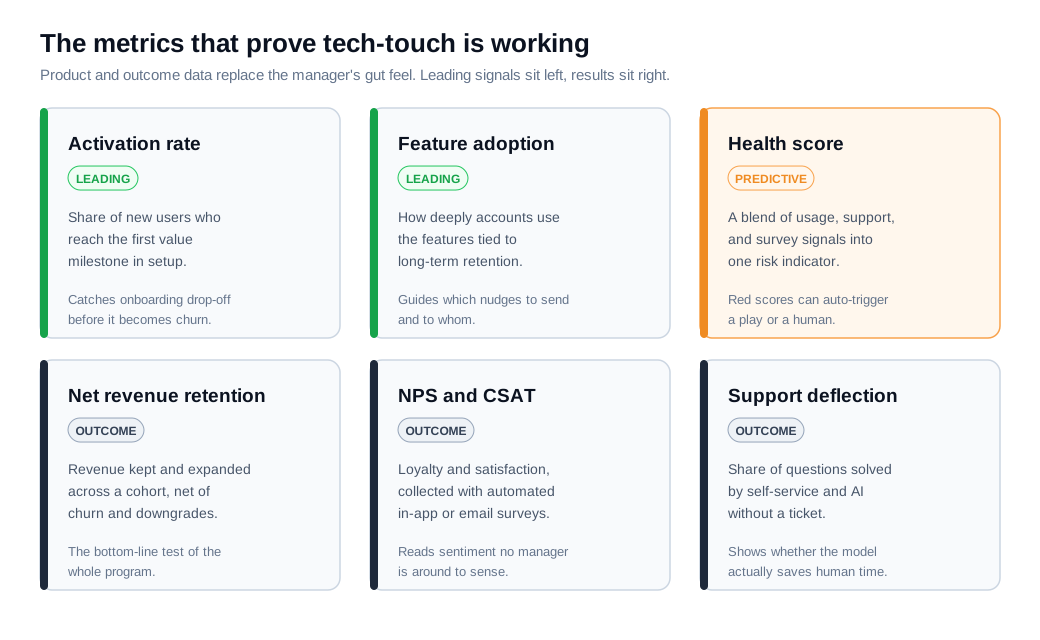
The metrics fall into three layers:
- Leading signals. Onboarding completion and activation rate show whether new customers reach first value, and feature adoption shows whether they go deeper. These move first, so they give you time to intervene.
- Predictive. A customer health score blends usage, support activity, and survey responses into a single risk indicator. Vitally builds its health score from four inputs, product setup, usage rate, NPS, and a manual pulse, which balances hard data with sentiment.
- Outcomes. Net revenue retention, gross retention, and churn tell you whether the program actually keeps and grows revenue, while NPS and CSAT track loyalty and satisfaction through automated in-app or email surveys. Support deflection, the share of questions solved by self-service, shows whether the model is saving human time or just hiding a backlog.
A worked example shows why the health score earns its place. Say a program flags 500 accounts as red on health in a given month, based on falling logins and an unresolved support ticket. An automated re-engagement play fires, a targeted email plus an in-app message offering a fast path to help. If that play recovers even 20% of the flagged accounts, that is 100 customers pulled back from the edge of churn without a manager ever opening a spreadsheet. The score did not save them on its own. The action it triggered did.
That is the discipline that separates measurement from decoration. A dashboard nobody acts on is a vanity project. The teams that get value route every red flag to a response, an automated play where one will do, and a fast handoff to a person where it will not. When a high-value account trips a serious alert, dropping it into a live conversation through live chat beats another automated email, because at that point a human is exactly what the moment needs.
What are the common mistakes with tech-touch customer success?
The most common mistake is treating tech-touch as set-and-forget, blasting generic messages on a fixed schedule instead of responding to what each customer actually does. A weekly newsletter pushed to the whole base on the same day, regardless of what any account is doing, is just a broadcast, and customers tune it out within a cycle or two.
Three other traps show up often. The first is removing every path to a human, so a frustrated customer with a real problem hits a wall of articles and bots with no way through. The second is measuring activity instead of outcomes, counting emails sent and messages shown rather than accounts activated and revenue retained. The third is skipping segmentation, applying one automated flow to a $50 account and a $5,000 account as if their needs were identical.
Each trap has the same root, mistaking automation for a reason to stop paying attention. The strongest tech-touch programs are watched closely, tuned constantly against the metrics above, and honest about when a customer has earned a human. Done that way, automation extends the team's reach without making customers feel processed.
Key takeaways
- Tech-touch serves customers through automation and self-service instead of a dedicated manager, so one team can support thousands of accounts at a cost per customer close to zero.
- The model sits on a spectrum with high-touch and low-touch, where account load runs from roughly 8 per manager at the high-touch end to hundreds or more under tech-touch, and each band has its own break-even.
- Behavioral triggers do the work, wiring product events to onboarding sequences, activation tours, adoption nudges, health alerts, and renewal prompts that fire without anyone pressing send.
- It fits low-ARR, high-volume, self-serve segments, and it is a poor choice for complex, high-value, or regulated accounts where a human can absorb nuance and own the outcome.
- Metrics are the early-warning system, so track activation, feature adoption, and health as leading signals, and retention, NPS, and support deflection as outcomes, then trigger action on every red flag.
- The failure mode is set-and-forget, since generic scheduled blasts, no human escape hatch, vanity metrics, and no segmentation are what make automation feel cold instead of helpful.

Written by
Nilas MylerCo-founder & CTO, Glimpze
Nilas is the co-founder and CTO of Glimpze, an inbound sales tool that turns high-intent website visitors into live conversations. A former SEO consultant for some of the largest companies in Denmark, he writes about speed-to-lead, inbound sales, and conversion rate optimization — the technical and operational mechanics of turning traffic into pipeline.


