On this page
- What is the ideal sales demo length?
- How long should the live product demonstration itself be?
- How does deal size affect demo length?
- How long should a recorded demo video be?
- How do you keep a sales demo tight?
- How do you handle a demo that runs over time?
- How do you know if your demo is the right length?
- Key takeaways
- Sources
Every rep has sat in a demo that should have ended fifteen minutes earlier. The buyer stopped asking questions somewhere around minute thirty, the rep kept clicking through screens, and the meeting limped to a close with no next step and a vague promise to circle back. The length was the symptom. The wrong content was the cause.
Ask how long a demo should be and most answers land on a round number like thirty minutes. The honest answer is a range with a reason behind it, because the right length depends on the deal, the audience, and how much of the talking the buyer is doing. A demo that runs long because the buyer keeps digging in is healthy. A demo that runs long because the rep will not stop presenting is a lost deal in slow motion.
This post covers the ideal length for a live demo, how short the walkthrough itself should be, how deal size moves the number, how long a recorded demo should run, how to keep a demo tight, and what to do when one runs over.
What is the ideal sales demo length?
A live sales demo should run about 30 to 45 minutes, with the product walkthrough taking a small share of that time and the rest going to conversation. That window fits how attention works and leaves room for the discovery and next-step talk that actually move a deal.
Gong's analysis of more than 67,000 recorded SaaS demos found that successful demos ran longer than unsuccessful ones, about 47 minutes against 36, roughly 30 percent more time. Read that carefully before you pad your calls: the extra minutes were an effect of a resonant demo, not a target to chase. A tight, relevant demo prompts the buyer to ask more questions and think out loud, and that back-and-forth is what stretches the clock. Gong's own read of the demo data is that you should never lengthen a call for its own sake.
So default to booking a 30-minute slot and let it run long only when the buyer drives it there. Gong studied 30,000 first calls and found no meaningful link between meeting length and the odds of earning a second one. A shorter default does help with attendance, though: Gong found buyers were 12 percent more likely to show up to a 30-minute invite than a 60-minute one. A smaller ask on the calendar gets more people in the room.
How long should the live product demonstration itself be?
Keep the actual product demonstration, the stretch where you are sharing your screen and talking, to about nine minutes at a time before you hand the conversation back. The clock on the meeting matters less than the clock on your own uninterrupted talking.
Gong looked at 121,828 web-based sales meetings and found that deals which closed used 9.1-minute presentations on average, while deals that were lost ran 11.4 minutes. Two and a half minutes of extra monologue tracked with a worse outcome. The pattern shows up inside the demo too. In Gong's demo study, successful reps never pitched for more than 76 seconds without a break, and top performers spent 39 percent less time talking about features than average reps did.
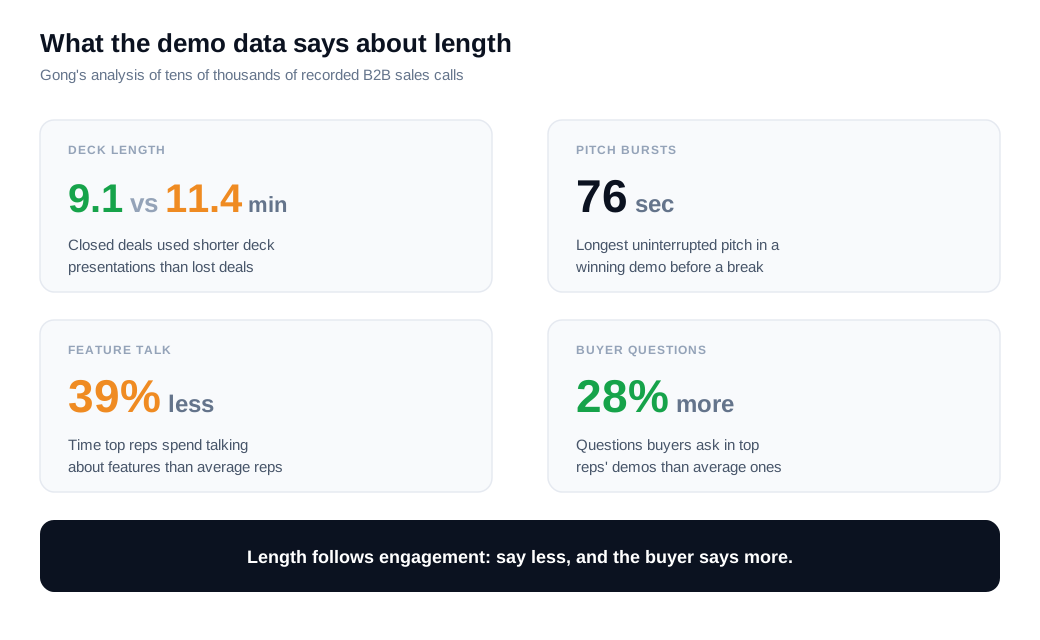
The payoff of saying less is that the buyer says more. When top reps trimmed the feature talk, their buyers asked 28 percent more questions than buyers in average reps' demos. Those questions are the signal you want, because a buyer who is asking is picturing the product in their own workflow.
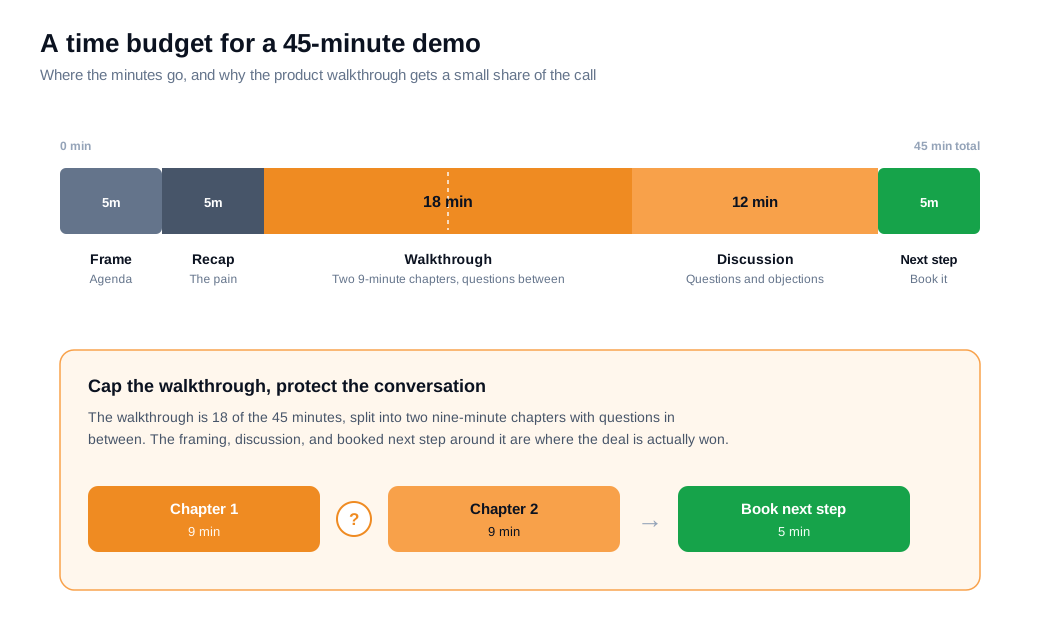
Treat nine minutes as a ceiling on any single chapter, not a budget for the whole call. Show one capability that solves a problem the buyer named, stop, and ask whether it fits how their team works today. Then move to the next one. A 45-minute demo built from short segments feels shorter than a 25-minute monologue, because the buyer never waits for a turn to speak.
How does deal size affect demo length?
The bigger and more complex the deal, the more total demo time it needs, but that time spreads across several sessions rather than one marathon call. A small, single-buyer deal can close on one short demo. A large deal earns more minutes because more people have to say yes.
At the small end, an SMB buyer often makes the call alone or with one colleague, and a single 20 to 30 minute demo can be enough to move to a trial or a signature. At the enterprise end, the buying group is the reason the math changes. Gartner's research on complex B2B purchases found that six to ten decision-makers are typically involved, each arriving with their own research. You run several tailored sessions for that group instead: an overview for the champion, a technical deep dive for the evaluators, a security review, and a short executive readout. Enterprise sales carry longer cycles and more stakeholders than SMB deals, so the demo footprint grows to match.
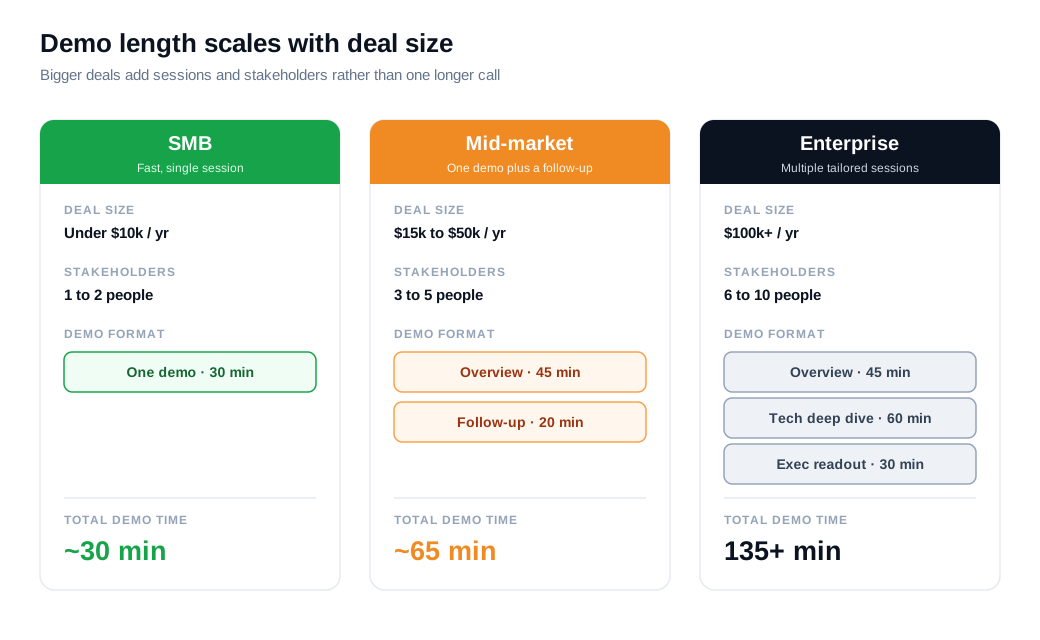
Take two deals side by side. A marketing agency evaluating a $60-per-month tool sends one person to a single 30-minute demo and signs within the week. An enterprise buyer weighing a $150,000 platform brings a champion, a technical evaluator, a security lead, and a VP across three separate sessions: a 45-minute overview, a 60-minute technical deep dive, and a 30-minute executive readout. Same product, very different total demo time, because more people have to agree.
The mistake at the enterprise end is trying to serve every stakeholder in one long session. A 90-minute demo built to cover everyone covers no one well, and attention has usually collapsed before the security questions arrive. Split the audience and the agenda so each session stays inside the healthy 30 to 60 minute window.
How long should a recorded demo video be?
A recorded or self-serve demo video should run about 2 to 3 minutes, far shorter than a live demo, because a viewer sitting alone at a screen drops off fast. The rule that a live demo can breathe does not carry over, since there is no rep in the room to read the pause and keep the buyer engaged.
The completion data is blunt. Demo videos under two minutes hold about an 88 percent completion rate, and once a video passes three minutes completion falls to roughly 50 percent. The best homepage demos land between 60 and 90 seconds. Match length to placement: 60 to 90 seconds on a homepage or pricing page, and up to 5 minutes for a deeper walkthrough a researcher chose to watch.
Interactive, self-guided demos change the calculus a little, because the buyer sets their own pace and can skip to what matters. Even then, keep any single guided path short and let the viewer branch. A recorded demo does the reach a live call never could, so its job is to earn the next click: a trial, a form, or a live conversation with a rep.
How do you keep a sales demo tight?
Keep a demo tight by agreeing an agenda up front, leading with the buyer's biggest problem, and breaking the walkthrough into short segments with a question after each. Tightness comes from sequence and pacing, and it starts before the screen share does.
Set the agenda at the top of the call and ask two things: whether there is anything to add, and whether there is a hard stop. Calendly's demo guidance frames the agenda as a scaffold you build the call around, and confirming a hard stop early protects the ending. Once the buyer edits and agrees the plan, they help you hold the line when a tangent appears.
A simple pacing check keeps you honest: when you are halfway through your time, you should be halfway through your content. If you are past the midpoint and still on the first capability, cut straight to the highest-priority screen and the close.
The deeper lever is talk-time. Gong found that successful demos had 21 percent more speaker switches per minute than losing ones, and the back-and-forth climbed in the second half as buyers asked and reps answered. A demo where the rep talks in short bursts and the buyer keeps interrupting is a tight demo even at 45 minutes. A live format helps here, because a rep running a two-way session over live video and screen share can drop a segment the moment the buyer signals they have seen enough. For teams turning site traffic into pipeline, starting that conversation the instant a high-intent visitor lands is the heart of an inbound sales motion, and a demo that begins from real interest tends to stay tight on its own.
How do you handle a demo that runs over time?
When a demo is about to run over, name the time out loud, give the buyer the choice to continue or reconvene, and park anything off the critical path for later. Silence is the wrong move: blowing past a hard stop without acknowledging it reads as ignoring the buyer's calendar.
The script is short. At about five minutes before the agreed end, say: "We are coming up on time. I still want to cover the next step, so we can wrap now and I will send a recap, or if you have a few extra minutes I can show the reporting view you asked about." That hands control back to the buyer and protects the one part of the call you cannot skip: the committed next step.
For the questions that keep pulling you off track, use a parking lot. When someone asks about a feature outside their core use case, note it visibly and offer to cover it at the end if time allows or in a follow-up, then return to the agenda. The parking lot acknowledges the question without letting it hijack the next fifteen minutes, and it gives you a ready-made reason for a second conversation.
If the overrun is a pattern rather than a one-off, the fix is earlier in the call. A demo that consistently runs long is usually front-loaded with too many features and too little discovery, so the buyer's real questions surface late. Cut a capability from the default agenda before you add minutes to the meeting.
How do you know if your demo is the right length?
You know your demo is the right length when the buyer is doing a healthy share of the talking and the call ends with a booked next step, whatever the clock says. Those two signals beat any target duration, because they measure whether the time was well spent.
Budget a 45-minute demo like this. Five minutes to frame and confirm the agenda, five to recap the problem you heard, eighteen for the walkthrough split into two nine-minute segments with questions between, twelve for open discussion and objections, and five to book a dated next step. If the walkthrough is eating the discussion time, the demo is too long where it costs you the deal and too short where the buyer decides.
The benchmark to judge outcomes against is demo-to-close. Optifai's analysis of 939 companies put the average demo-to-close rate at 25 percent, with SaaS near 30 percent and interactive demos at 38 percent. A demo that ran the perfect length but produced no next step did not work, whatever the timer said. Watch your trend on demo-to-close and on the share of demos that end with a scheduled next step, since a demo with no next step almost never becomes a deal.
Then record your calls and review a few. How long did you talk before the buyer spoke? Did the walkthrough stay under nine minutes a chapter, or run twenty in a single breath? Did the meeting end on a date or a "we'll be in touch"? The answers tell you which minutes to cut and which to protect, and they matter more than whether the call ran 32 minutes or 44.
Key takeaways
- Aim for 30 to 45 minutes, and default to booking 30. Gong found no link between raw length and winning, and buyers were 12 percent more likely to show up to a 30-minute invite than a 60-minute one.
- Keep the product walkthrough short. Closed deals in Gong's data averaged 9.1-minute presentations against 11.4 for lost deals, and successful reps never pitched more than 76 seconds without a break.
- Let deal size stretch the total, not the single call. SMB deals can close on one 20 to 30 minute demo, while enterprise deals spread across several sessions because six to ten stakeholders each need their own.
- Cut recorded demos to 2 to 3 minutes. Videos under two minutes hold an 88 percent completion rate, and completion falls to about 50 percent once a video passes three minutes.
- Tightness comes from sequence and talk-time. Agree an agenda, lead with the biggest problem, keep segments short, and let the buyer carry a real share of the talking.
- Judge the length by the ending. A demo is the right length when the buyer is engaged and the call closes on a dated next step, not when the timer hits a round number.
TAGS

Written by
Daniel SemeckyCo-founder & CEO
Daniel is the co-founder and CEO of Glimpze. He spends his days talking to revenue teams about how to catch high-intent visitors before they bounce, and writes about inbound sales, lead conversion, and building a motion where marketing and sales actually share a number.