On this page
- What does it mean for an inbound lead to be "not ready to buy"?
- Why nurture inbound leads who aren't ready to buy?
- How do you identify not-ready-to-buy leads?
- What nurture sequences keep them engaged?
- How do you time re-engagement?
- How do you know when to route them back to sales?
- What does a 90-day nurture look like in practice?
- What are the most common lead nurturing mistakes?
- Key takeaways
- Sources
Most people who raise a hand on your website will not buy this month. They download a guide, watch a demo video, or open a chat with one real question, then go quiet.
Marketo's research puts a number on it: roughly 96% of the visitors who land on a site are not ready to buy today.
Going quiet is not the same as being a bad lead. Around half of the leads sitting in a typical funnel are a solid fit who simply need more time, and the companies that keep showing up for them close more deals, and larger ones, than the teams that forget them a week later.
The discipline of staying useful to a lead until they are ready has a name, and it is lead nurturing.
This guide covers what "not ready to buy" actually means, why nurturing pays off, how to spot these leads, the sequences that keep them engaged, when to re-engage a quiet one, and how to tell when a lead has warmed up enough to hand back to sales, with a 90-day worked example and the mistakes that quietly waste pipeline.
What does it mean for an inbound lead to be "not ready to buy"?
A not-ready-to-buy lead is someone who matches your ideal customer profile and has shown real interest, but has no active project, budget, or timeline to make a purchase right now. The fit is there. The moment is not.
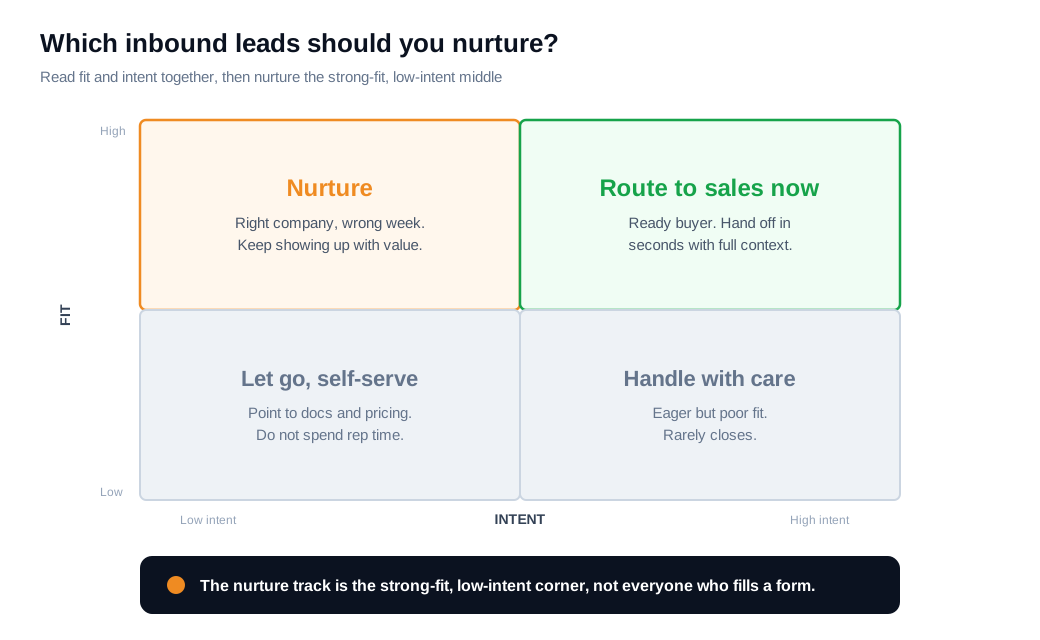
Every lead sits somewhere on two axes:
- Fit is who they are: company size, industry, role, and region measured against the profile of your best customers.
- Intent is what they are doing: the pages they read, the content they open, the questions they ask.
A not-ready lead scores high on fit and low or early on intent, and they belong to a large group. Marketing research popularized by Marketo has long held that about half of the leads in a given system are qualified but not yet ready to buy, which is why a form fill or a content download rarely means "call me today."
Keep this group separate from two others. A poor-fit lead, someone outside your market or far too small, should be disqualified rather than nurtured, because time spent on them returns nothing. A ready lead, strong fit and high intent, should go straight to a rep.
The nurture track is for the middle: right company, wrong week.
Why nurture inbound leads who aren't ready to buy?
Nurture them because most of your future pipeline is sitting in the not-ready pile, and staying in touch with it is cheaper and more effective than buying fresh leads to replace it. The numbers behind that claim are consistent and have held for years.
Forrester's research, cited across marketing benchmarks, found that companies which excel at lead nurturing generate 50% more sales-ready leads at a 33% lower cost per lead. The Annuitas Group reported that nurtured leads make 47% larger purchases than leads that were never nurtured.
Put those together and nurturing does two jobs at once: it produces more qualified opportunities and it grows the size of the deals that result.
The buyer's own behavior explains why patience wins. Gartner's study of the B2B buying journey found that buyers spend only about 17% of their total purchasing time meeting with any potential supplier, split across a buying group of six to ten people.
If you get a sliver of that attention today and then vanish, you are absent for the rest of the journey, which is where the decision actually forms. Nurturing keeps you present, in a low-key way, across the weeks or months a real evaluation takes.
Treating your site as an inbound sales channel rather than a lead-collection form is the mindset that makes this pay off.
How do you identify not-ready-to-buy leads?
You identify a not-ready lead by reading fit and intent together: strong fit paired with low or early-stage intent is the signature of someone worth nurturing rather than routing or dropping. Either axis on its own will mislead you.
The intent tells are consistent:
- They consumed top-of-funnel content, a broad guide or a blog post or a webinar registration, rather than anything close to a decision.
- Their questions are general ("how does this work?") instead of specific ("does this support SSO for 200 seats?").
- They describe a project that starts "sometime next year," mention they are "just researching," or have no budget owner involved yet.
- A single low-effort action, one download or one newsletter signup, is easy to trigger by accident and should read as early interest rather than a buying signal.
The fit tells decide whether the lead is worth the effort at all. A business email domain, a company size and role that match your best customers, and a region you serve mean the intent is worth waiting for.
When fit is weak, do not nurture on hope. Route by fit first, then let intent decide timing.
You can also just ask. A short question in a live conversation ("are you evaluating for now, or planning ahead?") sorts a ready buyer from an early researcher in one line, which is why a light touch of live chat on your high-intent pages beats guessing from clicks.
The answer tells you which track the lead belongs on before you have spent a single nurture email.
What nurture sequences keep them engaged?
The sequences that keep not-ready leads engaged deliver genuinely useful content on a spaced, behavior-aware cadence that moves from education to proof to product, without pushing for a sale before the lead is ready. Structure matters more than volume.
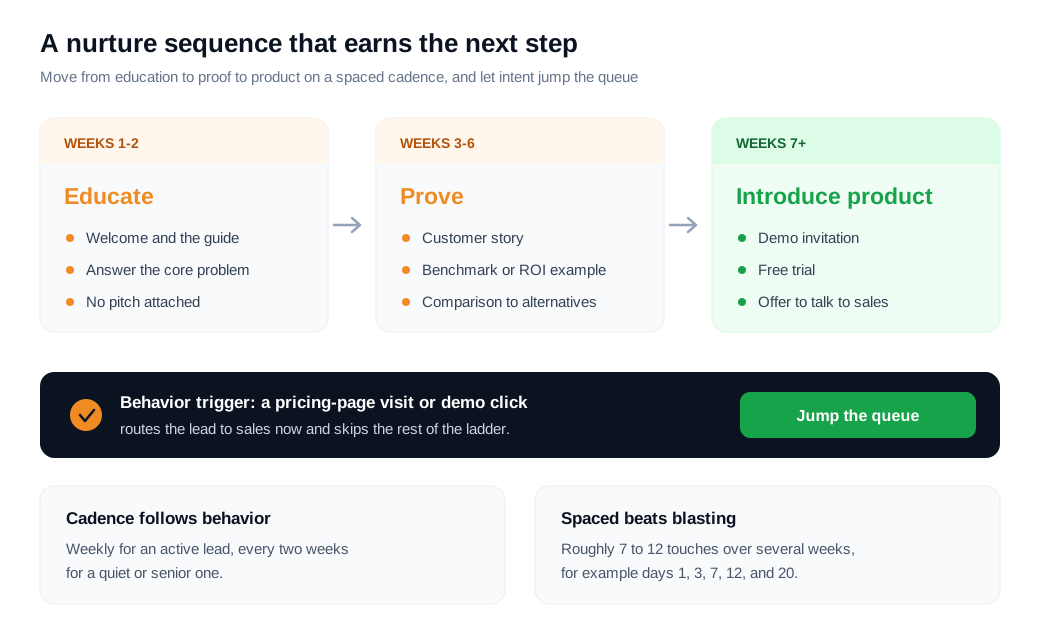
Think of the content as a ladder with three rungs:
- Educate. A welcome, a practical guide, an answer to the problem that brought them in, with no pitch attached.
- Prove. A case study, a benchmark, an ROI example, a comparison that shows how teams like theirs get results.
- Introduce the product. A demo invitation, a free trial, an offer to talk.
Each rung earns the right to the next.
Cadence should follow behavior instead of a fixed calendar. Practitioner benchmarks put a typical B2B nurture at seven to twelve emails over several weeks, with spaced sends (for example days 1, 3, 7, 12, and 20) that outperform daily blasts and protect your sender reputation.
Weekly is a reasonable default for an actively engaging lead; for senior buyers or quiet ones, stretch to every two weeks.
The rule that matters most is that high-intent behavior jumps the queue: a lead who visits your pricing page mid-sequence should get the demo invite now, not three more weeks of education. Behavior-triggered nurtures reliably out-click time-based drips because the message lands when the lead is already paying attention.
Vary the channel too. Email carries the weight, but a well-timed proactive outreach nudge on the site, a retargeting touch, or a short personal note keeps you from betting the whole relationship on one inbox that may never get checked.
How do you time re-engagement?
Time re-engagement to the lead's own buying rhythm, roughly twice the length of your average sales cycle in silence, and let any renewed behavior override the calendar.
A lead that normally takes 30 days to buy is worth a nudge after about 60 days of quiet; a six-month enterprise cycle can wait 90 to 180 days before the relationship counts as dormant.
Segment dormant leads by how long they have been quiet, because the odds fall fast. Reactivation guides report that leads inactive for around 90 days come back at roughly 10% to 12%, while those left for 180 days reactivate at only 2% to 4%.
Earlier is better, so a light re-engagement touch at the 30-to-60-day mark saves far more relationships than a heroic win-back attempt six months later.
The strongest re-engagement trigger is behavioral. When a quiet lead opens a re-engagement email, clicks a link, or returns to the site, that action should graduate them back into an active sequence automatically, with no one waiting to notice.
A clean re-engagement message stays short and honest: acknowledge the gap, offer one useful thing (a new benchmark, a relevant feature, a short call), and give an easy way to say "not now" so you can move the truly cold ones to a lighter, quarterly rhythm instead of burning the list.
How do you know when to route them back to sales?
Route a nurtured lead back to sales when its behavior crosses a scoring threshold you have agreed on with the sales team, or when it takes a single high-intent action like requesting a demo or returning to your pricing page. The handoff should follow a rule you can defend, not a hunch.
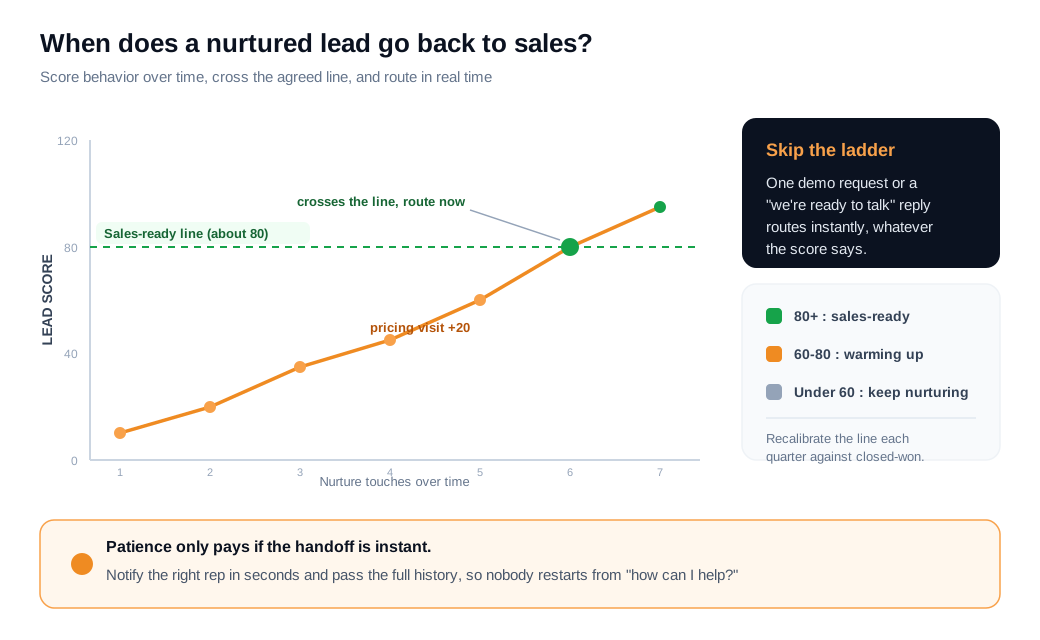
Lead scoring makes the rule concrete. You assign points for fit (title, company size, industry) and for behavior (pricing views, repeat visits, content depth, email clicks), then draw a line.
Growth teams commonly treat 60 to 80 points as approaching sales-ready and 100-plus as an automatic handoff, and the healthy habit is to recalibrate those numbers against closed-won data every quarter so the threshold keeps reflecting who actually buys. A score that never gets checked against outcomes drifts into fiction.
Some actions should skip the ladder entirely. A demo request, a pricing-page return after weeks away, or a reply that says "we're ready to talk" is worth an instant handoff regardless of score, because that lead just told you the moment arrived. The value of all the nurturing is that you were still there when they did.
Speed on that handoff decides whether the nurture paid off. A lead who re-enters the market and waits a day for a reply is a lead a faster competitor can take.
Route the warm lead to the right rep in seconds, pass the full history so nobody starts from "how can I help?", and where the question is easier to talk through than to type, drop into a call.
A ping to the rep the instant a nurtured lead crosses the line is the job of your lead routing and notifications setup, and the difference between a real service-level agreement and an aspirational one.
What does a 90-day nurture look like in practice?
Here is how one not-ready lead moves through 90 days, and what a batch of them returns. The point is to show the mechanics with concrete numbers rather than a vague promise.
Dana, an operations manager at a 120-person logistics company, downloads a "reducing response time" guide and starts a chat asking how the product works in general terms. Strong fit, early intent, no timeline. She goes onto the nurture track.
- Week 1: a welcome and the guide she wanted, no pitch.
- Weeks 2 to 4: a customer story from a similar logistics team and a short benchmark on speed-to-lead.
- Weeks 5 to 6: a comparison piece and an ROI example.
- Day 38: Dana clicks back to the pricing page and reads it twice.
That behavior adds enough points to cross the sales-ready line, a rep is notified within seconds, and Dana is in a screen-share demo the same afternoon. Ninety days from a quiet download to a live sales conversation, with no cold call in between.
Now the batch math. Say 200 not-ready leads enter nurture in a quarter. If a well-run sequence re-engages 30% of them (60 leads) and 15% of the original 200 (30 leads) eventually cross the threshold into sales, and sales closes 20% of those at an $8,000 average deal, that is six deals worth $48,000 from leads most teams would have written off after the first week of silence.
The sequence ran on automation the whole time, so the cost was mostly the content you built once.
What are the most common lead nurturing mistakes?
The most common mistakes are treating every lead the same, sending content on a fixed calendar regardless of behavior, nurturing bad-fit leads forever, and handing warm leads back to sales too slowly. Each one is easy to fix once you name it.
- One sequence for everyone wastes the segments. A demo-requester and a single-blog-reader need different messages at different speeds, so split your nurtures by intent tier and by fit before you write a word.
- Calendar-only sending ignores the strongest signal you have. If a lead visits your pricing page, the next email should respond to that, not fire off step four of a pre-planned drip that assumes nothing changed.
- Nurturing poor-fit leads forever is a slow leak. A contact who will never match your profile does not improve with more emails, so disqualify early and free the list for real prospects.
- A slow handoff is the costliest. All the patience in a 90-day nurture is wasted if the lead raises a hand and then waits a day for a human.
The whole purpose of nurturing is to be ready to move the instant the lead is.
Key takeaways
- Most inbound leads are not ready to buy yet: roughly 96% of visitors are not ready today and about half of qualified leads need more time, so nurturing is where most future pipeline lives.
- Nurturing pays twice: companies that do it well generate 50% more sales-ready leads at 33% lower cost, and nurtured leads make around 47% larger purchases.
- Identify by fit and intent together: strong fit with early intent is the nurture signature, poor fit gets disqualified, and high intent gets routed now.
- Build a spaced, behavior-aware sequence: move from education to proof to product across seven to twelve touches, and let a pricing visit jump the lead straight to a demo.
- Re-engage on the lead's rhythm: nudge at roughly twice your sales cycle of silence, act earlier while reactivation odds are still 10% to 12%, and let renewed behavior reset the clock.
- Route back the instant they warm up: cross an agreed score or take one high-intent action, then hand off in seconds with full context so a faster competitor cannot take the lead.
TAGS

Written by
Daniel SemeckyCo-founder & CEO
Daniel is the co-founder and CEO of Glimpze. He spends his days talking to revenue teams about how to catch high-intent visitors before they bounce, and writes about inbound sales, lead conversion, and building a motion where marketing and sales actually share a number.