
On this page
- Why does most website traffic never convert?
- What does it take to book a meeting while intent is still high?
- How does instant scheduling increase bookings?
- How does live chat drive meeting bookings?
- How do you turn a form into a booked meeting instead of a dead end?
- How do you measure meetings booked per visit?
- What does booking more meetings from the same traffic look like?
- Key takeaways
- Sources
A marketing team spends months and a real budget getting 10,000 people to the website this month. Most of them read a page or two and leave. A tiny slice ever speak to sales, and fewer still end up on a calendar. The traffic showed up. The meetings did not.
The gap between a visit and a booked meeting is where most inbound revenue quietly drains away. Closing it rarely takes more traffic. It takes making the path from an interested visitor to a time on a rep's calendar short enough that people finish it while they still care about the answer.
This guide covers why so much traffic stalls, what it takes to book a meeting while intent is still high, how instant scheduling and live chat convert that intent, how to stop losing people at the form, and how to measure meetings booked per visit so you can find the leak and fix it.
Why does most website traffic never convert?
Most website traffic never converts because the average B2B site turns only 2 to 3 percent of visitors into a lead of any kind, which leaves the other 97 percent to leave without a trace. Published benchmark reports put the typical B2B conversion rate near 2 to 3 percent, with wide variation by industry, and a booked meeting sits one or two steps below that, so the share of visits that turn into a real sales conversation is smaller still.
Three things drive the drop-off. Most visitors stay anonymous and never identify themselves. Many are outside your ideal customer profile and were never going to buy. And the good-fit ones who remain often hit a high-friction form, get a "we will be in touch" page, and go cold before anyone follows up.
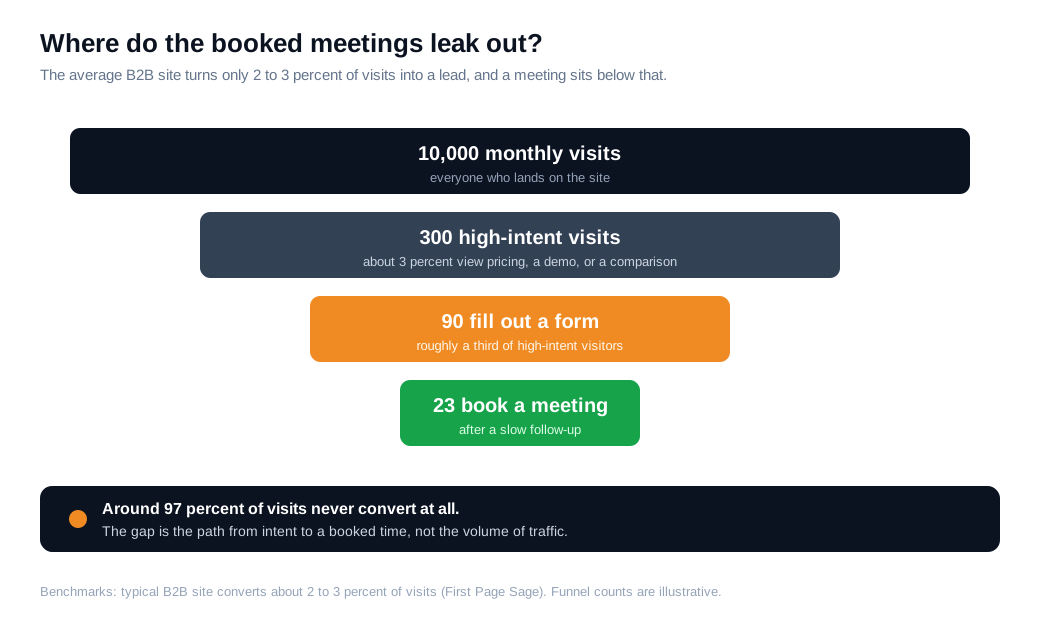
The buying behavior underneath makes the timing worse. Gartner's research on the B2B buying journey found that buyers spend only 17 percent of their total purchase time meeting with any potential supplier, spread across a buying group of six to ten people. Two-thirds of B2B buyers now say they prefer a rep-free experience for parts of the journey, so the site has to carry the buyer right up to the moment they choose to talk, then make that moment effortless. If a good-fit buyer lands on your pricing page ready to talk and your only offer is a form that files them for tomorrow, you have handed the window to whichever competitor answers first. Treating the site as an inbound sales channel, rather than a brochure that collects addresses, is the shift that starts closing the gap.
What does it take to book a meeting while intent is still high?
Booking a meeting while intent is high takes reaching the visitor in minutes rather than hours, because inbound interest decays fast and the first team to respond usually wins the conversation. The research on response time has held the same shape for more than a decade.
Dr. James Oldroyd's Lead Response Management study found that contacting a new lead within five minutes instead of thirty makes you about 21 times more likely to qualify it and 100 times more likely to reach a person at all. Harvard Business Review's audit of 1.25 million leads across 2,241 companies found the same pattern from the other side: firms that answered within an hour were nearly seven times more likely to have a qualifying conversation, yet the average first response took 42 hours and 23 percent of companies never replied at all.
Almost nobody clears the bar. Recent speed-to-lead benchmarks find that only about 7 percent of B2B companies respond within five minutes, while typical response times still run 42 to 47 hours. That gap is the opening. Being the one team that answers a raised hand while it is still up is mostly a question of routing the right rep to the right visitor in seconds, so a routing and notifications setup that pings the correct person the moment a high-intent visitor appears is what turns a five-minute goal into a real one.
How does instant scheduling increase bookings?
Instant scheduling increases bookings by letting a qualified visitor pick a time and walk away with a confirmed meeting in the same session, instead of trading emails to find a slot after the moment has passed. Every step you remove between "I am interested" and "it is on the calendar" is a step where a busy buyer can drop out.
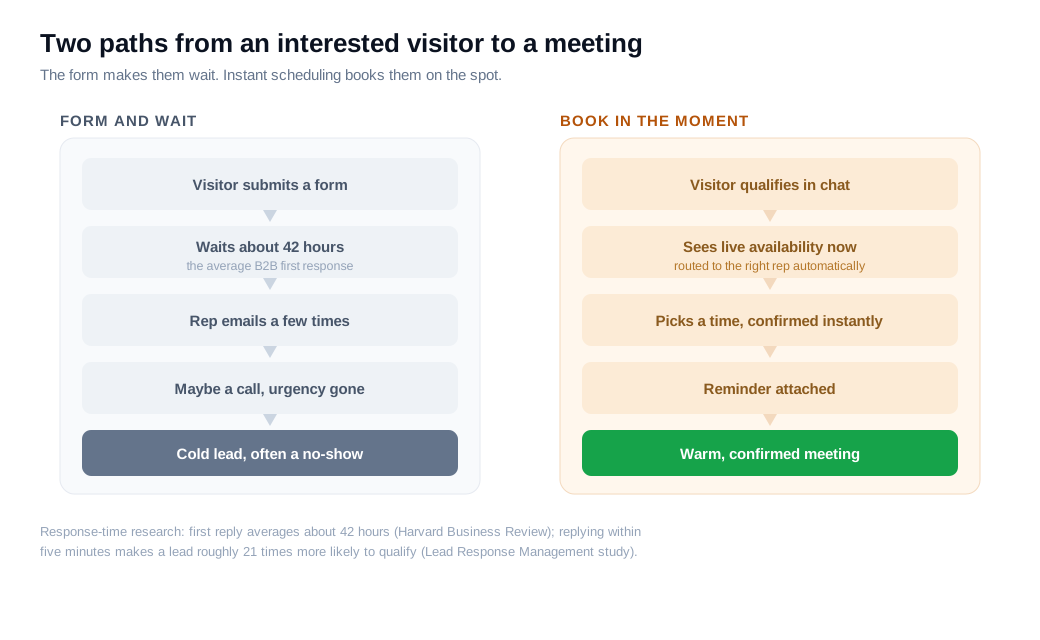
The old path has too many gaps. A visitor fills out a form, waits for a rep to notice, gets an email offering a few times, replies, waits again, and maybe lands on a call three days later with the urgency gone. Instant scheduling collapses that into one action. The visitor qualifies, sees live availability, and books, often routed by round-robin rules to the right rep by territory or team so no one has to reassign it by hand. Scheduling vendors report that moving qualified visitors straight into a live calendar can lift inbound demo bookings by roughly 20 to 30 percent, and the mechanism is simple: fewer steps, less waiting, less chance to reconsider.
Instant booking also protects the meetings you win. A time the visitor chose themselves, confirmed on the spot with an automatic reminder attached, shows up more reliably than a slot negotiated over two days of email. Calendly's own guidance on cutting no-shows points to the same levers, immediate confirmation and automated reminders, as the most reliable ways to keep booked meetings on the calendar.
How does live chat drive meeting bookings?
Live chat drives meeting bookings by opening a real conversation on high-intent pages, qualifying the visitor in the moment, and handing a hot buyer straight to a rep or a calendar before they leave the tab. It works because it removes the wait entirely, since the answer, the qualification, and the booking all happen in one thread.
The conversion difference is large. Chat-to-conversion rates commonly land in the 10 to 20 percent range, several times the 2 to 3 percent typical of static forms, because a chat meets a question with an answer rather than a submit button. When Salesloft moved its inbound chat to a tool with no pre-chat form, 40 percent of its demos ended up booked through chat, an eightfold jump over the previous setup, driven mostly by letting leads start talking the instant they had a question.
A tool like live chat on your pricing and comparison pages turns a lingering visitor into a live exchange, and the strongest version does not stop at text. When a question is easier to show than to type, escalating the same conversation to a live video call or screen share lets a rep demo the answer and book the follow-up without the buyer ever filling anything out. Off hours, an AI assistant can field the first questions, qualify, and offer a time, so the conversation still ends in a booking instead of a bounce.
How do you turn a form into a booked meeting instead of a dead end?
You turn a form into a booked meeting by trimming it to the few fields that actually route the lead and sending a qualified submission straight to a live scheduler, so the confirmation page becomes a calendar rather than a promise to email. Most forms leak for a boring reason. They ask for too much and deliver too little.
Field count is the lever with the most evidence behind it. Form research shows completion falling with each extra field, and cutting a form from four fields to three can lift completions by close to 50 percent. For a demo request, five or six fields is defensible if each one improves routing or lead quality, but a phone number you do not need and three questions sales will re-ask anyway are pure drop-off.
The bigger change is what happens after submit. Most platforms let you redirect a completed form straight to a meeting scheduling page, so a qualified visitor picks a time immediately instead of waiting for outreach. Keep the form short, qualify with one or two fields, and route the good-fit submissions into an on-the-spot booking. That dead-end "thank you" page is where a large share of your hardest-won leads go quiet.
How do you measure meetings booked per visit?
You measure meetings booked per visit by dividing the number of meetings booked by the number of qualifying visits over the same period, then segmenting that rate by page, traffic source, and response time to see what moves it. The base calculation is the standard conversion-rate formula applied to meetings as the goal: meetings booked divided by visits, times 100.
One number is not enough on its own. Track it alongside three others. Visit-to-meeting rate tells you how much of your traffic reaches a calendar. Time-to-first-response tells you whether speed is helping or hurting that rate. Meeting show rate tells you how many booked meetings actually happen, which is where instant confirmation and reminders earn their keep. And meetings by source and page tells you which parts of the site produce real conversations rather than raw sessions.
Segment before you judge the number. A 0.3 percent visit-to-meeting rate across all traffic can hide a 3 percent rate on your pricing page and near zero on your blog, and the fix for each is different. Once you can see which pages, sources, and response times produce booked meetings, you can put chat, scheduling, and reps where the intent already is, instead of spreading them evenly across traffic that will never convert.
What does booking more meetings from the same traffic look like?
Here is the same 10,000 monthly visits run two ways, once through a form-and-wait funnel and once through a book-in-the-moment funnel, with no change to the traffic itself. The numbers are illustrative, but the ratios track what the response-time research predicts.
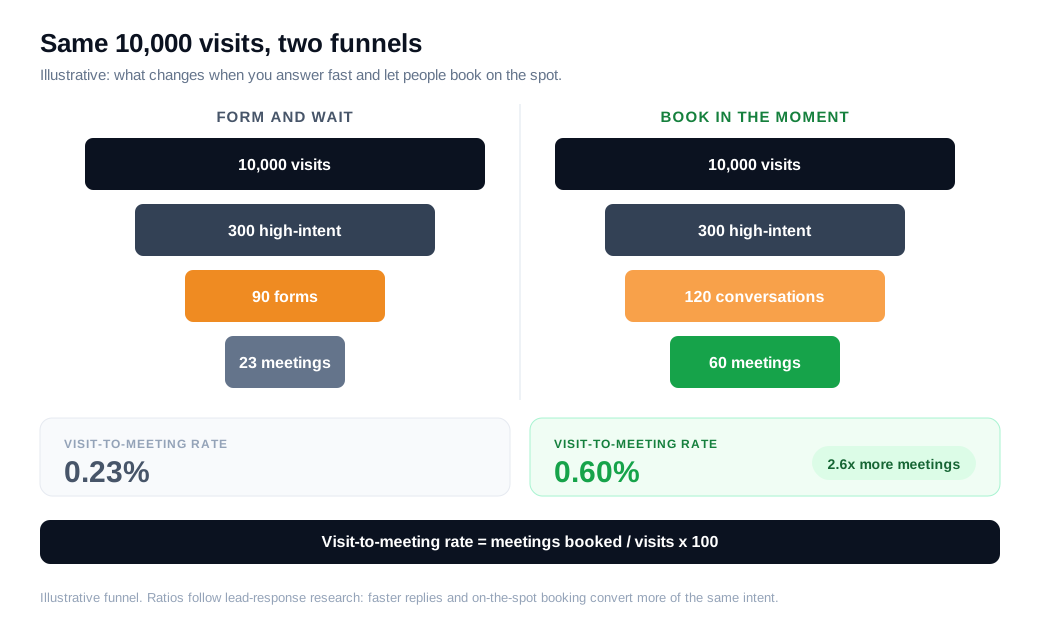
Start with the form-and-wait version. Of 10,000 visits, about 3 percent show real buying intent by viewing pricing, opening a demo page, or checking a comparison, which is 300 people. Around 30 percent of those fill out a form, so 90 leads. Because first response averages a day or more, many go cold, and roughly a quarter of the forms turn into an actual meeting. That is about 23 meetings booked, a visit-to-meeting rate of 0.23 percent.
Now run the same 300 high-intent visitors through a book-in-the-moment funnel. Chat and instant scheduling on the high-intent pages pull more of them into a conversation, say 40 percent, or 120 people. Because the answer and the calendar are right there, roughly half of those book a time before they leave. That is about 60 meetings, a visit-to-meeting rate of 0.6 percent.
Same traffic, same product, more than double the meetings, because the second funnel answered fast and let people book on the spot. The lever was never the size of the audience. It was the length of the path between a raised hand and a confirmed time.
Key takeaways
- Most traffic leaves before it books: the average B2B site converts only 2 to 3 percent of visitors, so the shortfall lives in the path to a meeting rather than the size of the audience.
- Speed decides who books: reaching a live buyer within five minutes makes you around 21 times more likely to qualify them, yet only about 7 percent of companies respond that fast.
- Instant scheduling removes the gaps: letting a qualified visitor book a confirmed time in the same session can lift demo bookings by 20 to 30 percent and protects them with instant confirmation and reminders.
- Live chat converts intent in the moment: chat-to-conversion runs several times higher than static forms, and one team booked 40 percent of its demos through chat after removing its pre-chat form.
- Fix the form or skip it: trim fields to what routes the lead, and redirect qualified submissions straight to a scheduler instead of a "we will be in touch" page.
- Measure meetings per visit, then segment: track visit-to-meeting rate with response time and show rate, broken down by page and source, and put your effort where the intent already is.
TAGS

Written by
Daniel SemeckyCo-founder & CEO
Daniel is the co-founder and CEO of Glimpze. He spends his days talking to revenue teams about how to catch high-intent visitors before they bounce, and writes about inbound sales, lead conversion, and building a motion where marketing and sales actually share a number.


