
On this page
- What is a SaaS retention strategy?
- Why does retention matter more than acquisition for SaaS?
- What levers drive SaaS retention?
- How do you prioritize retention initiatives?
- How do you measure retention results?
- What is a good retention rate for SaaS?
- What are the most common retention strategy mistakes?
- Key takeaways
- Sources
A SaaS team can run its best acquisition quarter on record, land a wall of new logos, and still watch annual recurring revenue sit flat. The reason rarely shows up in the marketing dashboard. It shows up in the back of the funnel, where last year's customers quietly stop paying at roughly the same rate new ones sign up.
Acquisition gets the budget because it is visible and satisfying. Retention is stealthy, and its effect on growth takes months or years to surface, which is exactly why it gets deprioritized until the leak is too big to ignore. A retention strategy is the plan that keeps the customers you already paid to win, and it is the difference between growth that compounds and growth that runs to stand still.
This post covers what a SaaS retention strategy is, why it outweighs acquisition, the levers that actually move retention, how to prioritize among them, how to measure whether any of it worked, what a good retention rate looks like, and the mistakes that quietly cap your results.
What is a SaaS retention strategy?
A SaaS retention strategy is a deliberate plan for keeping existing customers active, paying, and growing their spend, organized around the specific points in the customer lifecycle where they tend to leave. It treats retention as a system you build into the product and the customer relationship, rather than a set of last-minute saves at the cancel screen.
The strategy has two halves that pull in the same direction. The first is holding onto the revenue you have, measured as gross retention, which can never exceed 100 percent because it only counts what you keep. The second is growing revenue inside the accounts that stay, through upsells, seat expansion, and upgrades, which is what pushes net retention above 100 percent. A strong strategy works both at once, plugging the leak while widening the accounts that remain.
Retention is easy to underrate because its payoff is delayed. As the Reforge team argues in its piece on why retention is the silent killer, the impact of a retention change often takes a year or more to show up in the numbers, so teams that judge everything on this quarter tend to starve it. The companies that treat retention as a first-class strategy, with an owner and a roadmap, are usually the ones still compounding three years later.
Why does retention matter more than acquisition for SaaS?
Retention matters more than acquisition because recurring revenue compounds, so a customer you keep this month is also the expansion and the referral you book for years, while a customer you lose cancels all of that future value at once. The math is lopsided in retention's favor before you spend a dollar more on ads.
The foundational number comes from Bain research summarized by Harvard Business Review, which found that raising retention by 5 percent can lift profits by 25 to 95 percent, and that winning a new customer costs five to 25 times more than keeping one you already have. Retention is the cheaper growth lever, and it is the one competitors cannot easily copy.
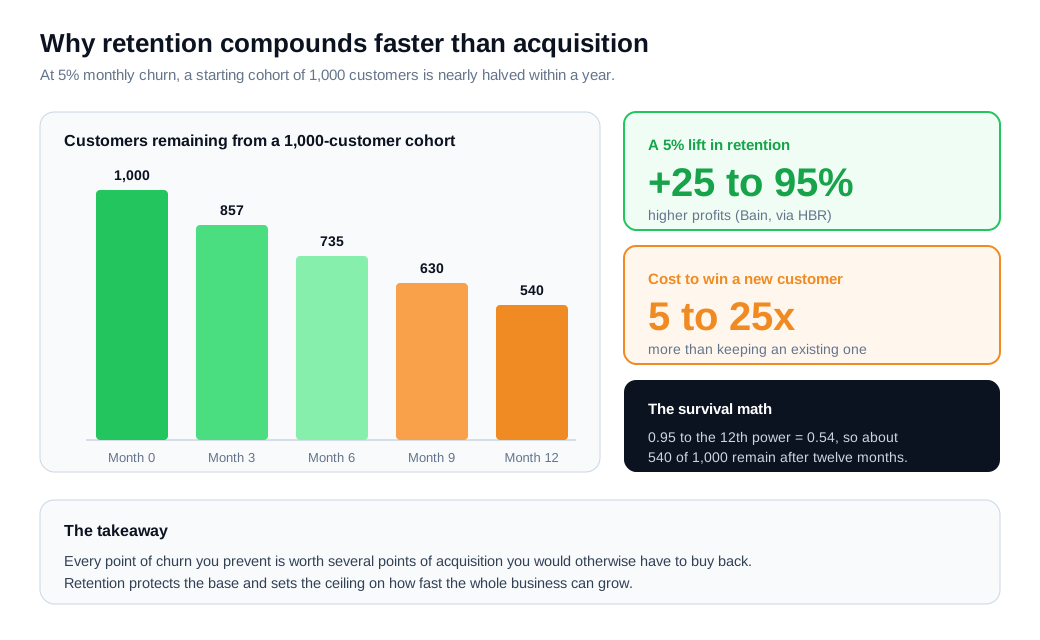
Here is the compounding worked out. Take a product losing 5 percent of its customers every month. Because losses stack, the survival rate after a year is 0.95 raised to the twelfth power, which is about 0.54. A cohort of 1,000 customers who signed up in January is down to roughly 540 by December, so nearly half of everyone you acquired is gone within twelve months. Every point of churn you prevent is worth several points of acquisition you would otherwise have to buy back.
The growth link is measurable. SaaS Capital's retention research reports that companies with the highest net revenue retention grow at a median rate roughly 83 percent higher than the typical private SaaS company. Retention protects the base, and it also sets the ceiling on how fast the whole business can grow.
What levers drive SaaS retention?
The levers that drive SaaS retention line up along the customer lifecycle: onboarding and activation, ongoing engagement and habit, value delivery through customer success, revenue expansion, and the billing hygiene that stops involuntary churn. Each one owns a different part of the retention curve, and the biggest gains sit early, where the curve drops most steeply.
Onboarding and activation are the highest-return lever because the sharpest drop in any retention curve happens right after signup, before the user ever reaches value. A structured first week that drives the new user to the specific action where the product clicks, the aha moment, does more for long-term retention than any win-back campaign later. Guiding that path with welcome messages and onboarding flows that point at the one action that matters, instead of a blank dashboard, is where a lot of retention is won or lost.
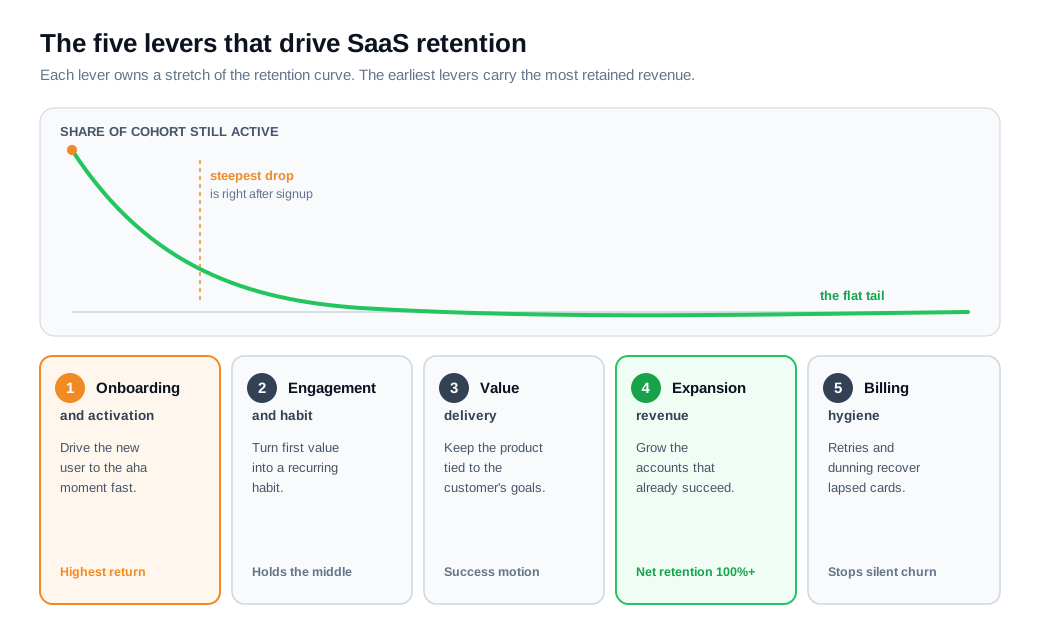
Engagement and habit hold the middle of the curve. Appcues frames retention as a staged problem where week-one, mid-term, and long-term retention each need their own tactics, and the middle stage is about turning first value into a recurring habit through nudges, feature discovery, and reasons to return. Catching a stalled user in the moment matters here, and a quick live chat session or screen share often surfaces the blocker faster than a week-long ticket thread.
Value delivery, expansion, and billing round out the set. Customer success keeps the product tied to the customer's goals so value stays visible, expansion grows the accounts that are already succeeding, and dunning plus smart payment retries recover subscriptions that lapse from an expired card rather than a real decision. Where support questions get answered feeds all of this, since the volume and tone of chats handled by a live agent or an AI chat assistant is itself a stream of engagement data.
How do you prioritize retention initiatives?
You prioritize retention initiatives by first finding the lifecycle stage where the retention curve drops most steeply, then scoring the candidate fixes for that stage so effort flows to the largest return. Diagnosis comes before the roadmap, because a brilliant expansion program does nothing if most customers are leaving in week one.
The scoring tool most teams reach for is RICE, a framework Intercom built on its own growth team. Each initiative gets a Reach (how many customers it touches in a period), an Impact (how much it moves retention, scored 3 for massive down to 0.25 for minimal), a Confidence (how sure you are, as a percentage), and an Effort (person-months of work). The score is Reach times Impact times Confidence, divided by Effort, which turns competing gut calls into one comparable number.
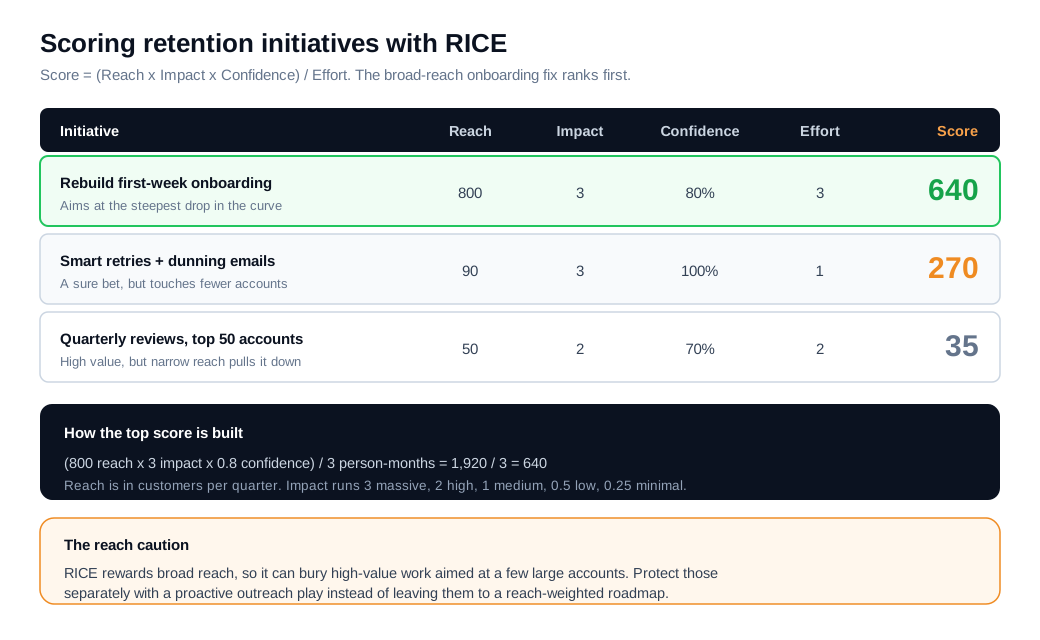
Work three initiatives through the formula. Rebuilding the first-week onboarding reaches 800 new users a quarter, with massive impact (3), 80 percent confidence, and 3 person-months of effort, scoring (800 times 3 times 0.8) divided by 3, which is 640. Adding smart retries and dunning emails for failed payments reaches 90 accounts, with massive impact (3), full confidence, and 1 month of effort, scoring 270. Running quarterly reviews for the top 50 accounts reaches 50, with high impact (2), 70 percent confidence, and 2 months of effort, scoring 35.
The ranking is clear: onboarding first, dunning second, reviews third. RICE rewards broad reach, which is why the onboarding rebuild wins even though the dunning fix is a surer bet. That is a feature and a caution at once. Reach-weighted scoring can bury high-value work aimed at a few large accounts, so protect those separately, and let a proactive outreach play catch the at-risk enterprise accounts that a broad-reach roadmap would otherwise skip.
How do you measure retention results?
You measure retention results with cohort retention curves and revenue retention tracked on consistent cohorts over time, not with a single headline churn number that averages away exactly where customers leave. A blended monthly churn figure can hide a small-business segment hemorrhaging while enterprise holds steady.
Start with the cohort curve. Amplitude's guide to cohort retention analysis describes grouping users by when they signed up and tracking what share is still active on day 1, day 7, day 30, and beyond. The shape of that curve tells you where the strategy is failing: a steep early drop points at onboarding, while a slow late decline points at fading engagement. A healthy product's curve flattens over time, which means a stable core of users has formed a habit.
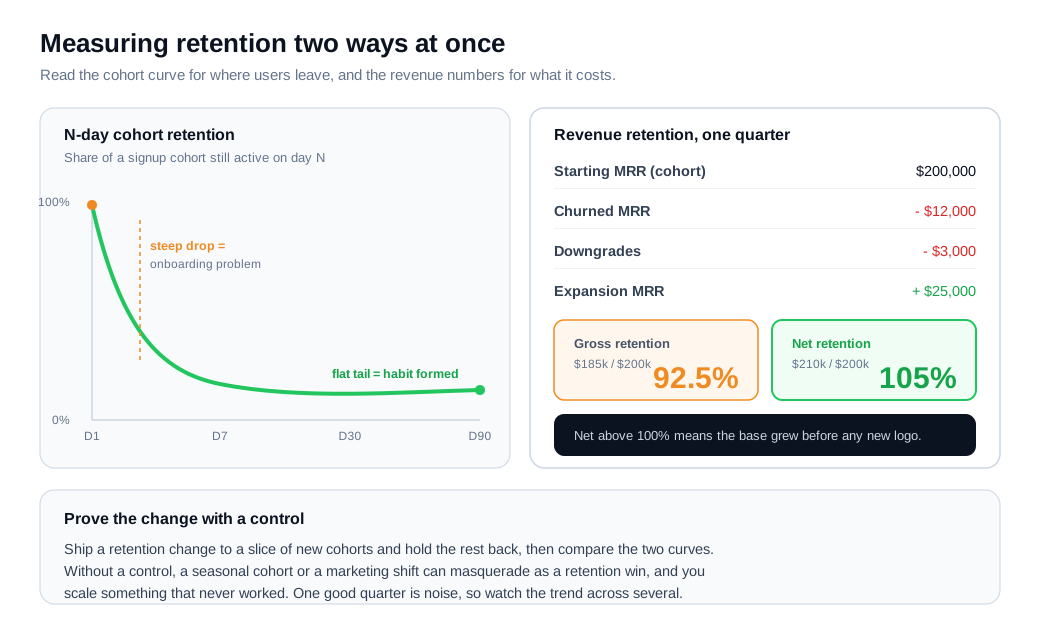
Add revenue retention on top of the user curve, because dollars and logos can move in opposite directions. Gross revenue retention counts only what you kept, and net revenue retention adds expansion back in. Work a quarter through it: a cohort starts at 200,000 dollars in monthly recurring revenue, loses 12,000 to cancellations and 3,000 to downgrades, and adds 25,000 in expansion. Gross retention is (200,000 minus 15,000) over 200,000, or 92.5 percent. Net retention is (200,000 minus 15,000 plus 25,000) over 200,000, or 105 percent, meaning the base grew before a single new logo landed.
One habit keeps the measurement honest. When you ship a retention change, run it as a controlled test on a slice of new cohorts rather than flipping it for everyone, so you can compare the treated cohort's curve against a held-back control. Without that control, a seasonal cohort or a marketing shift can masquerade as a retention win, and you scale something that never worked.
What is a good retention rate for SaaS?
A good retention rate for SaaS depends heavily on segment, but the median business keeps most of its revenue and expands modestly on top of it. SaaS Capital's benchmark data for bootstrapped companies between 3 and 20 million dollars in ARR puts median net revenue retention around 103 percent and median gross revenue retention around 91 percent, with the 90th percentile reaching about 118 percent net and 100 percent gross.
Segment sets the expectation. Enterprise products with annual contracts and deep expansion routinely clear 110 percent net retention, while small-business and self-serve products run lower because contracts are short and switching is cheap. Treat these figures as orientation, not a target. The comparison that matters is your own trend: is this quarter's cohort retaining better than last year's, and is net retention climbing toward and past 100 percent?
What are the most common retention strategy mistakes?
The most common retention strategy mistake is treating retention as a rescue operation at the cancel button instead of a system built into onboarding, engagement, and expansion. By the time a customer clicks cancel, most of the decision was made weeks earlier, when value stopped landing and nobody noticed.
The Reforge analysis names three recurring failures. The first is deprioritizing retention entirely, because its payoff is delayed and acquisition feels more urgent. The second is defining retention metrics incorrectly, such as leaning on a blended churn rate that hides which segment is actually leaking. The third is ignoring engagement, and measuring only whether accounts are still paying while missing the usage decline that predicts next quarter's churn.
A fourth mistake compounds the others: optimizing a vanity milestone like "completed onboarding" that is easy to move and tells you nothing about whether users found value. A team can push onboarding completion to 90 percent and watch retention stay flat, because the checklist steps were never the thing that made the product stick. Tie every retention metric back to a behavior that genuinely predicts users staying, then keep re-checking that the link still holds as the product changes.
Key takeaways
- A retention strategy is a system, not a save. It keeps existing customers active and growing across the lifecycle, and it works both halves at once, protecting gross retention while pushing net retention past 100 percent with expansion.
- Retention outcompounds acquisition. A 5 percent retention lift can raise profits 25 to 95 percent, new customers cost five to 25 times more than kept ones, and the highest-NRR companies grow far faster than the median.
- The levers sit along the lifecycle. Onboarding and activation carry the steepest part of the curve, engagement holds the middle, and value delivery, expansion, and billing hygiene round out the set.
- Prioritize by diagnosis, then RICE. Find the stage where the curve drops most steeply, score the fixes by Reach times Impact times Confidence over Effort, and protect high-value accounts that reach-weighting would skip.
- Measure cohorts, not a headline. Track N-day retention curves alongside gross and net revenue retention on consistent cohorts, and prove any change with a held-back control rather than a single good month.
- Avoid the classic traps. Do not deprioritize retention, do not hide behind a blended churn rate, do not ignore engagement, and do not optimize a vanity milestone that fails to predict whether users stay.

Written by
Nilas MylerCo-founder & CTO, Glimpze
Nilas is the co-founder and CTO of Glimpze, an inbound sales tool that turns high-intent website visitors into live conversations. A former SEO consultant for some of the largest companies in Denmark, he writes about speed-to-lead, inbound sales, and conversion rate optimization — the technical and operational mechanics of turning traffic into pipeline.


