
On this page
A demo form gets filled out on your pricing page at 9:40 a.m. A chat opens on a comparison page ten minutes later. A trial account activates over lunch. For a while, a founder or one generalist rep works every one of these by hand, and it holds together because the volume is small enough to keep in one head.
Then it stops holding. Leads arrive faster than one person can answer, the fast replies convert while the slow ones go cold, and no one can say which lead got dropped or why. Building an inbound sales team is how you turn that overflow into revenue you can forecast. The hard part is sequence: hire the wrong role first, or split the team before you have the volume to feed it, and you add payroll without adding pipeline.
This guide covers what an inbound sales team actually is, when to make the first hire, which roles to add and in what order, how to structure them, the tools and processes to put in place, how to scale as inbound grows, and how to tell whether the team is working.
What is an inbound sales team?
An inbound sales team is the group of reps whose job is to respond to buyers who came to you, qualify the ones with real intent, and carry them to a decision, instead of cold-prospecting accounts that have shown no interest. Marketing and your product create the demand, a visitor raises a hand, and the team's work begins from that signal.
That direction of demand changes what the team optimizes for. An inbound team lives on speed to the first reply, sharp qualification, and a clean handoff, where an outbound team lives on account selection and multi-touch patience. The two motions can share a floor, but they are graded on different things and are usually best staffed separately once volume justifies it. For the wider motion these hires sit inside, the inbound sales use case covers where the team fits in the funnel.
The methodology most inbound teams borrow from is HubSpot's, which frames the rep as an advisor who helps a buyer decide. HubSpot's inbound sales model runs four stages: identify active buyers, connect with relevance, explore the buyer's goals and blockers, and advise on a specific next step. Your team structure exists to run those stages at the volume your site produces.
When should you hire your first inbound salesperson?
Hire your first inbound salesperson once founder-led selling has produced a pattern you can hand over, and not a day before. You should be able to describe your buyer, the objections that come up, the pricing logic, and what a qualified opportunity looks like, because a first hire scales a working process rather than inventing one.
The common failure is hiring a salesperson to fix product-market fit. If the product is still shifting under your feet and deals close on the founder's personal credibility, a new rep has nothing repeatable to run and will stall. BIP Ventures frames the transition as gradual: the founder stays close to deals for months while the first rep ramps, handing over intuition that has been written down.
Timing matters because ramp is slow. The Bridge Group's sales development research puts average ramp near three months before a rep is fully productive, so the moment to hire is before you are drowning, not after the queue is already on fire. The signal is concrete: inbound is arriving faster than the founder can answer within minutes, and deals are being lost to slow response rather than to gaps in the product.
What roles do you need first?
The first roles you need, in order, are one full-cycle closer, then a sales development rep to feed that closer, then a second closer, then a manager and specialist seats. Resist the urge to hire a specialist team on day one, because at low volume a narrow role sits idle while the rest of the funnel backs up.
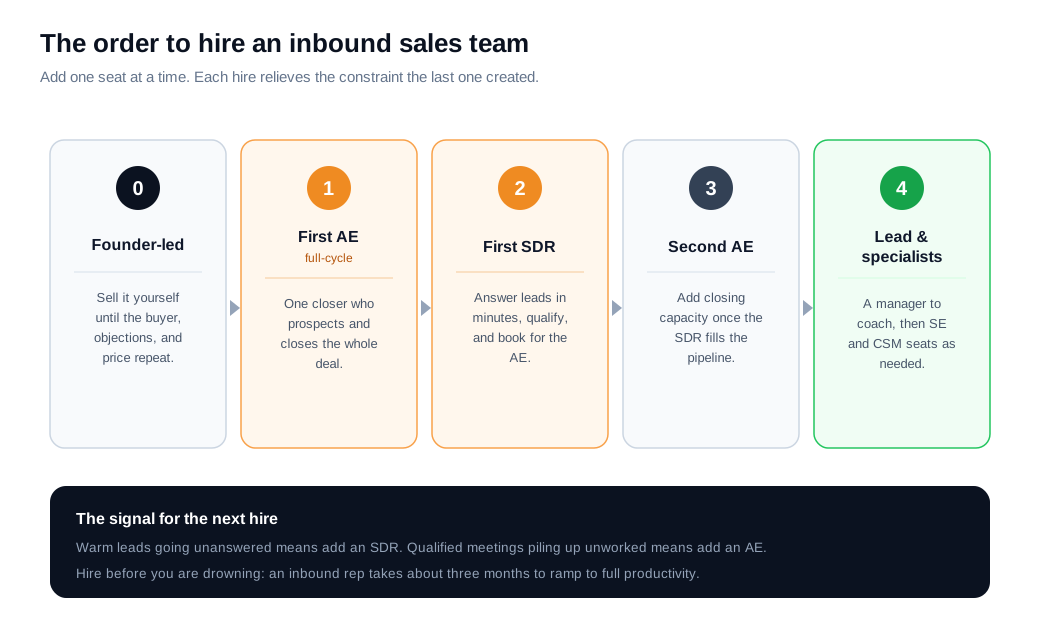
Start with a full-cycle account executive (AE). This first rep prospects, runs discovery, demos, and closes, the same end-to-end motion the founder was running, which keeps the job simple to hand over and gives you one person who understands the whole deal. Splitting the funnel now would just create handoff overhead with almost nothing to hand off.
Add a sales development rep (SDR) second, once inbound volume outgrows the closer's ability to also answer and qualify every lead fast. The SDR's whole job is speed and qualification: reach a hand-raiser in minutes, run a short discovery, and book the qualified ones for the AE. This is the seat that a live path on your site, such as live chat on high-intent pages, is built to support, since it lets the SDR talk to a buyer at the moment interest peaks.
Add a second AE third, when the SDR is generating more qualified meetings than one closer can work. Only then bring in a sales lead to coach and forecast, and specialist seats after that: a sales engineer (SE) for technical demos on complex products, and a customer success manager (CSM) to own onboarding and expansion so closers are not dragged back into accounts they already won.
How do you structure the team?
Structure the team by matching its shape to your headcount and deal complexity: run full-cycle "islands" while you are small, split into an assembly line as you add reps, and group into pods once you are large enough to give each pod its own book. The CRO Report's org-structure guide lays out these three models and roughly when each fits.
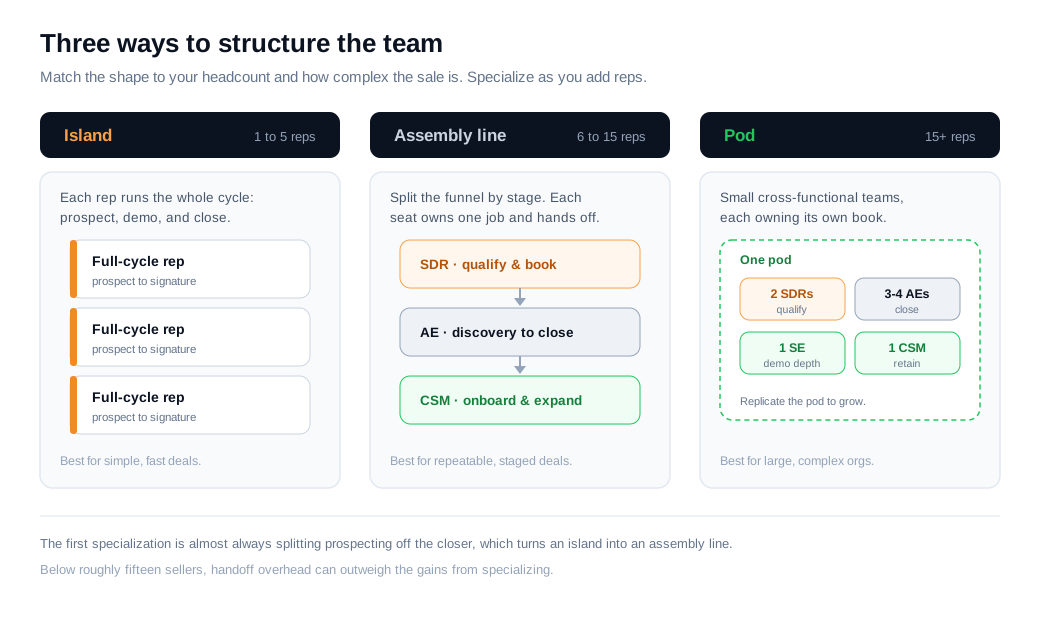
The island model fits roughly one to five reps. Each rep owns the whole cycle, there are no handoffs to coordinate, and it suits simple, fast-moving deals. Its weakness is that everyone does everything at a mediocre level, which is exactly the problem Aaron Ross's Predictable Revenue set out to solve at Salesforce by specializing the front of the funnel.
The assembly line fits roughly six to fifteen reps. Here you split prospecting from closing from retention: SDRs qualify and book, AEs run discovery through close, and CSMs onboard and expand. The first specialization is almost always pulling prospecting off the closer, and it pays off once you have enough volume that a dedicated SDR stays busy.
The pod model fits larger orgs, typically past fifteen sellers. A pod bundles a small cross-functional team (a common shape is two SDRs, three to four AEs, one SE, and one CSM) that owns a territory or segment and runs like a small business, and you grow by replicating the pod.
The ratio between SDRs and AEs falls out of this. Benchmark data puts it around one SDR for every two to three AEs; The Bridge Group's data lands near one SDR per 2.4 AEs, and it moves with deal size, since higher-value enterprise deals need more prospecting support per closer. Treat the ratio as an output of capacity rather than a rule you impose.
What tools and processes should you set up?
Set up three things before you scale headcount: a CRM as the system of record, fast routing that puts each new lead in front of an available rep within minutes, and a live path on high-intent pages so a hot buyer can reach a human on the spot. Everything else is optional until these three work.
A CRM anchors the stack by recording every stage, owner, and timestamp, which is also what makes the health metrics later in this post measurable at all. Without it, you are guessing about where deals stall. Layer lead scoring and routing and notifications on top so a high-intent lead reaches whoever is qualified and available now, rather than landing in an inbox no one is watching.
The live path is the piece most early stacks miss. Inbound intent is perishable, and the MIT and InsideSales.com Lead Response Management study found that contacting a web lead within five minutes rather than thirty made it 21 times more likely to qualify. Yet real-world response is slow: one benchmark of inbound leads reported a median response time measured in dozens of hours, not minutes. A live path closes that gap, and an AI chat assistant can catch and pre-qualify inbound after hours so a warm lead does not sit until morning.
Then write down the processes, because tools without rules produce inconsistent data. Define a speed-to-lead target (a first human touch inside five minutes on high-intent leads), the criteria that make a lead sales-qualified, what a clean handoff to an AE includes, and a follow-up cadence for leads that go quiet. These definitions are what let two different reps run the same play and produce numbers that mean the same thing.
How do you scale the team as inbound grows?
Scale the team by adding capacity where the funnel is actually constrained, one specialized seat at a time, rather than hiring in round numbers or copying another company's org chart. The right question is which stage is backing up right now, rather than how many reps the team should have in total.
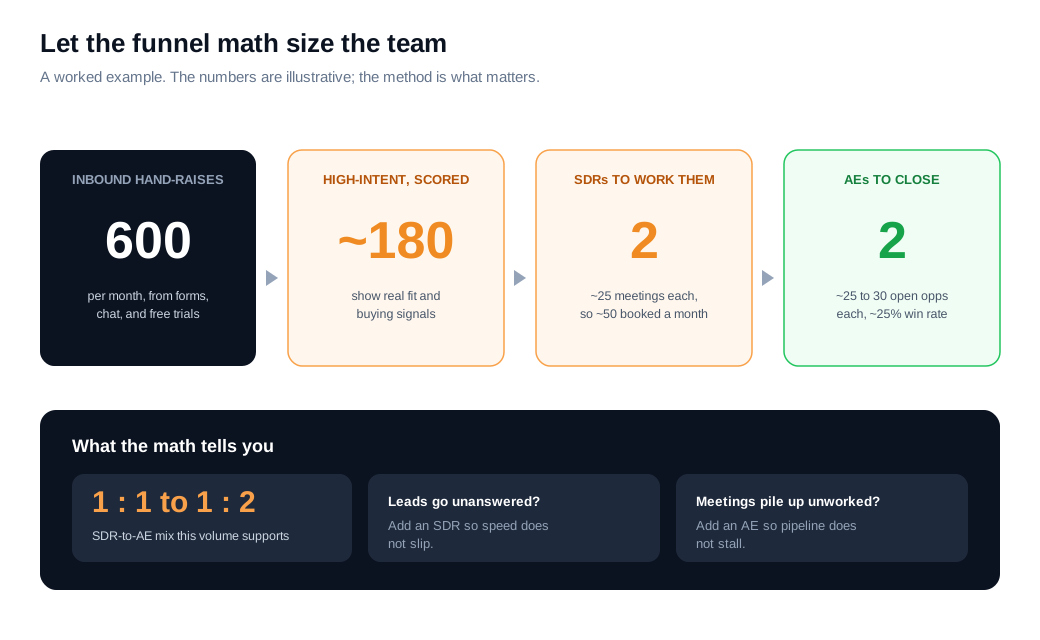
Here is the math worked through. Say inbound generates 600 hand-raises a month, and scoring narrows that to about 180 with real fit and intent. A mature inbound SDR might book on the order of 25 qualified meetings a month, so working 180 warm leads fast enough to matter takes about two SDRs, who together book roughly 50 meetings. If one AE can run and close from about 25 to 30 open opportunities a month at a 25% win rate, those 50 meetings support about two AEs. That lands near a one-to-one to one-to-two SDR-to-AE mix and, more usefully, tells you the next hire: if high-intent leads go unanswered, add an SDR; if qualified meetings pile up unworked, add an AE. The numbers here are illustrative, and your real rates will differ, but the method holds.
Layer in management and specialists as the count grows. A rough rule of thumb is one frontline manager for every six to eight reps, added before a lead's span of control gets thin enough that coaching disappears. Specialization itself only pays once you have the volume: below roughly fifteen sellers, the handoff overhead of a full assembly line can outweigh the gains, which is why small teams stay full-cycle longer than they expect.
One more force is reshaping the ratios: AI tooling. Assistants that qualify and sequence inbound let one SDR cover work that used to take two, which pushes the SDR-to-AE ratio toward fewer prospecting seats per closer. Treat that as a reason to automate the repetitive first-touch work before adding a head, while keeping human judgment on the live deals.
How do you know your inbound sales team is working?
You know the team is working when a small set of stage metrics stays healthy as volume grows, rather than when the year-end number happens to land. A single win rate at the end tells you whether the quarter worked; it never tells you which stage to fix next.
Watch four things. Speed-to-lead, the time from a hand-raise to the first human touch, tracked as a median and a 90th percentile so a few fast replies do not hide a slow tail. Stage-to-stage conversion, especially lead to qualified opportunity, which localizes where the funnel leaks. Win rate, segmented by lead source so you can tell which inbound channels produce revenue rather than just volume. And ramped-rep quota attainment: the Bridge Group has found roughly two-thirds of reps hit quota in a given period, a figure that has stayed stable across editions, so if far fewer of your reps are clearing it, the problem is usually the process or the quota rather than the people.
These numbers also tell you when to hire again. When speed-to-lead creeps up because the current team cannot keep pace, that is the queue backing up, and it is the same signal that says add the next seat.
Key takeaways
- Hire only once founder-led selling repeats, because a first salesperson scales a working process and cannot create product-market fit that is not there yet.
- Add roles in order: a full-cycle AE first, an SDR to feed that closer second, a second AE third, then a manager and specialist seats like SE and CSM.
- Match the structure to your size: full-cycle islands at one to five reps, an assembly line at six to fifteen, and pods past fifteen sellers.
- Set up three things before scaling: a CRM as the system of record, fast routing, and a live path on high-intent pages, since intent decays in minutes.
- Let funnel math size the team, so the SDR-to-AE ratio falls out of capacity and the next hire is wherever the queue backs up.
- Measure at the stage level: speed-to-lead, stage conversion, win rate by source, and quota attainment, so the next fix and the next hire are both obvious.
TAGS

Written by
Daniel SemeckyCo-founder & CEO
Daniel is the co-founder and CEO of Glimpze. He spends his days talking to revenue teams about how to catch high-intent visitors before they bounce, and writes about inbound sales, lead conversion, and building a motion where marketing and sales actually share a number.


