
On this page
- What is a conversational marketing platform?
- What features should a platform have?
- How do you evaluate bot and routing capabilities?
- What integrations matter?
- How do you compare pricing and support?
- How do you shortlist and trial a platform before buying?
- What mistakes should you avoid when choosing?
- Key takeaways
- Sources
A demo of a conversational marketing platform always looks good. A polished bot greets a visitor, answers three easy questions, and drops a meeting straight onto a calendar. Then you buy the thing, point it at your real traffic, and the distance between that demo and your actual pipeline shows up within a week.
Every platform in this category sells the same promise: catch people while they are interested and turn more of them into conversations. They differ in the places a demo never shows you. How the bot handles a question nobody scripted. How fast a hot lead reaches a rep who can close. Whether the conversation lands in your CRM or in a dashboard nobody opens.
This guide covers what a conversational marketing platform actually is, the features that matter, how to pressure-test the bot and the routing, which integrations to insist on, how to compare pricing and support without fooling yourself, and how to run a trial that tells you the truth before you sign.
What is a conversational marketing platform?
A conversational marketing platform is software that lets your website talk to visitors in real time, through chat, bots, and sometimes audio or video, and moves the promising conversations to the right person or system while the visitor is still on the page. It replaces the static contact form and the 24-hour email reply with a live exchange in the moment interest peaks.
The category grew out of a simple observation about how people buy. Buyers want answers now, and a form makes them wait. In Drift and SurveyMonkey's State of Conversational Marketing survey, only 14 percent of respondents said they would rather fill out a form than talk to a chatbot, and a large share expected an immediate reply from chat.
That is the demand these platforms serve. The choice matters because the tools that serve it range from a lightweight chat widget a solo founder installs in an afternoon to a full revenue platform with routing, AI, and analytics that a whole sales team lives in. Picking one that is too thin leaves conversations on the table. Picking one that is too heavy leaves you paying for modules you never switch on.
What features should a platform have?
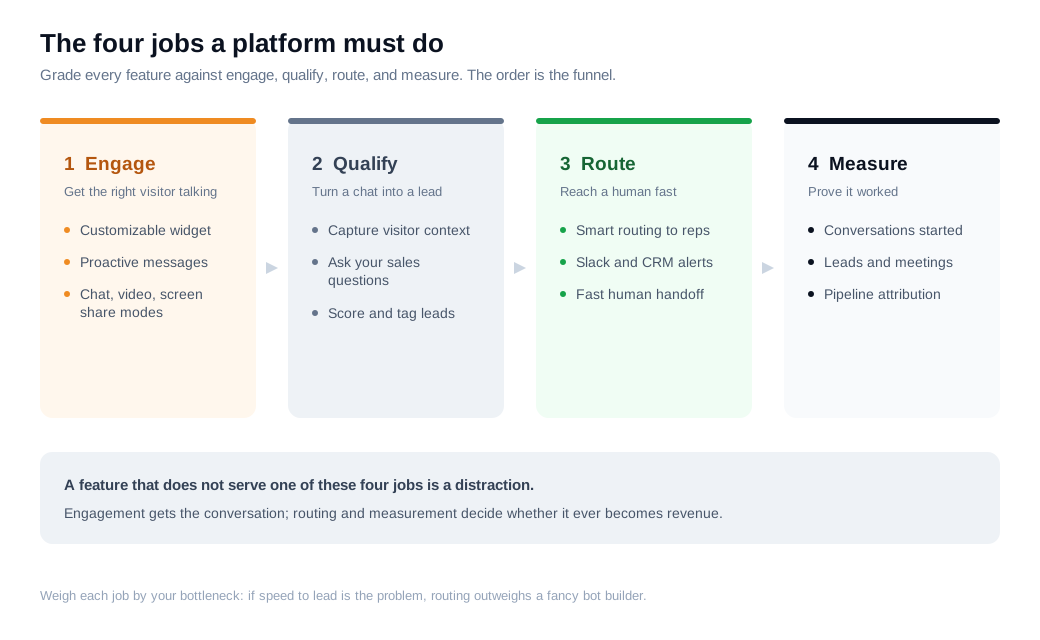
The features that matter fall into four jobs the platform has to do well: engage the right visitors, qualify them, route them to the right destination, and measure what happened. Judge every feature list against those four jobs, and the shiny extras sort themselves out fast.
Engagement is the front door. Look for a customizable widget, proactive messages that can fire on behavior (time on a pricing page, a repeat visit, a specific referral source), and more than one conversation mode. Text chat is table stakes, and a good live chat experience sits at the center of it. The ability to escalate a promising thread into a live video call or screen share is what separates a support tool from a sales tool, because a rep who can show the product closes faster than one typing paragraphs.
Qualification is where a conversation becomes a lead. The platform should capture the visitor's context, ask the questions your sales team actually cares about, and score or tag the result so nobody wastes time on a tire-kicker. An AI chat assistant that can answer questions and qualify at the same time carries this load around the clock.
Routing decides who gets the lead and how fast. Measurement tells you whether any of it worked. A platform that engages and qualifies but cannot prove its effect on pipeline is impossible to defend at renewal.
The evidence that engagement itself moves numbers is strong. Forrester found that site visitors who use web chat are 2.8 times more likely to convert than those who do not, and Intercom's own data puts visitors who chat first at 82 percent more likely to convert.
How do you evaluate bot and routing capabilities?
You evaluate a bot by throwing messy, off-script questions at it and watching whether it grasps intent and hands off cleanly, and you evaluate routing by timing how long a high-intent lead takes to reach a live human. Both tests are easy to run in a trial, and both predict how the platform behaves on your worst-case Tuesday.
Start with the bot. Ask it something a real buyer would ask, phrased badly, with a typo, mid-thought. A rule-based bot loops back to its menu. A capable assistant reads what you meant, pulls an accurate answer, and offers a next step. Then check the exit. When the bot cannot help, does it hand the conversation to a person with the full transcript attached, or does it trap the visitor in a loop? A bot with no clean escape hatch to a human quietly kills your hardest, most valuable conversations.
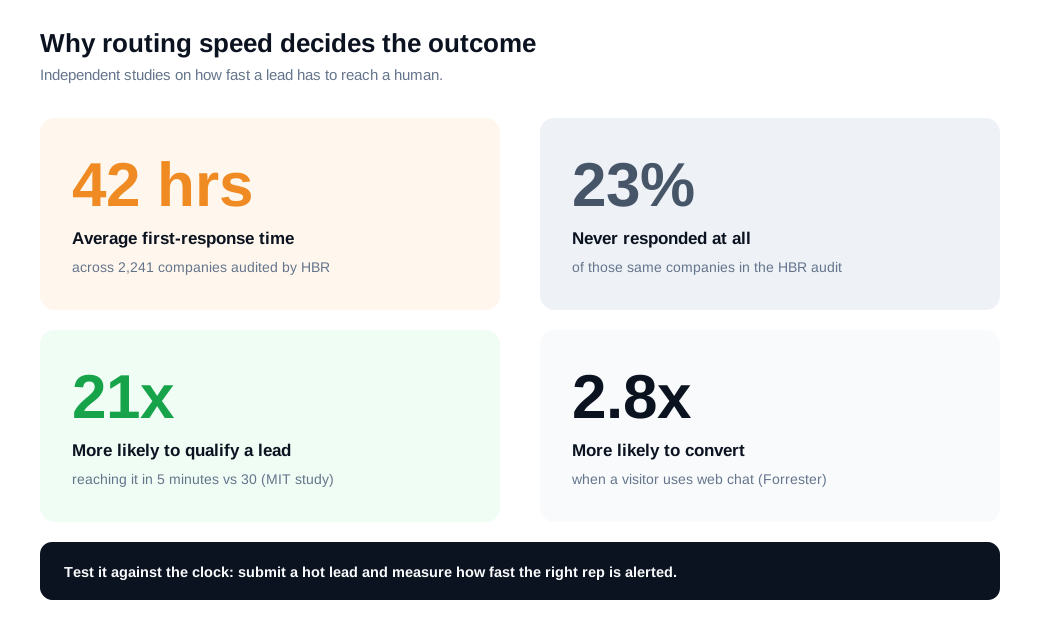
Routing is the other half, and speed is the whole game. The research here is old and unambiguous. Harvard Business Review's audit of 2,241 companies found an average first-response time of 42 hours, with 23 percent of firms never responding at all, and companies that reached a lead within an hour were nearly seven times more likely to qualify it than those that waited even one hour longer. The widely cited MIT lead-response study pushed the window tighter: contact a web lead within five minutes and you are 21 times more likely to qualify it than at 30 minutes.
So test the routing against the clock. When you submit a high-intent message, how fast does the right rep get pinged, and through which channel? A platform that posts a Slack alert through smart routing and notifications the instant a hot lead appears turns those research numbers into your numbers.
What integrations matter?
The integrations that matter most are your CRM, your calendar, your team's chat tool, and your analytics stack, because a conversation that does not sync into those systems becomes a data silo instead of a pipeline. Every good chat gets thrown away if the record dies inside the vendor's dashboard.
Put the CRM first. Contacts, conversation history, and lead scores should flow into Salesforce or HubSpot automatically, so a rep opening a record sees the whole thread without copy-paste. HubSpot makes the case plainly in its primer on CRM integration: connected systems keep sales, marketing, and support working from the same reliable data and prevent the silos that scatter your insight.
Calendar integration is what turns a chat into a booked meeting without the back-and-forth. Team messaging, most often Slack, is how routing actually reaches a human, so a native connection there is worth more than a generic webhook you have to maintain. Analytics matters at the other end, where the platform should either report on conversations-to-pipeline itself or feed the events into the tool that does.
Two practical checks save pain later. First, is the integration native, or does it lean on a third-party connector you will pay for and babysit? Second, does it write both ways, or only read? A one-way sync that pulls contact data in but never writes the conversation back is half an integration. Read the integrations list before you fall for the feature list, since a platform you love that cannot talk to your CRM is a platform you will fight every day.
How do you compare pricing and support?
Compare pricing on total cost of ownership rather than the sticker price, and judge support by how fast you can reach a human and whether onboarding is included, because both quietly decide whether the platform ever pays for itself. The number on the pricing page is usually the smallest number you will pay.
Read every line item. Seats are only the base. Many platforms meter AI resolutions, charge for extra integrations, gate routing or analytics behind a higher tier, and add a one-time onboarding fee. A plan that looks cheap per seat can double once you add the pieces you assumed were included.
Here is a worked example with round numbers. Say your site gets 8,000 visitors a month, and you want chat on your high-intent pages with five reps able to jump in. Platform A advertises 50 dollars per seat, so five seats read as 250 dollars. Then add metered AI at roughly 1 dollar per resolved conversation; if the bot handles 600, that is another 600 dollars. Add a 1,500 dollar onboarding fee spread over the first year, about 125 dollars a month. Your real first-year cost is closer to 975 dollars a month, not 250. Platform B lists a flat 79 dollars for the whole team with AI included. Even if Platform B is missing one integration you wanted, the honest comparison is 975 dollars against 79 plus a small workaround. The sticker price told you almost nothing.
Support deserves the same scrutiny. Find out the real response time on the plan you would actually buy, whether onboarding and migration help are included or sold separately, and whether there is a free tier you can prove value on before committing. A free plan and clear pricing let you test with your own traffic, and a side-by-side comparison of the alternatives is worth more than any sales deck.
How do you shortlist and trial a platform before buying?
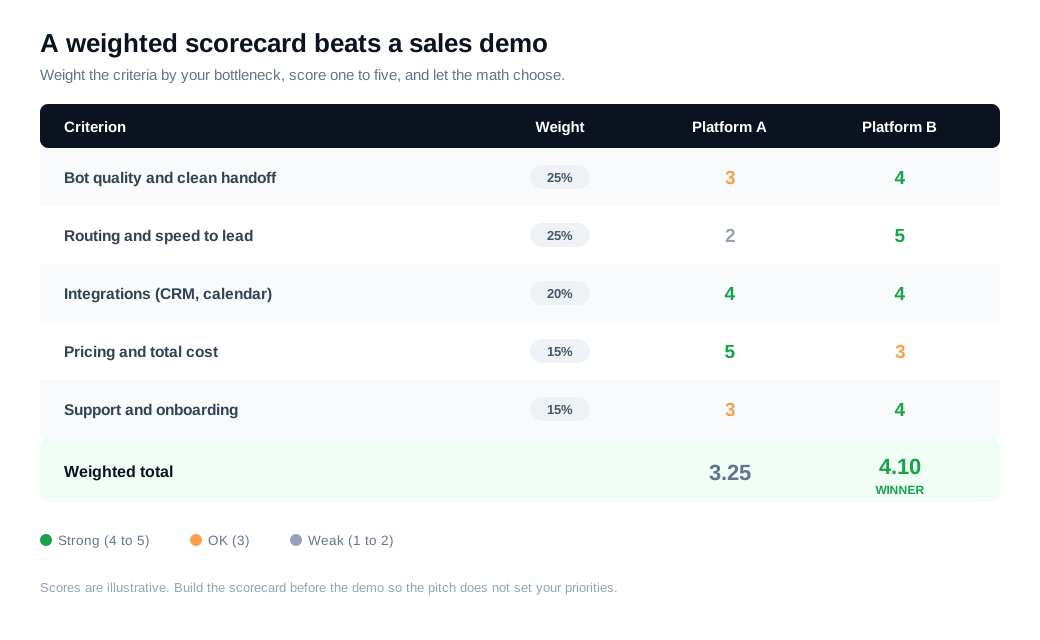
Shortlist two or three platforms against a weighted scorecard, then run each on real traffic for two weeks and measure conversations started, leads qualified, and meetings booked. A trial on your own site beats any reference call, because your visitors and your reps are the only test that counts.
Build the scorecard before you demo anything, so the sales pitch does not set your priorities for you. Weight the criteria by what your business needs. If speed to lead is your bottleneck, routing and notifications should carry more weight than a fancy bot builder. Score each platform one to five on every criterion, multiply by the weight, and let the total narrow the field to a real trial.
Then trial deliberately. Install the widget on the same two or three high-intent pages for each tool, use the same qualifying questions, and route to the same reps. Watch four things: how many conversations start, how many turn into qualified leads, how fast the handoff happens, and how the data looks in your CRM afterward. Two weeks is usually enough to see a pattern.
The point of the trial is to replace opinion with your own data. A platform that started 120 conversations and booked 14 meetings on your traffic is a fact. A platform that demoed beautifully is a hope.
What mistakes should you avoid when choosing?
The biggest mistake is buying for the demo instead of your buying process, and the rest follow from it: over-automating, ignoring the human handoff, and skipping the measurement plan. Each one is easy to avoid once you name it.
Buying for the demo means picking the tool with the slickest bot rather than the one that fits how your prospects actually decide. Over-automating means routing every conversation to AI to save money, then watching high-intent buyers bounce off scripted non-answers. Ignoring the handoff means installing chat with no fast path to a person, which wastes the exact conversations worth the most, the kind that feed inbound sales. Skipping measurement means having no way to prove the platform's effect at renewal, which is how good tools get cut in a budget review.
The fix for all four is the same discipline. Define your goal, weight your criteria, test the bot and the routing on real traffic, and insist the whole thing reports back into the systems your team already uses. Choose the platform that wins on your process rather than the one that wins the demo.
Key takeaways
- Start with the four jobs, not the feature list. A conversational marketing platform has to engage the right visitors, qualify them, route them to a human fast, and measure the result, so grade every feature against those.
- Pressure-test the bot with off-script questions. A capable assistant reads intent and hands off cleanly with the transcript attached, while a bot that traps visitors in a loop costs you your best conversations.
- Routing speed is the whole game. HBR found an average 42-hour first response with 23 percent of firms never replying, and reaching a lead within five minutes makes qualification 21 times more likely, so time the handoff in every trial.
- Insist on native, two-way integrations. Your CRM, calendar, team chat, and analytics all need the data, and a conversation stuck in the vendor's dashboard is a silo rather than a pipeline.
- Compare total cost, not sticker price. Seats, metered AI, add-on integrations, and onboarding fees can multiply a cheap-looking plan, so check support response time and whether a free trial lets you prove value first.
- Trust your own trial over any demo. Run two or three finalists on real traffic against a weighted scorecard and pick the one that wins on your process.

Written by
Daniel SemeckyCo-founder & CEO
Daniel is the co-founder and CEO of Glimpze. He spends his days talking to revenue teams about how to catch high-intent visitors before they bounce, and writes about inbound sales, lead conversion, and building a motion where marketing and sales actually share a number.


