
On this page
Your CEO asks a simple question in the Monday meeting: how much did we actually close last quarter? Marketing's dashboard shows one number. The sales VP's pipeline export shows another. Finance's recognized revenue shows a third. All three people are honest, all three are reading real data, and the three numbers are tens of thousands of dollars apart.
That gap has nothing to do with bad math. It shows up because each team keeps its own copy of the truth in its own tool, under its own definitions, and no one ever agreed which copy wins. A single source of truth closes the gap by naming one authoritative record for each kind of revenue data, so a lead, an opportunity, and a dollar mean the same thing to everyone who looks.
This post covers what a single source of truth for revenue data is, why teams end up with conflicting numbers, which system should hold the truth, how to unify your data into one record, how to keep it clean over time, and how to tell whether it is working.
What is a single source of truth?
A single source of truth for revenue data is one authoritative record that every team agrees to treat as correct for each type of revenue information, so sales, marketing, finance, and customer success all report from the same numbers instead of separate copies. The aim is agreement across teams, and it does not require one database that swallows every tool you own.
The common misread is that a single source of truth means one system for everything. It does not. It means one designated system of record for each type of data, with every other tool either feeding that record or reading from it. Your CRM can be the authority for accounts and pipeline while your billing system stays the authority for invoiced revenue, as long as everyone knows which is which and the two stay in sync.
Fullcast frames the CRM as the gravitational center of RevOps data, with every other system either pushing data into it or pulling data from it. That framing turns an impossible goal, one tool to rule them all, into a practical one: one clear owner per data type. When a rep, a marketer, and a finance analyst each look up the same account, they should see the same stage, the same amount, and the same close date.
Why do teams have conflicting numbers?
Teams have conflicting revenue numbers because each function stores its own data in its own tool, under its own definitions, and no one has agreed which version is authoritative. The numbers conflict by design.
Three forces produce most of the mess. The first is data silos: marketing lives in its automation platform, sales in the CRM, finance in billing, and success in a separate tool, so no one holds a full picture of a single account. The second is incompatible definitions: when marketing, sales, and finance each define an MQL, a qualified opportunity, or ARR differently, their reports cannot reconcile even when the underlying records are identical. The third is disconnected systems that never sync, so a change in one tool never reaches the others.
The scale is easy to underestimate. One analysis summarized by Brixon Group found that 76% of companies with pronounced silos use incompatible performance metrics for marketing and sales, and that in 68% of them marketing is judged on lead volume while sales is judged on revenue and close rate. Two teams measured on different yardsticks will always report different numbers. The underlying data problem is expensive too: Gartner estimates poor data quality costs organizations an average of $12.9 million a year.
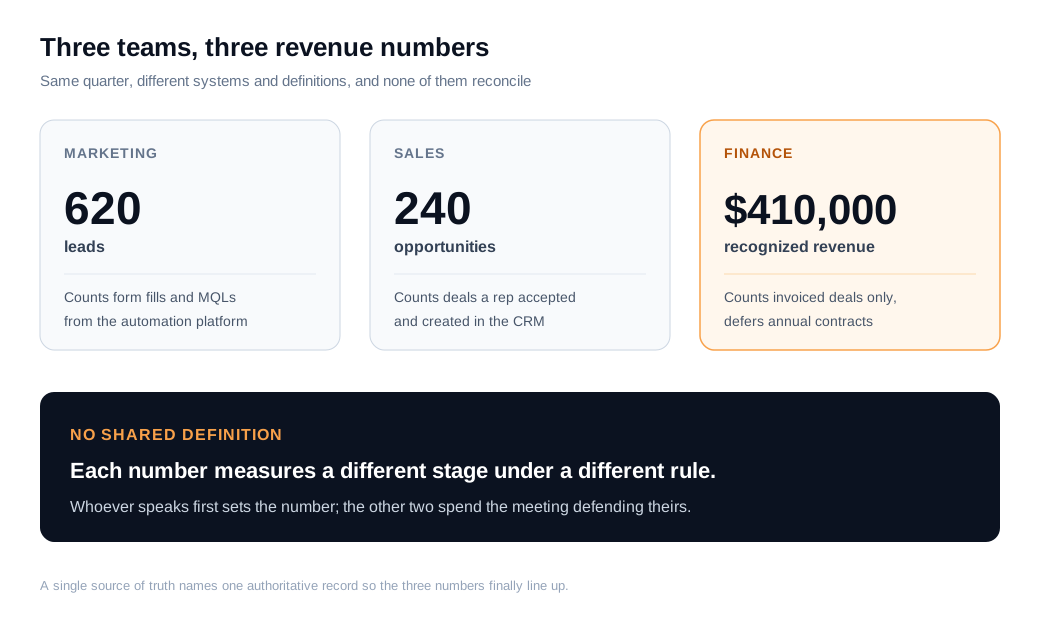
Here is how the gap forms in practice. Marketing's automation platform counts 620 leads for the quarter. The CRM shows 240 opportunities, because a lead only becomes an opportunity after a rep accepts it, and reps never touched the rest. Finance's billing system recognizes $410,000, because it counts invoiced deals and defers the annual contracts signed in the final week. Three real systems, three real numbers, and none of them reconcile, because each measures a different stage under a different definition. Whoever speaks first in the meeting sets the number, and the other two spend it explaining why theirs is different.
Which system should be your single source of truth?
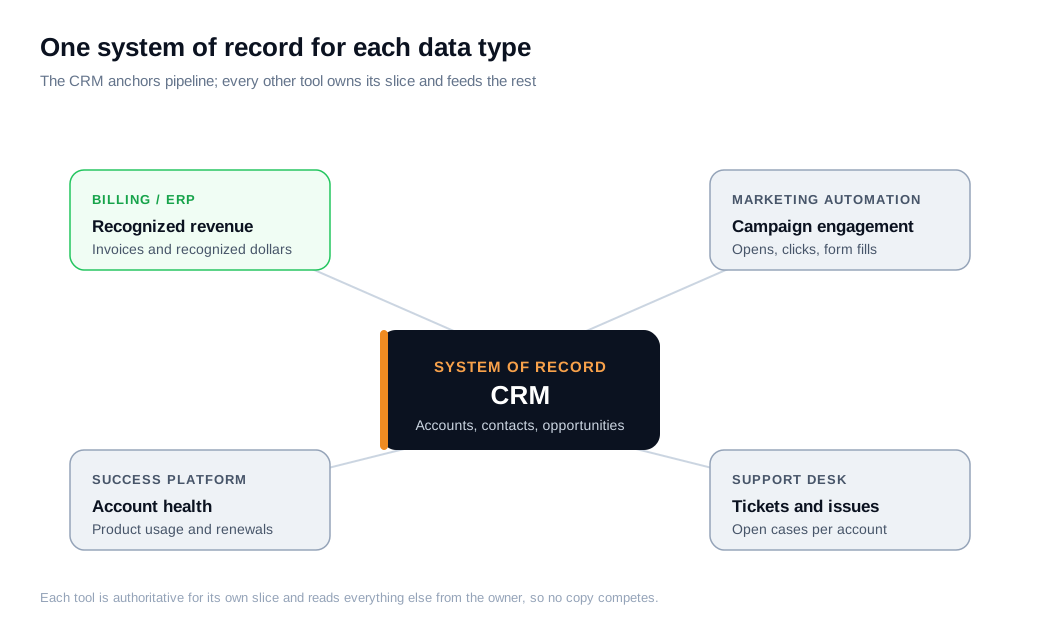
For most revenue teams the CRM should be the single source of truth for accounts, contacts, and pipeline, with every other tool feeding it rather than keeping a competing record. It sits in the middle of the revenue motion, so it is the natural anchor for who is a customer and what stage each deal is in.
The rule that keeps this sane is one system of record per data type. The CRM owns accounts, contacts, and opportunities. Your billing or ERP system owns invoices and recognized revenue. Marketing automation owns campaign engagement. The customer success platform owns product usage and account health. Each tool is authoritative for its own slice and reads everything else from the owner, so there is never a question about which copy is right.
Activity data is where this quietly breaks. Salesforce research found that sales reps spend less than 30% of their time actually selling, with much of the rest lost to admin and manual data entry. Every call and email a rep forgets to log is a hole in the source of truth. The fix is to capture activity automatically wherever you can, so lead routing and notifications and call logging flow into the record without depending on anyone's memory. A source of truth built on manual entry is only as complete as the busiest rep's discipline that week.
How do you unify revenue data?
You unify revenue data in a fixed order: agree on shared definitions first, pick a system of record for each data type, connect your tools so data flows automatically, clean and deduplicate what you already have, then assign an owner before you trust the result. Definitions come first because tooling cannot fix a disagreement about what a word means.
The practical sequence:
- Agree on definitions in writing. Sit marketing, sales, and finance down and define every shared term: what makes a lead an MQL, what promotes it to a qualified opportunity, how you count pipeline, and how you recognize revenue. HubSpot's guide to lead qualification is a useful starting point for MQL and SQL definitions, though the exact thresholds have to be yours.
- Choose a system of record per data type. Write down which tool is authoritative for accounts, revenue, engagement, and health, and make it a rule that no one reports a metric from anywhere else.
- Connect the sources. Integrate your CRM, marketing automation, billing, and success tools so data moves without manual re-entry. Where a native path does not exist, an integration or a sync layer closes the gap.
- Clean and deduplicate. Merge duplicate accounts and contacts, fill required fields, and retire dead records before you build reports on top of them.
- Assign an owner. One named person owns the health of the source of truth and reports on it, or the standard erodes the first busy week.
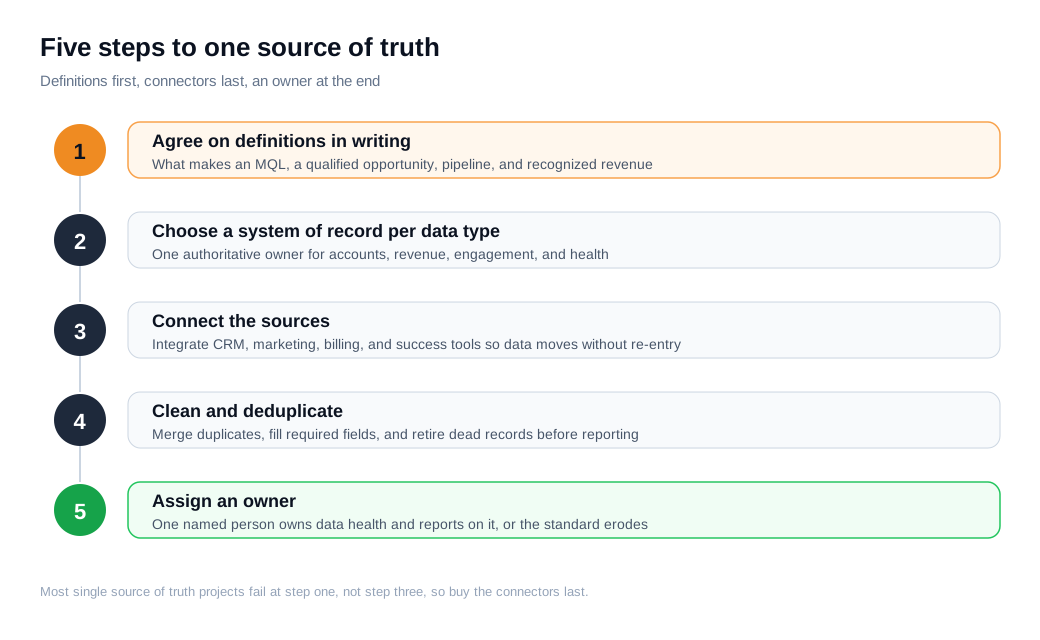
The sequence matters because most single source of truth projects fail at step one, not step three. Common causes of failure are unclear ownership of which system is authoritative, weak deduplication rules, and syncing data before agreeing on a shared model. For an inbound sales team, the shared model is what lets a hot lead move from marketing to a rep without a single number changing meaning along the way. Buy the connectors last.
How do you keep it clean over time?
You keep a single source of truth clean by treating data quality as a standing process rather than a one-time cleanup: validation rules at every entry point, automated deduplication, required fields, a regular audit cadence, and one owner accountable for data health. Revenue data decays constantly as people change jobs, companies merge, and deals move, so a database that was clean in January is dirty by summer unless something keeps it honest.
A few controls do most of the work. CRM data hygiene practices start with validation at the point of entry, so a record cannot be created without the fields your reports depend on. Deduplication rules that match on a unique identifier like email address or company domain catch duplicates automatically instead of waiting for a quarterly scrub. A scheduled audit, monthly or quarterly, surfaces stale records, missing fields, and rule violations before they reach a board deck.
Here is what that is worth. Say your CRM holds 30,000 contact records, and an audit finds 12% are duplicates and 8% are missing a valid email. That is 3,600 duplicates inflating your account counts and 2,400 contacts marketing can never reach. Set a merge rule that matches on email and company domain, run it, and add a validation rule that blocks new records without an email. The duplicate count falls toward zero, the reachable database becomes honest, and every pipeline number built on those accounts stops overstating your real reach.
How do you know your single source of truth is working?
You know a single source of truth is working when the same question returns the same answer no matter who asks or which report they open. A short list of metrics makes that concrete.
- Reconciliation time: how long it takes to explain the gap between two revenue reports. In a working system it approaches zero, because there is no gap to explain.
- Forecast accuracy: actual revenue divided by forecasted revenue. It climbs when every team forecasts from the same pipeline instead of three private spreadsheets.
- Duplicate rate: the share of records that are duplicates. It should trend toward zero and stay there.
- Field completeness: the percentage of records that carry the fields your reports require. Low completeness is a source of truth with holes in it.
When those four move in the right direction together, the Monday meeting stops being a reconciliation exercise and goes back to being a conversation about the business.
Key takeaways
- A single source of truth is agreement, not one giant database. It names one designated system of record per data type, with every other tool feeding that record or reading from it.
- Conflicting numbers are a design flaw. Data silos, incompatible definitions, and systems that never sync guarantee that marketing, sales, and finance report different figures for the same quarter.
- Let the CRM anchor pipeline and give every data type one owner. Billing owns recognized revenue, marketing owns engagement, success owns account health, and each reads the rest from the owner.
- Fix definitions before you touch tooling. Most projects fail because teams never agreed what an MQL or a qualified opportunity means, so buy connectors last.
- Clean data is a standing process. Validation rules, automated deduplication, required fields, a regular audit, and one named owner keep a record honest as data decays.
- Measure it by reconciliation time. If two reports still disagree, the source of truth is not finished yet, no matter how good the tooling looks.

Written by
Nilas MylerCo-founder & CTO, Glimpze
Nilas is the co-founder and CTO of Glimpze, an inbound sales tool that turns high-intent website visitors into live conversations. A former SEO consultant for some of the largest companies in Denmark, he writes about speed-to-lead, inbound sales, and conversion rate optimization — the technical and operational mechanics of turning traffic into pipeline.


