
On this page
Marketing hits its number for the quarter. Two thousand leads, dashboard green, campaign filed as a win. Sales looks at the same two thousand leads, sees a stack of ebook downloads from students and job seekers, works a handful, gives up, and goes back to its own outbound list. Both teams did exactly what they were measured on. The pipeline still came up short.
A sales and marketing SLA exists to end that argument. It is a written agreement that turns vague phrases like "good leads" and "fast follow-up" into specific numbers both teams sign their name to, so the handoff between them runs on rules instead of blame.
This post covers what a sales and marketing SLA is, why the two teams need one, what it should define, how to set the lead volume and follow-up terms with real math, how to enforce it, and which metrics tell you it is actually working.
What is a sales and marketing SLA?
A sales and marketing SLA is an internal agreement that sets what marketing will deliver to sales, and what sales will do with it in return. Marketing commits to a volume and quality of leads. Sales commits to how quickly and how persistently it will follow up on each one. Both halves are written down, measured, and reviewed on a cadence.
The term SLA comes from IT and vendor contracts, where a provider guarantees a level of service such as uptime or a response window. Applied between two internal departments, the same idea creates accountability across a handoff that usually has none. HubSpot popularized the practice under the label "smarketing," and its guidance frames the SLA as the place where marketing and sales document shared goals and the specific contribution each side makes to them.
The distinction worth holding onto is direction. A vendor SLA runs one way, from supplier to customer. A sales and marketing SLA runs both ways at once. Marketing owes sales qualified leads, and sales owes marketing real follow-up, so each side can point to the other's number when a deal slips.
Why do sales and marketing need an SLA?
Sales and marketing need an SLA because the handoff between them is where deals leak, and a written agreement replaces finger-pointing with commitments both teams can be held to. Without one, marketing optimizes for lead count and sales optimizes for its own pipeline, and the leads in the middle get worked inconsistently or not at all.
The upside is measurable. HubSpot's 2015 State of Inbound found that companies with an active SLA between sales and marketing were 34% more likely to report greater year-over-year ROI than companies without one. An SLA is one of the clearest signals that the two teams share a single definition of success.
Speed is where the cost of a missing SLA shows up first. The Lead Response Management Study, run by Professor James Oldroyd with InsideSales.com across more than 15,000 leads and 100,000 call attempts, found that contacting a web lead within five minutes rather than thirty made a rep 100 times more likely to reach the lead and 21 times more likely to qualify it. Harvard Business Review's audit of 2,241 companies in The Short Life of Online Sales Leads found the average firm took 42 hours to respond, and that firms answering within an hour were 60 times more likely to have a meaningful conversation with a decision-maker than those that waited 24 hours or more. A follow-up term in the SLA exists so a hot lead does not sit in a queue while that window closes. Getting the timing right is the backbone of any serious inbound sales motion.
What should a sales and marketing SLA define?
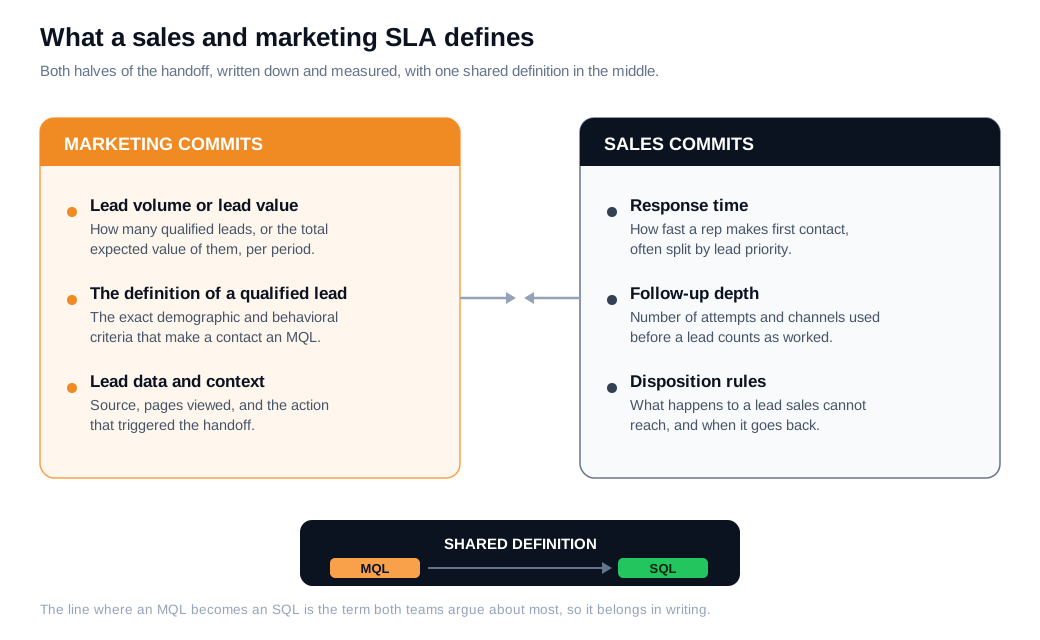
A sales and marketing SLA should define both halves of the handoff: what marketing delivers, and what sales does with it. Vague intentions on either side are what the document is meant to remove, so every term should be something you can measure at the end of the month. The Pedowitz Group's breakdown of the SLAs that should exist between the two teams splits them the same way, into what marketing owes and what sales owes back.
On the marketing side, the SLA sets:
- Lead volume or lead value. The number of qualified leads, or the total expected value of them, marketing will pass to sales in a given period.
- The definition of a qualified lead. The exact demographic and behavioral criteria that turn a contact into a marketing qualified lead (MQL), so both teams mean the same thing by the word.
- Lead data and context. What has to travel with each lead, such as source, pages viewed, and the action that triggered the handoff.
On the sales side, the SLA sets:
- Response time. How fast a rep makes first contact after a lead arrives, often split by lead priority.
- Follow-up depth. The number of attempts and the channels used before a lead is considered worked.
- Disposition rules. What happens to a lead sales cannot reach, and when it goes back to marketing for nurturing.
The two definitions that cause the most friction are MQL and SQL. Salesforce describes a marketing qualified lead as one that has engaged enough to be worth sales' attention, while a sales qualified lead is one a rep has vetted and accepted as a real opportunity with need, budget, and intent. The SLA is where both teams agree, in writing, on the score or criteria that move a lead from one to the other, which is the single line most often argued about after the fact.
How do you set lead volume and follow-up terms?
You set lead volume by working backwards from the revenue goal, and you set follow-up terms by tying response speed to how much each lead is worth. Both numbers come from data you already have, which keeps the agreement grounded rather than aspirational.
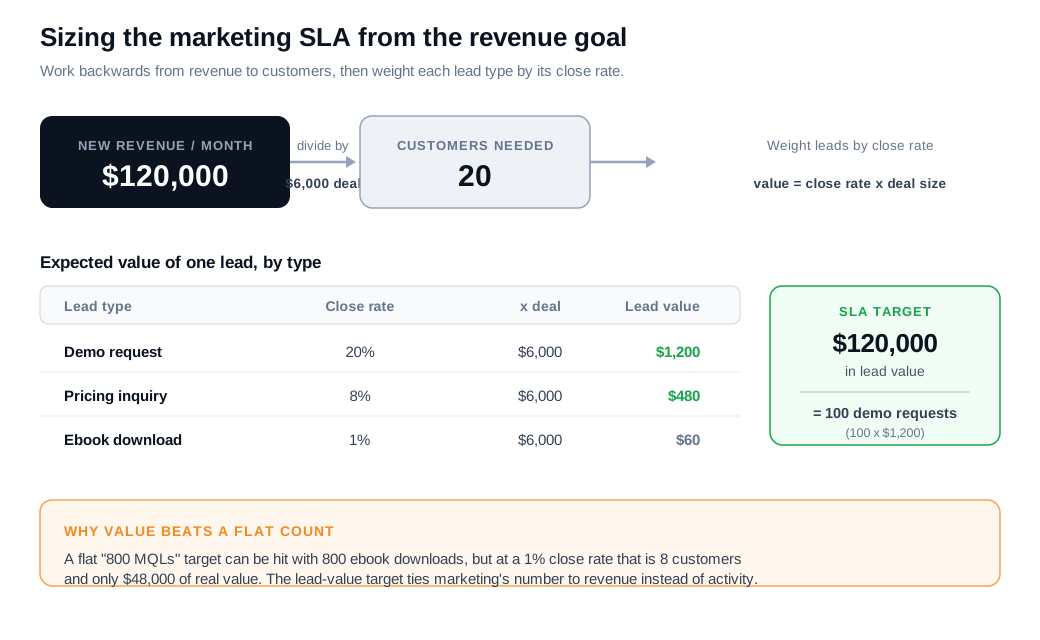
Start with the marketing side. Take the new revenue sales is on the hook for, divide by average deal size to get the number of customers needed, then use historical close rates to find how many leads produce that many customers. HubSpot recommends going one step further and setting the target in lead value rather than raw count, so marketing gets credit for quality instead of sheer volume.
Here is a worked example. Say sales must close $120,000 in new business a month, and the average deal is $6,000, so the team needs 20 new customers. Now weight each lead type by its historical close rate:
- A demo request closes at 20%, so it is worth 0.20 times $6,000, or $1,200 in expected revenue.
- A pricing-page inquiry closes at 8%, worth $480.
- An ebook download closes at 1%, worth $60.
Marketing's SLA becomes "deliver $120,000 in lead value per month," which 100 demo requests would satisfy on their own. Compare that to a flat target of 800 MQLs. Marketing could hit 800 by flooding the pipeline with ebook downloads, but 800 ebook leads at a 1% close rate produce only 8 customers and $48,000, far short of the goal. The lead-value method ties marketing's number to revenue instead of activity.
Follow-up terms work the same way, weighted by value. A common structure gives the highest-intent leads the fastest and most persistent follow-up: first contact within five minutes during business hours and up to six attempts over three days for a demo request, then a slower cadence for lower-value leads. The response windows should reflect the speed research above, not a comfortable internal habit. Hitting a five-minute window at any volume depends on the lead reaching the right rep the moment it lands, which is why automated routing and notifications and instant live chat on high-intent pages tend to sit underneath the sales side of any SLA that actually holds.
How do you enforce a sales and marketing SLA?
You enforce a sales and marketing SLA with one shared dashboard both teams read, a fixed review cadence, and an agreed consequence when either side misses its number. A document nobody opens after the kickoff meeting changes no behavior, so enforcement is what turns the terms into an agreement.
The dashboard comes first. Both the marketing number (lead value or volume delivered) and the sales number (response time, attempts, acceptance rate) belong on a single view that leadership and both teams can see at any time. When the numbers are shared and visible, most disputes settle themselves before they reach a meeting.
Then set the cadence. A practical rhythm is a weekly operational check on whether leads are being worked inside the SLA, a monthly review where both teams look at the trend and clear blockers, and a quarterly reset where leadership adjusts the targets and definitions to match capacity and the market. Executive sponsorship matters here, because the SLA only has teeth if a leader above both functions treats the numbers as real.
Consequences make it stick. If marketing misses its lead-value target, that is a signal to shift budget or fix a channel, and never a reason to quietly loosen the definition of a qualified lead. If sales does not contact a lead inside the response window, the lead should be flagged, and repeated misses should surface in the review by rep and by source. A short worked example: a team moves from 55% of MQLs contacted at an average of six hours to 92% contacted at nine minutes after putting response time on a shared dashboard and reviewing it weekly. No new leads were created. The lift came from making the commitment visible and reviewed.
What metrics tell you the SLA is working?
The metrics that tell you an SLA is working are the ones that cross both teams, so neither side can look good while the handoff fails. Tracking marketing's output and sales' effort in isolation is what let the problem hide in the first place.
The core set:
- Lead value or volume vs. target. Whether marketing delivered what it committed to, measured the way the SLA defines it.
- Speed to lead. The average time from lead creation to first sales touch, ideally segmented by lead priority.
- MQL acceptance rate. The share of marketing qualified leads that sales accepts as genuine opportunities, which is the truest test of lead quality.
- MQL-to-opportunity and closed-won from marketing. How many passed leads become pipeline and revenue, closing the loop back to the goal.
- SLA compliance rate. The percentage of leads handled inside the agreed response and follow-up terms.
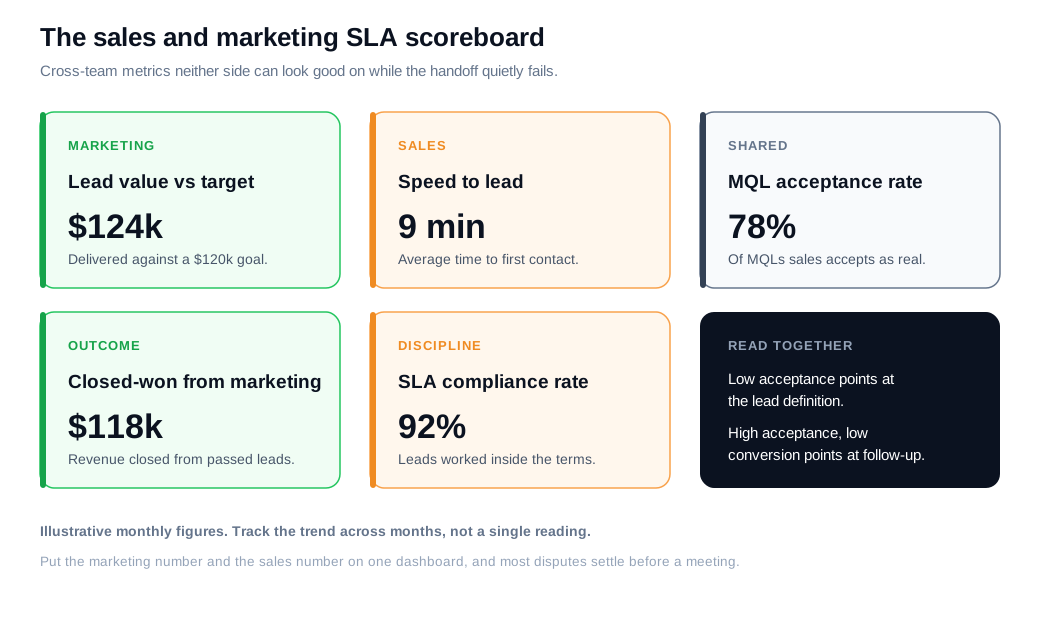
MQL acceptance rate deserves the most attention, because it is where the two halves of the SLA meet. A low acceptance rate means marketing is passing leads sales does not believe in, so the definition needs tightening. A high acceptance rate with poor conversion means the leads are fine and the follow-up is falling down, which points back at the sales terms. Read together, these numbers tell you which side of the agreement to fix, which is the whole reason to write one down.
Key takeaways
- An SLA makes the handoff measurable. It turns "good leads" and "fast follow-up" into numbers marketing and sales both sign, so the space between the two teams has rules instead of blame.
- It runs in both directions. Marketing commits to a volume or value of qualified leads, and sales commits to a response time, a number of attempts, and clear rules for leads it cannot reach.
- Size lead targets from revenue, not activity. Work backwards from the revenue goal to a lead-value number so marketing is credited for quality and cannot hit its target with low-intent volume.
- Speed terms should follow the research. The Lead Response Management Study found contacting a lead within five minutes made reps 21 times more likely to qualify it, which is why response windows belong in the agreement.
- Enforce it with visibility and cadence. One shared dashboard, a weekly, monthly, and quarterly review rhythm, and executive sponsorship keep the SLA alive after kickoff.
- Watch the cross-team metrics. MQL acceptance rate, speed to lead, and closed-won from marketing show whether the handoff is healthy and which side to fix when it is not.

Written by
Daniel SemeckyCo-founder & CEO
Daniel is the co-founder and CEO of Glimpze. He spends his days talking to revenue teams about how to catch high-intent visitors before they bounce, and writes about inbound sales, lead conversion, and building a motion where marketing and sales actually share a number.


