
On this page
- What is the lead-to-cash process?
- What are the stages of the lead-to-cash process?
- How is lead-to-cash different from quote-to-cash and order-to-cash?
- Where does the lead-to-cash process commonly break down?
- How do you optimize the lead-to-cash process?
- Which metrics tell you the lead-to-cash process is working?
- Key takeaways
- Sources
A marketing team posts a record month: 600 new leads. Sales works the ones it can reach, closes a respectable handful, and the quarter still misses target. When finance digs in, the picture gets uncomfortable. Roughly a third of those leads were never contacted at all, a dozen signed contracts sat unbilled for weeks, and two renewals lapsed because nobody flagged them in time. No single team failed. The revenue fell through the seams between them.
Those seams are exactly what the lead-to-cash process is built to hold together. It is the full path a customer travels from the first flicker of interest to money in the bank, and the discipline of running that path as one connected system instead of a relay race between teams that barely see each other's data.
This post covers what the lead-to-cash process is, the stages it moves through, how it differs from quote-to-cash and order-to-cash, where it usually breaks, how to optimize it, and the metrics that tell you it is actually working.
What is the lead-to-cash process?
The lead-to-cash process, often shortened to L2C, is the end-to-end sequence of steps that converts a new lead into collected revenue and a retained customer, spanning marketing, sales, finance, and customer success. It starts the moment a prospect raises a hand and ends well after the first invoice clears, at renewal and expansion.
DealHub defines lead-to-cash as all of the activities involved in turning potential leads into paying customers, covering the whole lifecycle from lead generation and marketing through sales, service, billing, and payment. The important word is "whole." Most process names in this area describe a slice of the journey. Lead-to-cash describes the entire thing, from the first click to the recurring payment two years later.
That breadth is the point. A lead is only worth something once the cash it represents is collected and the customer stays. When companies map their revenue engine as one continuous process rather than a set of departmental relays, the gaps that quietly swallow deals become visible. As Salesforce Ben's guide to lead-to-cash frames it, the value comes from connecting sales, marketing, and finance so a deal in progress can move without stalling at a border between teams.
What are the stages of the lead-to-cash process?
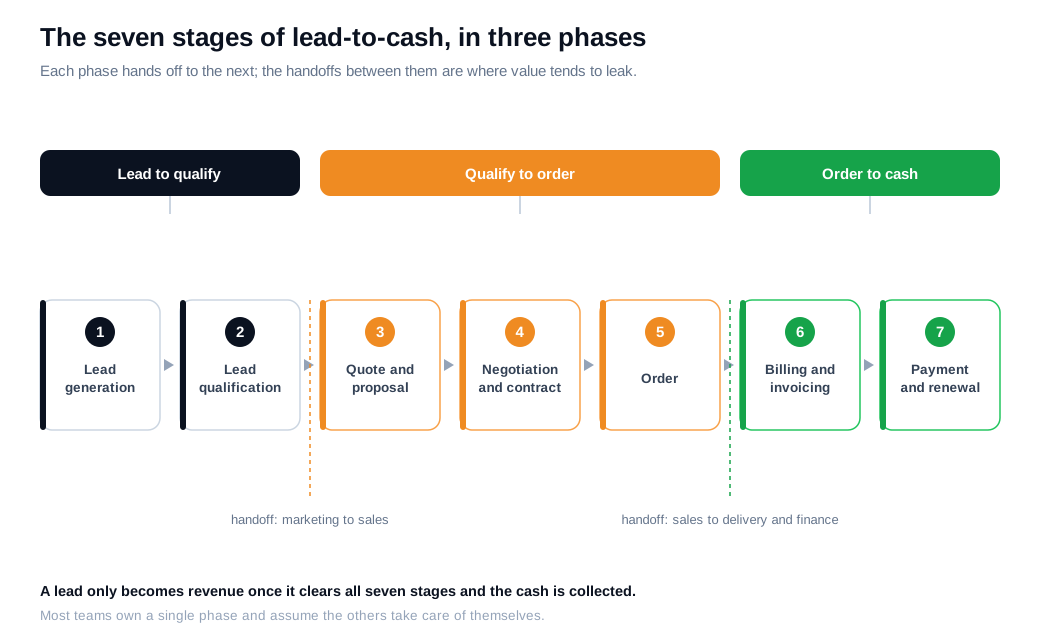
The lead-to-cash process runs through seven core stages that group into three phases: lead-to-qualify, qualify-to-order, and order-to-cash. The phases matter because each one hands off to the next, and the handoffs are where value tends to leak.
The seven stages, in order:
- Lead generation. Marketing and sales create demand and capture interest through content, ads, events, referrals, and inbound traffic.
- Lead qualification. Each lead is scored against fit and intent (budget, authority, need, and timing) so reps spend time on the ones worth a conversation.
- Quote and proposal. Sales configures a solution, prices it, and sends a quote, usually through configure-price-quote (CPQ) tooling for anything with options or discounts.
- Negotiation and contract. Terms, pricing, and legal language get agreed and the contract is signed.
- Order. The signed deal becomes an order that provisioning or fulfillment can act on.
- Billing and invoicing. The customer is invoiced according to the contract, whether that is a one-time charge or a recurring subscription.
- Payment, collection, and renewal. Payment is collected, revenue is recognized, and the relationship moves into onboarding, retention, and expansion.
DealHub groups these into the three phases: lead-to-qualify handles relationship development up to qualification, qualify-to-order covers the direct-sale mechanics where CPQ does most of the work, and order-to-cash delivers the product and collects the money. The three-phase view is useful because most teams own only one phase and assume the others take care of themselves.
How is lead-to-cash different from quote-to-cash and order-to-cash?
Lead-to-cash is the widest of the three processes: order-to-cash starts at the order, quote-to-cash starts at the quote, and lead-to-cash wraps both by adding demand generation and qualification in front of them. They nest inside each other like rings.
Order-to-cash (O2C) is the narrowest. It covers post-sale execution: taking an order, fulfilling it, invoicing, and collecting payment. It usually lives in an ERP or billing system and begins only after someone has already agreed to buy.
Quote-to-cash (Q2C) adds the pre-sale commercial steps. It begins at the quote and runs through configuration, pricing, contract negotiation, and order, then continues into invoicing and payment. According to RESPEC's breakdown of the three processes, quote-to-cash contains order-to-cash and simply starts earlier in the timeline.
Lead-to-cash extends the timeline one step further back, to the very first touch. It folds in marketing, lead capture, and qualification, so the process starts before a buyer has any interest and ends after they have paid. The practical takeaway is scope of ownership. A finance team can run order-to-cash on its own. Lead-to-cash forces marketing, sales, and finance to operate as one system, which is why it tends to sit with revenue operations rather than any single department.
Where does the lead-to-cash process commonly break down?
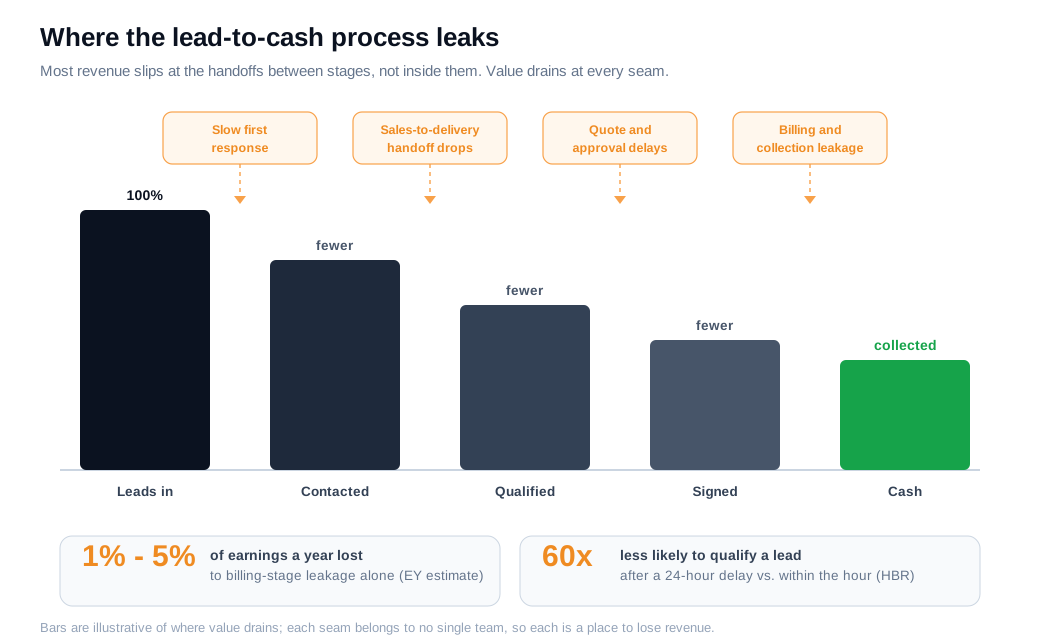
The lead-to-cash process almost always breaks at the handoffs between stages rather than inside them, at the moments when a lead, a quote, or a signed deal changes hands and loses momentum, context, or data. Each seam belongs to no single team, so each seam is where revenue quietly slips out.
Four breakpoints show up again and again:
- Slow first response. A lead comes in and sits in a queue while marketing and sales debate whose job it is. Classic research from Harvard Business Review, The Short Life of Online Sales Leads, analyzed 2.24 million leads and found that firms trying to contact a prospect within an hour were nearly seven times more likely to have a meaningful conversation than those who waited even 60 minutes longer, and 60 times more likely than those who waited 24 hours or more.
- The sales-to-delivery handoff. The deal closes, then the baton drops. Gartner's research on buyer regret found that most software buyers come away with some regret about a purchase, and a problematic handoff between sales and implementation is one of the leading drivers, cited by roughly 43% of buyers as a top source of dissatisfaction.
- Quote and approval delays. A quote waits days for a discount approval that lives in someone's inbox, and the buyer's urgency cools while the paperwork moves.
- Billing and collection leakage. Contracts get billed at the wrong rate, usage goes unmetered, and renewals lapse unnoticed. NetSuite's guide to revenue leakage describes how earned revenue slips away when contract terms, orders, and invoices fall out of sync. Industry estimates from EY, cited in DealHub's revenue leakage overview, put the loss at roughly 1% to 5% of earnings a year for a typical company.
Here is a worked example that puts numbers on the first breakpoint. Say marketing passes 600 leads a month to sales. Before any fixes, average first-response time is six hours and only 55% of leads are ever contacted, which means 330 conversations. The team then agrees on a rule: every lead gets a first touch within ten minutes during business hours, routed automatically to the right rep. First-response time drops to nine minutes and the contact rate climbs to 90%, which is 540 conversations. That is 210 more real conversations a month from the same 600 leads, with no extra marketing spend. The lift came entirely from closing one seam.
How do you optimize the lead-to-cash process?
You optimize the lead-to-cash process by mapping the whole journey end to end, giving one owner responsibility for the seams, tightening each handoff with clear rules and automation, and connecting the systems so data stops being re-keyed by hand. The order matters, because tooling cannot fix a process nobody has drawn.
A practical sequence:
- Map the full path. Draw every stage from first touch to renewal, mark each handoff, and note which system and which team owns each step. The map alone usually exposes two or three seams where deals stall.
- Assign a single owner. Someone, usually revenue operations, has to own the process across marketing, sales, and finance. Without one owner, every seam remains an orphan.
- Define entry and exit criteria for each stage. A "qualified" lead should mean the same thing to the marketer who passes it and the rep who receives it, with agreed rules for what triggers the handoff and how fast the next team must respond.
- Automate the handoffs. Route each lead to the right rep the moment it arrives and alert them instantly, so nothing waits in a queue. Getting the right lead to the right person quickly through automated routing and notifications is one of the highest-return fixes in the whole process, and it sits at the core of any serious inbound sales motion.
- Connect the stack. Link the CRM, CPQ, and billing systems so a quote becomes an order becomes an invoice without anyone retyping it. Manual re-entry is where both delay and error creep in.
- Shorten the first conversation. When a high-intent visitor is on the site, a real-time channel such as live chat turns a form-and-wait into a conversation while interest is still hot, which is often the difference between a qualified lead and a cold one.
The Salesforce Ben guide makes the same core point about consolidation: when lead management, quoting, ordering, and billing live in one connected flow rather than four disconnected tools, data stops shifting across systems and the cycle compresses on its own. Optimization is mostly the removal of friction at the borders, not heroics inside any single stage.
Which metrics tell you the lead-to-cash process is working?
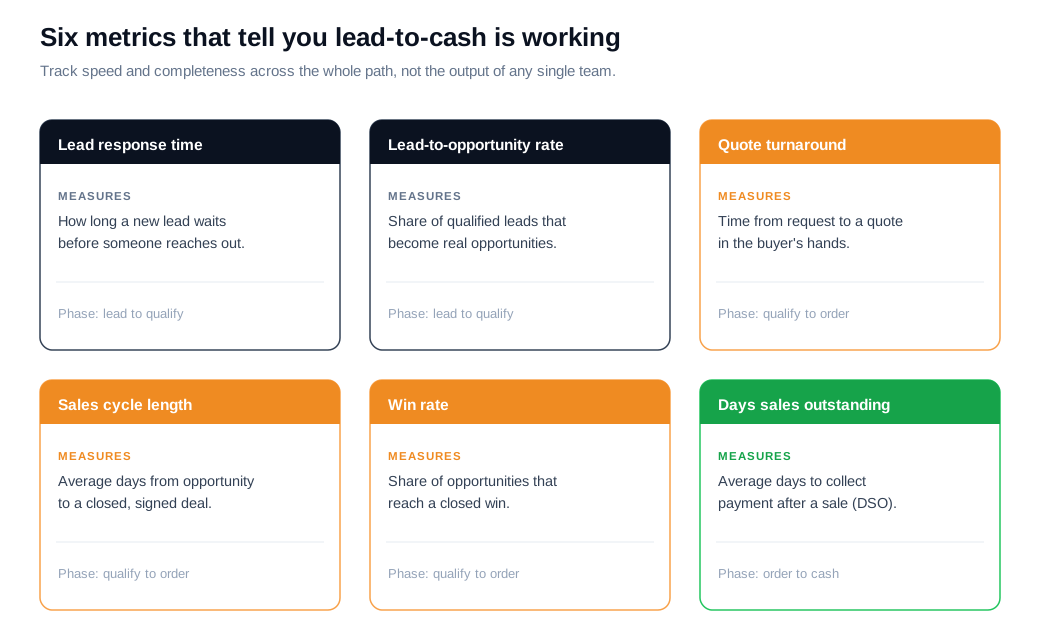
The metrics that tell you lead-to-cash is working measure how fast and how completely value moves through the entire path, rather than the output of any single team: lead response time, lead-to-opportunity conversion, quote turnaround, sales cycle length, win rate, and days sales outstanding. Watched together, they show where the process speeds up and where it clogs.
The core set and what each one answers:
- Lead response time: how long it takes to make first contact with an inbound lead. It is the earliest signal that a handoff is slow.
- Lead-to-opportunity conversion: the share of qualified leads that become real opportunities. It shows whether qualification is doing its job.
- Quote turnaround: how long from request to a quote in the buyer's hands. Long turnaround points at approval and pricing bottlenecks.
- Sales cycle length: the average days from opportunity to closed deal. It is the headline speed number for the middle of the process.
- Win rate: the share of opportunities that close. It reveals how much of the pipeline the process actually converts.
- Days sales outstanding (DSO): the average days to collect payment after a sale. It closes the loop, because a deal is not revenue until the cash lands.
Here is a worked example on cycle time and cash. A company closes deals at an average of $18,000 and runs a 70-day cycle from first touch to signature, then takes another 45 days to collect (a DSO of 45), so cash lands about 115 days after the lead arrives. RevOps tightens the qualify-to-order phase, cutting the sales cycle to 55 days, and moves billing into the CRM so invoices go out on the day of signature, trimming DSO to 30. The same deal now converts to cash in about 85 days. Across 200 deals a year, pulling roughly $3.6 million forward by a month materially changes what the business can fund, with no change to price or volume.
Key takeaways
- Lead-to-cash is the whole revenue path. It runs from the first sign of interest through qualification, quoting, ordering, billing, payment, and renewal, treated as one connected system across marketing, sales, and finance.
- It moves through seven stages in three phases. Lead-to-qualify, qualify-to-order, and order-to-cash each hand off to the next, and the handoffs are where deals stall.
- Scope is what separates it from its cousins. Order-to-cash starts at the order and quote-to-cash starts at the quote, while lead-to-cash wraps both by adding demand generation and qualification up front.
- The breaks happen at the seams. Slow first response, a dropped sales-to-delivery handoff, quote delays, and billing leakage of roughly 1% to 5% of earnings all live between stages, not inside them.
- Optimization is friction removal at the borders. Map the path, give the seams one owner, define stage criteria, automate the handoffs, and connect the CRM, CPQ, and billing systems.
- Measure speed and completeness end to end. Track lead response time, conversion, quote turnaround, sales cycle length, win rate, and DSO together, because a lead only counts once the cash is collected.

Written by
Daniel SemeckyCo-founder & CEO
Daniel is the co-founder and CEO of Glimpze. He spends his days talking to revenue teams about how to catch high-intent visitors before they bounce, and writes about inbound sales, lead conversion, and building a motion where marketing and sales actually share a number.


