
On this page
- How do technical buyers evaluate demos?
- How do non-technical buyers evaluate demos?
- How do you adjust depth and language for each audience?
- How do you demo to a mixed audience of technical and non-technical people?
- How do you find out who will be in the room before the demo?
- How do you know if you demoed at the right level?
- Key takeaways
- Sources
Two people join the same 45-minute demo. One is a VP who wants to know whether the product will save her team a day a week. The other is an engineer who wants to know whether it will survive contact with their single sign-on setup. You show one demo, and one of them leaves convinced while the other leaves unsure, because the call was pitched at exactly one of them.
The gap rarely comes down to talent. A technical evaluator and a business buyer grade a demo against different questions, and a demo tuned for one reads as thin or as noise to the other. The fix is to know who is evaluating what, then pitch each person at the depth they actually trust.
This guide covers how technical buyers evaluate a demo, how non-technical buyers evaluate it, how to adjust depth and language for each, how to run a demo for a mixed audience, how to find out who is in the room before you start, and how to tell whether you pitched at the right level.
How do technical buyers evaluate demos?
Technical buyers evaluate a demo by whether the product will actually work in their environment, so they watch the architecture, integrations, security, and the honest edges of the product more than the headline features. An engineer, IT lead, or solutions architect joins to find the risk you are not showing, and a smooth happy-path tour reads to them as a reason to dig harder.
They also want to drive. Dock's guide to selling to technical buyers makes the point that engineers and developers want to try before they buy, which usually means a sandbox, a trial, or a proof of concept rather than a scripted walkthrough. Walnut describes the technical demo as the deep, customized, hands-on session where a solutions engineer proves compatibility and works through real use cases, and notes that an unguided format that lets the buyer click freely suits confident, high-intent evaluators.
What convinces this buyer is specifics. Real data instead of "Acme Corp" placeholders, a live connection to a system they actually run, a straight answer to "what happens when this fails," and a willingness to say "that is on the roadmap, not shipped yet." Consensus, in its six demo types framework, places the technical demo late in the cycle precisely because it is where a sales engineer's expertise carries the deal, after the vision has already landed with someone else.
The fastest way to lose a technical buyer is to dodge. A vague answer to a pointed question does more damage than admitting a gap, because the entire reason they are in the room is to test whether you are a credible partner under pressure.
How do non-technical buyers evaluate demos?
Non-technical buyers evaluate a demo by whether the product produces a business outcome they care about, so they track time saved, cost avoided, risk reduced, and revenue gained more than how any feature is built. A VP, a director, or an economic buyer is measuring the meeting against one question: is this worth the money and the disruption of switching?
They think in outcomes and they lose the thread on mechanics fast. HubSpot's write-up on value-based selling puts it plainly: buyers care about the result a capability produces, so every screen has to answer "so what?" for their corner of the business. A line like "our engine re-indexes in real time" lands as noise for a CFO until it becomes "your team stops waiting an hour for reports, so a month-end close that runs four days runs two."
Proof for this buyer looks different too. A named customer in their industry, a before-and-after number, a simple payback figure, and a plausible path to getting live all carry more weight than a feature count. Consensus reserves the vision demo, the short problem-solution-benefit story, for exactly this listener at the top of the cycle, because a business buyer needs to picture the payoff before anyone opens the hood.
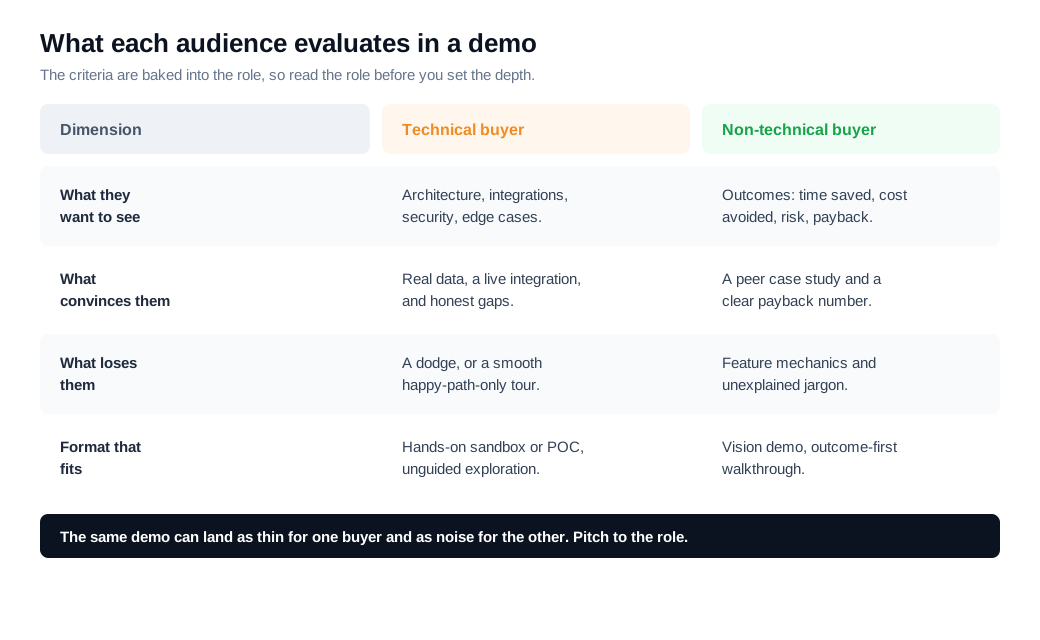
The mistake in both directions is symmetrical. Show a business buyer the architecture and they check their phone. Show a technical buyer a slide of logos and a payback chart and they conclude you are hiding the product. The evaluation criteria are baked into the role, so read the role first.
How do you adjust depth and language for each audience?
Adjust depth and language by moving three dials for each listener: the amount of technical detail, the vocabulary you reach for, and the kind of proof you show. The same feature gets a different framing for an engineer and a finance lead, and saying it two ways in one breath is a skill you can practice.
The trap is the curse of knowledge. Research on overcoming the curse of knowledge describes a cognitive bias where experts overestimate what others know, skip the background, and reach for jargon that means nothing to an outsider. In a demo it shows up as an acronym the VP will not interrupt you to define, so they quietly disengage instead. A working habit fixes it: for every technical term, keep a plain-language version ready and lead with it, then add the precise term for anyone who wants it, as in "we cache the results, so the page loads instantly even on a repeat visit."
Depth follows the same logic in reverse for each side. For a business buyer, give one sentence on how it works and three on what it produces. For a technical buyer, flip the ratio, with one sentence on the outcome and the rest spent under the hood, on the integration, the data model, and the failure modes.
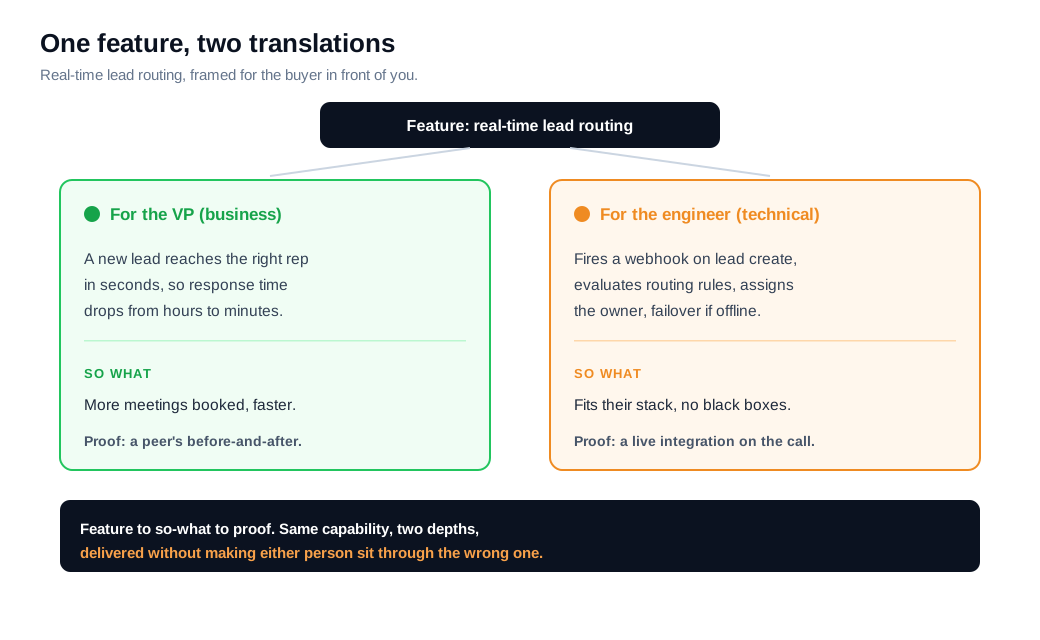
Try it on a single capability. Take real-time lead routing. For the VP: "a new lead reaches the right rep in seconds, so your response time drops from hours to minutes and more meetings get booked." For the engineer: "it fires a webhook on lead creation, evaluates your routing rules, and assigns the owner, with a fallback queue if the primary rep is offline." Same feature, two translations, and the strongest demos deliver both without making either person sit through the wrong one.
How do you demo to a mixed audience of technical and non-technical people?
Demo to a mixed audience by splitting the call into role-based blocks, signposting who each block is for, and parking deep technical questions to a named point rather than chasing every one live. Most real demos are mixed rooms, because a B2B buying decision now runs through a committee where every stakeholder grades a different thing.
The committee is the reason this matters. Gartner puts the typical B2B buying group at 6 to 10 decision makers, each carrying their own criteria, and finds that buyers spend only about 17 percent of the purchase journey meeting with all suppliers combined, so any single vendor gets a sliver of their attention. You often get one live demo to satisfy the whole group, which makes structure the difference between a call that lands for everyone and one that lands for no one.
Signposting is the core move. Open with a business frame that everyone needs, run a shared outcome-first walkthrough, then split out loud: "for the next ten minutes I'll go deep on the integration and security side for the technical folks, and if that is not your area, this is a fine moment to step away, I'll flag when we're back to the big picture." That single sentence respects the VP's time and gives the engineer permission to go deep, and it keeps neither person trapped in the other's section.
Two presenters make this easier. The account executive carries the business context and the close while the sales engineer owns the technical depth and fields the detailed questions. Gong's analysis of 67,149 recorded SaaS demos found that the calls that lost tended to be long, uninterrupted monologues, while the ones that won chopped content into short segments with questions between them, a rhythm that matters even more when half the room only cares about half the material.
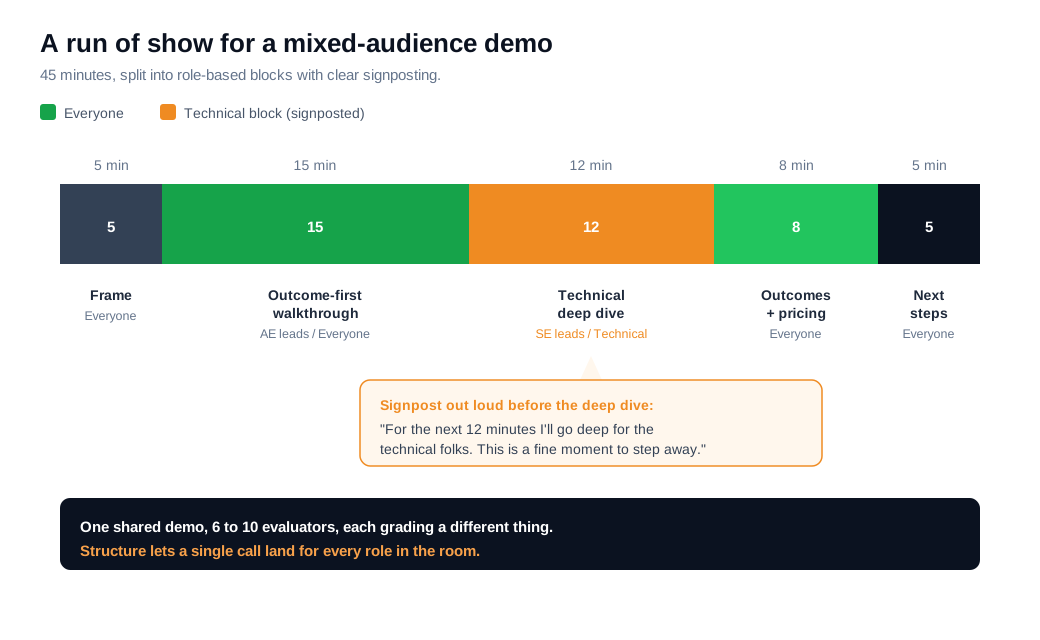
The math works out cleanly on a 45-minute slot. Spend about 5 minutes framing the call for everyone, 15 on an outcome-first walkthrough the whole room can follow, 12 on a signposted technical deep dive led by the engineer on your side, 8 coming back to outcomes and a pricing frame, and 5 on next steps. The business buyer gets 28 minutes aimed at them and can drop off during the deep dive, the technical buyer gets a dedicated 12 with the hood up, and no one sits through a stretch that was never meant for them.
How do you find out who will be in the room before the demo?
Find out who will be in the room by asking during scheduling and confirming again in the first two minutes of the call, because you cannot tailor depth for people whose roles you are guessing. A one-line question in the calendar invite, "who else should join, and what is each person hoping to get out of it," turns a blind demo into a targeted one.
Discovery is where the plan gets set. If you learned that the VP cares about ramp time and the architect cares about single sign-on, you already know the two threads to pull and the two translations to prepare. When a demo grows out of an inbound conversation on your own site, you often have that context before a call is even booked, and a rep who opens a live video call or screen share with a high-intent visitor can simply ask who the evaluators are while interest is peaking. For an inbound sales team, that head start is the whole difference between a tailored demo and a generic one, and pairing the signal with fast lead routing and Slack alerts puts the request in front of the right rep before the moment passes.
The opening minutes are your last checkpoint. Confirm the roles out loud, restate what each person told you they want, and adjust the plan if a surprise VP or a surprise engineer showed up uninvited. It costs thirty seconds and it saves you from pitching the entire call at the wrong depth.
How do you know if you demoed at the right level?
You know you demoed at the right level when each stakeholder can restate, in their own words, why the product matters to them, and the technical evaluator agrees to a concrete next technical step. The signals are behavioral, and you can read most of them while the call is still live.
Watch engagement person by person. If the VP went quiet during a feature stretch and the engineer leaned in, you pitched that section technically, and the reverse pattern means you skated over depth the engineer needed. The fix is to check in by role rather than to the room in general: "does that cover the security questions on your side?" for the engineer and "does that map to the outcome you're measuring?" for the VP. A real answer tells you more than a polite nod from the whole group.
Presales teams measure this split on purpose. A sales engineering function can win 80 percent of its technical evaluations and still lose deals when the business case never lands, so tracking the technical win and the business sponsor's stated outcome as separate signals shows you which half of the room you keep losing. Consider a rep running 20 mixed demos a quarter and stalling on 8 of them because one audience walks away unconvinced. Tightening the role-based structure to recover half of those stalls is 4 more live deals a quarter, produced by resequencing a call you were already running.
The scarcity of the meeting raises the stakes. Gartner's 2026 sales survey found that 67 percent of B2B buyers prefer a rep-free experience, which means the live demo you do earn is rare and has to work for every role in the room at once. Record your calls and review them against a simple test: could each stakeholder have said, out loud, why this is worth it to them? When the answer is yes across the room, your depth was right.
Key takeaways
- Technical buyers grade the product, business buyers grade the outcome. Engineers watch architecture, integrations, and failure modes and want to drive, while VPs and economic buyers watch time saved, cost avoided, and payback and want the "so what."
- Read the role before you set the depth. The evaluation criteria are baked into the job, so a business buyer tunes out on architecture and a technical buyer distrusts a demo that only shows logos and charts.
- Adjust three dials for every listener. Change the level of detail, swap jargon for a plain-language version led first, and match the proof, giving one sentence on how it works to a VP and the opposite ratio to an engineer.
- Signpost a mixed room into role-based blocks. With a typical buying group of 6 to 10 people and often one shared demo, open for everyone, split out loud for the deep dive, and use two presenters so no one sits through the wrong section.
- Find out who is joining before you start. Ask in the invite and confirm in the first two minutes, and lean on discovery or a live inbound conversation to learn each evaluator's priority ahead of time.
- Judge the level by what each person can restate. You pitched right when every stakeholder can say why it matters to them and the technical evaluator books a next technical step, and recovering stalled mixed demos adds deals with no new pipeline.
TAGS

Written by
Daniel SemeckyCo-founder & CEO
Daniel is the co-founder and CEO of Glimpze. He spends his days talking to revenue teams about how to catch high-intent visitors before they bounce, and writes about inbound sales, lead conversion, and building a motion where marketing and sales actually share a number.


