
On this page
- What goes into conversational marketing ROI?
- How do you calculate conversational marketing ROI?
- How do you attribute revenue to conversations?
- What metrics prove the value of conversational marketing?
- What counts as a good conversational marketing ROI?
- How do you present conversational marketing ROI to leadership?
- What mistakes make conversational marketing ROI look worse than it is?
- Key takeaways
- Sources
A marketing lead is defending the chat program at a budget review. The CFO asks a simple question: what did the conversation channel actually return last quarter? The honest answer, for most teams, is a shrug and a slide showing how many chats were started, which is a number the CFO has no way to price.
Conversational marketing is measurable. The trouble is that the return hides in three places at once. Some revenue the conversation sourced outright, some it only influenced on the way to a deal that closed months later, and a cost that is easy to understate because most of it is people's time. Get the accounting right and the channel usually defends itself. Get it wrong and a program that works looks like a rounding error.
This guide covers what goes into the ROI number, how to calculate it with a worked example, how to attribute revenue to conversations, which metrics prove value, what a good return looks like, how to present it to leadership, and the mistakes that make the result look worse than it is.
What goes into conversational marketing ROI?
Conversational marketing ROI has two sides: a cost you can list on one hand, and a return that arrives in a few different forms, and most arguments about the number come from mishandling one of them.
The cost side is the easier half to get right, as long as you count all of it. That means the platform subscription, the staff time spent answering and routing chats, the one-time work of wiring the tool into your CRM and Slack, any AI assistant or add-ons, and the hours someone spends pulling the reports. The subscription is usually the smallest line. Human time is usually the largest, and leaving it out is the fastest way to publish an ROI number that falls apart under questioning.
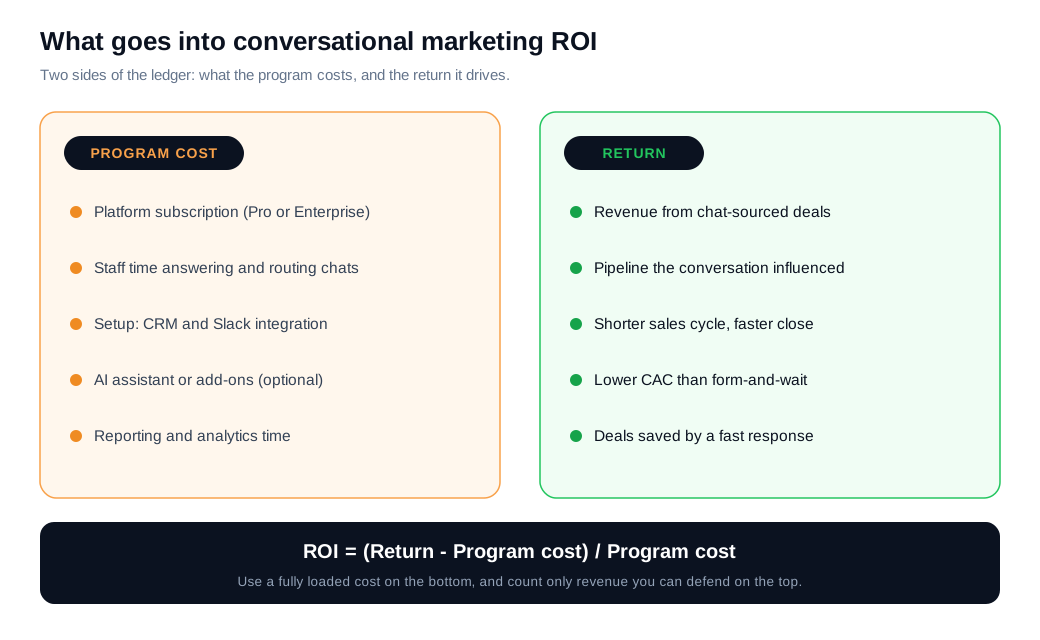
The return side is where the real work lives. Revenue the conversation sourced outright is the cleanest form and the one to lead with. Pipeline the chat influenced but did not source is real too, though you have to claim it carefully. Two softer returns round it out: a shorter sales cycle when a live answer removes a back-and-forth, and a lower cost per acquired customer because you are converting traffic you already paid to attract rather than buying new clicks. A live chat widget on a pricing page mostly captures demand you already paid to attract, rather than creating new demand.
The formula itself is the same one every marketing channel uses. ROI equals return minus cost, divided by cost, expressed as a percent. HubSpot's marketing ROI guide frames it the same way, with a campaign that returns $10,000 on $2,000 of spend landing at a 400 percent return. The formula is trivial. Deciding which revenue and which cost belong inside it is the whole job.
How do you calculate conversational marketing ROI?
You calculate it by running defensible revenue through that formula over a fully loaded cost, and the discipline is in the word defensible: count the deals you can trace to a conversation, at a margin your finance team recognizes, against every dollar the program spent.
Here is a worked example with illustrative B2B SaaS numbers. Suppose your site sends 600 high-intent visitors a month to pricing, product, and demo pages. A conversational setup engages 12 percent of them, which is 72 conversations. Half qualify into 36 real leads, reps book 11 of those into meetings, and roughly 2 become customers. That is about 24 chat-sourced customers a year.
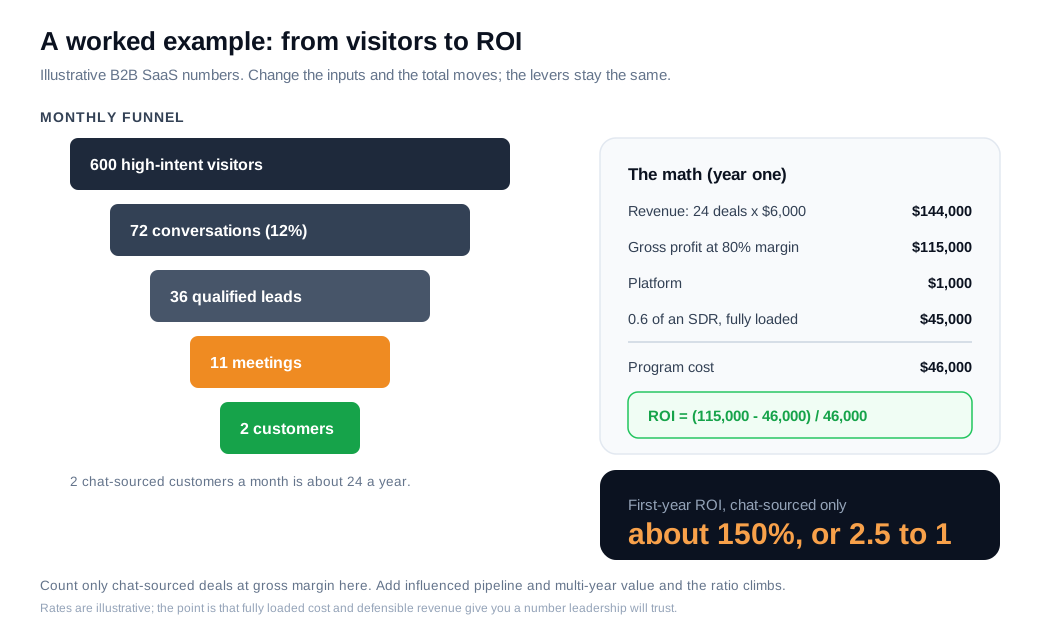
Now price it. At a $6,000 average contract value, 24 deals is $144,000 in first-year revenue. Apply a typical 80 percent SaaS gross margin and you have $115,000 in gross profit. On the cost side, the platform runs about $1,000 a year, and the honest labor line is roughly 0.6 of an SDR's fully loaded time monitoring chat and running meetings, call it $45,000. Total program cost is $46,000. ROI is (115,000 minus 46,000) divided by 46,000, which is about 150 percent, or 2.5 to 1, in the first year, counting only chat-sourced deals at gross margin.
That is a conservative floor on purpose. Count the pipeline the channel influenced, or the three-year value of those customers instead of one, and the ratio climbs past 5 to 1. Lead with the conservative number in front of finance, and keep the fuller version ready for the follow-up question.
How do you attribute revenue to conversations?
You attribute revenue to conversations by capturing an identity in every chat, passing it to your CRM as a distinct source, and reporting it through both a single-touch and a multi-touch model so the channel is not judged on last-click alone.
The plumbing comes first. A conversation that qualifies a buyer has to create or update a CRM record, tagged as chat-sourced, with the transcript attached. That only happens reliably if the tool pushes the lead the moment it qualifies, which is why lead routing and notifications are part of measurement and not just operations. No record, no attribution.
Then choose your models. First-touch attribution credits the interaction that opened the relationship, last-touch credits the final step before the deal, and multi-touch spreads credit across the journey. B2B buying is long and crowded, so a single-touch model almost always misreads a conversation's role. A common multi-touch approach, the W-shaped model, weights the first touch, the lead-creation touch, and the opportunity-creation touch at roughly 30 percent each, splitting the remainder across the rest.
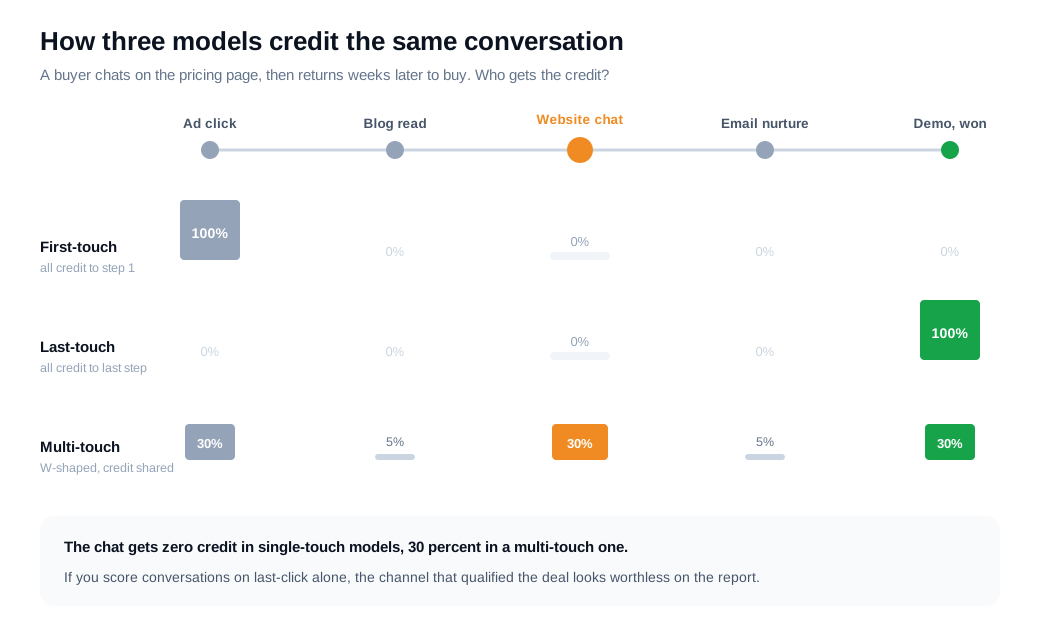
The diagram shows why this matters. A buyer chats on the pricing page, disappears, and returns weeks later to buy through a demo. Score that on last-click and the conversation that qualified the deal gets nothing. Score it W-shaped and it earns about 30 percent, which is closer to its real influence. Report both models side by side so nobody can accuse you of cherry-picking the flattering one.
Two settings finish the job. Set your attribution window to your actual sales cycle, since a 7-day window on a 60-day cycle systematically undercounts the channel; most B2B SaaS teams need 30 to 90 days. And accept the lag, because reliable attribution data for a multi-month cycle takes 6 to 12 months to accumulate. This also explains the dark-funnel gap: Gartner has found that B2B buyers spend only 17 percent of their total purchasing time meeting with any supplier, so a great deal of the journey happens where no touch is logged. Multi-touch attribution narrows that gap, it does not close it.
What metrics prove the value of conversational marketing?
The metrics that prove value climb a ladder from activity to revenue, and leadership cares only about the top rungs, so track the whole ladder but lead with the money.
The bottom rung is activity: conversations started and engagement rate, meaning the share of high-intent visitors who actually chat. Useful for optimizing prompts, close to worthless in a board slide on their own. The next rung is efficiency: qualification rate, first response time, and chat-to-meeting rate. This is where conversational marketing earns its keep on paper, because chat-to-conversion rates run about 10 to 20 percent against the 2 to 3 percent a static web form manages, per Which-50's benchmark roundup.
The top two rungs are the ones executives price. Pipeline metrics cover meetings booked and pipeline sourced and influenced. Revenue metrics cover closed-won, customer acquisition cost, and the ROI figure itself. Cometly's framework for reporting to executives sorts KPIs into four layers, activity, efficiency, pipeline, and revenue, and maps each to a different audience, which is a clean way to decide what goes on which slide.
A practical rule keeps the reporting honest. Pick three to five metrics per audience and no more. Your team needs engagement rate and first response time to run the channel. Your VP needs meetings and sourced pipeline. Your CFO needs revenue, CAC, and ROI. An AI chat assistant that qualifies visitors around the clock feeds this ladder cleanly, because every conversation it handles is logged, timestamped, and scored, which is exactly the raw data attribution needs.
What counts as a good conversational marketing ROI?
A good conversational marketing ROI lands between 3 to 1 and 5 to 1 for most B2B teams, though the channel is better judged on cost per acquired customer and payback than on the headline ratio alone.
The general benchmarks give you goalposts. A 2 to 1 return is usually the minimum worth keeping, 3 to 1 is a solid baseline, and 5 to 1 is considered strong, with B2B software often targeting the higher end because contract values and margins are high, according to MarketerHire's roundup of marketing ROI benchmarks. In the worked example above, a first-year 2.5 to 1 on chat-sourced revenue alone sits just above baseline, and it grows once influenced pipeline and multi-year value are counted.
CAC and payback are the more durable measures. A healthy business runs a lifetime-value-to-CAC ratio around 3 to 1, per Wall Street Prep, and the median SaaS company recovers its acquisition cost in under 7 months. The example channel acquires 24 customers for $46,000, a CAC near $1,900, which usually undercuts a company's blended CAC because it converts existing traffic instead of paying for new clicks. That comparison, chat CAC versus blended CAC, is often more persuasive than the ROI percentage.
Treat vendor case studies as directional rather than typical. Lift AI reports that Drift customers using its intent scoring see around 9 times more conversations turn into pipeline, and it cites a customer, PointClickCare, that lifted conversions by 400 percent and added more than $1M in incremental revenue in the first year. Those are real, published results, and they are also the best cases from a vendor with an interest in the number. Use them to size the opportunity, then prove your own figure.
How do you present conversational marketing ROI to leadership?
You present it by translating chat activity into the language leadership already speaks, pipeline and revenue and CAC, then telling one tight story with a situation, an action, a result, and a recommendation.
Lead with the business goal, not the channel. If the company wants to grow new ARR, open with the pipeline and revenue the conversation channel produced against that target, then work down to how it happened. Cometly's guidance is blunt on this point: executives think in revenue, pipeline, and return, so map every marketing activity to those before anything else, and pick three to five KPIs that carry the core story rather than pasting the full dashboard.
Here is how a single line sounds when it is built this way. "The conversation channel sourced $144,000 in new ARR last year against $46,000 of fully loaded cost, a first-year ROI near 150 percent, at a CAC of about $1,900 per customer, below our blended CAC." That sentence names the return, the cost, the ratio, and the efficiency measure a CFO trusts most, in the order they want to hear them.
Two more habits protect the number. Report on a steady monthly cadence with a one-page summary, so the channel is a known quantity rather than a surprise at budget season. And account for lag out loud, because pipeline created this quarter often closes next quarter, and a team that measures ROI in real time will understate a channel that works and lose the budget that proves it. The whole exercise is really about inbound sales discipline: tie the conversation to a dollar, and report that dollar the same way every month.
What mistakes make conversational marketing ROI look worse than it is?
The mistakes that sink the number are a last-click report that hides the channel's influence, a cost figure that omits staff time, and an attribution window shorter than the sales cycle.
Last-click is the most common and the most damaging. It hands all the credit to whatever touch happened right before the deal, usually a demo or a sales email, and leaves the conversation that qualified the buyer looking like it did nothing. Reporting a multi-touch model alongside it is the fix, and it is the difference between a channel that reads as free pipeline and one that reads as overhead.
The cost mistakes cut both ways. Omitting staff time inflates ROI until finance recalculates it and your credibility with it. The reverse error, charging a full SDR salary against a channel the rep only works part-time, understates the return just as badly. Load the cost honestly, at the fraction of time actually spent.
The timing mistakes are quieter. A short attribution window on a long cycle undercounts every deal that takes more than a few weeks, and measuring the program at all in month two, before a multi-month cycle has closed anything, produces a loss on paper for a channel that is working. Give it 6 to 12 months of data before you judge it. One operational trap underlies all of these: a widget that promises a fast reply and then goes unanswered converts worse than no widget, so the response has to be genuinely fast for any of the measurement to matter.
Key takeaways
- Count both sides honestly. Conversational marketing ROI is return minus cost over cost, where the cost is fully loaded with staff time and the return is defensible revenue, not conversation counts.
- Lead with sourced revenue, then influence. A conservative first-year figure using only chat-sourced deals at gross margin is the number that survives a budget review; influenced pipeline and multi-year value are the follow-up.
- Attribute with two models, not one. Report a single-touch and a multi-touch view side by side, set the attribution window to your real sales cycle, and expect 6 to 12 months before the data settles.
- Climb the metrics ladder. Track activity, efficiency, pipeline, and revenue, but put pipeline, CAC, and ROI in front of leadership and keep engagement rate for the team.
- Judge it on CAC and payback. A 3 to 1 return is a solid baseline and 5 to 1 is strong, though chat CAC versus blended CAC is usually the more persuasive comparison for a CFO.
- Report on a cadence and account for lag. A steady monthly one-pager, and an explicit note that this quarter's conversations close next quarter, protect a working channel from being measured too early.

Written by
Daniel SemeckyCo-founder & CEO
Daniel is the co-founder and CEO of Glimpze. He spends his days talking to revenue teams about how to catch high-intent visitors before they bounce, and writes about inbound sales, lead conversion, and building a motion where marketing and sales actually share a number.


