
On this page
A marketing lead opens the quarterly review with one slide: live chat drove $312,000 in revenue. The room nods along until the CFO asks the only question that matters. How much of that would have closed anyway?
That question is where most live chat ROI numbers fall apart. The widget sits in front of your highest-intent visitors, the ones already reading your pricing page with a card half out of their wallet, so it collects credit for deals it merely witnessed. Proving real return means separating the revenue chat caused from the revenue it happened to be near, then setting that against a cost most teams quietly undercount.
This guide covers what live chat ROI is and how to calculate it, the full ledger of costs and returns, how to attribute revenue to chat without fooling yourself, the metrics that prove value, how long payback takes, and how to present the number to leadership so it survives scrutiny.
What is live chat ROI, and how do you calculate it?
Live chat ROI is the net financial return your chat program produces divided by what it costs to run, written as (return minus cost) divided by cost, then read as a percentage or a multiple. The formula is the same one finance uses for any investment. The work is in filling the two numbers honestly.
Return has two parts: the incremental gross profit from revenue chat actually caused, plus the support cost you avoid by handling contacts in chat instead of on the phone. Cost also has parts you can name: the software subscription, the loaded time your reps spend answering, and the one-time setup spread across the months it serves.
Here is the shape of a clean calculation. A program that returns $17,000 in a month against a $2,100 monthly cost has an ROI of ($17,000 minus $2,100) divided by $2,100, which is about 7.1, or 710 percent. One detail decides whether that number is real. Count gross profit on the revenue side, never top-line revenue, because a dollar of sales that costs 20 cents to deliver is worth 80 cents to the business, and ROI is a profit measure.
What costs and returns go into chat ROI?
Chat ROI has two sides, an investment side made of software, agent time, and setup, and a return side made of incremental revenue and avoided support cost, and the most common mistake is to inflate the return while forgetting the loaded cost of the people typing the replies. The subscription line is the easy part and usually the smallest.
Agent labor is the line teams miss. A fully-loaded US support agent runs roughly $60,000 to $65,000 a year once you add benefits, payroll tax, software seats, and management overhead onto base pay. If two reps each spend a fifth of their week in chat, that is a real four-figure monthly cost, and leaving it out is how a 2x program gets reported as a 20x one.
Chat earns part of its return by being cheaper to staff than the phone. Because an agent can hold several chats at once, a web chat contact costs less than a voice call, and channel benchmarks bear that out: one 2026 cost-per-ticket roundup puts chat resolutions at $8 to $14 against $17 to $25 for phone and $9 to $16 for email. Every contact chat absorbs from the phone queue is a saving that belongs on the return side.
The bigger return is revenue. Forrester found that site visitors who use web chat are 2.8 times more likely to convert than those who do not, and a Bold360 benchmark in the same analysis found that a buyer who chats tends to spend around 60 percent more. Those numbers describe correlation, so the trick is to convert them into a defensible dollar figure rather than banking them at face value.
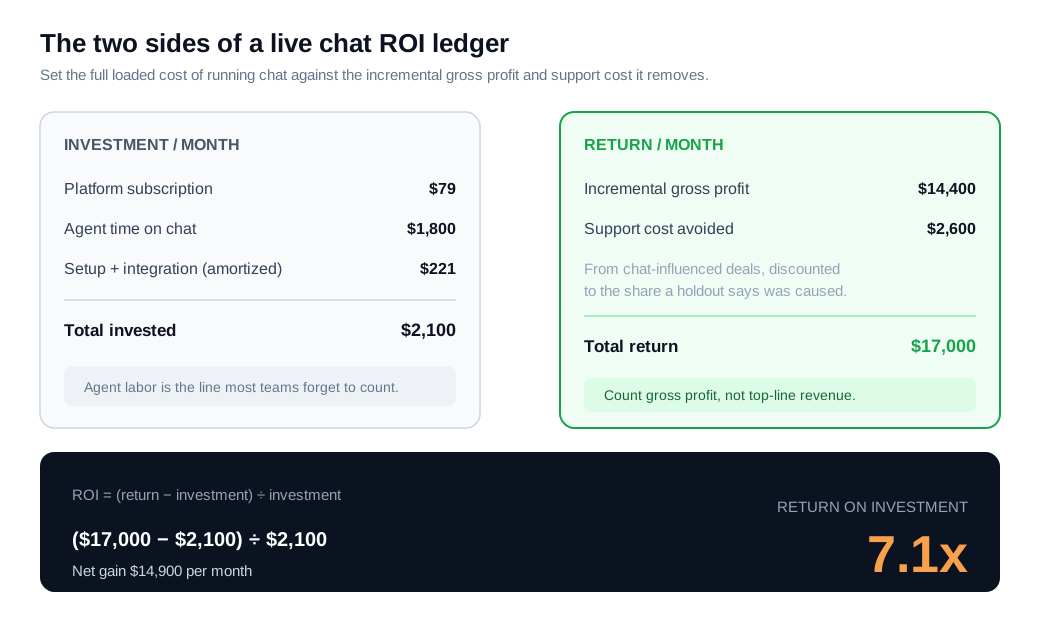
Take a worked example. A B2B live chat program pays $79 a month for the platform, spends about $1,800 a month of loaded agent time on chat coverage, and carries $221 a month of amortized setup and integration work, for $2,100 invested. On the return side it earns $14,400 in incremental gross profit and avoids $2,600 in phone and email cost, for $17,000 returned. Net gain is $14,900 a month, and the ROI is 7.1x. The next section shows how that $14,400 gets built, because it is the number a skeptic will attack first.
How do you attribute revenue to chat?
Attribute revenue to chat by tagging which conversations touched a deal, then discounting that credit down to the portion chat actually caused, because raw "chat-influenced" totals always overstate impact. The gap is not a small one, and ignoring it is common. Ruler Analytics reports that 53 percent of marketers fail to attribute sales and revenue back to live chat, which leaves them guessing at the number that decides the budget.
Start with tagging, and there are two reliable ways. The first is a sales tracker pixel: a small piece of code on your closed-won or thank-you page that fires whenever a visitor who chatted reaches it, stamping that chat with the sale. LiveChat's sales tracker works this way and lets you set a fixed value per sale or pull the dynamic order value straight from the page. The second is to pass the chat into your CRM and analytics as a touchpoint, then let a first-touch, last-touch, or multi-touch model share the credit across the journey.
Tagging tells you which deals chat touched. It does not tell you which deals chat caused, and those are different questions. A visitor who was going to buy anyway opens a chat to confirm a shipping date, and your tracker now credits chat with the whole order. To find the causal slice you need a holdout.
A holdout, or incrementality test, withholds chat from a random share of eligible visitors and compares how the two groups convert. The lift is (treatment minus control) divided by control. If the chat-enabled group converts at 4.0 percent and the withheld control converts at 2.5 percent, chat drove a 60 percent lift on that cohort, and only that lift is yours to claim.
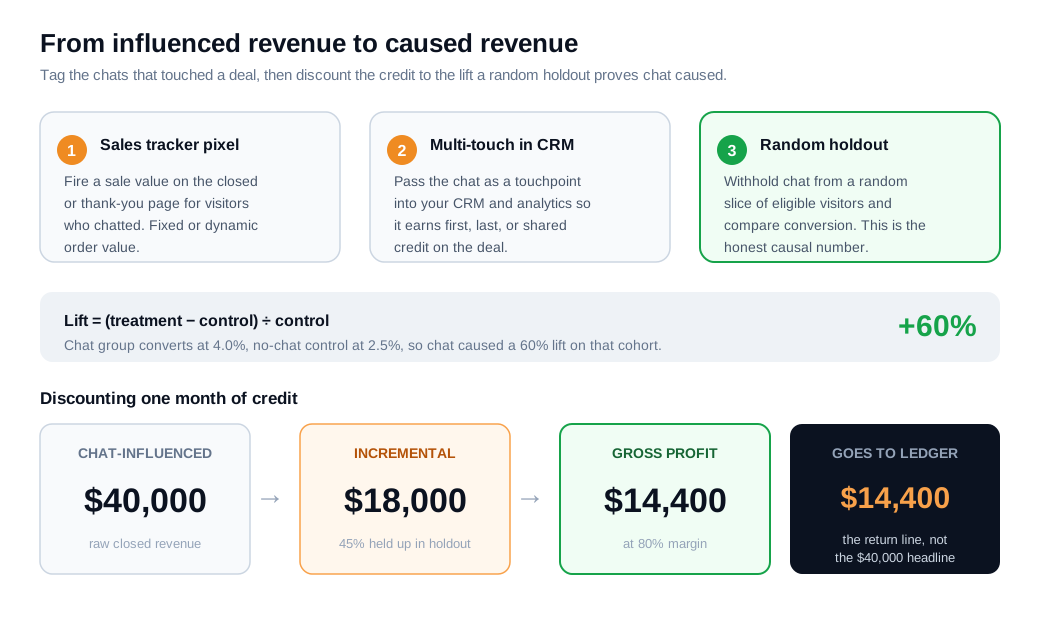
Now the $14,400 makes sense. Say your tracker credits chat with $40,000 in closed revenue this month. Your holdout shows that only about 45 percent of that would not have happened without chat, so incremental revenue is $18,000. Apply an 80 percent gross margin and you get $14,400 in incremental gross profit. That is the figure that lands on the ledger, not the $40,000 headline, and running the holdout is what lets you defend it when the CFO pushes back.
What metrics prove chat value?
The metrics that prove chat value form a chain, from leading indicators like response time and engagement rate, through quality signals like CSAT and first-contact resolution, to the lagging financial outcomes like chat-influenced pipeline and conversion lift that leadership actually funds. No single number carries the case. You report the dollars, and you report the operational metrics that explain how the dollars got there.
The leading indicators are your early warning system. First response time under one minute keeps warm visitors in the conversation, engagement rate tells you what share of visitors the widget reaches, and chat volume sizes the whole opportunity. These move first, days or weeks before revenue does, so they tell you whether the program is on track long before an attribution report can.
Quality metrics translate speed into trust. Live chat carries the highest customer satisfaction of any support channel at around 88 percent in ACSI data, and Comm100 benchmarks put chat satisfaction at 82 percent against 61 percent for email and 44 percent for phone. Customer preference points the same way, with 41 percent of consumers preferring live chat over other support channels. High CSAT and first-contact resolution are what keep chat-driven revenue from turning into refunds and churn later.
The lagging metrics are the ones you put in front of finance: incremental revenue from the holdout, conversion lift, revenue per chat hour, and cost per resolved chat. Report a lagging metric alone and it looks like luck. Show it beside the leading and quality metrics that produced it and it looks like a system leadership can trust.
How long does it take to see live chat ROI?
Most teams reach positive live chat ROI within three to six months, once the widget is live on high-intent pages, routing is tuned, and enough conversations have piled up to attribute revenue with any confidence. The ramp is predictable, and rushing the attribution is the main way teams talk themselves out of a working program.
The first month is setup and baseline. Install the widget, wire up tracking, and place chat where intent runs hottest, on pricing, comparison, and demo pages, so the earliest conversations are the most valuable ones. Months two and three are about volume and tuning: enough chats to see patterns, plus fixes to routing and notifications so a qualified chat reaches a live rep in seconds instead of sitting in a shared queue. By months three to six, your holdout has run long enough that the incremental number stops swinging, and that is when the ROI figure becomes safe to present.
You can shorten the wait. Placing chat on your warmest pages, adding proactive outreach nudges so high-intent visitors get pulled into a conversation, and moving serious buyers into a live video call or screen share all raise the value per conversation, which fills the attribution math faster. Most platforms, Glimpze included, offer a free plan, so you can baseline conversion and support cost before spending, which makes the before-and-after comparison cleaner.
How do you present chat ROI to leadership?
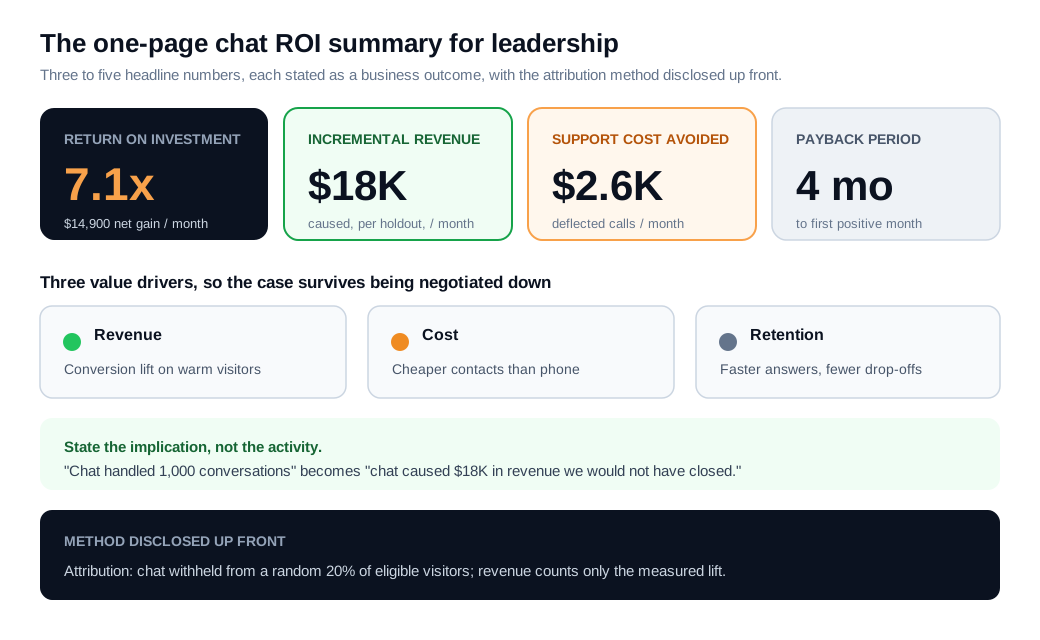
Present chat ROI to leadership as three to five headline numbers tied to revenue, cost, and retention, with every metric stated as a business outcome and the attribution method disclosed up front. A slide with forty metrics tells executives you do not know which ones matter. Marketing-ROI practitioners advise you to pick three to five KPIs that tell the core story and leave the rest in an appendix.
Turn each metric into an implication. "Chat handled 1,000 conversations last month" is an activity count. "Chat caused $18,000 in revenue we would not otherwise have closed, at a 7.1x return" is a business signal, and executives want business signals, not dashboards. Every headline number should finish the sentence "which means the business gained...".
Bring more than one value driver. Guides on proving ROI to executives recommend naming three drivers rather than one, because leadership tends to negotiate your best number down, and revenue lift, cheaper contacts, and retention give you three legs to stand on when one gets discounted. Then disclose the holdout before anyone asks. The most credible ROI presentation is the one that names its own limits, so state plainly that chat was withheld from a random 20 percent of eligible visitors and that revenue counts only the measured lift.
Keep the Glimpze angle low. The one-pager exists to give finance a number they can trust, whether your chat runs on Glimpze or anything else. Where it fits the inbound sales motion, the same free-plan baseline lets you rerun this calculation each quarter, so the ROI you present is a trend you can defend rather than a one-time claim.
Key takeaways
- Count gross profit against loaded cost. Live chat ROI is (return minus cost) divided by cost, and it only means something when the return uses gross profit and the cost includes the fully-loaded agent time most teams forget.
- Separate caused revenue from influenced revenue. Chat sits in front of warm visitors, so tagging alone overstates it, and 53 percent of marketers never attribute chat revenue at all. Discount influenced totals to what a holdout proves.
- Run a holdout to find the real lift. Withhold chat from a random slice of eligible visitors and take lift as (treatment minus control) divided by control, then claim only that share of the revenue.
- Report leading, quality, and lagging metrics together. Response time and engagement explain the CSAT, and CSAT explains the revenue, so a dollar figure shown beside its operational drivers reads as a system rather than luck.
- Expect three to six months to positive ROI. Place chat on high-intent pages, tune routing, and let the holdout run long enough that the incremental number stops swinging before you present it.
- Present three to five numbers as business outcomes. Tie each to revenue, cost, or retention, state it as an implication, bring more than one value driver, and disclose the attribution method before anyone asks.
TAGS

Written by
Nilas MylerCo-founder & CTO, Glimpze
Nilas is the co-founder and CTO of Glimpze, an inbound sales tool that turns high-intent website visitors into live conversations. A former SEO consultant for some of the largest companies in Denmark, he writes about speed-to-lead, inbound sales, and conversion rate optimization — the technical and operational mechanics of turning traffic into pipeline.


