
On this page
- What is a personalized sales demo?
- Why does demo personalization matter?
- What data helps you personalize a sales demo?
- How do you tailor the demo flow to each prospect?
- How do you personalize a demo when there was no discovery call?
- How do you scale demo personalization across a team?
- How do you measure whether demo personalization is working?
- Key takeaways
- Sources
A prospect books time, sits through your standard 30 minute product tour, tells you it looks great, and then goes quiet. Nothing in the demo was wrong. It just never felt like it was about them, so it gave no one a reason to move.
A personalized demo works differently. It opens on the problem the buyer came to solve, uses data that resembles their world, and skips the features they will never touch. That takes more preparation than a canned walkthrough, and the preparation pays off, because buyers now expect relevance and buying groups now demand it.
This post covers what a personalized sales demo actually is, why it matters, what data to gather, how to tailor the flow, what to do when there was no discovery call, how to scale personalization across a team, and how to measure whether any of it is working.
What is a personalized sales demo?
A personalized sales demo is a product demonstration built around one prospect's industry, role, current tools, and stated problems, instead of a fixed walkthrough shown to everyone in the same order. The change is in what you cut, what you reorder, and whose language you use.
A generic demo shows every feature in the sequence the product team happened to build them. A personalized demo shows the two or three capabilities that map to what this buyer told you they needed, framed in their terminology and populated with a dataset that looks like theirs.
Personalization runs on a spectrum. At the light end you swap in a logo, an industry, and sample data that matches the buyer's world. At the deep end you rebuild the flow around their exact process, their stakeholders, and the metric they are measured on. Both ends beat a tour, and the right depth depends on deal size and how much you already know going in.
Why does demo personalization matter?
Demo personalization matters because relevance is now the default expectation, and a generic demo loses the room long before you reach the part you are proud of. The research on buyer expectations is consistent across sources.
McKinsey's work on personalization found that 71 percent of consumers expect companies to deliver personalized interactions, and 76 percent get frustrated when that does not happen. The same research found that companies growing faster than their peers draw 40 percent more of their revenue from personalization. At this point, relevance tracks with growth.
The pattern holds for business buyers. In Salesforce's State of the Connected Customer research, 88 percent of customers said the experience a company provides matters as much as its products, and 73 percent said they expect companies to understand their unique needs and expectations. A demo is that experience concentrated into 30 minutes, and for inbound sales teams it is often the first real look a buyer gets at how you operate.
Two more forces raise the stakes. Gartner's survey work found that 61 percent of B2B buyers prefer a rep-free buying experience, which means a live demo has to earn the meeting by being more relevant than anything the buyer could find alone. Gartner's research on the buying journey also found that a typical purchase involves six to ten stakeholders, each carrying conflicting information, who spend only about 17 percent of their total time with any single supplier. When your face time is that thin, every minute has to be about them.
What data helps you personalize a sales demo?
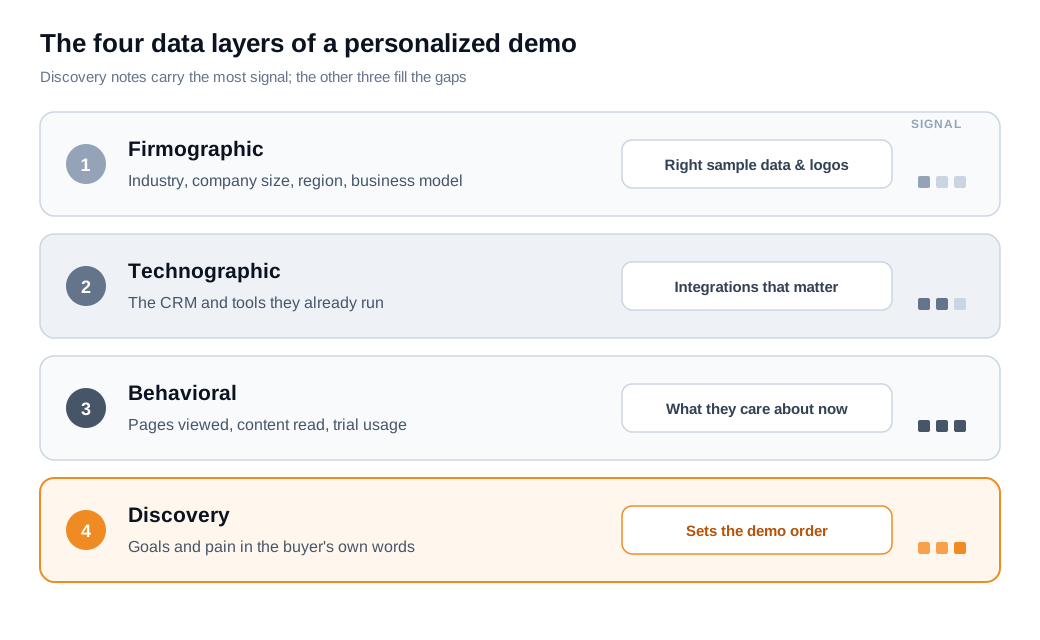
Four kinds of data let you personalize a demo: firmographic data about who the company is, technographic data about what they already run, behavioral data about what they have done with you, and discovery data about what they told you they need. The last one carries the most signal, and the first three fill the gaps.
Firmographic data is the base layer: industry, company size, region, and business model. It tells you which sample dataset, which example logos, and which use-case framing will feel native to the buyer rather than borrowed from someone else's pitch.
Technographic data is what they already have in place, from their CRM to the tools your product would sit next to. Knowing the stack lets you show the integrations that actually matter to them and speak to migration instead of guessing.
Behavioral data is what the prospect did on your site, in your content, and inside a trial. A visitor who lingered on the pricing page and opened a competitor comparison is telling you their concern before you ask. That live intent is the freshest data you have, and it is the easiest to waste.
Discovery data is what the buyer said out loud about their goals, their pain, and their priorities. It is the richest layer because it is in their own words, and it is the one that should drive the demo. A short rule keeps this manageable: collect the data you will actually use in the room, and skip the rest.
How do you tailor the demo flow to each prospect?
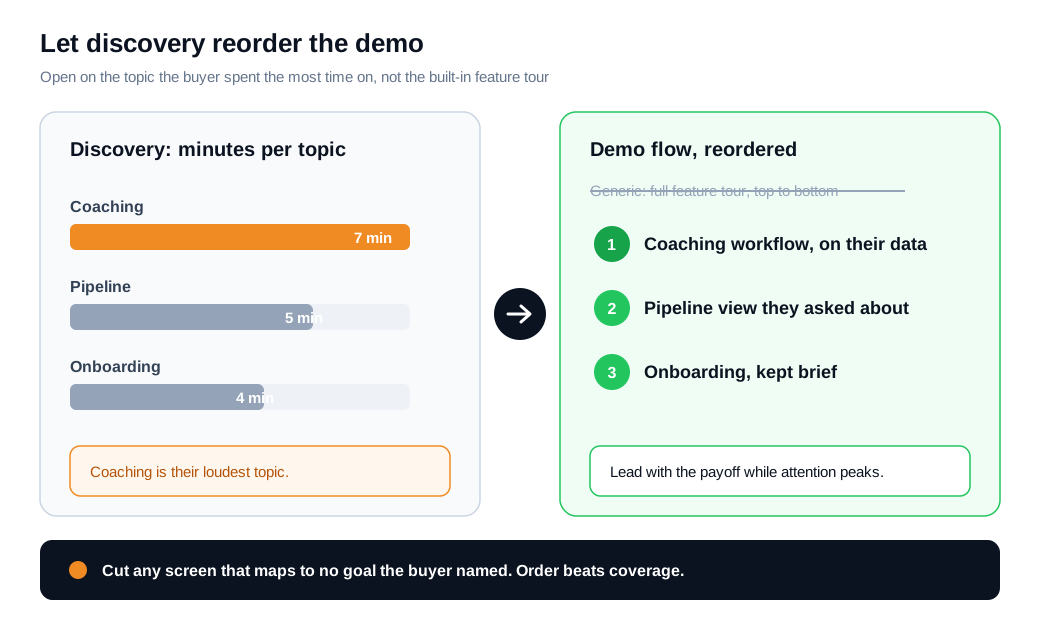
You tailor the demo flow by letting discovery decide the order, opening with the capability tied to the buyer's biggest stated pain and cutting anything that does not map to a goal they named. The sequence matters more than most reps think.
Gong's demo research makes the point directly: what you talked about during discovery should dictate the demo flow. If a buyer spent seven minutes on coaching, four on onboarding, and five on pipeline, you open on coaching while attention is highest, rather than saving your favorite feature for a finale the buyer may never reach. Lead with the payoff, then let everything after it play a supporting role.
Populate the demo with data that looks like their world: their team's role names, an account that resembles their customer, the metric they report on. A buyer processes "your reps would see this queue" very differently from "here is some placeholder data," even when the click path is identical.
Then map segments to stakeholders. With six to ten people involved across a deal, the economic buyer wants the return, the end user wants the daily workflow, and IT wants security and integration. Chapter the demo so each person sees the part built for them, and hand your champion a version they can carry into the rooms you will never enter.
How do you personalize a demo when there was no discovery call?
When there was no discovery call, personalize from the signals you already have: the prospect's company, the pages they viewed, and a tight set of questions asked in the first two minutes. Plenty of demos start this way, especially inbound and product-led ones, so this is a skill worth building rather than an edge case.
Behavioral signals stand in for discovery here. A visitor comparing plans on your pricing page or reading a feature comparison has told you their concern without a call. Enrich that with firmographic data from their email domain, and you can open with the right industry framing before you have said hello. Confirm with two or three sharp questions, then demo the one workflow that answers what you just heard.
The moment is the advantage. Harvard Business Review's audit of 2,241 companies found the average first response to an inbound lead took 42 hours, and that firms replying within an hour were roughly seven times likelier to have a meaningful conversation with a decision-maker. A high-intent visitor is at their most personalizable while they are still on the page, which is why tools like live video chat and screen share matter here. A rep can open a tailored, in-the-moment demo of the exact workflow the visitor cares about, rather than booking a generic call for a week later when the urgency has cooled.
How do you scale demo personalization across a team?
You scale personalization by building a modular demo library rather than a longer script, so reps assemble a tailored demo from reusable blocks instead of rebuilding one from scratch every time. The goal is to make the relevant version the easy version.
Start with modular segments: short, self-contained blocks for each core use case, industry, and persona, each preloaded with data that fits. A rep then chooses three or four blocks based on the discovery notes and drops them into a proven opening and close. Pair that with a templated discovery-to-demo handoff so the flow gets selected on purpose, not improvised on the call.
For the rep-free majority, prebuilt interactive and async demos do the personalizing at scale. Consensus, which studies demo automation, has reported that deals with nine or more demo views close at far higher rates, with win rates climbing sharply past that threshold, and that surfacing one additional stakeholder raised win rates several times over. Personalized async demos travel through a buying group the way a live demo cannot, and wiring up routing and notifications makes sure the right rep follows up the moment a real buyer engages.
Keep a guardrail on effort. An 80/20 split works well: roughly 80 percent of the demo comes from reusable, well-built blocks, and 20 percent is customized to this specific prospect. Personalizing every pixel of every demo does not scale, and it rarely moves a deal further than the parts that address the buyer's actual problem.
How do you measure whether demo personalization is working?
Measure demo personalization with two numbers: the demo-to-close rate as the outcome, and the share of demos that end with a booked next step as the leading signal. A demo that produces no scheduled next step almost never turns into revenue, so that share moves before the close rate does.
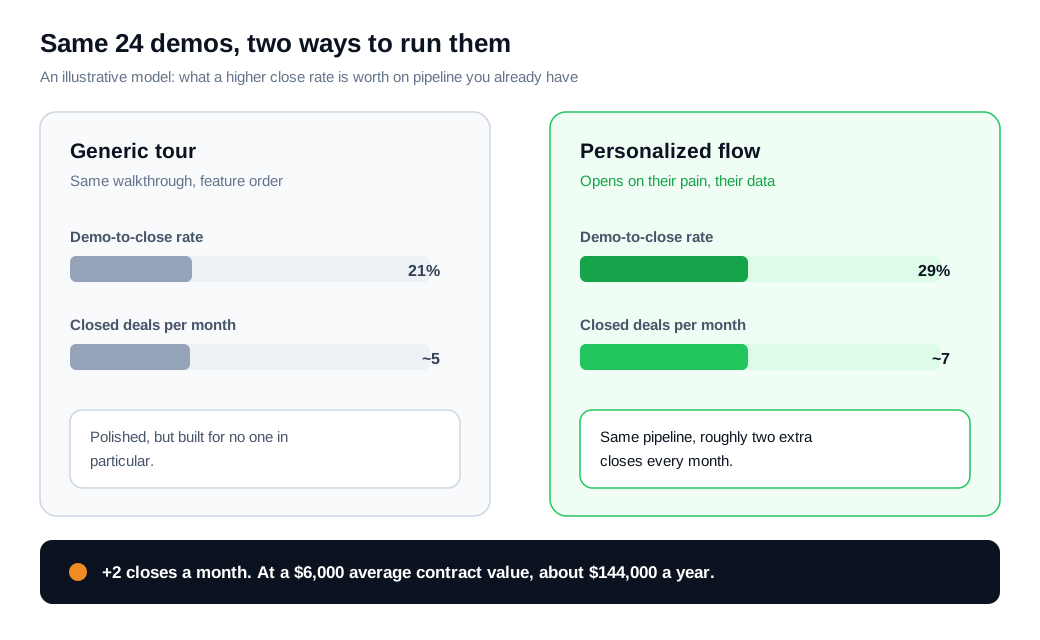
Here is an illustrative worked example. Say a rep runs 24 demos a month. In the generic version they front-load a feature tour and close about 21 percent, which is roughly five deals. Now rebuild the same 24 demos on the principles above: open on the buyer's top pain from discovery, use data that looks like theirs, tailor segments to the people in the room, and book the next step live. Assume the close rate moves to 29 percent, in line with the directional lift the personalization research points to.
That is about seven deals from the same 24 demos, or roughly two extra closes a month with no added pipeline and no extra marketing spend. At a $6,000 average contract value, that is about $12,000 a month, close to $144,000 a year, from reordering and repopulating demos you were already running. The numbers here are a model, so run your own before and after. Record the demos too, and watch how much the buyer talked and how many questions they asked, since those soft signals shift before the close rate catches up.
Key takeaways
- Relevance is the new baseline. McKinsey found 71 percent of people expect personalized interactions and 76 percent get frustrated without it, while faster-growing companies draw 40 percent more revenue from personalization.
- Discovery data should drive the demo. Let what the buyer emphasized in discovery set the order, open on their biggest pain while attention peaks, and cut anything that maps to no stated goal.
- Four data layers do the work. Firmographic, technographic, behavioral, and discovery data each personalize a different part of the demo, with discovery notes carrying the most signal.
- You can still personalize without discovery. Use page views, firmographic enrichment, and two or three opening questions to tailor a demo in the moment, especially for high-intent inbound visitors.
- Scale with modules, not longer scripts. A library of reusable, preloaded blocks plus interactive async demos lets a team personalize at volume, kept sane by an 80/20 rule.
- Track close rate and next-step-booked. Moving 24 monthly demos from a 21 to 29 percent close rate is about two extra deals, which is real money on pipeline you already have.
TAGS

Written by
Daniel SemeckyCo-founder & CEO
Daniel is the co-founder and CEO of Glimpze. He spends his days talking to revenue teams about how to catch high-intent visitors before they bounce, and writes about inbound sales, lead conversion, and building a motion where marketing and sales actually share a number.


