
On this page
A visitor opens your chat widget with a question that stands between them and a purchase or a renewal. They type it, hit send, and wait. Twenty seconds pass, then a minute, then two. The typing dots never appear. By the time an agent finally picks up, the tab is closed and the person is three clicks into a competitor's help center.
That gap between the question and the first human reply is the wait, and it is one of the most controllable numbers in support. You rarely control how many people show up or how hard their questions are. You almost always control how long they sit before someone answers.
This guide covers what a good live chat wait time looks like, what actually causes long waits, how staffing and concurrency set the floor, how bots and routing pull the average down, and how to set expectations so the waits you cannot avoid still feel short. Two worked examples run the staffing and blended-average math, so you can reduce live chat wait times without simply throwing bodies at the queue.
What is a good live chat wait time?
A good live chat wait time is under 30 seconds to the first reply, with under a minute still acceptable and anything past two minutes starting to lose visitors. Those thresholds come from what customers will actually tolerate before they give up.
Keep three clocks separate, because they get blended into one vague "wait" and then nobody knows which to fix. Queue wait is how long a visitor sits before any agent is assigned. First response time is how long until the first human reply lands. Handle time is how long the whole conversation runs. Queue wait and first response time are what a visitor experiences as the wait, and they are the two this guide works on.
The bar customers set is high. Roughly 82 percent expect an immediate response when they open a chat, about half want a reply in under a minute, and 90 percent treat ten minutes as the outer limit before the experience feels broken. Satisfaction tracks this closely. It peaks near 84.7 percent when the first reply arrives within 5 to 10 seconds and slides from there, and around 57 percent of visitors abandon a chat once the wait crosses three minutes.
Most teams are nowhere near those numbers. SuperOffice tested live chat on 1,000 company websites and found an average wait of 2 minutes and 40 seconds, with 21 percent of chats never answered at all. The target and the typical reality sit far apart, which is exactly why the wait is worth working on.
What causes long chat wait times?
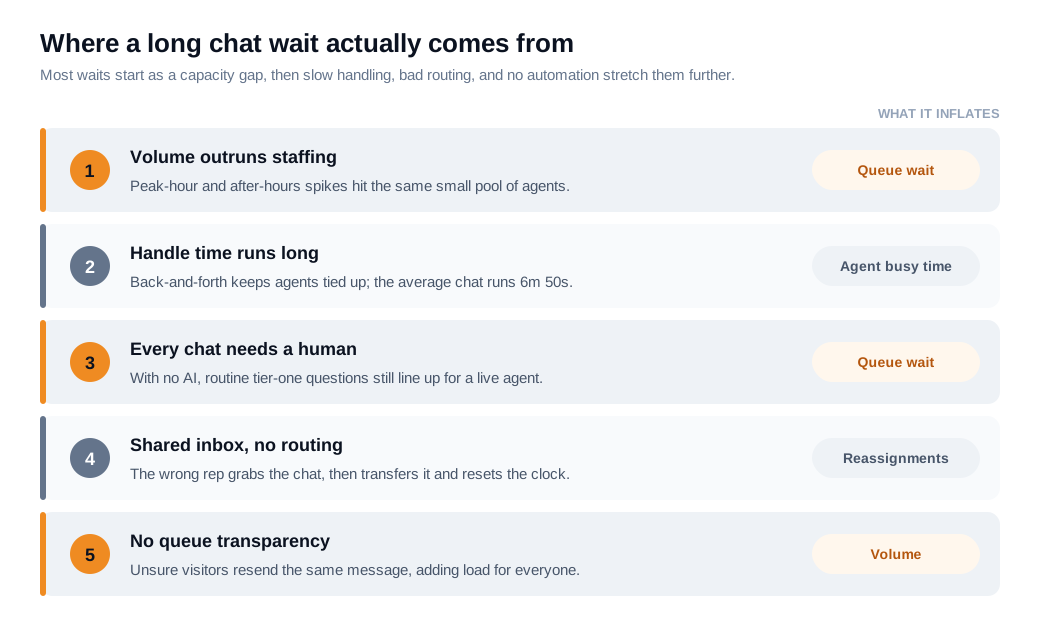
Long chat wait times come from a mismatch between how much chat arrives and how much answering capacity is online at that moment, then get worse from slow handling, poor routing, and a widget that promises more coverage than the team can give. Almost every long wait traces back to one of those.
Volume and staffing are the root cause. Chat is spiky, and traffic clusters into peak hours, after-hours spillover, and waves of routine tier-one questions that all compete for the same agents. When arrivals outrun the capacity online, a queue forms and grows until the surge passes.
Slow handle times turn a small staffing gap into a large one. If each conversation drags because of constant back-and-forth, an agent stays tied up longer and clears fewer chats per hour. SuperOffice put the average chat handle time at 6 minutes and 50 seconds, and every minute added to that number is a minute the next visitor waits.
The rest is friction. Agents juggling too many chats at once slow down on all of them. Reps switching tabs, hunting through a CRM, or waiting on a slow knowledge base add dead time to every reply. A shared inbox with no routing means the wrong person often grabs a chat and then has to transfer it, resetting the clock. And when the widget shows no queue position or estimate, anxious visitors send the same message three times, which inflates volume and slows everyone further. Talkative's queue guidance flags that missing transparency as a direct driver of abandonment and duplicate contacts.
How does staffing affect chat wait times?
Staffing sets the floor on wait times, because a queue forms the instant arriving chats outrun the capacity online, and that capacity is your number of agents multiplied by how many chats each can safely handle at once. Get the staffing wrong and no amount of agent hustle will save the wait.
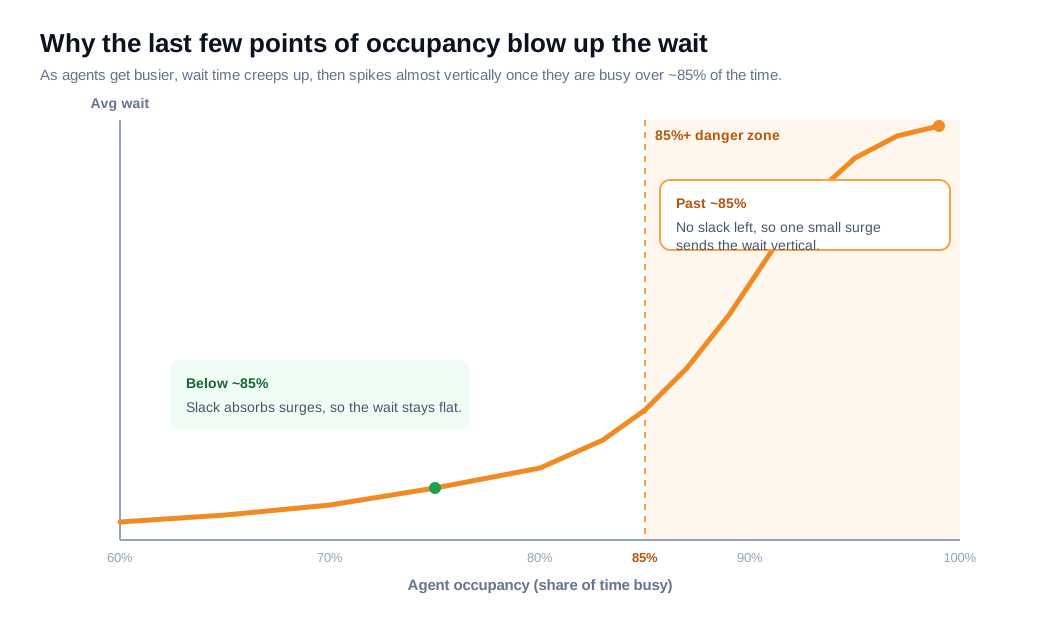
The counterintuitive part is how the wait behaves near full utilization. Contact centers size chat with queueing math (the Erlang C model and its variants) that predicts the probability a contact waits given arrival rate, handle time, and staff. The lesson from that math is a cliff. Wait times climb slowly as occupancy rises, then spike sharply once agents are busy more than about 85 percent of the time. Run your team at 95 percent occupancy to look efficient and the queue explodes on the first small surge, because there is no slack to absorb it.
Concurrency is the other multiplier. A chat agent can hold more than one conversation at once, but quality and speed both decay when the count climbs too high. Practitioner benchmarks land on 2 to 3 concurrent chats for most agents and up to 4 for strong ones on simple questions, with reply times slipping once you push past that. Concurrency raises capacity, but that capacity comes with a quality cost you have to watch.
Here is the worked example. Say your busiest hour brings 45 chats, your average handle time is 8 minutes, and each agent runs 3 concurrent chats. One agent clears (60 / 8) x 3, which is 22.5 chats per hour at full tilt. On paper, 2 agents cover 45 chats. But "on paper" means 100 percent occupancy, an unbroken queue, and waits that balloon. Target a sustainable 80 percent occupancy and each agent effectively clears about 18 chats an hour, so you need 45 / 18, which rounds up to 3 agents. That extra half-agent of slack is the difference between a wait near zero and a wait that spikes every time two chats land together. Staff to your peak intervals rather than your daily average, and plan for shrinkage (breaks, training, and admin routinely eat 25 to 35 percent of paid time) so the schedule survives contact with reality.
How do bots and routing help reduce wait times?
Bots and routing cut wait times from two directions: an AI assistant answers or deflects the easy chats instantly so they never reach the human queue, and routing sends everything else to the right available rep in seconds instead of into a shared inbox. Together they shrink both the number of chats waiting and the time each one waits.
Deflection is the bigger lever. A large share of chat volume is repeat, tier-one questions (order status, password resets, "does it do X") that an AI chat assistant can resolve in seconds with no human involved. Well-run deployments deflect a meaningful chunk of tickets and cut support cost 30 to 40 percent in the first year, according to Crisp's review of chatbot impact, and every chat the bot closes is one that never sits in line. When the AI cannot resolve something, it collects context and hands a tagged, summarized conversation to a human, so the customer does not restart from zero.
Routing attacks the wait for the chats that do need a person. Skills-based and account-based routing with instant notifications read the page, the message, and the visitor, then send the chat straight to a qualified rep and ping them in Slack, so someone jumps in within seconds rather than after a chat sits in a general queue. For a high-intent buyer, escalating in the same thread to live video or screen share often resolves the question faster than another round of typing.
The second worked example shows how this bends the average. Suppose you handle 1,000 chats a month. An AI assistant resolves 60 percent of openers instantly at a 3-second reply, and humans take the other 40 percent at a 90-second median. The blended first response works out to (0.60 x 3) plus (0.40 x 90), which is 1.8 plus 36, or about 38 seconds. The humans did not get faster. The mix changed, and the mix is what the average measures.
How do you set expectations during a wait?
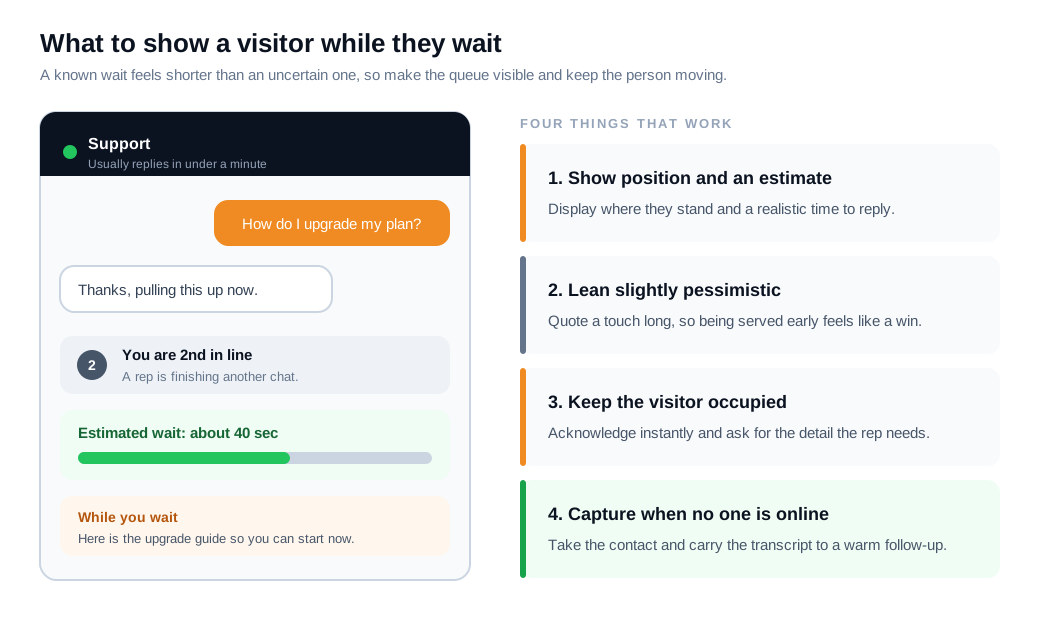
Set expectations by telling the visitor exactly where they stand: their place in line, an honest time estimate, who is helping, and what happens if nobody is free, because a known wait feels far shorter than an uncertain one. The waits you cannot remove, you can at least make tolerable.
The psychology is well documented. Work on the experience of queuing (summarized well in Queue-it's rules of waiting, building on David Maister's research) shows that uncertain waits and unexplained waits feel longer than known ones, and that occupied time feels shorter than idle time. A visitor staring at silence invents a worst case. A visitor who sees "you are second in line, about 40 seconds" waits calmly for the same 40 seconds.
So show the state of the queue. Display position and a realistic estimate, and lean slightly pessimistic, since theme parks post wait times a touch longer than reality so guests feel relieved when they are served early. Keep the visitor occupied by acknowledging the message instantly, asking for the detail the agent will need, or surfacing a relevant help article, so the time moves toward an answer rather than a spinner.
Handle the empty queue honestly. When no one is online, flip the widget to an offline state that says when the team replies and captures the right contact detail, ideally with an AI assistant fielding what it can and booking a time for the rest. SuperOffice found 23 percent of companies never ask for contact information and 55 percent offer no transcript, so a lead that arrives after hours simply evaporates. Capturing the contact and carrying the transcript forward turns an unanswerable midnight chat into a warm follow-up the next morning.
How do you measure and keep wait times down?
Measure the wait as three separate numbers, queue wait, first response time, and abandonment rate, then fix the slowest one first and judge progress against your own history instead of a headline benchmark. A single blended "average response" hides which step is actually broken.
Watch first response time and queue wait by hour rather than as a daily mean, because a fine daily average can hide a brutal 2 p.m. spike. Track abandonment alongside them, since a wait that looks acceptable but sheds a third of visitors is doing real damage. Then set a first response target per channel, alert reps before a chat crosses it, and read the transcripts on the chats that missed so you learn whether the cause was staffing, routing, or a slow answer.
The order of operations matters. Attack the biggest source of delay first (usually the gap before the right person sees the chat), then peak coverage, then concurrency limits, then the reply itself through saved responses and AI. Most platforms, Glimpze included, offer a free tier, so you can baseline your current wait and abandonment before you spend anything on changing them. A channel like live chat only pays off for inbound sales and support when the first answer arrives while the visitor is still there, and the steps above are what make a short wait the norm instead of the exception.
Key takeaways
- Aim for a first reply under 30 seconds. Under a minute is still fine, but customer patience runs out fast, and roughly 57 percent abandon once the wait passes three minutes.
- Most long waits are a capacity gap. Volume that outruns the agents online is the root cause, then slow handle times, bad routing, and no automation stretch it further.
- Staff to the occupancy cliff, not the average. Wait times spike once agents are busy more than about 85 percent of the time, so build in slack and schedule against peak intervals.
- Let bots and routing shrink the queue. An AI assistant deflects tier-one chats instantly while skills-based routing gets the rest to the right rep in seconds, which pulls the blended wait down without more headcount.
- A known wait feels shorter than an uncertain one. Show queue position and an honest estimate, keep the visitor occupied, and capture the contact when no one is online.
- Measure three clocks and fix the slowest. Track queue wait, first response time, and abandonment by hour, attack the biggest delay first, and compare against your own baseline.

Written by
Nilas MylerCo-founder & CTO, Glimpze
Nilas is the co-founder and CTO of Glimpze, an inbound sales tool that turns high-intent website visitors into live conversations. A former SEO consultant for some of the largest companies in Denmark, he writes about speed-to-lead, inbound sales, and conversion rate optimization — the technical and operational mechanics of turning traffic into pipeline.


