
On this page
A support lead opens the chat dashboard and sees a satisfaction score of 92 percent. It reads like a win, so she checks the detail. Only 41 of the month's 1,300 chats were rated, and 38 of those ratings came from one agent who asks every happy customer to leave a thumbs up. The score is real. It just says nothing about the other 1,259 conversations.
That gap is the trouble with CSAT in live chat. The metric is easy to calculate and easy to misread, and the number is meaningless until you know how it was collected and what you are comparing it against. A team can post 85 percent and be average, or post the same 85 percent and be excellent, depending on the industry and the way the survey was run.
This guide covers what CSAT measures in a chat, how to calculate it, the benchmarks worth holding yourself to, how to collect ratings without gaming them, what actually moves the score, and how CSAT fits next to NPS and CES.
What is CSAT in live chat?
CSAT in live chat is the share of surveyed visitors who rate a chat positively, usually captured by a one-click survey the moment the conversation ends. It answers a single question: did this specific interaction leave the person satisfied?
The metric is transactional. Each rating is attached to one chat, gathered while the experience is still fresh, so it reflects how that conversation felt rather than how the customer feels about your brand overall. That focus is what makes it useful for a chat team. You can trace a low score back to a transcript, an agent, a time of day, or a page.
Visitors give the rating in one of a few formats. The most common is a thumbs up or thumbs down at the end of the chat. Others use a one-to-five scale or a row of stars. Whatever the format, CSAT collapses it into one percentage that answers whether the help was any good. Live chat tends to score well on that question, which is part of why so many teams put live chat on high-intent pages in the first place. It also means a weak score stands out, because the channel is expected to please.
How do you calculate a live chat CSAT score?
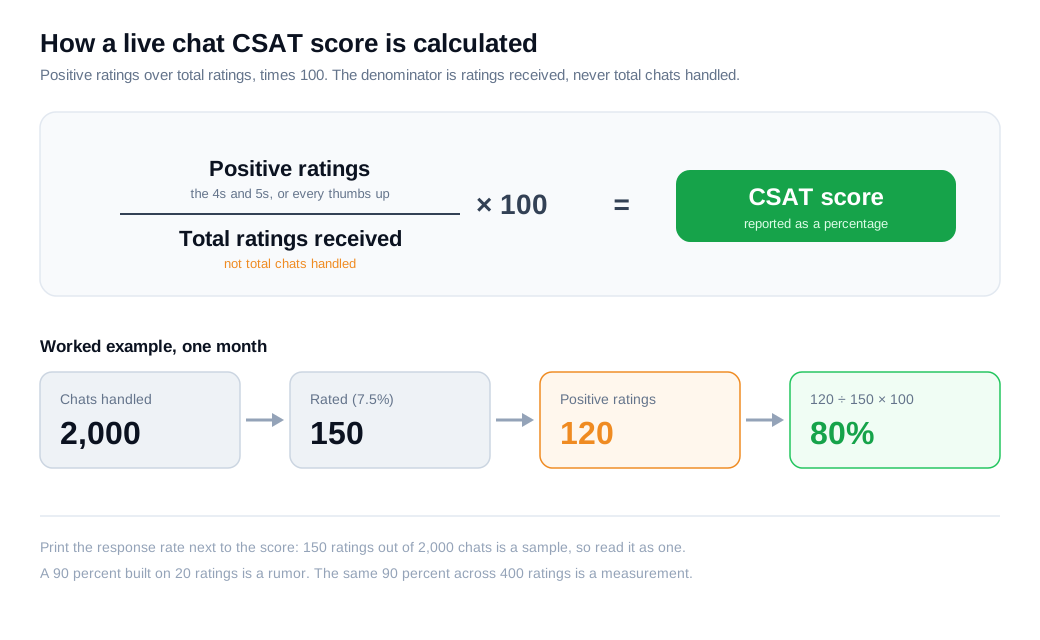
The formula is the number of positive ratings divided by the total number of ratings, times 100. On a one-to-five scale, positive means the top two boxes, the 4s and the 5s. On a thumbs widget, positive is every thumbs up. Neutral and negative ratings stay in the denominator but not the numerator.
The denominator is the total ratings received, never the total chats handled. That distinction trips up more teams than the arithmetic does. If you divide positive ratings by every chat, you punish yourself for the visitors who closed the tab without answering the survey, and the score sinks for a reason that has nothing to do with quality.
Here is the calculation with real figures. Say the widget handled 2,000 chats last month and 150 visitors rated theirs. 120 of those ratings were positive. CSAT is 120 divided by 150, times 100, which is 80 percent. The score looks solid, and it rests on 150 opinions out of 2,000 conversations, so treat it as a sample rather than a census. That response rate is the context every CSAT number needs printed next to it.
What is a good live chat CSAT benchmark?
A good live chat CSAT score is 80 percent or higher, with strong teams clearing 85 to 90 percent and anything under 75 percent worth a closer look. Those are cross-industry starting lines, and your own trend line matters more than any external figure.
Live chat is the highest-rated support channel to begin with, so the bar sits higher than it would for email or phone. In eDigital's benchmark survey of 2,000 consumers, live chat drew the highest satisfaction of any channel at 73 percent, ahead of email at 61 percent and phone at 44 percent. Operational data lands higher still. LiveChat's own customer service report puts average live chat satisfaction near 85 percent, with roughly 87 percent of rated chats coming back positive. Comm100's benchmark analysis of tens of millions of chats has reported a global live chat CSAT around 84 percent, so clearing 85 marks a genuinely strong operation rather than a typical one.
The right benchmark also depends on your industry and the size of your team. Retail chat tends to run near 85 percent while SaaS sits closer to 75 percent and financial services around 80 percent, which means an 80 percent score can be leadership in one sector and middling in another. Team size moves it too. In the Comm100 data, teams of 26 or more agents scored highest at about 86 percent, while teams of one to five agents came in lowest near 80 percent, a reminder that coverage and specialization show up directly in the rating.
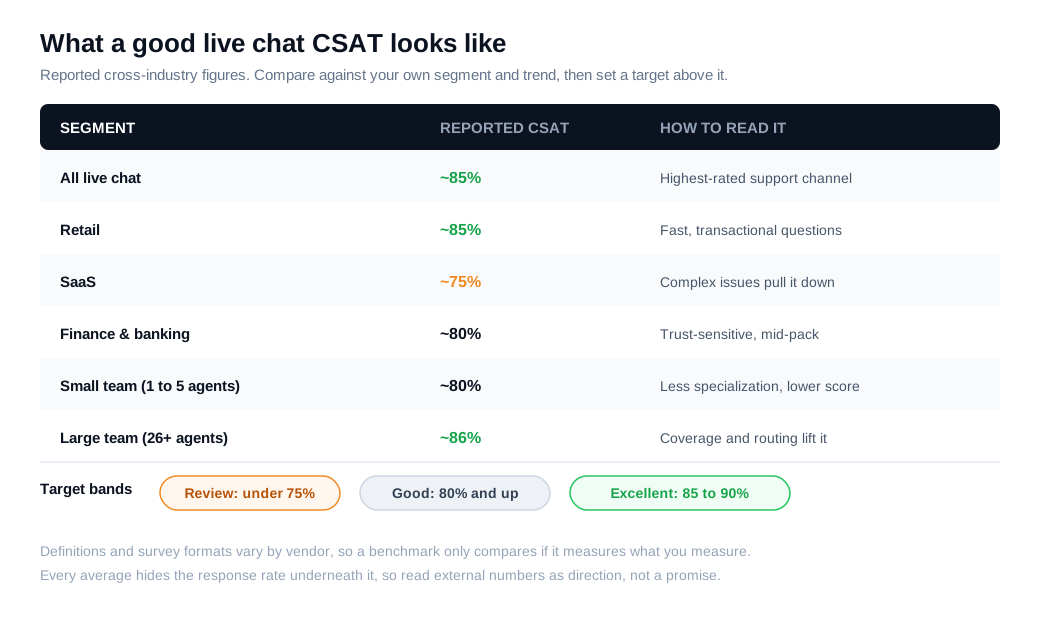
Two cautions before any of these go on a wall. First, definitions and survey formats vary between vendors, so a benchmark only compares if it measures what you measure. Second, a headline average hides the response rate underneath it, so read every external number as direction rather than a promise.
How do you collect chat CSAT?
Collect chat CSAT with a short post-chat survey that fires the instant the conversation closes, while the interaction is fresh in the visitor's mind. Speed of asking is the single biggest driver of an accurate, well-populated score. A survey sent the next day measures memory. A survey shown at the moment of close measures the experience.
Keep the survey to one question, or two at most. A thumbs up or thumbs down asks for almost no effort, which is why it collects the most responses, and you can add one optional comment box for the visitors who want to explain. Every extra field costs you responses, and the fewer responses you gather, the shakier the number becomes.
Expect the response rate to be low no matter what you do. Post-chat surveys commonly return ratings from only 5 to 15 percent of conversations, and many chat tools see just a single-digit share of chats rated at all. That is normal, and it is why sample size belongs next to the score. A 90 percent CSAT built on 20 ratings is a rumor. The same 90 percent across 400 ratings is a measurement.
Guard against the gaming that inflated the score in this article's opening. When agents can nudge only their happy customers to rate, or when the survey favors positive clicks, the number drifts up while the experience stays flat. Fire the same survey on every chat, automatically, and watch the response rate per agent. If one rep's ratings volume is triple everyone else's, the score is measuring that rep's habits more than the team's service.
What drives your live chat CSAT up or down?
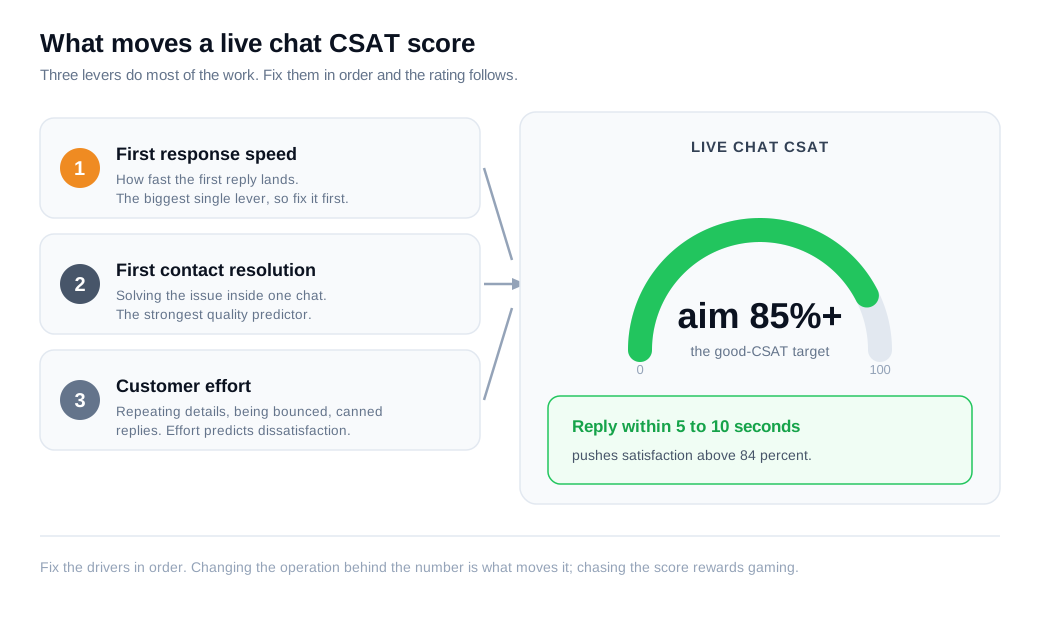
The three biggest levers are how fast the first reply arrives, whether the issue gets resolved in one conversation, and how much effort the visitor had to spend. Fix those and the score follows. Ignore them and no amount of surveying will move it.
Speed comes first because it colors everything after it. LiveChat's report found that when teams reply within 5 to 10 seconds, satisfaction climbs above 84 percent, and the number falls off as the wait grows. A visitor who waits ninety seconds for a first response has already decided how the chat is going before the agent types a word.
First contact resolution is the quality lever. Solving the problem inside a single chat is the strongest predictor of a positive rating, and every repeat contact drags the score down hard. Close to that sits customer effort, the amount of work the visitor had to do to get helped. Repeating account details, being bounced between agents, or getting a canned reply that misses the question all register as effort, and effort predicts dissatisfaction more reliably than almost anything else. When a chat clearly involves a complicated setup or a serious buyer, moving it to live video or screen share inside the same thread often resolves the issue in one pass and lifts the rating, because the visitor stops typing and starts getting shown.
How do you improve a low CSAT score?
Improve a low CSAT score by fixing the drivers in order, starting with first response time, then first contact resolution, then the effort a visitor has to spend, and finally by coaching on the specific chats that scored badly. Chasing the number directly rewards gaming. Changing the operation behind it moves the number for real.
Start with speed, because it lifts the most at once. Get chats to a live person quickly through skills-based routing and instant notifications, so a qualified conversation reaches whoever owns that product or region and pings them before the visitor gives up. For repetitive questions and after-hours coverage, an AI chat assistant can answer instantly, resolve the simple cases, and hand off to a human with the context already gathered, which raises first response time and first contact resolution together.
Then close the loop on the chats that failed. When a rating comes in low, read the transcript, find what went wrong, and where it makes sense send the visitor a short personal follow-up. That habit does two things: it recovers a customer who was about to leave, and it turns individual bad chats into a pattern you can coach against. Track CSAT and first response time per agent, review the low-scoring transcripts each week, and feed the recurring problems back into training.
Walk it with numbers. Say a team sits at 72 percent CSAT on 150 ratings, and the transcripts show a third of the low scores mention a slow reply during the mid-morning rush. Staff that hour, add an AI assistant to catch overflow, and the slow-reply complaints thin out. If those chats had been rating around 40 percent and they climb to 80 percent, the blended score moves from 72 into the low 80s without touching a single survey setting. Baseline your current numbers before you change anything, and since most platforms including Glimpze offer a free tier, you can measure where you stand before spending on the fix.
CSAT vs NPS vs CES: which should you track?
Track CSAT for the chat itself, CES for how hard the visitor had to work, and NPS for the relationship over time, because each answers a question the others cannot. Reaching for one metric to cover all three is how teams end up measured on the wrong thing.
CSAT is transactional and immediate. It tells you whether a given chat satisfied the person, which is exactly what a chat team needs to see day to day. Customer Effort Score, or CES, asks how easy it was to get the problem solved, and it often predicts loyalty better than raw satisfaction because low effort is what keeps people coming back. Net Promoter Score, or NPS, is relational. It asks how likely someone is to recommend you, and it moves slowly across the whole customer journey rather than after a single conversation.
For live chat specifically, CSAT is the workhorse and CES is the useful companion. Run CSAT on every chat, add a one-line effort question when you want to understand why a score moved, and leave NPS to the broader lifecycle surveys where it belongs.
Key takeaways
- A good live chat CSAT score is 80 percent or higher, with 85 to 90 percent marking a strong team and anything under 75 percent worth investigating, since live chat is the highest-rated support channel and the bar sits higher than for email or phone.
- Calculate it as positive ratings over total ratings, never over total chats, and always print the response rate and sample size next to the percentage.
- Benchmark against your own industry and team size, because retail near 85 percent, SaaS near 75 percent, and small versus large teams all shift what a good score looks like.
- Collect ratings with a one-click survey at the moment of close, fired on every chat automatically, and treat a low response rate as normal rather than a problem to solve by nudging happy customers.
- Move the score by fixing drivers in order, first response speed, first contact resolution, and visitor effort, then coaching on the specific transcripts that scored low.
- Pair CSAT with CES and NPS, using CSAT for the chat, CES for how hard the visitor worked, and NPS for the long-term relationship.

Written by
Nilas MylerCo-founder & CTO, Glimpze
Nilas is the co-founder and CTO of Glimpze, an inbound sales tool that turns high-intent website visitors into live conversations. A former SEO consultant for some of the largest companies in Denmark, he writes about speed-to-lead, inbound sales, and conversion rate optimization — the technical and operational mechanics of turning traffic into pipeline.


