
On this page
- What is a good first response time in chat?
- What is the average live chat response time right now?
- How do live chat response time benchmarks vary by industry?
- Why do the benchmarks differ so much between industries?
- How does response time affect customer satisfaction and revenue?
- How do you consistently hit your response time targets?
- Key takeaways
- Sources
A visitor lands on your pricing page, reads for ninety seconds, and opens the chat widget with one question standing between them and a purchase. What happens in the next thirty seconds decides most of it. Answer fast and you usually keep the sale. Let the message sit while a rep finishes another chat, and a good share of those visitors are gone before anyone types back.
The catch is that "fast" means different things in different places. A thirty-second reply that looks slow for an ecommerce store can be strong for a bank working through a complex account question. A response time benchmark only helps when you compare yourself to the right group, using the right definition, against your own history.
This guide covers what counts as a good first response time in chat, what the current cross-industry averages actually are, how the benchmarks split by industry, why they differ so much, how response time moves satisfaction and revenue, and how to hit your targets without burning out the team.
What is a good first response time in chat?
A good live chat first response time is under one minute, with under 30 seconds marking excellent performance and the best teams replying in 10 to 20 seconds when no queue has built up. Those are the numbers that keep a warm visitor in the conversation instead of clicking away.
First response time is the count of seconds a visitor waits for the first human reply after sending their opening message. Keep it separate from two neighbors that often get blended into the same average. Queue wait time is how long someone sits before a rep is even assigned. Resolution time is how long the whole conversation runs before the issue is settled. First response time is the one that decides whether a visitor stays, so it deserves its own target.
A short acknowledgment still stops the clock. "Hi, let me pull that up" counts as a first response and holds attention while a rep finds the real answer, which is why a fast opener matters even when the full solution takes longer.
Customer patience sets the ceiling on any target. Roughly 60 percent of people expect a reply within two minutes, and about 82 percent expect a response within 10 minutes of sending a chat. That gives a clean set of tiers to judge yourself against: under 30 seconds is excellent, under one minute is good, one to two minutes is passable, and anything past two minutes starts leaking visitors.
What is the average live chat response time right now?
The average live chat response time across industries lands somewhere between about 25 seconds and two minutes, and which figure you get depends entirely on whether a report measures queue wait or first human reply, and whether it uses a median or a mean. The spread is wide enough that two honest sources can look like they disagree.
Comm100's benchmark analysis, drawn from hundreds of millions of chats, put the average wait for a first agent response near 23 seconds in a recent year after a sharp year-over-year drop. Cross-industry averages for the first human reply often land closer to 1 minute 35 seconds, with SaaS teams a touch faster. Strong teams answer 80 percent of chats within 40 seconds, which is a better yardstick than any single average.
Two measurement details explain most of the gap. First, wait time and first response time are not the same clock, so a 23-second wait figure and a 95-second first-response figure can both be right. Second, a median describes the typical visitor while a mean gets dragged upward by a handful of chats that sat open through a lunch-hour gap. When a report quotes an average, check which number it means before deciding you are behind. The target most teams chase, under 30 seconds, sits below the typical average on purpose, because that is the level where satisfaction and conversion hold up.
How do live chat response time benchmarks vary by industry?
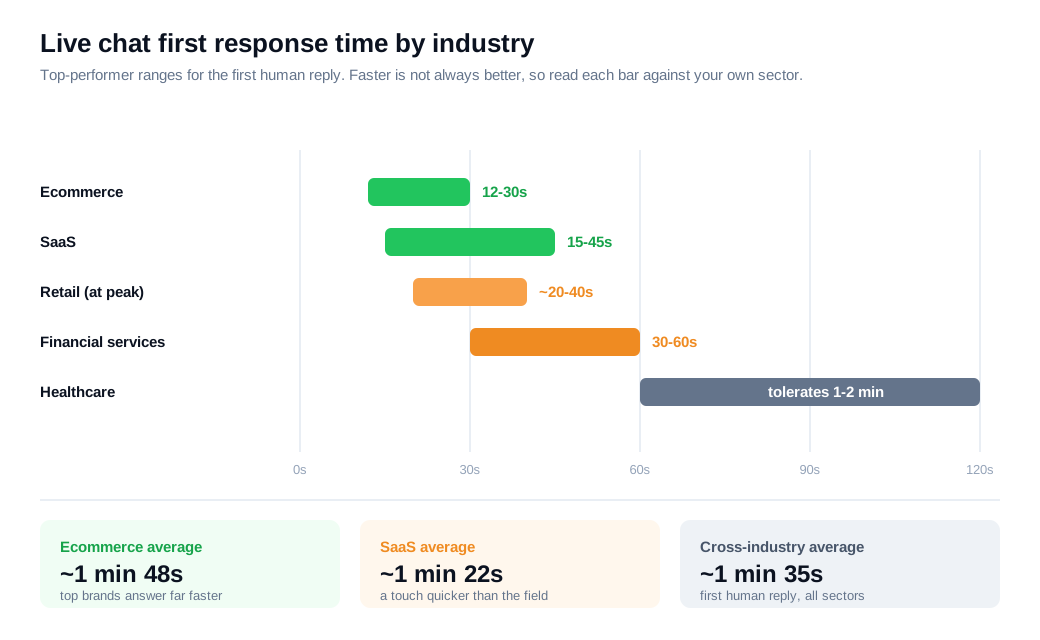
Live chat response time benchmarks vary by industry by a factor of three or more, with fast-moving ecommerce teams answering in 12 to 30 seconds while financial services and healthcare reasonably run 30 to 60 seconds or longer. The right target for one sector would be a failing grade in another.
Published figures from Which-50's benchmark roundup sketch the range. Top ecommerce brands reply in 12 to 30 seconds, and the ecommerce average sits near 1 minute 48 seconds. SaaS companies average around 1 minute 22 seconds, with the best answering in 15 to 45 seconds. Financial services top performers land in the 30 to 60 second window, since answers often require an account lookup or a compliance-safe phrasing. Healthcare customers tend to tolerate slightly longer first responses because they expect a careful answer, though the opening acknowledgment should still arrive fast.
Here is a worked example of how a modern team lands inside the ecommerce or SaaS window even with human reps who cannot answer in three seconds. Say a SaaS team fields 1,000 chats a month. An AI chat assistant handles 70 percent of openers instantly with a 3-second reply, and humans pick up the other 30 percent at a 2-minute median. The blended first response time works out to (0.70 x 3 seconds) plus (0.30 x 120 seconds), which is 2.1 plus 36, or about 38 seconds. The AI did not make the humans faster. It changed the mix, and the mix is what the average measures.
Why do the benchmarks differ so much between industries?
The benchmarks differ because three things change from one industry to the next: how urgent the question feels, how complex the answer is, and how much each conversation is worth. Read those three together and the sector-by-sector spread stops looking random.
Urgency sets expectations. An ecommerce shopper with a cart open and a card in hand wants a shipping or sizing answer in seconds, and a slow reply sends them straight to a competitor's tab. A patient researching a procedure or a business evaluating a six-month software rollout is on a slower clock and will wait a bit longer for a precise answer.
Complexity sets the floor. A "does this ship to Canada" question can be answered instantly from a canned reply. A "will this integrate with our billing system" question needs a rep who understands the product, and a regulated financial or healthcare question may need a specific, approved phrasing. That work takes time, which is why the reasonable first-response window widens for considered, technical, or compliance-heavy conversations.
Value and volume shape staffing. High-ticket B2B deals justify a specialist watching the queue, while high-volume, low-margin retail leans on automation and saved replies to keep the average down. Comm100 has reported the finance sector carrying some of the heaviest chat volume per operator, which pushes teams there toward routing and automation just to keep pace. The practical takeaway is to set your benchmark from your own intersection of urgency, complexity, and deal value, then judge yourself against your history rather than a blended headline number.
How does response time affect customer satisfaction and revenue?
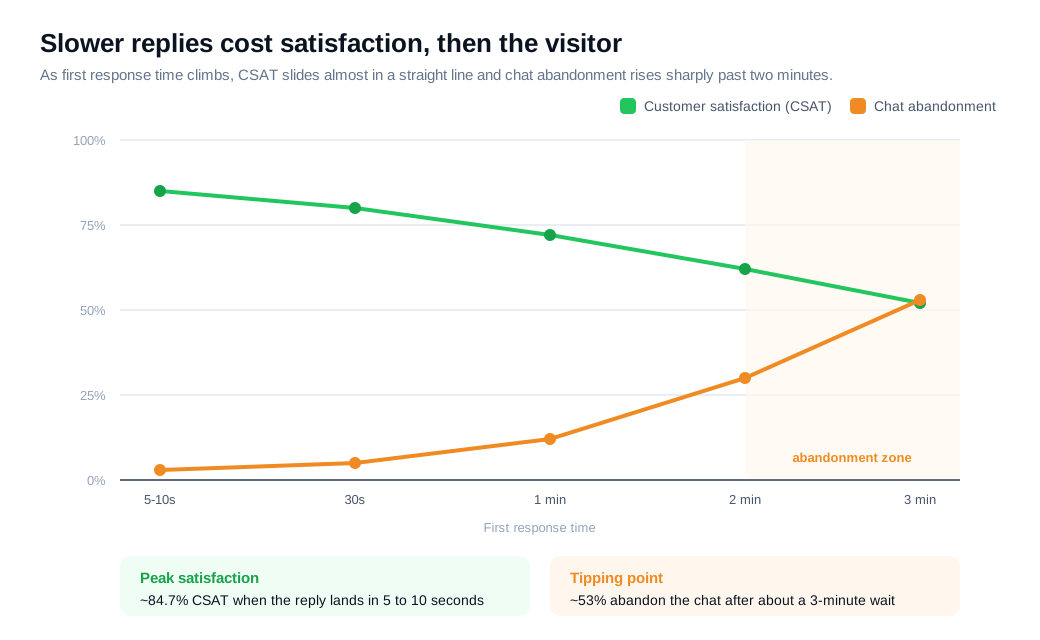
Response time and satisfaction move together almost in a straight line: the longer a visitor waits, the lower the odds of a positive rating, and past the two to three minute mark a large share simply leave. This is the most controllable lever most support and sales teams have.
The relationship between first response time and CSAT is nearly linear, with each added stretch of waiting shaving points off the probability of a happy customer. At the fast end, satisfaction peaks around 84.7 percent CSAT when the reply arrives within 5 to 10 seconds of the opening message. At the slow end, the damage is not a lower score but an empty chat: roughly 53 percent of customers abandon a chat after about three minutes of waiting, and those visitors tend to go to a competitor rather than switch to email. Which-50's roundup goes further and ties every extra minute of delay to a measurable drop in conversions from chat.
Put revenue on it with a worked example. Suppose a pricing page draws 500 chats a month, and these are warm visitors, so engaged chats convert at 15 percent on a $2,000 average deal. Answer them in 20 seconds and maybe 5 percent abandon, leaving 475 live conversations and about 71 conversions worth $142,000. Let the median first response slip past three minutes and abandonment climbs toward that 53 percent figure, leaving 235 live chats and roughly 35 conversions worth $70,000. Same traffic and the same reps, and the slow clock quietly erased more than $70,000 in monthly pipeline. The exact rates are illustrative, but the shape holds at any realistic numbers, because the visitors you lose to a slow reply are the warmest ones you had.
How do you consistently hit your response time targets?
You hit your response time targets by attacking the slowest step first, which is usually the gap between a chat arriving and the right person seeing it, then covering your peak hours, capping concurrency, and using saved replies and automation to shorten the reply itself. Numbers move only when the operation behind them changes.
Start with routing and alerts, because a fast rep cannot help a chat they never saw. Skills-based routing and instant notifications send a qualified chat to whoever owns that product or region and ping them in Slack, so a rep can jump in within seconds instead of a chat waiting in a shared queue. That single change attacks queue wait and first response time at once.
Cover your peaks instead of spreading staff evenly. Pull a week of chat volume by hour and clear spikes appear, usually mid-morning and mid-afternoon on weekdays for B2B. Schedule people against those spikes so nobody juggles six chats during the rush while the widget sits idle at 8 a.m. Then cap concurrency at two to three chats per skilled agent, since both quality and speed decay once attention splits too far.
Shorten the reply itself. Saved replies and a solid knowledge base let a rep answer common questions in seconds, as long as they personalize the opener rather than pasting boilerplate. For repetitive questions and after-hours coverage, an AI assistant can reply instantly and capture a lead when no human is online, which is how the blended-average math earlier lands inside a tight window. When a chat clearly involves a serious buyer, moving it to live video or screen share inside the same thread often closes faster than another round of typing.
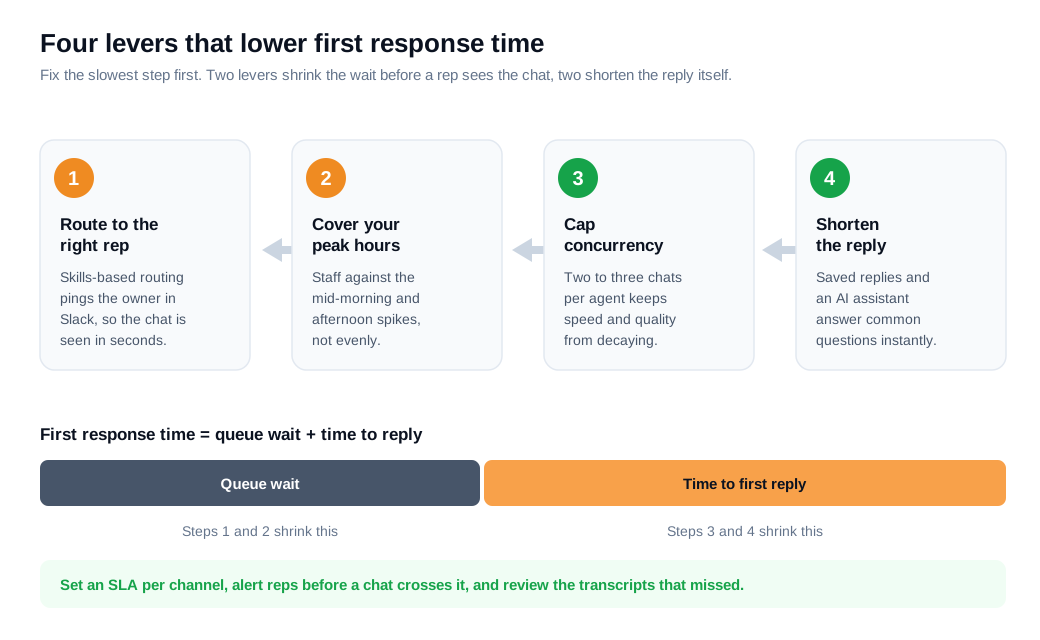
Finally, make the target visible and measured. Set a first response SLA per channel, alert reps before a chat crosses it, and review the transcripts on the chats that missed. Most platforms, Glimpze included, offer a free tier, so you can baseline your current first response time and abandonment rate before spending anything on changing them. A tool like live chat only pays off for inbound sales when the first answer arrives while the intent is still warm, and the fixes above are what make that reliable rather than lucky.
Key takeaways
- Aim under 30 seconds, treat under a minute as good. The best teams reply in 10 to 20 seconds with no queue, and customer patience runs out fast once a wait passes two minutes.
- Averages and targets are different numbers. Reported wait times can sit near 23 seconds while first-response medians run over 90 seconds, so always check whether a benchmark measures wait or reply, median or mean.
- Industry moves the benchmark threefold. Ecommerce answers in 12 to 30 seconds while financial services and healthcare reasonably run 30 to 60 seconds or more, driven by urgency, complexity, and deal value.
- Speed and satisfaction move almost in a straight line. CSAT peaks near 85 percent on a 5 to 10 second reply, and about 53 percent of visitors abandon a chat after roughly three minutes of waiting.
- A slow clock is lost pipeline. Warm chatters are your highest-intent visitors, so the abandonment a slow first response causes lands squarely on your best opportunities.
- Fix the slowest step first. Routing, peak staffing, a concurrency cap, saved replies, and AI coverage move first response time far more than a dashboard-wide push, then remeasure against your own history.

Written by
Nilas MylerCo-founder & CTO, Glimpze
Nilas is the co-founder and CTO of Glimpze, an inbound sales tool that turns high-intent website visitors into live conversations. A former SEO consultant for some of the largest companies in Denmark, he writes about speed-to-lead, inbound sales, and conversion rate optimization — the technical and operational mechanics of turning traffic into pipeline.


