
On this page
- What counts as a normal sales meeting no-show rate?
- Why do prospects no-show?
- How does booking speed affect show rate?
- How do reminders reduce no-shows?
- How do you confirm a meeting so the prospect actually shows up?
- How do you re-engage no-shows?
- What does a no-show reduction plan look like over one month?
- Key takeaways
- Sources
You did the hard part. A qualified buyer picked a time, the invite landed on both calendars, and your rep blocked the slot. Then the clock hits the meeting time and the room stays empty. Across B2B teams, roughly 30% of booked sales meetings end this way, which means close to a third of the pipeline your calendar promises never actually arrives.
No-shows feel personal, and the data says they rarely are. Most missed meetings trace back to timing, memory, and weak logistics, all of which you can influence before the call ever starts. The teams with the best show rates do not have more disciplined prospects. They book faster, remind smarter, confirm harder, and chase a no-show within minutes rather than writing it off.
This guide covers what a normal no-show rate looks like, why prospects miss meetings, how booking speed and reminders change the odds, how to confirm a meeting so it sticks, and how to win back the no-shows you still get.
What counts as a normal sales meeting no-show rate?
A normal B2B sales meeting no-show rate sits around 30%, so if roughly one in three of your booked calls falls through, you are near the industry middle rather than doing something uniquely wrong. Anything under 20% is solid, and the strongest teams hold 85% to 90% of what they book.
The number moves by funnel stage. A top-of-funnel discovery call booked off a content download will no-show more often than a bottom-of-funnel demo the buyer requested by name, so a fair target is under 20% for early-stage meetings and under 10% deeper in the pipeline. Practitioner benchmarks put a good sales appointment show rate at 70% to 80%, with excellent performers reaching the high eighties through tight qualification and confirmation. Demo-specific no-shows run higher, with the industry range landing between 30% and 50% for unmanaged funnels.
Before you chase any tactic, measure your own booked-to-held rate by source and stage. Meetings booked from a live conversation on your site behave differently from meetings booked off a cold outbound sequence, and averaging them together hides where the leak actually is.
Why do prospects no-show?
Prospects no-show mostly because of competing priorities, plain forgetfulness, and a meeting that never felt worth defending, rather than a sudden loss of interest in what you sell. Understanding which cause is driving your misses tells you which fix to reach for.
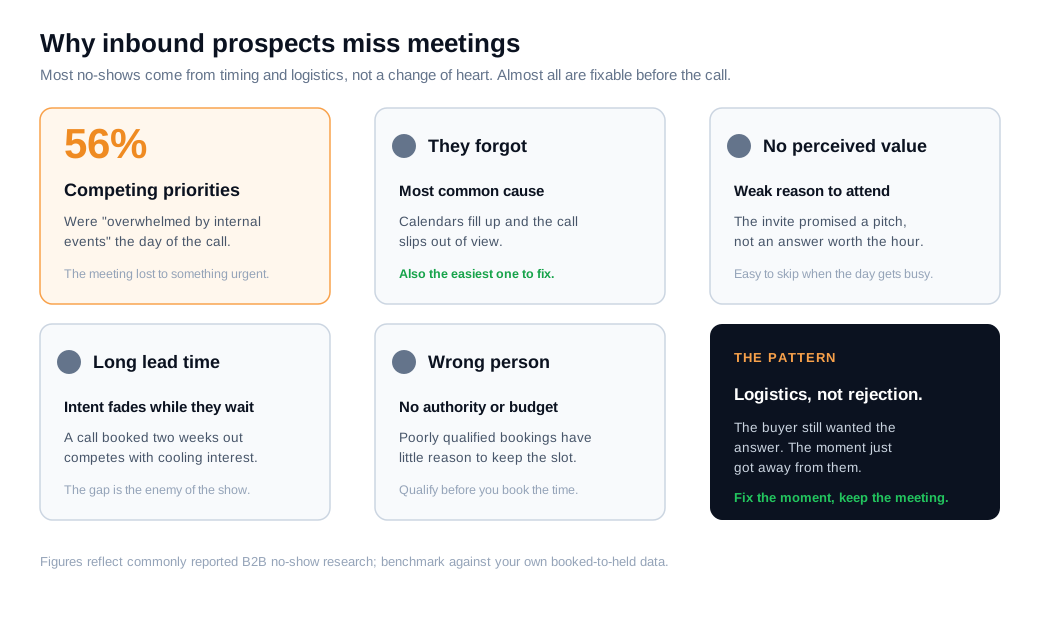
Competing priorities lead the list. In one analysis of missed sales meetings, 56% of no-shows happened because prospects were "overwhelmed by internal events" on the day of the call, not because they had cooled on the offer. A fire drill at their company beat a meeting they had every intention of keeping.
Forgetting is the most common cause and the easiest to fix. Calendars fill up, the invite scrolls out of view, and a call agreed to a week ago vanishes from working memory. Close behind sits weak perceived value: a meeting framed as a generic pitch gives a busy buyer nothing to protect when something urgent competes for the same hour. Two structural causes round it out. A long gap between booking and the call lets interest fade, and poor qualification puts someone with no budget or authority on the calendar, where they have little reason to attend. Read together, these are problems of logistics and timing, which is good news, because logistics are fixable.
How does booking speed affect show rate?
Booking speed has a direct effect on show rate: the shorter the gap between the moment a buyer commits and the meeting itself, the more likely they are to actually attend. Intent is perishable, and every day of lead time gives it more room to cool.
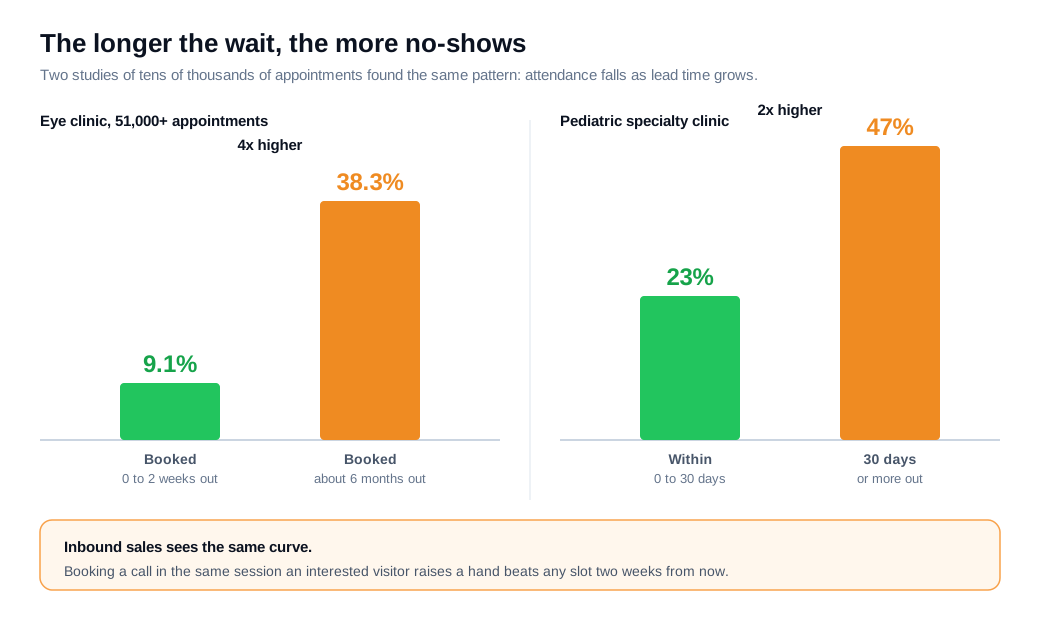
The clearest evidence comes from healthcare, where the samples are large and the pattern is consistent. A study of more than 51,000 ophthalmology appointments found the no-show rate was 9.1% when the visit was booked within two weeks and 38.3% when booked about six months out, a fourfold jump driven by nothing but lead time. A separate pediatric analysis found no-shows of 23% for visits scheduled within 30 days against 47% for those booked 30 days or more ahead. The gap between booking and meeting is one of the strongest predictors of whether anyone shows.
Inbound sales sees the same curve. Here is the worked version. Imagine two identical buyers who each ask for a demo on your pricing page. The first gets offered a slot in the next few days and holds it while the problem is still front of mind. The second is routed to a scheduler and picks the first open time on the rep's calendar, eleven days out, by which point a competitor has already called and the internal urgency has passed. Same intent at the start, very different odds at the finish. The fastest version of this is booking the meeting inside the same session interest peaks, which is where treating your website as an inbound sales channel pays off. When a high-intent visitor raises a hand over live chat and a rep can either take the conversation live or lock a same-week slot on the spot, the lead time that kills show rates never gets a chance to open up.
How do reminders reduce no-shows?
Reminders reduce no-shows by closing the memory gap, and a layered set of them across email and text can cut missed appointments by a third or more. The buyer who forgot is the buyer a reminder saves, and forgetting is the single most common reason meetings slip.
The research is unusually clear about the size of the effect. A widely cited Imperial College London study found that text message reminders cut no-shows by 38%. A systematic review in the American Journal of Medicine put the average reduction in non-attendance at about 34% from baseline across reminder types, with manual phone calls trimming misses by 39% and automated reminders by 29%. Some multi-channel programs that combine text, email, and voice report cutting no-shows by up to 60%, because more channels catch more of the people any single inbox would miss.
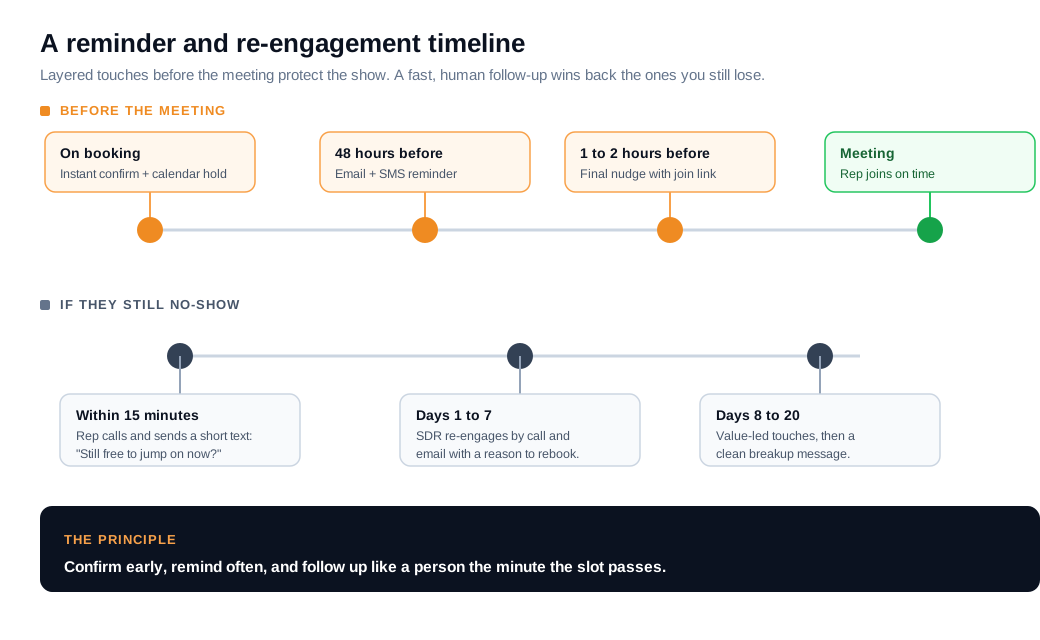
The pattern that works is layered, not a single ping. Confirm the moment the meeting is booked with a calendar invite and a plain summary of what the call will cover. Send a reminder about 48 hours out, when there is still time to reschedule rather than cancel. Send a final nudge one to two hours before with the join link one tap away. Make the reminders two-way, so a prospect who cannot make it can move the meeting in the same message instead of ghosting, which frees the slot and keeps the relationship intact. Every layer costs almost nothing and each one saves a share of the buyers who simply lost track of the time.
How do you confirm a meeting so the prospect actually shows up?
You confirm a meeting by getting the prospect to take one small action that signals real commitment, then making the invite worth keeping. A booking the buyer actively confirmed behaves very differently from a slot a scheduler dropped on them.
Start with a light double opt-in. A short "reply YES to lock it in" or a one-click confirm in the reminder turns a passive booking into a small promise, and people keep promises they have restated. Next, give the invite a reason to survive a busy morning. A calendar description that names the two or three things the buyer will walk away with, tied to the problem they raised, defends the slot far better than "Intro call." A meeting framed around their agenda is one they will protect.
Two smaller levers help at the margins. Shorter meetings show up more often, with prospects 12% more likely to attend a 30-minute call than a 60-minute one, so ask for less time and earn the longer session later. Timing matters too, with the mid-to-late afternoon window tending to hold better than early morning. The biggest confirmation lever, though, is qualification. If the person on the invite has budget, authority, and a live problem, they have a reason to show, so confirm fit before you confirm a time. When a qualified lead does book, route it to the right rep instantly and ping them so they arrive prepared, which is the job of a solid lead routing and notifications setup. A rep who joins on time, in context, and ready to help is itself a confirmation the buyer feels.
How do you re-engage no-shows?
You re-engage a no-show by reaching out within minutes while the slot is still warm, then running a short, human follow-up over the next two to three weeks. The window right after a missed meeting is the highest-value moment you have, because the prospect may be one room away and genuinely embarrassed they forgot.
Move first, and move fast. In the fifteen minutes after a no-show, a quick call plus a short, friendly text ("Looks like we got our wires crossed, are you free to jump on now?") recovers a meaningful share of misses, since many prospects are simply at their desk having lost track of the time. If that does not land, run a defined cadence rather than a single hopeful email. One practical structure has an SDR work the no-show by phone and email through the first seven days, then hands wider re-engagement to other reps from days 8 through 20.
Tone carries the follow-up. A no-show usually knows they missed, so lead with empathy and a touch of lightness rather than guilt, and give them a frictionless way back onto the calendar. HubSpot's no-show templates lean on exactly this, short and human over stiff and accusatory. Add a reason to rebook that is about them, a relevant resource or a new detail, instead of "just following up." For the prospect who has missed twice, a direct breakup line ("Should I close this out for now?") respects everyone's time and often pulls a real answer. The fastest re-engagement of all skips rescheduling entirely: offer to handle the question live, right now, over chat or a quick video call or screen share, so the buyer who missed a formal slot can still get what they came for in the moment.
What does a no-show reduction plan look like over one month?
Here is the whole system applied to one team's numbers over a single month, so the tactics add up to something you can measure. The point is to show how small changes at each stage compound into held meetings and pipeline.
Say a team books 100 inbound sales meetings in a month and starts at the industry-average 30% no-show rate. That is 30 misses and 70 meetings held. Now layer in the fixes. Booking high-intent leads into same-week slots and, where possible, into the same session, pulls the average lead time down and lifts show rate. A confirm-on-booking step plus a 48-hour and a day-of reminder recovers most of the buyers who would have forgotten. Sharper qualification keeps wrong-fit bookings off the calendar. Together these are enough to move a 30% no-show rate to around 12%, which is 88 meetings held instead of 70.
The re-engagement plan then works the remaining 12 misses. A within-15-minutes call plus a light cadence typically wins back a third of them, so roughly 4 rebook and hold, bringing the month to about 92 held meetings against the original 70. That is 22 additional real conversations from the same 100 bookings. If a quarter of held meetings turn into qualified opportunities at a $12,000 average deal size, those 22 extra meetings represent about 5 to 6 new opportunities and roughly $66,000 in added monthly pipeline, illustrative numbers you should replace with your own conversion and deal data. None of it required more leads. It came from losing fewer of the meetings you already earned.
Key takeaways
- A 30% no-show rate is average, so aim lower on purpose. Under 20% is solid and the best teams hold 85% to 90%, but you cannot improve what you have not measured by source and stage.
- Most no-shows are logistics, not rejection. Competing priorities drove 56% of misses in one analysis, and forgetting is the most common and most fixable cause, so treat the problem as timing rather than interest.
- Book fast, because lead time predicts attendance. No-shows jumped from 9.1% to 38.3% as booking moved from two weeks out to six months out, so lock high-intent meetings into the same week or the same session.
- Layer your reminders across channels. Text reminders alone cut no-shows by 38% and multi-channel programs report up to 60%, so confirm on booking, remind at 48 hours, and nudge again on the day.
- Confirm commitment and defend the invite. A one-click confirm, an agenda built around the buyer's problem, a shorter 30-minute slot, and tight qualification all give the prospect a reason to show.
- Re-engage within minutes, then persist. A call and text in the first 15 minutes recovers many misses, and a short, human cadence through day 20 wins back a meaningful share of the rest.
TAGS

Written by
Daniel SemeckyCo-founder & CEO
Daniel is the co-founder and CEO of Glimpze. He spends his days talking to revenue teams about how to catch high-intent visitors before they bounce, and writes about inbound sales, lead conversion, and building a motion where marketing and sales actually share a number.


