
On this page
- What makes a product demo effective?
- Why does discovery come before the demo?
- What is a repeatable demo structure?
- How long should a product demo be, and how do you keep it engaging?
- How do you handle objections and questions live?
- How do you follow up after a demo?
- How do you know if your demos are working?
- Key takeaways
- Sources
A product demo is the most expensive fifteen minutes in your sales cycle. You spent marketing dollars to earn the meeting, a rep spent hours preparing, and the buyer handed over the one thing they rarely give twice: their full attention. Spend it on a feature tour and the deal cools by the time you stop sharing your screen.
The good news is that strong demos are a pattern, not a personality trait. They repeat across reps, products, and deal sizes. Gong studied 67,149 recorded SaaS demos and found that the ones that closed shared a small set of habits, most of which have nothing to do with charisma.
This post covers what makes a demo effective, why discovery comes first, a five-stage structure you can reuse, how to handle objections in the room, and how to follow up so the meeting becomes a real next step.
What makes a product demo effective?
An effective product demo shows one buyer how your product solves the specific problem they told you about, in the order that matters to them, and ends with a clear next step. Everything else is decoration.
The most common failure mode is the feature tour: a rep walks left to right across the navigation, showing every tab because they know the product well. The buyer sits through forty minutes of capabilities they will never use and leaves without seeing the one screen that would have changed their mind.
Gong's data-science team analyzed 67,149 recorded demos, transcribed them, and matched each one to its outcome in the CRM. The demos that closed shared a structure they called the upside-down pyramid. Instead of building toward a grand finale, winning reps opened with the capability that solved the problem the buyer had talked about most during discovery. The best part came first, while attention was highest, and the rest supported it.
Two more findings from that study are worth internalizing. Top performers received about one third more questions from buyers during demos than mid performers, which is a sign the buyer was engaged rather than watching. Those same reps asked roughly 30 percent fewer questions of the buyer during the demo, because they had already done that work up front. A good demo feels like a working session, and the buyer does a fair share of the talking.
There is a buyer-expectation angle too. In Salesforce's State of the Connected Customer survey, 88 percent of customers said the experience a company provides is as important as its products and services. The demo is that experience in concentrated form. A tailored, well-run session signals how you will treat them as a customer.
Why does discovery come before the demo?
Discovery comes before the demo because a demo without it is a guess. You cannot lead with the capability that matters most if you do not yet know which problem keeps the buyer up at night.
Discovery is the research that lets you personalize. Some of it happens on an earlier call, and some of it you can gather before you ever speak: the prospect's industry, company size, tech stack, and the language they use on their own site. The goal is to walk into the demo able to name the buyer's top problem in their own words, know who else is in the room, and understand what a good outcome looks like to them.
When you have that, the demo writes itself. You know which two or three capabilities to show and, more usefully, which ten to skip. If you learn that discovery never really happened, spend the first five minutes recovering it. Ask what prompted them to take the call, what they are using today, and what would have to be true for this to be worth switching. Then demo against the answers.
Discovery is also easier when you catch buyers at the moment of peak interest. A visitor comparing pricing or reading a feature page is telling you what they care about right now. Tools like live video chat and screen share let a rep open a conversation on the spot, run a lightweight discovery, and in many cases roll straight into a short demo while the intent is fresh. For inbound sales teams, that on-site moment is often where the best discovery happens, long before a formal call is booked.
What is a repeatable demo structure?
A repeatable demo structure gives every rep the same five stages, time-boxed so the important parts never get squeezed. Here is a version that fits a 40-minute call.
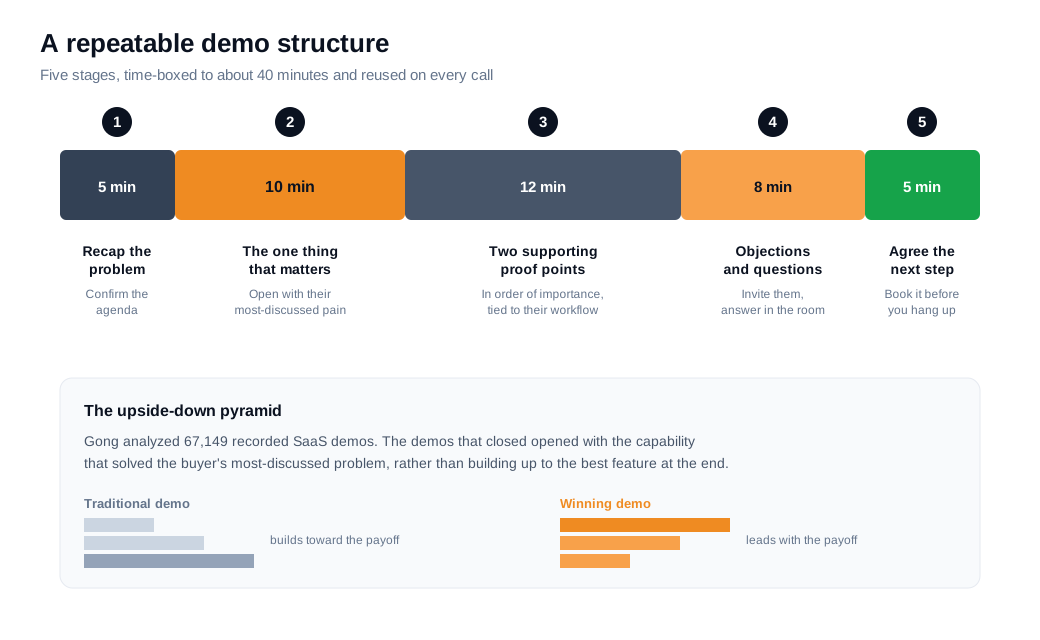
Stage one, recap the problem (5 minutes). Restate what you heard in discovery and confirm the agenda. Setting an agenda establishes that you are in control of the time and gives the buyer a map. Ask whether anything has changed since you last spoke.
Stage two, the one thing that matters (10 minutes). Open with the capability that solves the problem the buyer discussed most. This is the upside-down pyramid in practice. Show the workflow end to end using realistic data, and connect it back to the outcome they said they wanted.
Stage three, two supporting proof points (12 minutes). Show the next two capabilities in order of importance to this buyer, not in order of how the product menu is laid out. Tie each one to a moment in their actual workflow. If you run short on time, you sacrifice the least important item, by design.
Stage four, objections and questions (8 minutes). Invite them explicitly. A demo should never be one-directional, so block real time for the buyer to push back and ask what they need to ask.
Stage five, agree the next step (5 minutes). Close the loop with a concrete action and a date. Do not let the meeting end on "we will be in touch."
Here is a worked example. A rep who had been running open-ended demos that averaged 55 minutes and drifted through the whole product rebuilt them on this structure. She opened with the reporting view that solved the prospect's most-cited headache, spent ten minutes there, then used twelve minutes on two workflows that supported it. Eight minutes went to questions, five to booking a technical review. The demos got shorter, the buyers talked more, and the reps stopped guessing which feature to show next.
How long should a product demo be, and how do you keep it engaging?
Keep the live demo to roughly 30 to 45 minutes, and never talk for more than a few minutes at a stretch without handing the conversation back. Attention is a budget, and monologues spend it fast.
The rhythm that works is tell, show, tell. Say what you are about to demonstrate and why it matters to them, show it, then confirm it landed before moving on. That last step is where reps get lazy. A quick "does that match how your team works today?" keeps the buyer active and surfaces a real reaction while you can still respond to it.
Watch your talk-to-listen ratio. Gong's call research consistently finds that the strongest reps let the buyer carry a meaningful share of the conversation, and that buyer questions are a leading indicator of a healthy deal. If you have talked for ten minutes straight, you have almost certainly gone too long. Pause, ask a question, and let the answer redirect you.
Two habits protect the pace. Use realistic sample data so the product looks lived-in, and prune ruthlessly. Every screen that does not tie to the buyer's stated problem dilutes the ones that do.
How do you handle objections and questions live?
Handle objections with a short, repeatable loop: pause and acknowledge, probe for the real concern, reframe with proof, then confirm you resolved it. The instinct to defend a feature the second you hear a doubt is the thing to unlearn.
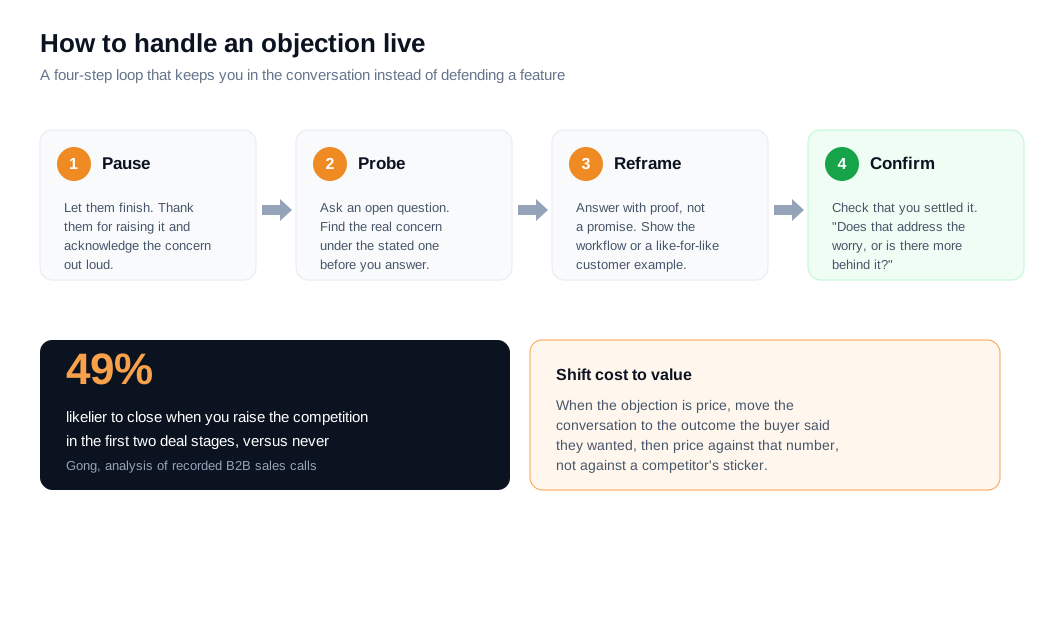
Pause first. Let them finish the thought, thank them for raising it, and acknowledge the concern out loud. HubSpot's guide to handling common objections makes the same point: acknowledging the concern before you respond builds enough trust that the buyer will tell you what is really going on.
Then probe. The stated objection is often a stand-in for a deeper one. "It looks expensive" can mean the budget lives with someone not on the call, or that they are unsure the rollout will work. Ask an open question and find the real issue before you answer, because answering the wrong objection wastes the goodwill you just earned.
Reframe with proof rather than a promise. If they doubt a workflow, show it. If they doubt adoption, describe a similar customer who had the same worry and what happened. When the objection is price, move the conversation to the outcome they told you they wanted and price against that number, not against a competitor's sticker.
Finally, confirm. Ask directly whether that settles it or whether something is still behind it. This peels back the next layer instead of leaving a silent doubt to resurface after the call.
One more, backed by data: bring up the competition early. Gong found that raising the competitive comparison in the first two stages of the deal made it 49 percent likelier to close than never mentioning rivals at all, because you shape the buyer's evaluation criteria while they are still forming an opinion.
How do you follow up after a demo?
Follow up the same day, and book the next step before the current call ends. The follow-up window is where good demos quietly die, and the response-time math is one-sided.
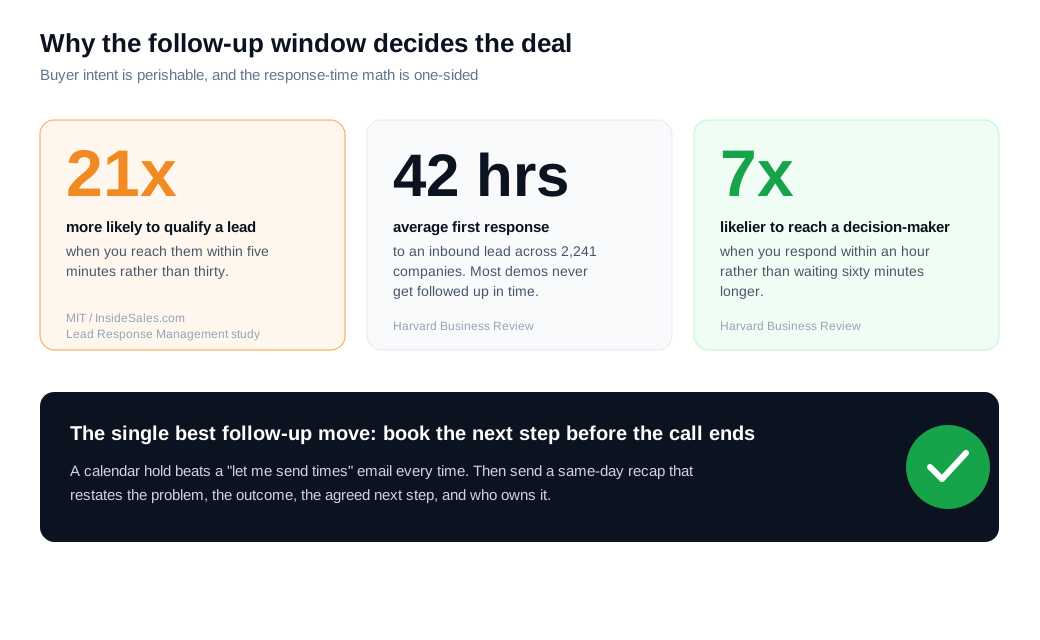
The Lead Response Management study run by Dr. James Oldroyd at MIT with InsideSales.com found that contacting a lead within five minutes rather than thirty made you about 21 times likelier to qualify it. Harvard Business Review's audit of 2,241 companies, "The Short Life of Online Sales Leads," found the average first response took 42 hours, and that firms answering within an hour were about seven times likelier to reach a decision-maker than those that waited even sixty minutes longer. Those numbers describe first response, and the same physics apply after a demo. Momentum decays by the hour.
The single most effective follow-up move is to book the next step live. A held calendar slot beats a "let me send some times" email, which starts a scheduling negotiation exactly when enthusiasm is highest. Ask for the technical review, the pilot, or the meeting with the economic buyer while you are still on the call.
Then send a same-day recap. Keep it short and scannable. Restate the problem in the buyer's words, the outcome you showed, the next step you agreed on, and who owns what by when. If several stakeholders were in the room, that recap doubles as the note they forward internally. When a demo comes off a live website conversation, routing the lead to the right rep and firing an instant Slack alert with a tool like Glimpze's lead routing and notifications is what makes a same-day, sometimes same-minute, follow-up realistic instead of aspirational.
How do you know if your demos are working?
You know your demos are working when your demo-to-close rate climbs and a rising share of demos produce a scheduled next step. Those two numbers tell you more than any post-call gut feeling.
Track the outcome metric and a leading indicator together. Demo-to-close rate is the outcome. The share of demos that end with a booked next step is the early signal, because a demo that produces no next step almost never becomes a deal.
Consider the math. A rep who runs 30 demos a month at a 20 percent close rate books six deals. Move the close rate to 26 percent, through tighter discovery, the upside-down structure, and faster follow-up, and that same 30 demos produces about eight deals. Two extra deals a month, with no increase in pipeline, is the difference a repeatable framework makes. Multiply it across a team and the revenue adds up without another marketing dollar.
Watch the softer signals too. How much did the buyer talk, how many questions did they ask, and did they invite other stakeholders? Recording and reviewing your own demos is the fastest way to see which habits move deals and which you can drop.
Key takeaways
- Discovery is the demo's foundation. You cannot lead with the capability that matters most until you know which problem the buyer cares about most, so do that research before you share your screen.
- Use the upside-down pyramid. Gong's study of 67,149 demos found that winning reps open with the capability tied to the buyer's biggest pain, rather than saving the best for last.
- Run a fixed five-stage structure. Recap the problem, show the one thing that matters, add two supporting proofs, handle objections, and agree the next step, time-boxed so the important parts never get squeezed.
- Handle objections with a loop, not a reflex. Pause and acknowledge, probe for the real concern, reframe with proof, then confirm you resolved it, and raise the competition early because it makes deals 49 percent likelier to close.
- Follow up the same day and book the next step live. Response-time research shows momentum decays by the hour, so a held calendar slot and a scannable recap beat "we will be in touch."
- Measure demo-to-close and next-step-booked rates. A move from a 20 to 26 percent close rate on 30 monthly demos is roughly two extra deals, with no added pipeline.
TAGS

Written by
Daniel SemeckyCo-founder & CEO
Daniel is the co-founder and CEO of Glimpze. He spends his days talking to revenue teams about how to catch high-intent visitors before they bounce, and writes about inbound sales, lead conversion, and building a motion where marketing and sales actually share a number.


