
On this page
- What is an inbound sales script?
- What should an inbound sales script include?
- How do you open an inbound sales call?
- How many qualifying questions should an inbound script include?
- How do you handle common objections?
- How do you keep scripts from sounding robotic?
- What does a full inbound talk track sound like?
- Key takeaways
- Sources
A prospect fills out your demo form, then picks up the phone three minutes later. She already knows what your product does. She read two case studies and your pricing page before she raised her hand. The rep who calls her does not need a pitch. He needs a path: a way to greet her, learn what she is trying to fix, answer the two questions she is holding, and book the next step before her calendar swallows the afternoon.
That path is a script. A script here means a talk track, an ordered set of openings, questions, and responses a rep leans on while still sounding like a person. The good ones lift conversion without flattening the conversation. The weak ones make a warm buyer feel processed, and processed buyers go quiet.
This guide covers what inbound sales scripts are, what a strong one includes, how to open the call, how many qualifying questions to ask, how to answer the objections you hear every week, and how to keep the whole thing from sounding robotic. Every section leaves you with lines you can lift and adapt.
What is an inbound sales script?
An inbound sales script is a structured talk track for buyers who contacted you first, built around questions and guided responses rather than a cold pitch. The person on the other end already chose to raise a hand, so the script's job is to qualify, understand, and direct, not to grab attention from a standing start.
That starting point changes the wording of everything that follows. An outbound script has to survive an interruption in the first eight seconds. An inbound script inherits interest and has to avoid wasting it. A rep who answers a warm call with a canned elevator pitch is solving a problem the buyer does not have, and the buyer feels the mismatch immediately.
Speed is why the script has to be ready before the phone rings. The MIT and InsideSales Lead Response Management study found that contacting a new lead within five minutes rather than thirty makes you about 21 times more likely to qualify it and 100 times more likely to reach a person at all. Harvard Business Review's audit of 2,241 companies found the average first response ran 42 hours, and 23 percent of firms never responded. A script you have to improvise is a script you deliver late. Treating your website as an inbound sales channel means the talk track is loaded and the rep is briefed before the lead cools.
What should an inbound sales script include?
A strong inbound sales script includes seven parts: a warm greeting, a permission-based agenda, qualifying questions, discovery, a value frame tied to what you heard, ready objection responses, and one specific next step. Each part has a job, and skipping one usually shows up later as a stalled deal.
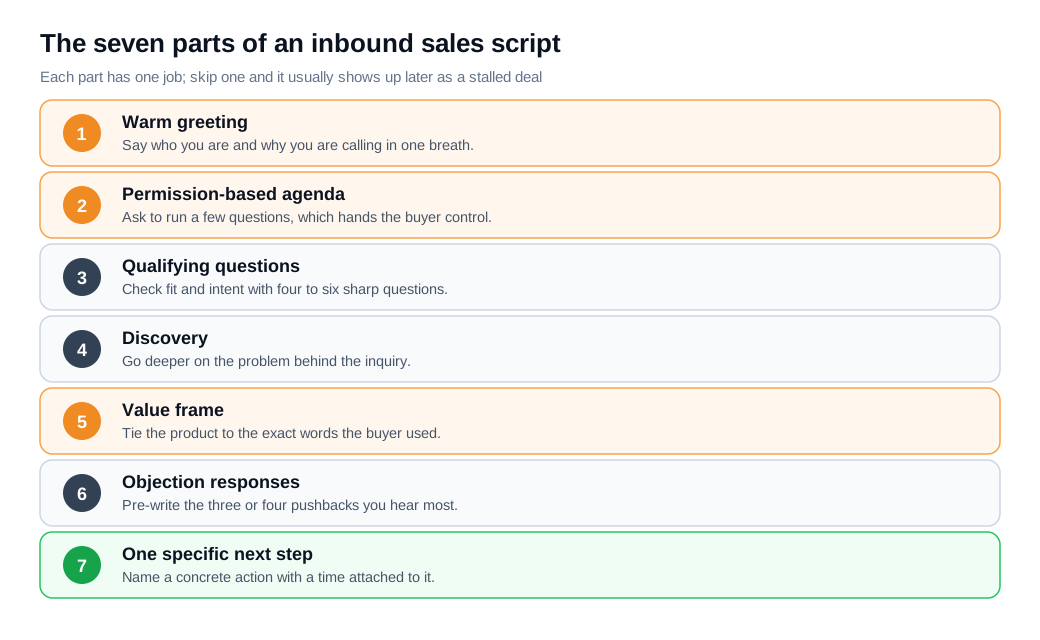
The greeting confirms who you are and why you are calling in one breath. The agenda asks permission ("mind if I ask a couple of quick questions so I only show you what's relevant?") and hands the buyer control, which lowers their guard. Qualifying questions check fit and intent. Discovery goes deeper on the problem behind the inquiry. The value frame connects your product to the exact words the buyer used, so the pitch feels earned instead of pre-loaded. Objection responses are written in advance for the three or four pushbacks you hear most. The close names a concrete next step with a time attached to it.
Most teams keep a short library rather than one master script: a version for a product question, one for a pricing inquiry, one for a demo request, and one built purely for objections. Template collections from Close and JustCall organize their inbound scripts the same way, around the reason for the call rather than a single catch-all flow. The library approach keeps each script short enough that a rep can actually hold it in their head.
How do you open an inbound sales call?
Open by confirming who you are, naming the exact reason they reached out, and proposing a short agenda they can approve, all inside the first fifteen seconds. The opening is where a warm lead decides whether the call will feel like help or a hard sell.
Anchor the first line to their action. "Hi Dana, it's Marco from Glimpze. You booked time right after looking at our pricing page, so I want to make sure I actually answer what you came for." That single sentence proves you know why they are here and signals the call is about them. Then set the agenda and ask for the nod: "I've got about fifteen minutes blocked. If it's alright, I'll ask two or three quick questions, then show you the part that fits. Sound good?"
The opening line is worth testing like any other high-traffic asset. Small changes, referencing the specific page they viewed versus leading with a benefit statement, move how many buyers stay engaged past the first thirty seconds. Write two or three openers into the script, track which one keeps people on the call, and standardize the winner. An opener that works for a self-serve trial signup rarely works for an enterprise demo request, so segment by the reason they raised a hand.
How many qualifying questions should an inbound script include?
Keep a working set of about four to six qualifying questions in the script, and let a full discovery call run to roughly eleven to fourteen questions total, which is where win rates peak. Fewer than that and you route blind; many more and you tip into interrogation.
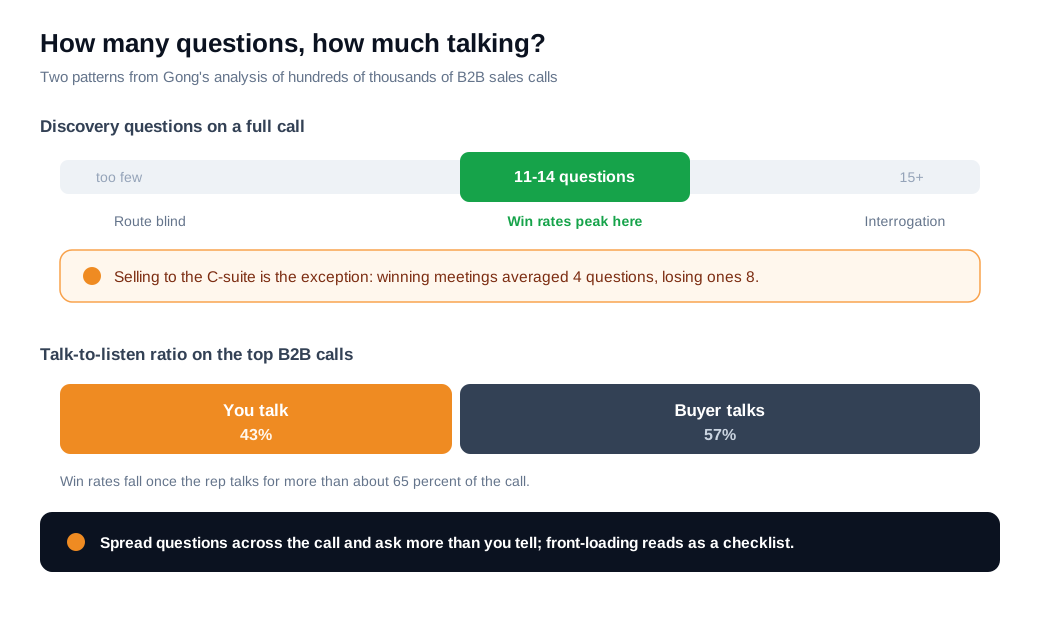
Gong's analysis of more than 519,000 B2B sales calls found the highest success when reps asked between 11 and 14 discovery questions; past 14, results slid back toward average. The same research flagged a special case: when selling to C-suite buyers, successful meetings averaged four questions and unsuccessful ones eight, because senior executives tire of discovery fast. Match the count to the seat you are selling to.
How you ask matters as much as how many. Gong's separate look at talk-to-listen ratios found the top B2B conversations sit near 43 percent rep talk to 57 percent buyer talk, and win rates drop once the rep talks for more than about 65 percent of the call. Spread the questions across the conversation instead of front-loading them like a checklist, which is the habit that separates average reps from strong ones. A script running in live chat has a built-in edge here: the rep can see the pages a visitor already read, so two or three of those qualifying questions are answered before anyone types a word.
How do you handle common objections?
Handle objections by pausing, acknowledging the concern in the buyer's own words, isolating the real issue, answering that one thing, and confirming you cleared it. The pause is a technique in its own right.
Gong's review of more than 67,000 recorded calls found that successful reps pause about five times longer after an objection than their less successful peers, roughly a second and a half versus a third of a second. Weaker reps interrupt and speed up when they hear pushback. The extra beat of silence signals you took the concern seriously and buys you a moment to answer the real problem instead of the surface one.
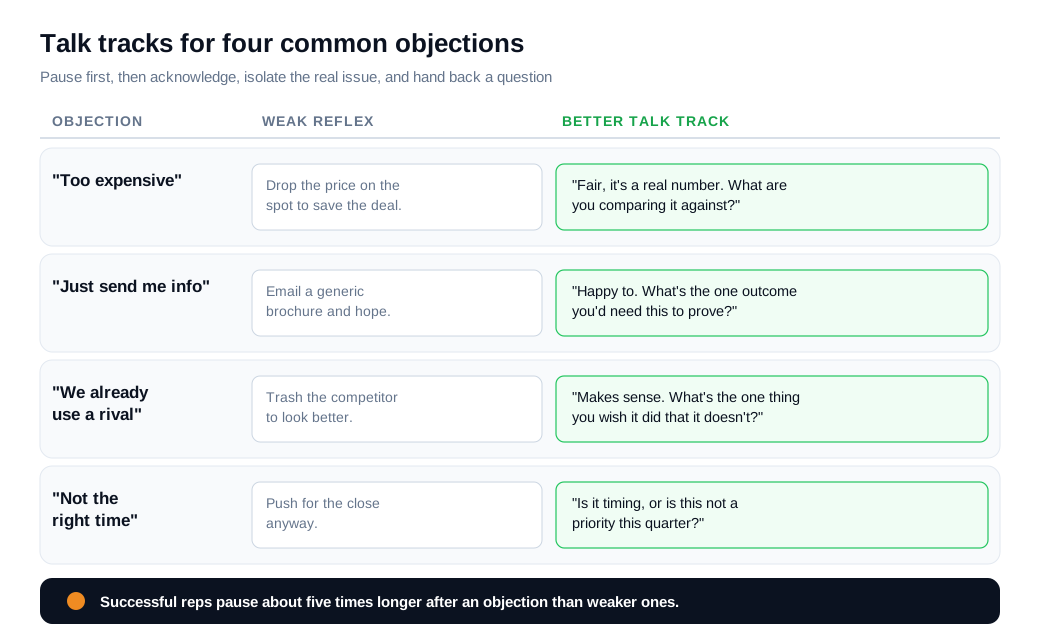
Write a talk track for each objection you hear weekly. For price, resist the reflex to discount on the spot: "Fair, it's a real number. Can I ask what you're comparing it against, so I can speak to the difference?" For "just send me some information," isolate the brush-off: "Happy to. So I send the right thing and not a generic brochure, what's the one outcome you'd need this to prove?" For "we already use a competitor," open a gap without trashing them: "Makes sense, plenty of teams start there. What's the one thing you wish it did that it doesn't?" For "now isn't the time," test whether the timing is real: "Totally understand. Is it a timing thing, or is it that this isn't a priority this quarter?" Every line acknowledges the concern, isolates it, and hands the buyer a question rather than a rebuttal to argue with.
How do you keep scripts from sounding robotic?
Keep scripts from sounding robotic by treating them as a skeleton to internalize, so the structure stays fixed while the words stay your own. A rep reading a page aloud sounds exactly like a rep reading a page aloud, and warm buyers disengage from it fast.
Learn the intent of each section, then deliver it in your own language. HubSpot's guidance on sales scripts frames them as flexible frameworks rather than lines to recite, and Forbes's panel on natural-sounding sales language makes the same case: rehearse until the content is automatic, then let your own cadence carry it. Practice out loud and record yourself, because a script read silently in your head is never really tested, and the spots where you stumble on tape are the exact spots a buyer would notice.
Three habits keep a script human. Use the buyer's name and their specific situation, never a generic filler phrase that could apply to anyone. Ask more than you tell, which the talk-to-listen data already argues for. And leave real silence after your questions so the buyer can give you a long answer; the longest uninterrupted thing a prospect says on a call tends to track with the deal moving forward. The script sets the path. The conversation still belongs to the two people having it, and a good rep lets it wander when wandering is where the truth comes out.
What does a full inbound talk track sound like?
Here is one inbound conversation, chat to call, showing how the parts connect with real numbers attached. A visitor named Dana lands on the pricing page, reads it twice across two days, and opens a chat.
Dana types: "Does this work for a 30-person support team?" The rep can see the two pricing visits and the question, so fit and intent are already halfway answered. He skips the throat-clearing: "It does, and teams around that size are our sweet spot. Mind if I ask two quick things so I point you at the right plan?" Two questions later he knows the team size, the current tool, and that they want to be live before the next quarter. That is four of his qualifying questions closed inside ninety seconds, with no form in sight.
Dana raises the predictable objection: "It looks pricier than what we use now." The rep pauses, then answers: "Fair, it is a real number. What are you comparing it against?" She names the incumbent. He isolates the gap she already hinted at, offers to show it rather than argue about it, and escalates the chat to a live video call and screen share to walk through the one workflow she actually cares about. Before he dials, the thread and her answers route to the right account executive through the team's routing and notifications setup, so nobody makes Dana repeat her story. One warm lead, about six minutes, no form and no next-day voicemail. The script did not sell for the rep. It kept him from fumbling the parts that quietly lose deals.
Key takeaways
- An inbound script is a talk track, and it guides a buyer who already raised a hand, so it leans on questions and prepared responses rather than a cold pitch.
- Cover seven parts: a greeting, a permission-based agenda, qualifying questions, discovery, a value frame in the buyer's own words, ready objection responses, and one specific next step.
- Open by naming their reason and asking permission for a short agenda in the first fifteen seconds, and test the first line the way you would test an email subject line.
- Ask about four to six qualifying questions in the script and up to eleven to fourteen on a full call, keep talk-to-listen near 43:57, and ask fewer of the C-suite.
- Answer objections with a pause first, then acknowledge in the buyer's words, isolate the real issue, respond to that, and confirm; a beat of silence outperforms a fast rebuttal.
- Beat the robotic problem by internalizing the skeleton, practicing out loud, personalizing to the buyer's situation, and leaving room for their longest answer.
TAGS

Written by
Daniel SemeckyCo-founder & CEO
Daniel is the co-founder and CEO of Glimpze. He spends his days talking to revenue teams about how to catch high-intent visitors before they bounce, and writes about inbound sales, lead conversion, and building a motion where marketing and sales actually share a number.


