
On this page
A support manager opens the dashboard on the first Monday of the quarter. Chat volume is up, first response time has doubled, and three agents are drowning while the widget on the pricing page keeps lighting up. The instinct everyone reaches for is "hire more people." The harder questions are how many, for which hours, and how to prove the number before payroll approves it.
Staffing chat by feel usually lands in one of two ditches. Overstaff and you pay for idle agents watching an empty queue. Understaff and warm buyers wait past the point where they still care, then close the tab. The way out is a small amount of arithmetic that converts volume, handle time, and concurrency into a headcount you can defend in a planning meeting.
This guide covers how to calculate chat staffing needs, what a healthy concurrency per agent looks like, why standard Erlang C needs adjusting for chat, how chat volume forecasting works, how to plan for peak hours, and how AI changes the math.
How do you calculate chat staffing needs?
You calculate chat staffing needs by converting expected chat volume and average handle time into a workload, dividing that workload by how many chats each agent runs at once, then padding the result for the hours agents are paid but not handling chats. Four inputs drive the whole calculation: chat volume for the interval, average handle time (AHT) per chat, concurrency, and shrinkage.
The core formula reads: agents = (chats x AHT) divided by (interval x concurrency), then divided by (1 minus shrinkage). Chats times AHT gives raw workload in agent-minutes. Concurrency shrinks that workload because one person carries several chats in parallel. Shrinkage grows the final number back up to cover breaks, meetings, coaching, and everything else that keeps a scheduled agent off the queue. Contact centers plan for roughly 25 to 35 percent total shrinkage, enough to change the headcount.
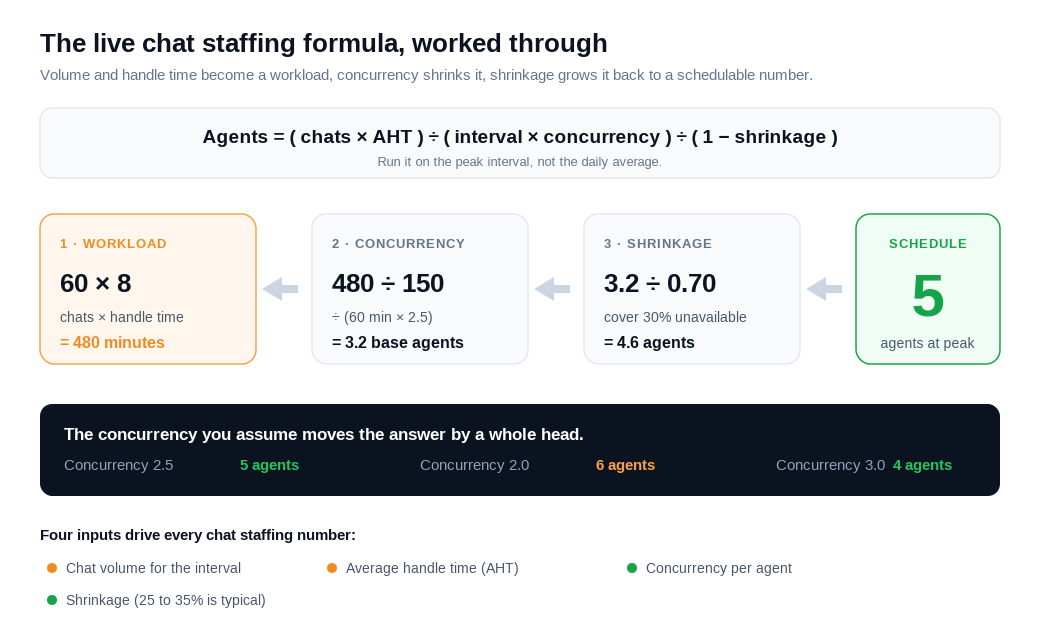
Here is a worked example for a single peak hour. Say a SaaS website fields 60 chats in its busiest hour, average handle time is 8 minutes per chat, each agent comfortably runs 2.5 chats at once, and shrinkage is 30 percent. Raw workload is 60 x 8, or 480 agent-minutes. Effective productive agents needed at once is 480 divided by (60 x 2.5), which is 480 divided by 150, or 3.2 agents. Divide by 0.70 to cover shrinkage and you get 4.57, which rounds up to 5 agents scheduled for that hour. Drop concurrency to 2 and the same hour needs 4.0 base agents, or 6 scheduled. The concurrency assumption alone moved the answer by a full head.
Run that math per interval, not once for the whole day, because a morning spike and a quiet afternoon need a different schedule shape than a flat day with the same total. Zendesk's deployment guide frames the same sequence: estimate volume, apply handle time and concurrency, then adjust for the time agents are unavailable.
What is a healthy concurrency per agent?
A healthy concurrency sits at two to three simultaneous chats for most experienced agents, with new hires held to one and only your strongest agents pushed to four on simple queues. Concurrency is the single input with the largest effect on your headcount, and it is also the one teams most often set too high.
Experience and complexity move the ceiling. The pattern reported across the field is that new agents should handle one chat, experienced agents two to three, and top performers up to four. Simple, repetitive questions such as order status support higher concurrency. Technical or regulated conversations that need real thought pull it back down to one or two.
Occupancy is the guardrail that keeps concurrency honest. The workable band sits around 60 to 75 percent occupancy, productive enough to justify the headcount and sustainable enough to protect quality. Push past roughly 85 percent and you start burning people out and dragging satisfaction scores down with them. Concurrency that looks efficient on a spreadsheet often means occupancy well above that line in practice.
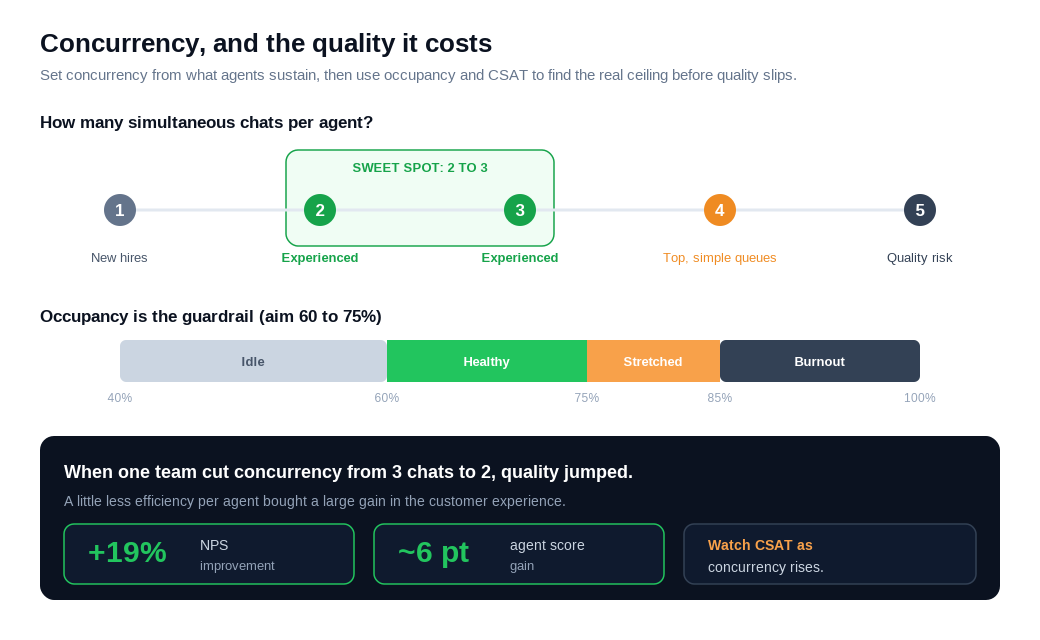
The quality cost of over-concurrency shows up in the numbers. One contact center that saw lower than expected satisfaction cut concurrency from three chats to two and recorded a 19 percent lift in NPS plus almost a six point gain in agent performance scores. The lesson for staffing is direct. If you plug a concurrency of four into the formula to shave the headcount, you can win the budget line and lose the satisfaction number that justified the channel in the first place. Set concurrency from what your agents actually sustain, watch CSAT as it rises, and treat the point where satisfaction slips as your real ceiling.
Why doesn't standard Erlang C work for live chat?
Standard Erlang C does not fit chat cleanly because it assumes one agent handles one contact at a time, which is the opposite of how chat works. Erlang C is the queuing model contact centers have used for decades to size phone teams from arrival rate, handle time, and a target service level, and it is excellent for voice. Applied to chat without adjustment, it quietly inflates your headcount.
The reason is concurrency. A phone agent is fully occupied by one call, so Erlang C counts one server per agent. A chat agent running three conversations is closer to three partial servers. Feed chat volume into a plain Erlang C calculator and it will tell you to hire far more people than the workload requires. One analysis of the model's limits found that ignoring concurrency, abandonment, and blended handle time produces a consistent 15 to 25 percent overstaff on chat queues.
The fix is to adjust the model for concurrency rather than abandon queuing math. Some tools call the adjusted version Erlang Chat, which builds simultaneous chats per agent into the calculation alongside customer patience and abandonment. The workload formula in the first section already bakes concurrency in. Either way, never size a chat team with a raw voice model, because the two channels do not share the same server assumption.
How does chat volume forecasting work?
Chat volume forecasting works by studying your own historical chat data to predict how many conversations will arrive in each future interval, so you can staff against the demand curve instead of guessing. The forecast is the input the staffing formula depends on, so a wrong volume number corrupts every downstream calculation.
Start with clean history at interval granularity. Reliable time series forecasting generally wants at least two years of clean historical data so the model can separate a real trend from noise. Within that history, three patterns matter: the long-run trend as your traffic grows, the weekly and daily seasonality that repeats, and one-off events such as a product launch or an outage that you flag and set aside so they do not distort the baseline.
Method scales with maturity. A small team can get a usable forecast from a weekday-by-hour average of the last several weeks. Larger operations lean on time series models such as ARIMA or exponential smoothing; one documented program used ARIMA models to forecast call volume and cut staffing costs by 17 percent. Modern workforce platforms now generate case and conversation volume forecasts at granular intervals to feed near-term scheduling directly.
Forecast chat on its own curve. Digital demand does not track voice. Phone tends to peak inside business hours while chat and messaging often shift later or spread differently, so a strong plan forecasts each channel separately and then composes the schedule against combined demand. A single blended voice-and-chat forecast is a common way to end up mis-staffed on both.
How do you plan for peak hours?
You plan for peak hours by forecasting volume down to the interval, then scheduling agents so headcount rises and falls with the demand curve instead of sitting flat across the day. Even coverage is the classic staffing mistake, because chat demand is anything but even. It clusters into a few hours that decide most of your response-time numbers.
The peak window is predictable for many teams. Reporting on live chat patterns finds that over half of all chats land between 10 a.m. and 3 p.m., with Monday and Tuesday the heaviest days and Monday volume running well above the weekly average. Friday afternoons fall off as customers defer non-urgent questions. Your own numbers will shift the exact hours, but the shape, a busy mid-day midweek and a quiet tail, shows up almost everywhere.
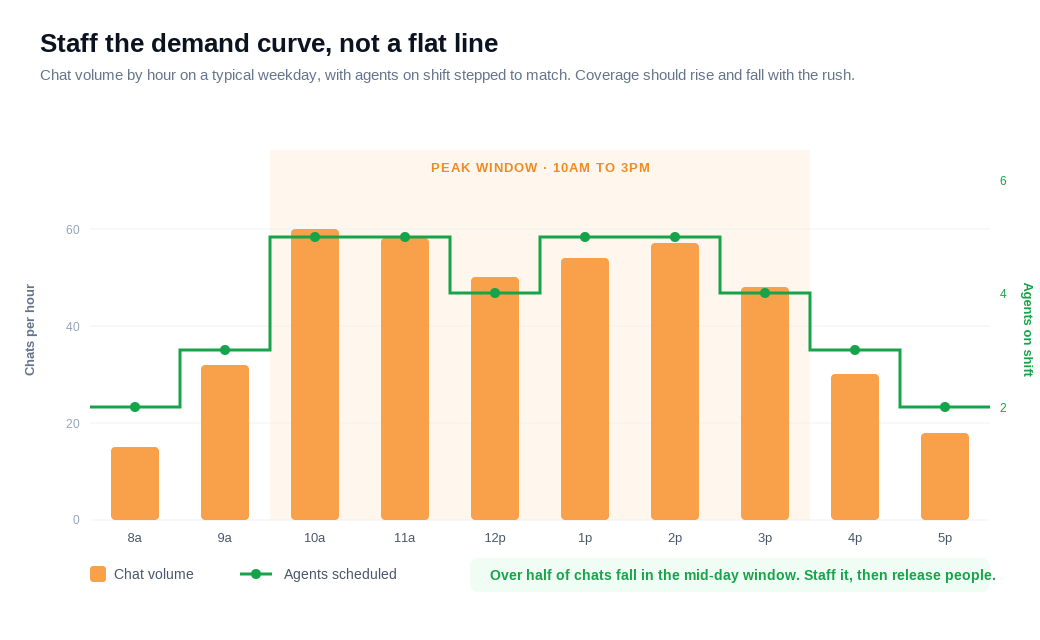
Run the staffing formula on the peak interval, not the daily average, or you will chronically understaff the rush. If the 10 a.m. hour draws 60 chats and needs 5 agents while the daily average is only 30 chats an hour, staffing to the average puts 3 agents on at 10 a.m. and leaves warm buyers waiting through the busiest window of the week. Staff the peak, then let quieter hours release people to other work.
Two levers make peak coverage cheaper. First, overlap shift start times so more agents are live during the mid-day block and fewer at the quiet edges, rather than everyone working an identical 9-to-5. Second, keep re-forecasting on the day itself, since real-time dashboards let a supervisor pull people onto chat before a surge turns into a service-level miss. Smart routing and notifications help here too, moving each chat to an available owner the moment it arrives so no agent sits idle while another queue backs up.
How does AI and automation change the chat staffing math?
AI changes the staffing math by lowering the effective volume that reaches human agents, which shifts every input in the formula. When an assistant resolves routine questions on its own, the humans you staff handle a smaller, more complex slice, so you plan headcount against deflection-adjusted volume rather than raw chat count.
Work an example through the same formula. Suppose the peak hour still draws 60 chats, but an AI chat assistant resolves 40 percent of them without a human. Human volume drops to 36 chats. At 8 minutes AHT and concurrency of 2.5, workload is 36 x 8, or 288 minutes, divided by (60 x 2.5) is 1.92 base agents, divided by 0.70 for shrinkage is 2.74, rounding to 3 agents for the peak hour instead of 5. The automation did not make anyone type faster. It removed volume from the human queue, and the formula turned that into two fewer scheduled heads.
Two cautions keep this honest. The chats that survive deflection are the harder ones, so their AHT climbs and their sustainable concurrency falls, which claws back part of the saving. A bot that raises deflection by frustrating people rather than resolving their issue pushes the cost downstream into repeat contacts. Size the human team against confirmed resolution, not against how many chats the bot merely intercepted.
The staffing lens also decides where automation should stop. When a visitor on the pricing page starts asking buying questions, the right move is often to route them straight to a person through live chat, or into a live video call or screen share to close faster, even though that lowers deflection on the conversation. Those are the chats worth staffing a human for. A free tier on most platforms, Glimpze included, lets you baseline your real chat volume, handle time, and deflection before committing to a headcount plan.
Key takeaways
- Staffing is a formula, not a feeling. Agents equal (chats x AHT) divided by (interval x concurrency), then divided by one minus shrinkage. Plan for 25 to 35 percent shrinkage and run the math per interval, not once for the whole day.
- Concurrency is the input that moves the answer most. Hold experienced agents to two or three simultaneous chats, new hires to one, and only top performers to four, then let CSAT tell you where the real ceiling is.
- Over-concurrency has a measured cost. One team that cut concurrency from three chats to two saw a 19 percent lift in NPS, so a concurrency assumption chosen to shrink headcount can quietly wreck quality.
- Adjust Erlang C before you trust it on chat. A raw voice model assumes one contact per agent and overstaffs chat by roughly 15 to 25 percent, so build concurrency into the queuing math or use a chat-adjusted version.
- Forecast chat on its own curve. Use clean interval-level history, separate trend from weekly seasonality, and forecast chat apart from voice, since digital demand does not follow the phone peak.
- Staff the peak and let AI reshape the volume. Over half of chats cluster between 10 a.m. and 3 p.m., so schedule to the demand curve, and plan the human team against deflection-adjusted volume with a fast handoff for high-intent buyers.

Written by
Nilas MylerCo-founder & CTO, Glimpze
Nilas is the co-founder and CTO of Glimpze, an inbound sales tool that turns high-intent website visitors into live conversations. A former SEO consultant for some of the largest companies in Denmark, he writes about speed-to-lead, inbound sales, and conversion rate optimization — the technical and operational mechanics of turning traffic into pipeline.


