On this page
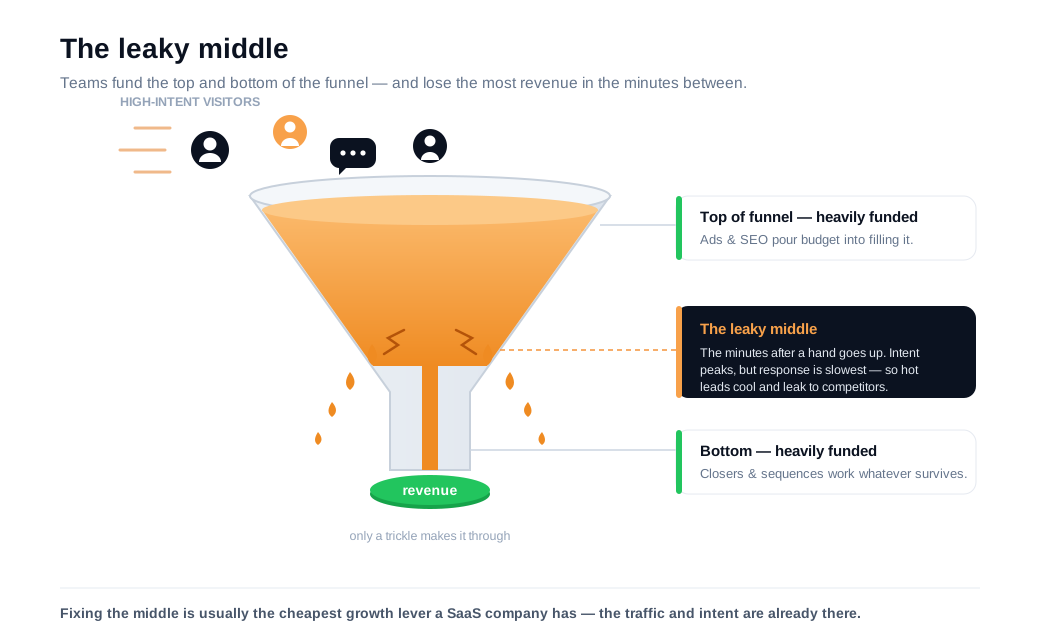
Most SaaS founders obsess over the top and bottom of the funnel. They pour budget into ads and SEO to fill the top, and they hire closers and build sequences to work the bottom. But the place where the most revenue quietly disappears is the middle — the few minutes right after someone raises their hand. That window is where intent is at its absolute peak and where most go-to-market motions are at their slowest. This is the leaky middle, and fixing it is usually the cheapest growth lever a SaaS company has.
I want to make the case that speed-to-lead is not a "nice to have" optimization but a structural advantage, walk through why the standard funnel is built to fail at exactly the wrong moment, and lay out a concrete playbook for closing the gap.
What is speed to lead?
Speed-to-lead refers to how quickly a business follows up with a new inbound lead after that prospect first makes contact — such as filling out a form, requesting a demo, or sending an inquiry. It's calculated as the time between the moment a lead submits an inquiry and when they hear back from you.
For example, if someone fills out your contact form and your team gets back to them two hours later, your speed-to-lead is two hours. It's an early-funnel metric that captures responsiveness at the very start of the sales process.
Why speed to lead matters
The data on lead response time has been remarkably consistent for over a decade.
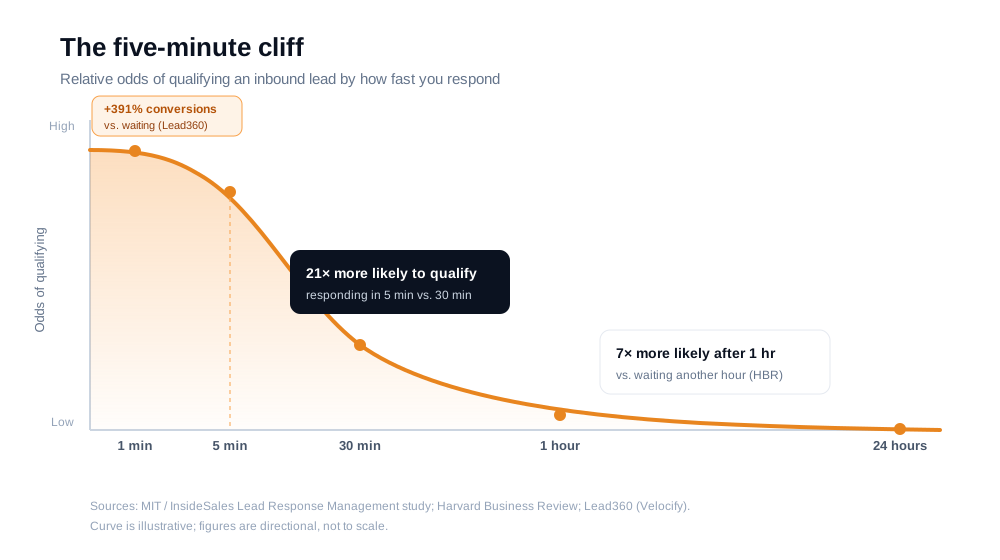
The widely cited Lead Response Management study (run by Dr. James Oldroyd at MIT with InsideSales.com) found that the odds of qualifying a lead drop by roughly 10x if you wait longer than the first five minutes to respond. Harvard Business Review's analysis of thousands of companies, "The Short Life of Online Sales Leads," found that firms contacting prospects within an hour were nearly seven times more likely to have a meaningful conversation with a decision-maker than those that waited even sixty minutes — and sixty times more likely than companies that waited a day or longer.
Research conducted by the B2B lead agency Lead360 (later Velocify) on millions of internet-generated leads went further: speed-to-call was found to be the single largest driver of lead conversion in the first two minutes after the lead was generated, and responding to a lead within one minute improved conversions by a staggering 391%. In sales, this is often called the five-minute lead rule.
Sit with those numbers for a second. The difference between a five-minute response and a one-hour response is not a few percentage points. It is the difference between a conversation and a voicemail. And yet the median B2B lead response time is still measured in hours, not minutes.
The reason is simple: buyer intent is perishable. When a prospect fills out your form or starts a trial, they are in a specific mental state. They have a tab open, a problem in mind, and a moment of motivation. Ten minutes later they're in a meeting. An hour later they're comparing you to two competitors. A day later they've forgotten which of the five vendors they evaluated was yours. You didn't lose the deal on price or features. You lost it to time.
Why your funnel slows lead response
Here's the uncomfortable truth: most SaaS funnels are engineered to introduce delay at the exact moment intent peaks.
Consider the typical path:
- A visitor reads a landing page and decides they're interested.
- They fill out a "Request a demo" form with five fields.
- The form fires to a marketing automation tool.
- A lead-scoring rule runs, then routing logic assigns an owner.
- A rep eventually sees the lead in their queue.
- The rep sends a "When are you free to chat?" email.
- The prospect replies (maybe), and you schedule something for next week.
Every one of those steps is a place where momentum dies. By the time a human actually talks to the prospect, the original spark is gone. We have built elaborate machinery whose net effect is to convert a hot, ready-to-talk buyer into a cold calendar invite.
The form itself is part of the problem. Each additional field reduces conversion, and worse, it reframes the interaction from "let's talk now" to "submit a request and wait." The form is a speed bump dressed up as a qualification step.
Close the speed-to-lead gap
The fix is not "respond faster within the same broken process." It's to collapse the gap between the moment of intent and the moment of conversation so completely that there is no queue to sit in.
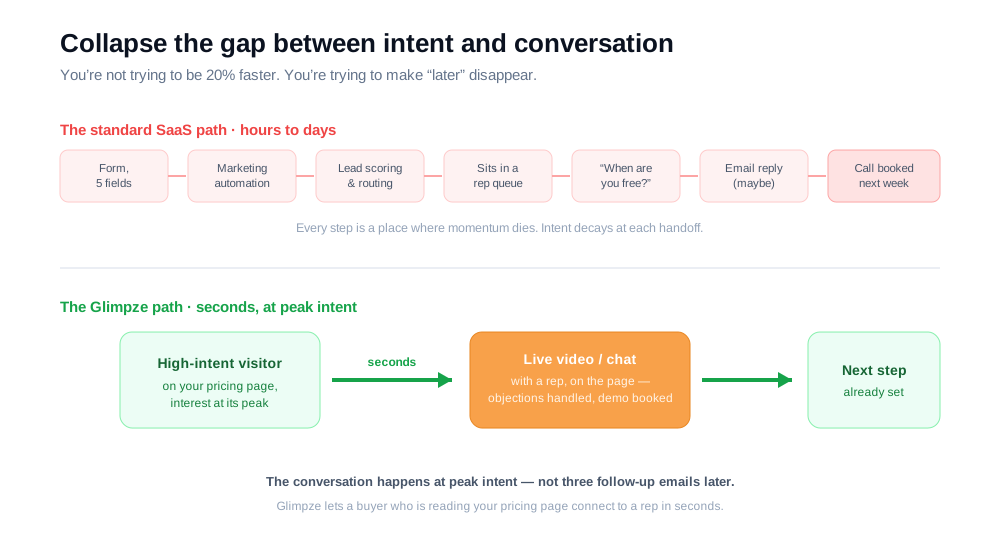
The highest-velocity SaaS teams are increasingly doing this by letting high-intent visitors start a real conversation directly on the page, while they're still browsing. Instead of routing a form fill into a sequence, they offer the buyer an instant path to a person — chat that escalates to a live call, or a one-click video conversation with a rep.
This is exactly why we built Glimpze. A buyer who is reading your pricing page can connect to a rep in seconds, right on the page: live video or chat, screen-share, objections handled, and the next step booked before they ever leave. The conversation happens at peak intent instead of three follow-up emails later.
This is the entire game. You are not trying to be 20% faster. You are trying to make "later" disappear as a concept.
How to improve speed to lead
You don't need to rebuild your whole go-to-market motion to capture most of the upside. Here's where I'd start, roughly in order of ROI.
1. Measure your real speed to lead
You cannot fix what you don't measure. Pull the timestamp of every inbound lead and the timestamp of the first genuine human touch — not an autoresponder. Look at the median and, more importantly, the 90th percentile. Most teams are horrified by what they find. This single audit usually justifies the whole project.
2. Find your high-intent pages
Not every visitor deserves the same treatment. Pricing pages, demo pages, comparison pages, and active trial sessions signal far more intent than a blog reader. Concentrate your fastest response paths on those surfaces specifically, so your reps aren't drowning in low-intent noise.
3. Add a live path at peak intent
Add a way for high-intent visitors to talk to a human now — live chat that can escalate to a call, or video chat on your highest-intent pages. This is the core of what Glimpze does: it gives the ready-to-buy minority a door that doesn't route them into a waiting room. Keep it off your low-intent pages so it stays a signal, not noise.
4. Route by availability, not territory
A perfectly assigned lead that sits because the owner is in a meeting is a lost lead. For real-time conversations, route to whoever is available and qualified right now, and reconcile ownership afterward. Speed beats tidiness here.
5. Shrink your forms
Every field you remove lifts conversion and reduces the friction between intent and conversation. Ask for the minimum to start a conversation; enrich the rest from the conversation itself or from data tools. Better still, let the conversation be the form.
6. Let the live touch power follow-up
When your first interaction is a real conversation, every subsequent step improves. You already know the use case, the objection, and the buying timeline. Your demo is tailored, your proposal lands faster, and your CRM notes are real instead of guessed. Speed at the top compounds into quality at the bottom.
Speed to lead is a competitive moat
Here's why I think this matters more than most SaaS teams realize. Your competitors can copy your features. They can undercut your pricing. They can outspend you on ads. What they usually cannot do, because it requires real operational discipline, is consistently talk to a buyer within sixty seconds of peak intent.
When you are the only vendor in a five-way evaluation who actually had a live conversation while the buyer was hot, you're no longer one of five logos. You're the one they already talked to, the one who already answered their question, the one who already felt human. That's a structural advantage that compounds with every deal.
The leaky middle is the cheapest fix in your funnel precisely because almost nobody is fixing it. The traffic is already arriving. The intent is already there. You're just letting it cool.
Key takeaways
- The five-minute cliff is real. Odds of qualifying a lead drop roughly 10x after the first five minutes. Treat speed-to-lead as a primary metric, not a footnote.
- Your funnel is probably engineered to be slow. Forms, routing, and sequences all insert delay at the exact moment intent peaks. Audit every step that sits between a raised hand and a human conversation.
- Collapse the gap, don't just shrink it. Offer high-intent visitors a synchronous path — live chat or video — at the moment of intent, so there's no queue to wait in.
- Concentrate speed where intent is highest. Pricing, demo, comparison, and trial surfaces deserve your fastest response paths; keep slower nurture for low-intent traffic.
- Speed compounds into quality. A live first touch makes every downstream step — demo, proposal, close — faster and more tailored. Start by measuring your true speed-to-lead this week.
TAGS

Written by
Nilas MylerCo-founder & CTO, Glimpze
Nilas is the co-founder and CTO of Glimpze, an inbound sales tool that turns high-intent website visitors into live conversations. A former SEO consultant for some of the largest companies in Denmark, he writes about speed-to-lead, inbound sales, and conversion rate optimization — the technical and operational mechanics of turning traffic into pipeline.


