
On this page
- What is a discovery call?
- What is the goal of a discovery call?
- How is a discovery call different from a qualification call?
- How do you structure a discovery call?
- What does an example agenda look like?
- What are the best discovery questions to ask?
- What are common discovery call mistakes?
- How do you end a discovery call and set the next step?
- Key takeaways
- Sources
A prospect books thirty minutes with you after reading two case studies and lingering on your pricing page. You can spend that half hour walking through features, or you can spend it figuring out what is actually broken in their business.
One of those paths ends with a polite "we decided to go another direction" a week later. The other ends with a scheduled demo and a number attached to the problem.
That half hour is the discovery call, and it decides whether the rest of your sales process is worth running. Done well, you leave with a quantified problem, a map of who makes the decision, and a firm next step on the calendar. Done badly, you leave with a friendly chat and nothing in the pipeline.
This guide covers what a discovery call is, what it is really for, how it differs from qualification, how to structure and time it, the questions that separate strong reps from weak ones, the mistakes that quietly kill calls, and a full example agenda you can copy.
What is a discovery call?
A discovery call is the first substantive conversation between a seller and a prospect, run to understand the prospect's situation, surface their problems, and decide whether there is a fit worth pursuing.
It usually happens right after a prospect shows interest, by requesting a demo, replying to outreach, or booking time from your site.
Think of it as the diagnosis before any prescription. A doctor who recommends surgery in the first ten seconds is guessing. So is a rep who pitches before understanding the problem.
The discovery call exists to gather the information that makes everything downstream (the demo, the proposal, the negotiation) relevant instead of generic.
Most discovery calls run 20 to 45 minutes and sit at the top of the sales process, right after a lead is created and before any product demo.
The output is a decision: qualify the opportunity and advance it, or disqualify it and free up your time. Both are wins, because a fast no is cheaper than a slow maybe.
What is the goal of a discovery call?
The goal is to diagnose the prospect's problem well enough to decide, together, whether to move forward, and to leave with a concrete next step. Everything else on the call serves that outcome.
A good call produces three things:
- A clear and quantified problem, stated in the prospect's own words, ideally with a cost attached in hours or dollars.
- The qualification facts you need: who is involved in the decision, how they buy, what budget exists, and by when.
- A specific next step that both sides have agreed to and put on a calendar.
There is a two-way element that reps forget. The buyer is also deciding whether you are worth their time, and their time is scarce.
Gartner's research on the B2B buying journey found that buyers spend only about 17 percent of the entire purchase process meeting with potential suppliers, split across every vendor they consider. When you finally get a live conversation, it carries a lot of weight, so wasting it on questions you could have answered with basic research is expensive.
For an inbound sales team, discovery sometimes starts before a call is ever booked. When a high-intent visitor is reading your pricing page right now, a real-time conversation, whether a chat window or a jump straight to a live video call or screen share, lets you begin diagnosing the problem while the interest is still live rather than waiting for a form and a scheduled slot.
How is a discovery call different from a qualification call?
A discovery call explores the prospect's situation and problems, while qualification checks whether the prospect meets your criteria to buy. For most teams, qualification is a part of discovery rather than a separate meeting, and the two goals run at the same time on the same call.
The cleanest way to hold the difference in your head is this: qualification is the guardrails, discovery is the map.
Qualification confirms fit against a checklist. Frameworks like BANT (Budget, Authority, Need, Timing) and MEDDIC (Metrics, Economic buyer, Decision criteria, Decision process, Identify pain, Champion) exist to make that checklist consistent.
Discovery goes underneath the checklist to find the impact, the urgency, and the reason the prospect is even looking. A rep who only qualifies learns whether the deal can close. A rep who also discovers learns why it would, which is what you need to actually win it.
How do you structure a discovery call?
Structure a discovery call in five phases: open and set the agenda, map the situation, surface problems and their impact, map the decision and timeline, then confirm next steps. The middle two phases are where the deal is made, so they should get most of the clock.
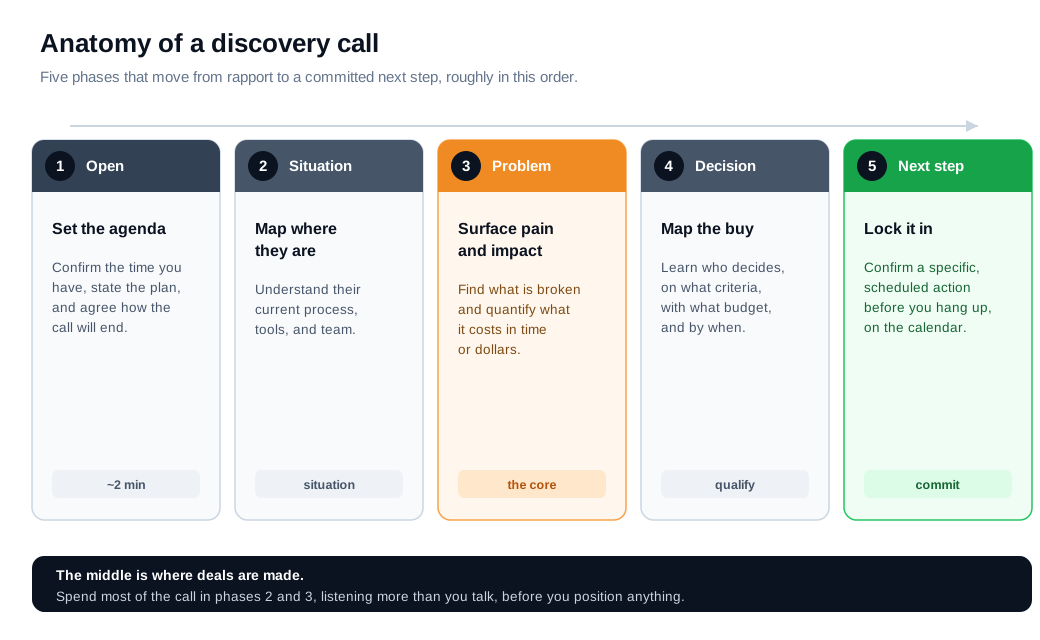
The opening should take about two minutes. Confirm how much time the prospect has, state what you plan to cover, and name how the call will end, usually by deciding on next steps or agreeing it is not a fit.
That last part sounds counterintuitive, and it lowers the pressure enough that the prospect stops selling you on themselves and starts telling you the truth.
From there you move into diagnosis. Ask about their current situation first (how the process works today, what tools and people touch it), then narrow into the problems and what those problems cost.
Only after that do you map the decision: who else weighs in, what criteria they will judge on, what budget range is realistic, and what deadline is driving this.
The data backs a specific shape. Gong's analysis of more than 500,000 B2B sales calls found that top performers ask between 11 and 14 questions on a discovery call, while average reps ask closer to 6 or 7.
Top reps also spread those questions evenly across the call instead of front-loading an interrogation, and the best calls surface three to four distinct business problems rather than fixating on one. There is a notable exception: when you are selling to a C-suite executive, win rates hold with a much smaller handful of questions, so read the room.
What does an example agenda look like?
Here is an example agenda for a 30-minute discovery call, split so that the diagnosis gets the largest block of time.
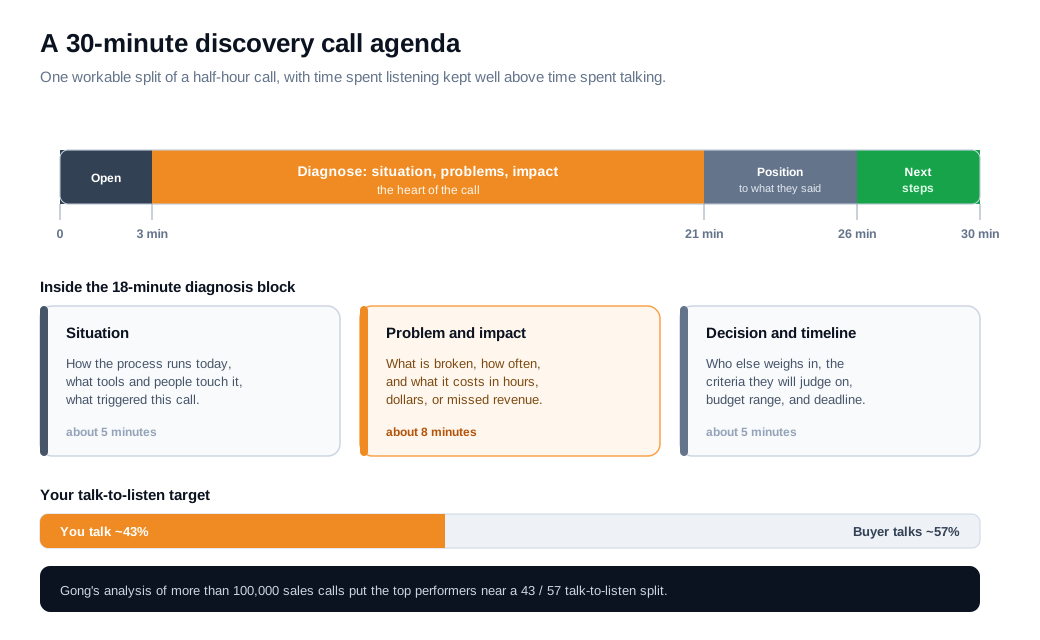
Give roughly 3 minutes to the open and agenda, 18 minutes to diagnosis (about 5 on situation, 8 on problem and impact, 5 on the decision and timeline), 5 minutes to tie your solution to exactly what they told you, and the final 4 minutes to lock a next step.
Notice that the pitch gets the smallest slice, and it comes near the end.
A worked example makes the diagnosis block concrete. Suppose you sell software to inbound sales teams and you are talking to a 12-person sales team.
Through situation and problem questions you learn that they get roughly 400 inbound leads a month, their average first response time is around 20 hours, and they estimate they lose about 15 percent of otherwise-qualified leads to competitors who reply faster.
You do the math with them on the call. If those 400 leads yield about 40 qualified opportunities a month, 15 percent is 6 deals slipping away. At an average deal size of 6,000 dollars, that is 36,000 dollars a month, or roughly 432,000 dollars a year, walking out the door because of response time.
That number, arrived at in the prospect's own words, becomes the spine of every conversation that follows. Your demo now has one job: show how you close that 432,000 dollar gap.
Your proposal has a return-on-investment story built in. And when procurement pushes back on price, the champion has a figure to defend the purchase with. None of that exists if you spent the 18 minutes describing features.
What are the best discovery questions to ask?
The best discovery questions are open-ended and follow a progression from situation to problem to impact to the value of solving it, the pattern Neil Rackham codified as SPIN.
Closed questions that invite a yes or no cap how much you can learn, so phrase almost everything as "how," "what," or "walk me through."
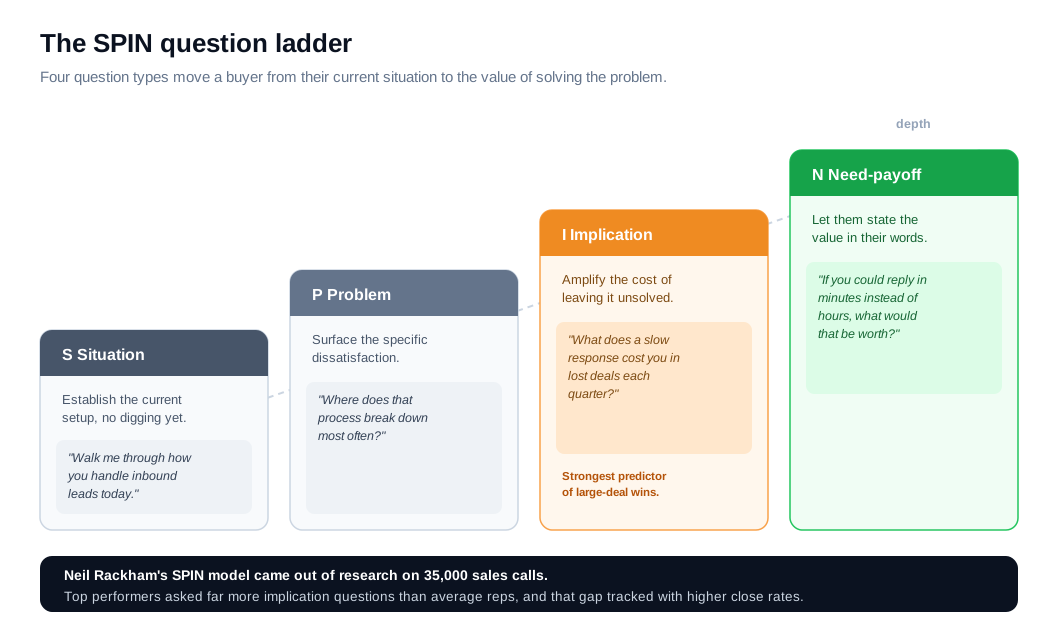
SPIN comes out of Rackham's study of roughly 35,000 sales calls, and it names four question types in order:
- Situation questions establish the current reality ("Walk me through how you handle inbound leads today").
- Problem questions surface dissatisfaction ("Where does that process break down most often?").
- Implication questions amplify the cost of leaving the problem alone ("What does a slow response cost you in lost deals each quarter?").
- Need-payoff questions let the buyer articulate the value in their own words ("If you could reply in minutes instead of hours, what would that be worth?").
Rackham's data found that the top reps asked far more implication questions than average reps, and that pattern tracked with higher close rates on larger deals.
A few questions earn their place on almost every call:
- Situation: "What does your current process look like, and what led you to look at alternatives now?"
- Problem: "What is the single biggest challenge with how it works today?"
- Impact: "If this is still unresolved three months from now, what does that cost you?"
- Decision: "Besides yourself, who else would need to weigh in on a decision like this?"
- Timeline: "What is driving the timing, and is there a date this needs to be solved by?"
- Budget: "Have you set aside budget for solving this, or is that still to be worked out?"
One rule about budget: earn the right to ask it. Leading with "do you have budget?" as your second question signals you only care whether the deal closes fast. Ask it after the prospect has felt the cost of the problem, and the conversation lands very differently.
What are common discovery call mistakes?
The most common mistakes are pitching too early, talking too much, accepting the first pain at face value, skipping the decision process, and ending without a firm next step. Each one is easy to fall into and each one has a fix.
Pitching too early is the big one. The moment a prospect mentions a pain point, the temptation is to launch into how your product solves it. Reps call this premature pitching, and it fails because you have not yet learned who the problem affects, how often it happens, or what it costs, so your pitch lands generic. Hold the pitch until diagnosis is done.
Talking too much is the measurable one. Gong's study of more than 100,000 sales calls found top performers sit near a 43 percent talk to 57 percent listen ratio, while the average rep talks far more, and conversion rates decline steadily once a rep speaks past about 65 percent of a call.
If you are doing most of the talking on a discovery call, you are pitching, not discovering.
"Happy ears" is the subtle one. A rep hears a keyword that matches the product, assumes it is the deep pain, and stops digging. The fix is one more question: after the prospect names a problem, ask what it costs and what they have already tried. Surface pain rarely justifies a purchase; the pain underneath it does.
Two more sink otherwise-good calls. Skipping the decision process means you find out about the VP who has to approve the spend during the negotiation, when it is too late to build a case with them.
And ending with a vague "I will follow up next week" leaves the deal to drift. A next step is a calendar invite with an agenda, not a promise.
How do you end a discovery call and set the next step?
End a discovery call by summarizing what you heard, confirming that you both see a potential fit, and booking a specific next step on the calendar before you hang up. Small, specific, and scheduled beats large, vague, and someday.
Play back the problem and its cost in a sentence or two, so the prospect hears you understood them. Then name the logical next step and put a date on it: a tailored demo with the two colleagues who also touch this process, a working session, or a proposal review.
If other stakeholders surfaced during the call, get them into that next meeting now, while the momentum is real. Send a short recap email the same day that restates the problem, the number you calculated together, and the agreed next step.
Speed matters more here than most reps assume, especially for inbound deals where the prospect is comparing several vendors at once. Getting the follow-up and the next meeting locked while interest is high often decides who stays in the running.
Teams that route new inbound conversations to the right rep and fire an instant alert, rather than letting leads sit in a queue, protect that momentum; a lead routing and notification setup is one way to make sure the person who ran discovery is also the one who responds fast.
The discovery call earns the deal the right to continue. The next step is what keeps it alive.
Key takeaways
- Discovery is diagnosis, and the pitch comes later. The call exists to understand the prospect's situation and problems well enough to decide, together, whether to move forward.
- Leave with three things. A quantified problem in the buyer's words, the decision and timeline facts, and a specific next step already on the calendar.
- Structure it in five phases and spend the clock in the middle. Open and set the agenda, map the situation, surface problems and impact, map the decision, then confirm next steps, with diagnosis getting the most time.
- Ask 11 to 14 open-ended questions and follow SPIN. Move from situation to problem to implication to need-payoff, and lean on implication questions, which correlated most with large-deal wins across Rackham's 35,000 calls.
- Listen more than you talk. Top performers sit near a 43 to 57 talk-to-listen split, and conversion drops once a rep talks past about 65 percent of the call.
- Avoid the five classic mistakes. Pitching too early, dominating the talk time, settling for surface pain, skipping the decision process, and ending without a firm, scheduled next step.
TAGS

Written by
Daniel SemeckyCo-founder & CEO
Daniel is the co-founder and CEO of Glimpze. He spends his days talking to revenue teams about how to catch high-intent visitors before they bounce, and writes about inbound sales, lead conversion, and building a motion where marketing and sales actually share a number.


