
On this page
A buyer sat through your demo last week and liked what she saw. Now she wants to run the product against her own data, with her own team, before she signs anything. That request is a proof of concept, and it is a different animal from the demo that got her here.
Teams mix the two up constantly, and the cost of the mix-up is real. Offer a full proof of concept when a sharp demo would have closed the deal and you burn weeks of engineering time. Offer a demo when the buyer needed hands-on proof and you lose to the vendor who let them test.
This post defines a proof of concept, shows how it differs from a demo, covers when to offer one and when to skip it, how to scope a POC that closes, how long one should run, why so many fail, and how to hand off from a demo to a POC without losing momentum.
What is a proof of concept?
A proof of concept is a scoped, time-bound test where a prospect runs your product against their own data and workflows to confirm it solves a specific problem before they commit. It comes after the demo, once a buyer is interested enough to put their own hours into validating what they saw.
The format sits close to a trial, with one difference that changes everything. A POC runs as a joint effort with the vendor's sales team, guided toward an agreed goal, while a plain trial hands the buyer a login and hopes they find the value alone. Storylane frames the POC as an extended, hands-on evaluation in a non-production environment that a buyer asks for after a demo, when they want to test-drive the tool for a longer stretch against real conditions.
Concretely, a POC usually means standing up a sandbox or limited environment, loading a slice of the buyer's data, connecting to a system or two, and having their team use the product for a set number of days against criteria both sides wrote down in advance. A solutions engineer typically runs point on the vendor side. The buyer commits people and time on theirs.
That mutual investment is the signal. A buyer who agrees to a POC is telling you they are serious enough to spend their own hours proving the case, which is why a well-run POC sits so late and so close to the signature.
How does a POC differ from a demo?
A POC differs from a demo on four axes: goal, environment, who drives, and cost. A demo shows the product, and a POC proves it works for one specific buyer in their own setup.
Start with the goal. A demo answers "what does this do and how does it look," usually in a curated environment the vendor controls, with the best data and the happy path on display. A POC answers "does this actually work for us," using the buyer's data, the buyer's edge cases, and the messy reality a demo tends to skip.
The environment follows from that. A demo runs on the vendor's polished sandbox or a recorded interactive walkthrough. A POC runs in something closer to the buyer's world: a trial tenant wired into a real integration, loaded with a representative data set, so the results reflect the buyer's real conditions.
Then there is who drives and what it costs. A single sales rep or solutions engineer runs a demo in thirty to sixty minutes, and it scales to hundreds of buyers. A POC pulls in engineers on both sides for days or weeks, which is why a single POC can tie up a solutions engineer for weeks and why teams reserve them for deals big enough to earn the effort.
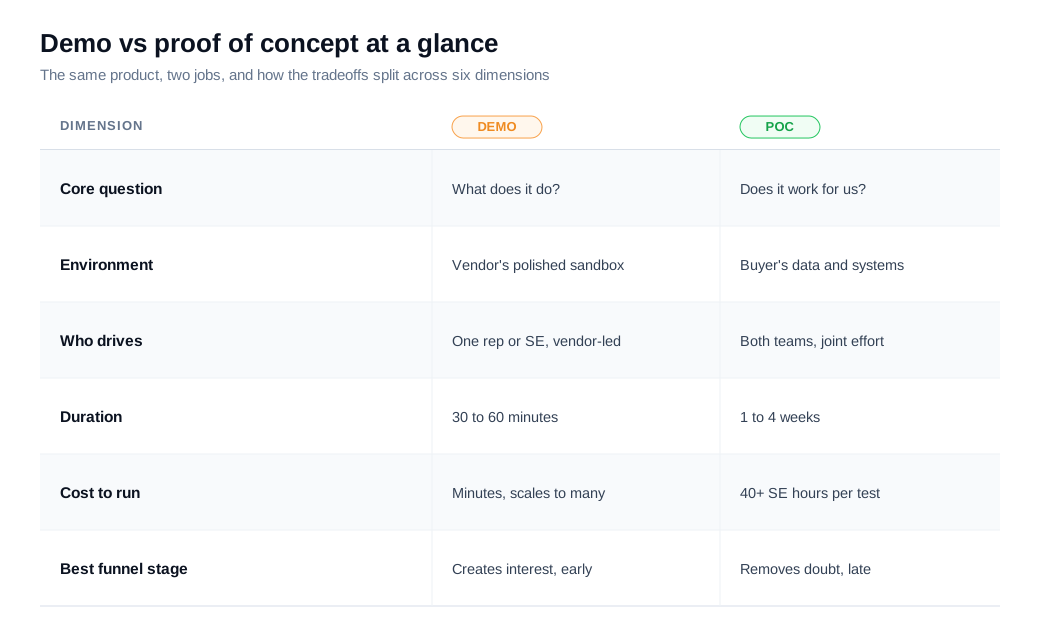
Sequence matters too. The demo comes first and creates the interest, and the POC comes later to remove the last technical doubt. Skip the demo and a buyer has no reason to grant you a POC. Rush to a POC and you spend the expensive resource before you know the buyer is real.
When should you offer a POC, and when should you skip it?
Offer a POC when the deal is large and complex enough that a demo cannot answer the buyer's real question, and skip it when a sharper demo or a reference would close the same deal for a fraction of the cost. The test is whether hands-on proof changes the decision.
Reach for a POC in a few clear cases. When the product has to prove itself on integration with legacy systems, performance at scale, security inside the buyer's own architecture, or compliance, a demo cannot show it and only a live test will. When you are displacing an incumbent that already runs in production, a POC is how you prove the switch is worth the pain. And when the buyer's own process always includes a pilot, fighting it wastes goodwill you could spend elsewhere.
Skip or downgrade the POC when the numbers do not support it. HowdyGo pegs a solutions engineer's loaded cost at $100 to $115 an hour, with a two-week evaluation burning 40-plus SE hours and an eight-week enterprise engagement running past $15,000 before infrastructure and opportunity cost. Spend that on a $6,000 annual deal and the math never works.
Here is the arithmetic. Say your average solutions engineer costs $110 an hour and a standard POC consumes 45 hours, so roughly $4,950 of engineering time per test. If POCs close at the roughly 58% rate SaaS benchmarks report and your average contract is worth $40,000, each POC returns about $23,200 in expected new revenue against that $4,950 cost, a strong trade. Run the same POC for a $5,000 deal and you are spending $4,950 to maybe win $2,900 in expected value. Same activity, opposite decision, and the only variable is deal size.
The best teams keep a spectrum rather than a switch. A case study, a guided demo, a short pilot, and a full POC are different weights of proof, and matching the weight to the deal keeps expensive engineering hours on the opportunities that can pay for them.
How do you scope a POC to win?
You scope a POC to win by agreeing on success criteria, boundaries, a timeline, and named owners before a single environment gets stood up. A POC without written criteria becomes a demo that never ends, because nobody can say when it is done or whether it worked.
Start with success criteria both sides sign off on. Dock's playbook is blunt about this: a POC should be scoped, time-bound, and carry defined success criteria agreed by both sides before it starts. Apollo recommends writing those criteria as SMART goals, specific, measurable, attainable, relevant, and time-bound, so "it should feel faster" turns into "cut ticket resolution time by 20% on our support queue in three weeks." Vague goals are how a POC drifts.
Then fence the scope. List exactly which use cases, integrations, and data sets are in and which are out, so a mid-POC request to test one more workflow gets logged as a change instead of silently expanding the work. Scope creep is the quiet killer, and a boundary written on day one is easier to point at on day ten.
Name the owners and the next step. Identify the decision-maker, the technical evaluator, and the end users on the buyer side, and confirm what happens if the criteria are met: a signature, a rollout plan, a start date. A POC that succeeds technically and then stalls because no one agreed on the next move is a loss dressed up as a win.
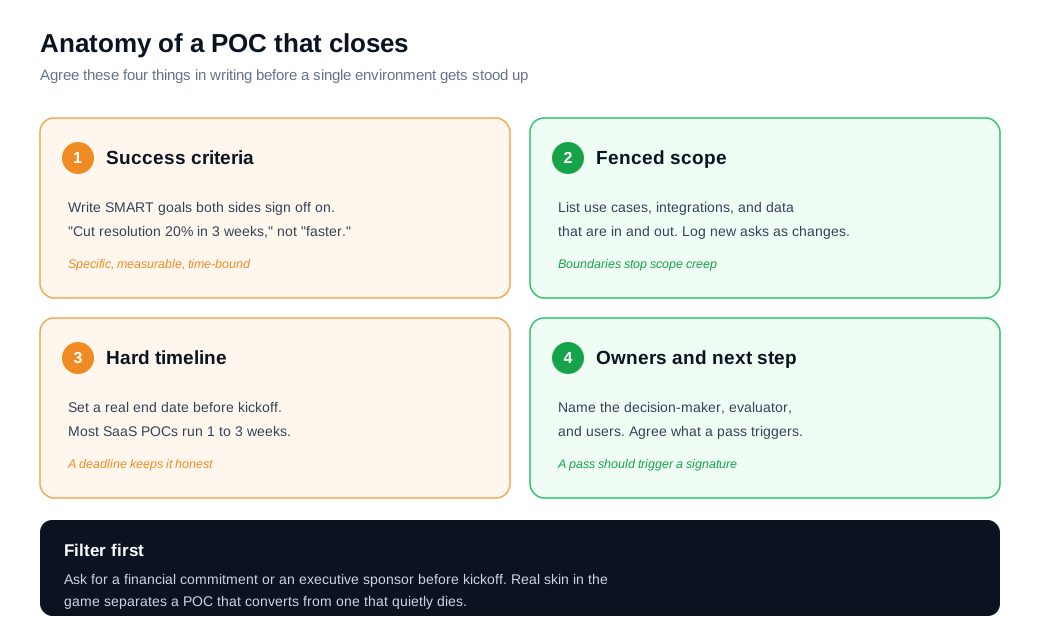
Sapphire Ventures adds a sharper filter: ask the buyer for a real commitment up front. Requesting a financial commitment or an executive sponsor before the POC begins signals genuine intent and focuses everyone's energy, which is often the difference between a POC that converts and one that quietly dies.
How long should a proof of concept take?
A proof of concept should run as short as the success criteria allow, usually one to four weeks for software, and never open-ended. The right length is the shortest window that lets the buyer's team prove the criteria with real usage, and no longer.
The benchmarks cluster tight. HowdyGo reports most SaaS POCs running 7 to 21 days, while Apollo puts the broader range at two to eight weeks depending on complexity. Simple tools land at the short end. Deep enterprise integrations stretch toward the long one.
Length cuts both ways. Too short and the buyer's team never builds a real habit around the product, so the test proves nothing. Too long and urgency drains out of the deal, the champion gets pulled onto other work, and the evaluation stalls in limbo. A hard end date, set with the buyer before kickoff, is what keeps a POC honest. When the clock runs out you either met the criteria or you did not, and both answers move the deal forward faster than an open-ended pilot.
Why do proof of concepts fail?
Proof of concepts fail most often because they start without clear criteria, run too long, or test a buyer who was never that serious. The technology is rarely the problem, and the setup around it usually is.
The failure rate is high enough to take seriously. Sapphire Ventures reports that more than 78% of IT executives at Global 2,000 companies said fewer than half of the POCs they join reach production. A POC that never converts still cost both sides real hours, a direct tax on the sales team's time.
Three patterns drive most of the losses. The first is fuzzy success criteria, where nobody agreed what "working" meant, so the buyer can always find a reason to wait. The second is scope creep, where an unbounded test keeps growing until it collapses under its own weight. The third is a weak champion, where the POC succeeds on paper but no one inside the account has the will to push it to a signature.
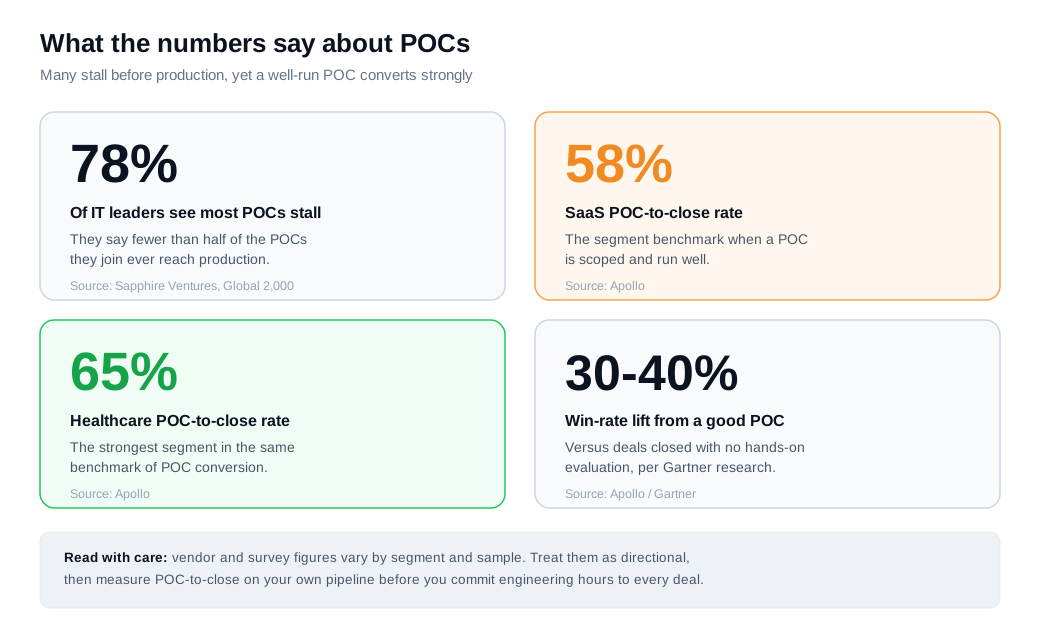
The fixes mirror the causes. Structured POCs convert well when they are run right: SaaS benchmarks put POC-to-close near 58%, and healthcare closer to 65%, and Apollo cites Gartner's finding that a well-structured POC can lift win rates 30 to 40% over deals with no hands-on evaluation. Tight criteria, a fenced scope, a real deadline, and a committed champion are what separate the POCs that close from the ones that drain the quarter.
How do you move from a demo to a POC without losing momentum?
You move from a demo to a POC by catching the buyer at the moment their interest peaks and turning that interest into a scoped plan before it cools. The handoff is where deals stall, because a buyer who says "I'd like to try this" on Tuesday is a colder buyer by the following Monday.
Speed is the whole game at that transition. Most buyers now research quietly and reach out only when they are ready to move, and Gartner found 67% of B2B buyers prefer a rep-free experience for much of their journey. By the time they raise a hand for a POC they have usually done their homework, and a slow response reads as a preview of slow support later.
This is where a real-time layer on your site earns its keep. When a buyer finishes an interactive demo or lingers on a pricing page, a live video call or screen share opened in the browser lets a rep scope the POC while the intent is hot, instead of trading emails for a week. A lighter live chat can capture the request when no one is free for a call, and smart routing and notifications put the raised hand in front of the right solutions engineer in seconds.
For an inbound sales team, that fast handoff keeps a demo's momentum alive long enough to turn it into a scoped POC, the last step before the deal is real.
Key takeaways
- A demo shows the product, a POC proves it. A demo answers what the tool does in a controlled setting, while a proof of concept lets the buyer test it against their own data and workflows before they commit.
- A POC is a joint, scoped, time-bound test. It runs as a shared effort with the vendor's team rather than a self-guided trial, and it comes after the demo once the buyer will invest their own hours in validation.
- Match the proof to the deal size. With a solutions engineer costing $100 to $115 an hour and a full POC burning 40-plus hours, reserve POCs for deals large and complex enough to earn the spend, and use a demo or reference for the rest.
- Written success criteria are non-negotiable. Agree on SMART criteria, fence the scope, set a hard end date, and name the owners before kickoff, or the POC drifts into a test that never ends.
- Most POCs fail on setup, not technology. More than 78% of IT leaders say fewer than half of their POCs reach production, and fuzzy criteria, scope creep, and a weak champion cause most of the losses.
- Win the handoff on speed. Catch the buyer at peak interest and scope the POC while the intent is still hot, because a fast move from demo to pilot is what keeps the deal from cooling.
TAGS

Written by
Daniel SemeckyCo-founder & CEO
Daniel is the co-founder and CEO of Glimpze. He spends his days talking to revenue teams about how to catch high-intent visitors before they bounce, and writes about inbound sales, lead conversion, and building a motion where marketing and sales actually share a number.


