
On this page
A prospect books a demo at 9 a.m. A sales development rep qualifies them, confirms the budget and the timeline, and marks the lead sales-ready. Then the record sits in a queue. By the time an account executive opens it two days later and asks "so, what brings you in today?", the buyer has already taken a call with a competitor who answered in ten minutes. The deal was real. The handoff killed it.
That gap between one rep finishing and the next one starting is where a surprising share of pipeline disappears. It rarely shows up in a report, because no single person owns the moment. A sales handoff is the process that closes that gap, and doing it well comes down to three things: speed, context, and a clear owner on the receiving end.
This guide covers what a sales handoff is, the main types you will run, the context that has to travel with the lead, how to keep a warm lead from going cold in the transfer, how to automate the whole thing in your CRM, and what a clean handoff looks like end to end with the pipeline math to back it up.
What is a sales handoff?
A sales handoff is the transfer of a prospect from one person or team to the next stage of the sales process, together with the context the receiving rep needs to continue the conversation without starting over. The classic version passes a qualified lead from a sales development rep (SDR) to an account executive (AE), but the same move happens at every seam in a revenue team.
A handoff has two parts that people tend to blur together. The routing decides who gets the lead. The briefing decides what they know when they get it. A lead can be routed perfectly to the right AE and still fail, because that AE opens a blank record and re-runs the discovery the buyer already sat through once.
Continuity matters because the buyer is a group, and a busy one. Gartner's research on the B2B buying journey found that a typical purchase involves a buying group of six to ten decision makers, and that buyers spend only about 17 percent of their total time meeting with any potential supplier. When you make a buyer repeat their situation to a second rep, you spend part of that thin attention budget on administration instead of on moving the deal forward.
What are the main types of sales handoff?
Most B2B teams run three handoffs along the funnel, and each one fails in a different way. Mapping them makes it clear where your own pipeline is leaking.
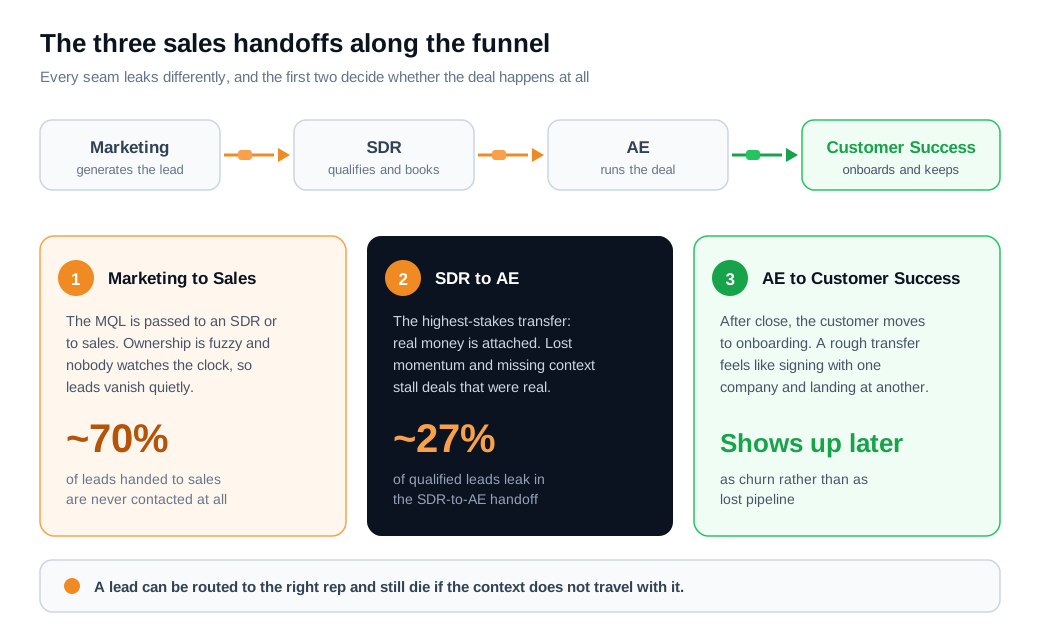
The first is the marketing-to-sales handoff, where a marketing qualified lead (a form fill, a content download, a high-intent page visit) is passed to an SDR or straight to sales for follow-up. This is the seam where leads most often vanish quietly, because ownership is fuzzy and nobody watches the clock. MarketingSherpa's widely cited analysis found that, on average, about 70 percent of the leads handed to sales were never contacted at all.
The second is the SDR-to-AE handoff, where a qualified meeting or opportunity moves from the rep who booked it to the rep who will run the deal. This is the highest-stakes transfer, because real money is now attached. One analysis of the SDR-to-AE transition estimates teams lose around 27 percent of qualified leads there, for reasons of lost momentum and missing context rather than weak leads.
The third is the AE-to-customer-success handoff, which happens after the deal closes and passes the new customer to onboarding. Handle it roughly and the customer feels like they signed with one company and got dropped onto another, which shows up later as churn rather than as lost pipeline. The rest of this guide focuses on the first two, since those decide whether a deal happens at all. The principles carry straight over to the third.
What context should transfer between reps?
Everything the receiving rep needs to pick up the conversation mid-stream should transfer: who the buyer is, why they are here, what has already been said, and what was promised. A good handoff brief answers those four questions in under a minute of reading.
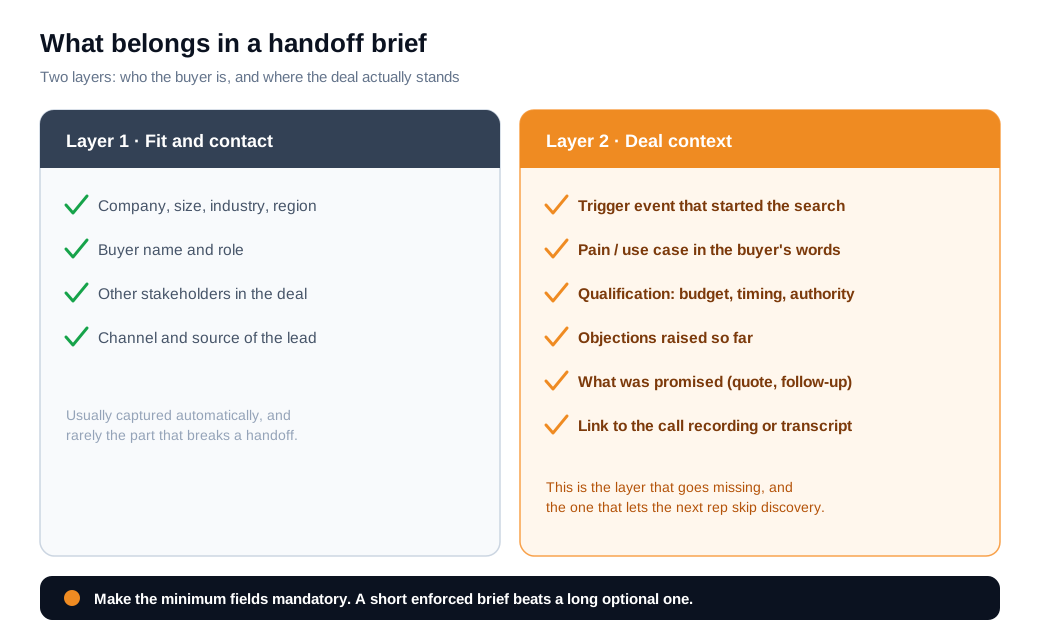
Split the brief into two layers. The first is fit and contact: the company, size, industry, region, the buyer's name and role, and the other stakeholders already in the conversation. The second is the deal context, and this is the part that usually goes missing. It includes the trigger event that started the search, the specific pain or use case in the buyer's own words, the qualification you confirmed (budget, timeline, and authority, or your BANT or MEDDIC notes), any objections that came up, and anything you committed to, such as a custom quote or a follow-up on a specific integration.
The strongest handoffs attach the raw material rather than a summary of it. A link to the call recording or the chat transcript lets the AE hear the tone and the exact words, so they can open with "you mentioned onboarding 40 reps by Q3" instead of a generic question. Practitioner playbooks from sellers like John Barrows argue that the brief should be built up across the whole sales cycle, so every discovery call and demo adds to it and the document is nearly complete by the time the lead is ready to move.
Write down the minimum required fields and make them mandatory, so no lead advances with an empty "use case" or a missing next step. A short, enforced template beats a long, optional one every time, because the optional one is the one reps skip when they are busy.
How do you prevent leads from going cold in the handoff?
You keep leads warm by shrinking the time between "qualified" and "first contact from the next rep" down to minutes, and by keeping the buyer inside the conversation instead of restarting it. Speed is the dominant factor, and the research on it has held the same shape for over a decade.
Harvard Business Review's study of 1.25 million leads found that firms responding within an hour were about seven times more likely to have a qualifying conversation than those that waited longer, yet the average response time was 42 hours and 23 percent of companies never responded at all. The Lead Response Management study puts a finer point on it: contacting a lead within five minutes rather than thirty makes you around 21 times more likely to qualify it. A handoff that adds a two-day queue between the SDR's qualification and the AE's first call throws that advantage away.
Three habits keep leads warm through the transfer. First, set a service-level agreement (SLA) on handoff speed and hold both sides to it. Handoff checklists built for marketing-to-sales alignment recommend a sub-one-hour response window for high-priority leads. Second, make the introduction warm. A single line from the outgoing rep, "meet Sara, she will take it from here, and she already has your notes," reassures the buyer that they are not back at square one.
Third, keep the buyer in the channel where the interest peaked. If a high-intent visitor is live on your site right now, the fastest handoff does not route them to a next-day call. It brings the right rep into the same live chat session, or escalates to a live video call or screen share, while the buyer is still on the page. Treating your website as an inbound sales channel, rather than a form that files leads for tomorrow, is what makes a zero-delay handoff possible in the first place.
How do you automate handoffs in your CRM?
You automate a handoff by wiring a trigger, a condition, an action, and a notification into your CRM so the lead is assigned and the rep is alerted the instant it qualifies. Every automatic assignment runs on the same logic: a trigger (a form submission, a lead score crossing a threshold, a deal-stage change) starts the flow, a condition checks the record against your rules, an action writes the new owner, and a notification pings that owner with context.
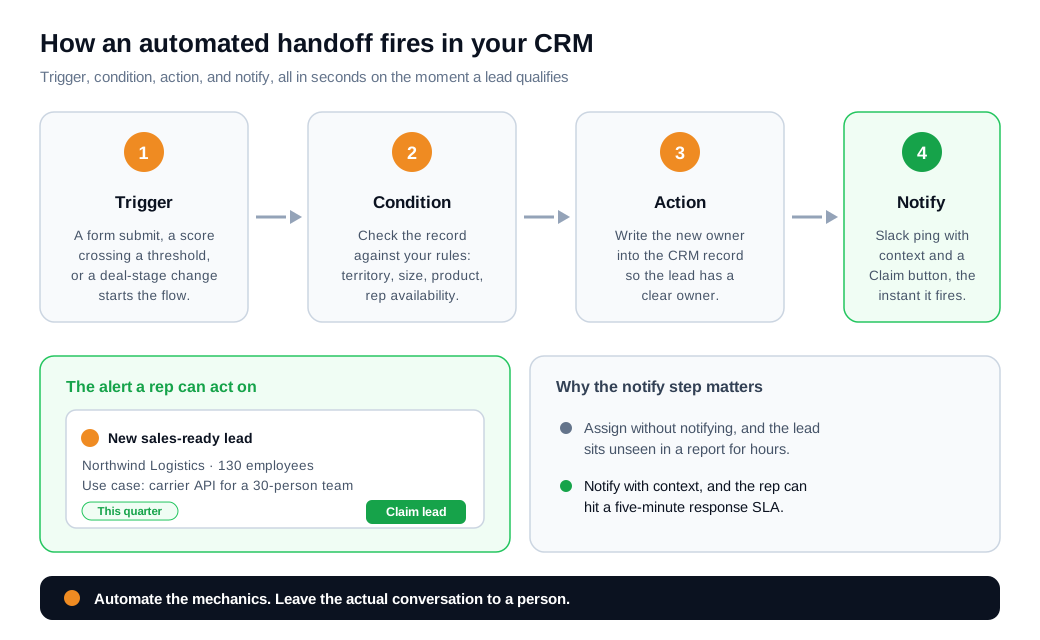
Routing rules should mirror your real sales structure: territory, industry, deal size, product line, and rep availability. Round-robin assignment works fine as a tie-breaker, but round-robining every lead to whoever is next up ignores fit and is a common way to make a handoff technically automated and practically broken. Guides on Salesforce lead-routing automation stress that the assignment has to write the owner field and alert the rep at the same time, or the speed advantage evaporates while the lead sits unseen in a report.
The notification is where the automation earns its keep. A Slack message that fires the moment a lead is assigned, carries the key context (company, use case, qualification), and includes a "Claim" or "Open in CRM" button turns a five-minute SLA into a target a rep can actually hit. That is the job of a solid routing and notifications setup, and it is why a Slack or CRM integration often matters more than the routing rules by themselves. Automate the mechanical parts, the assignment, the alerting, and the field checks, and leave the judgment, the actual conversation, to people.
What does a broken handoff cost, and what does a clean one look like?
A broken handoff costs you deals you already earned, and the size of the bill is easy to underestimate. Work through a simple example.
Say your SDRs qualify 100 meetings a month and pass them to AEs. If the handoff leaks 27 percent, the figure one analysis of the SDR-to-AE transition puts on it, then 27 of those meetings never become real opportunities, for reasons that have nothing to do with lead quality. The remaining 73 close at, say, 22 percent, which is about 16 wins. Now tighten the handoff so leakage falls to 10 percent: 90 meetings survive, and at the same 22 percent close rate you get about 20 wins. Four extra deals a month, at a $12,000 average contract value, is roughly $576,000 a year in recovered revenue, from a process step most teams never put on a dashboard.
Here is the same lead run through a clean handoff. A visitor at a 130-person logistics company spends six minutes on your pricing and integrations pages, then opens a chat asking whether you support their carrier API for a team of 30. An SDR (or an AI assistant) answers, confirms the team size and a this-quarter timeline, and tags the lead sales-ready. The CRM trigger fires: the lead routes to the mid-market AE for that territory, and a Slack alert lands with the company, the use case, and the transcript attached. The AE joins the same chat within three minutes, opens with "I saw you asked about the carrier API, let me show you," and shares their screen. The buyer never repeats a word. Total elapsed time from raised hand to live AE conversation is under five minutes.
Contrast that with the cold version. The same chat ends with "a rep will follow up," the lead drops into a shared queue, and an AE emails two days later asking what the buyer is trying to solve. By then the buyer has demoed a competitor and mentally moved on. Same lead, same product, opposite outcome, decided entirely by how the handoff was run.
Key takeaways
- A sales handoff is a transfer plus a briefing. Routing the lead to the right rep is only half the job; the receiving rep also needs the context to continue the conversation without a reset.
- Know your three handoff seams. Marketing to sales, SDR to AE, and AE to customer success each leak differently, and the first two are where most deals are won or lost.
- Deal context matters more than a contact card. The trigger, the pain in the buyer's words, the qualification, objections, and what was promised carry the deal, so attach the recording or transcript and make the key fields mandatory.
- Speed keeps leads warm. Responding within an hour makes a qualifying conversation about seven times more likely, so set a sub-one-hour handoff SLA and, when the buyer is live, hand off inside the same session.
- Automate the mechanics in your CRM. Wire a trigger, condition, action, and notification so the lead is assigned and the right rep is pinged with context the instant it qualifies.
- Measure the leak. A handoff that loses around a quarter of qualified meetings is a five- or six-figure annual problem hiding in a step nobody owns.
TAGS

Written by
Daniel SemeckyCo-founder & CEO
Daniel is the co-founder and CEO of Glimpze. He spends his days talking to revenue teams about how to catch high-intent visitors before they bounce, and writes about inbound sales, lead conversion, and building a motion where marketing and sales actually share a number.


