
On this page
A visitor opens your pricing page, reads it twice, clicks through to your comparison page, then comes back the next morning to do the same thing. Somewhere in that pattern is a person who is close to a decision. Your CRM shows nothing, because they never filled out a form.
Buyer intent is how you read that pattern before the form arrives. Done well, it tells you which accounts are in a live buying cycle and how ready each one is. Done badly, it produces a dashboard full of signals nobody ever acts on. This guide covers what buyer intent means, the signals and data behind it, how to turn those signals into a score, how to act on your highest-intent visitors, and whether the whole idea holds up under scrutiny.
What is buyer intent?
Buyer intent is a prospect's likelihood and readiness to buy, inferred from what they do rather than what they say. It is a read on behavior: the searches, page views, downloads, and comparisons that show someone moving toward a purchase in your category.
That makes it different from fit. Firmographic data (industry, company size, revenue, job title) tells you whether an account looks like your ideal customer. Intent tells you whether that account is doing anything about it right now. A perfect-fit company that has not touched your category in a year is a cold lead. A slightly-off-fit company reading three vendor comparisons this week is a live one. Strong pipelines pay attention to both.
The idea has academic roots in purchase intention, a long-studied predictor of actual buying behavior in consumer research. The practical B2B version is narrower. It is the measurable evidence that a company or a person is evaluating a solution like yours, captured from digital behavior across the web and your own properties.
What are the different types of buyer intent?
Most marketers split buyer intent into four types, each defined by what the behavior reveals about where someone sits in their journey.
Informational intent is early. Someone is learning about a problem and is not shopping yet, so a search for "how to reduce lead response time" is informational. Navigational intent means the person is looking for a specific brand or page, such as searching your company name or typing your domain directly. Commercial intent shows active evaluation: comparing options, reading reviews, searching "[category] software" or "X vs Y." Transactional intent sits closest to a purchase, where the person is ready to act and is looking at pricing, a trial, or a demo.
These map cleanly onto behavior you can see. A first blog read is usually informational. A pricing-page visit and a comparison view are commercial moving to transactional. The value of the framework is that it stops you from treating every signal as equally hot. A downloaded top-of-funnel guide and a demo request are both intent, at very different temperatures.
What are buyer intent signals?
Buyer intent signals are the observable actions that suggest someone is researching a purchase or getting ready to make one. They range from a single anonymous pageview to an explicit demo request with a name attached.
On your own site, the high-value signals are consistent across most B2B businesses: repeated pricing-page visits, comparison-page views, demo or trial requests, return visits within a few days, and time spent in documentation or case studies. Off your site, signals include category research on publisher networks, reading competitor reviews on sites like G2, and spikes in topic consumption picked up by third-party data providers.
Not every signal carries the same weight, and two variables decide most of it. The first is the type of action. Requesting a demo or viewing pricing three times says far more than opening one marketing email. The second is timing. Recency and velocity matter more than raw volume, so three visits in 48 hours is a stronger signal than fifteen spread over six months. A signal that fired last quarter is close to noise. A cluster of signals firing this week is a buying cycle.
First-party vs third-party intent data: what is the difference?
First-party intent data is behavior you collect on your own properties. Third-party intent data is behavior collected across the wider web by outside providers and sold to you. The difference comes down to a trade between certainty and reach.
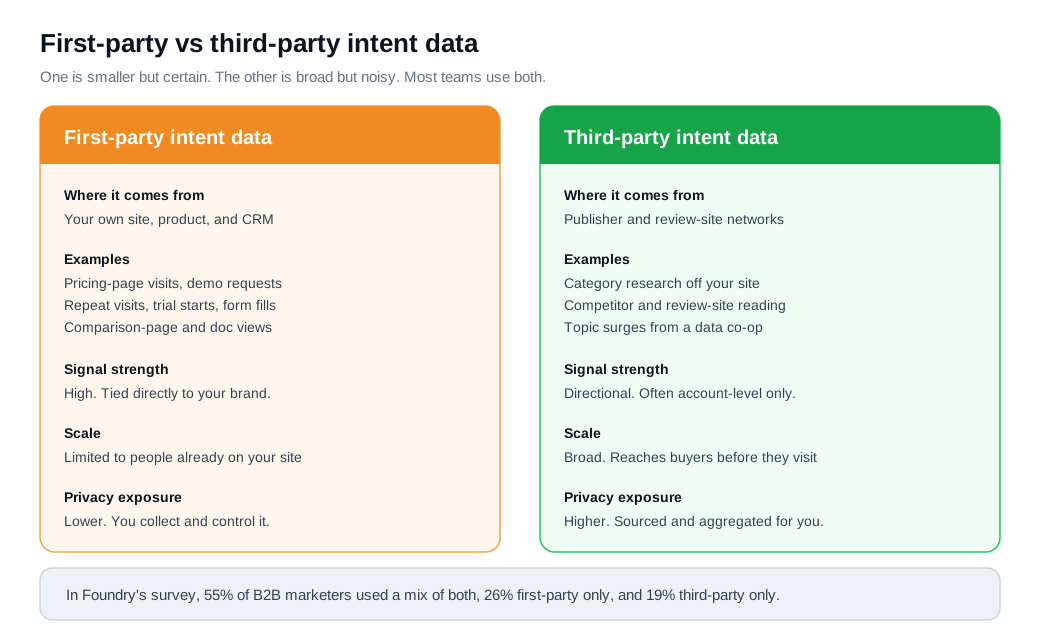
First-party data (website visits, product usage, form fills, CRM activity) is the strongest signal you have, because it ties directly to your brand. Someone on your pricing page is showing interest in you specifically, which off-site category research can never confirm. It is also cheaper and easier to defend on privacy grounds, since you collect and control it. The limit is scope: you only see people who already found you.
Third-party data trades certainty for reach. Providers aggregate content consumption across large publisher and review networks, then tell you which accounts are surging on topics in your category, often before those accounts ever visit your site. Bombora's Company Surge model compares an account's topic consumption over a recent three-week window against its own twelve-week baseline, then flags a surge when current activity runs well above normal, scoring topics from 0 to 100 with 60 and above treated as a meaningful spike. That helps you prioritize outreach early. The cost is noise, because much of it is account-level and directional, showing general category interest rather than interest in you specifically.
There is a middle category, second-party data, which is essentially someone else's first-party data shared with you, such as leads or engagement from a review site or a co-marketing partner. Most teams end up combining sources. In one Foundry survey, 55 percent of B2B marketers used a mix of first and third-party intent data, while 26 percent used first-party only and 19 percent third-party only. First-party tells you who is engaging with you. Third-party widens the net to accounts you have not met yet.
How do you score buyer intent?
You score buyer intent by assigning weighted points to each signal based on how strongly it correlates with closed revenue, then combining fit, behavior, and third-party intent into a single number a rep or a workflow can act on.
A workable model has three inputs. Fit points come from firmographics: the right industry, company size, and buyer title. First-party behavior points come from on-site actions, weighted so that high-intent moves (demo requests, repeated pricing views, trial starts) score far above passive ones (a blog read, an email open). Third-party intent points come from external surge data. Weight first-party signals above third-party, because direct engagement with you is more reliable than category research somewhere else.
Two rules keep the score honest. Apply decay, so intent fades when an account goes quiet: a common approach reduces the score by 20 to 25 percent for every two to four weeks of inactivity, which keeps stale accounts from sitting at the top of the list. Then recalibrate against real outcomes, checking your thresholds against historical win rates every quarter so the model reflects how people actually buy.
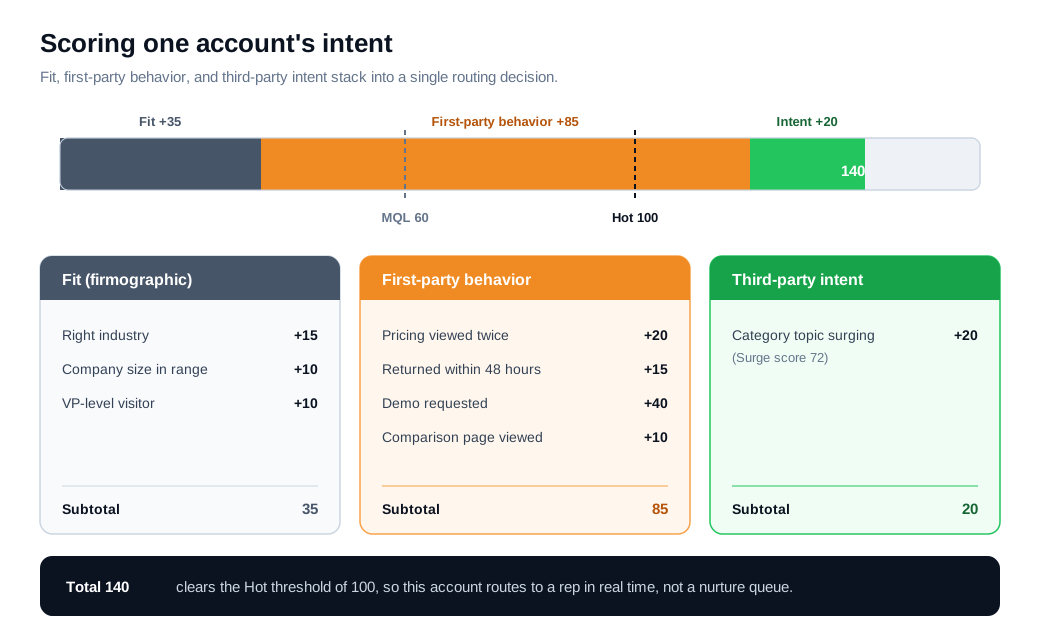
Here is a worked example. Suppose you set your qualified threshold at 60 and your "hot, route now" threshold at 100. An account called Northwind lands with the right industry (+15), a company size in your range (+10), and a VP-level visitor (+10), for 35 fit points. Over one week it views your pricing page twice (+20), returns within 48 hours (+15), requests a demo (+40), and reads a comparison page (+10), for 85 first-party behavior points. A third-party provider shows it surging on your category topic at a score of 72 (+20). The total is 140, well past the hot threshold, so Northwind goes straight to a rep instead of into a nurture sequence. A near-identical account that only read one blog post would land near 20 and stay in nurture. The score exists to make that call the same way every time.
Where the score lives matters as much as the math. A lead routing and notification setup can push an account that crosses the hot threshold to its owner in Slack the moment it happens, rather than surfacing it in a report someone reads on Friday.
How do you act on high-intent visitors?
You act on high-intent visitors by reaching them fast, in the channel they are already in, while the interest is still live. Speed is the single variable that decides most of the outcome.
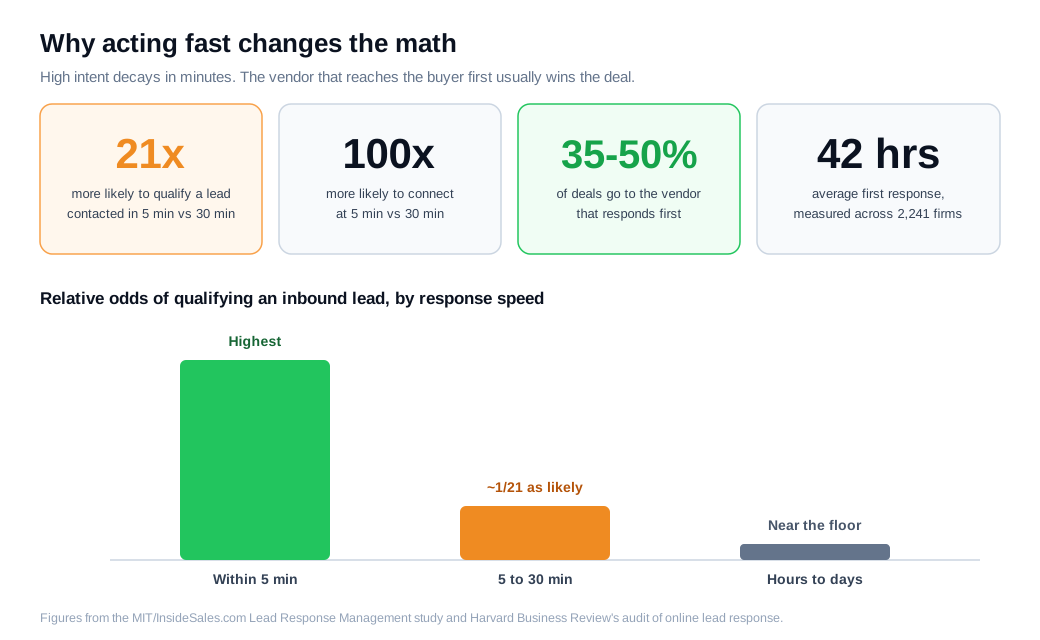
The evidence here is old and consistent. The MIT and InsideSales.com Lead Response Management study, built on more than fifteen thousand leads and a hundred thousand call attempts, found that contacting a new inbound lead within five minutes made a rep about 21 times more likely to qualify it than waiting 30 minutes, and roughly 100 times more likely to reach the person at all. InsideSales research also placed 35 to 50 percent of sales with the vendor that responds first. Harvard Business Review's audit of 2,241 companies in The Short Life of Online Sales Leads found an average first-response time of 42 hours, with 23 percent of firms never responding at all. The behavior the data rewards and the behavior most teams deliver sit far apart, and that gap is the opening.
The catch is that most high-intent behavior is anonymous. A visitor reading your pricing page for the third time has not filled out anything, so a form-and-follow-up motion never fires. Closing the gap means engaging in the moment. For an inbound sales team, that can be a real-time nudge when someone lingers on a high-value page, a live chat window that answers a pricing question in the same session, or a jump straight to a live video call or screen share when the deal is worth it. A proactive outreach rule decides who is worth interrupting, and the conversation is what converts.
There is a sequencing point worth making. Not every visitor deserves a human. Lower-intent traffic can be handled by an assistant or an automated reply that holds attention until a person is warranted, while your fastest response is reserved for accounts that clear the hot threshold. Prioritize by intent, not by who happened to arrive most recently.
Does intent data actually work?
Yes, with a large caveat: intent data works when teams actually operationalize it, and many do not. The signal is real, and buyers have moved most of their journey off your radar. Research from 6sense and Gartner puts B2B buyers at roughly 70 percent of the way through their buying process before they engage a vendor, which means the accounts worth winning are researching long before they raise a hand.
Practitioners are broadly positive. Surveys of intent-data users consistently show the large majority reporting good or excellent returns, alongside reported gains in win rates and shorter sales cycles. The honest asterisk is that only a minority describe the return as exceptional, and a familiar pattern is that many organizations collect buyer signals without ever building the workflows to act on them. The data lands in a spreadsheet or a Slack channel and decays.
So the accurate answer is conditional. Intent data does not close deals by itself, and third-party data in particular carries enough noise that treating every surge as a hot lead will waste a rep's time. What works is a tight loop: collect the signals, score them so the strong ones rise, route the top of the list to a person or a workflow immediately, and engage while the interest is still warm. Teams that build that loop get faster cycles and higher win rates. Teams that buy a data feed and stop there get a bigger spreadsheet.
Key takeaways
- Intent measures behavior, fit measures the profile. Firmographics say whether an account looks right; intent says whether it is doing anything about it now, and healthy pipelines watch both.
- Weight signals by type and timing. A demo request and repeated pricing views beat a single blog read, and three visits in 48 hours beat fifteen over six months.
- First-party data is strongest, third-party is broadest. Your own site shows real interest in you, external surge data finds accounts before they arrive at the cost of noise, and most teams combine them.
- Score, decay, and recalibrate. Combine fit, first-party behavior, and third-party intent into one number, fade it when accounts go quiet, and check thresholds against real win rates each quarter.
- Speed decides the payoff. Reaching an inbound lead within five minutes can make qualification about 21 times more likely, yet the average company takes 42 hours, so acting in the moment beats acting thoroughly later.
- The data is only as good as the loop. Most organizations collect signals they never act on, and the value comes from routing high-intent accounts to a person or workflow fast, not from the dashboard.
TAGS

Written by
Nilas MylerCo-founder & CTO, Glimpze
Nilas is the co-founder and CTO of Glimpze, an inbound sales tool that turns high-intent website visitors into live conversations. A former SEO consultant for some of the largest companies in Denmark, he writes about speed-to-lead, inbound sales, and conversion rate optimization — the technical and operational mechanics of turning traffic into pipeline.


