
On this page
- What is consultative selling?
- What are the core principles of consultative selling?
- How does consultative selling differ from transactional selling?
- What does the consultative selling process look like?
- What questions do consultative sellers ask?
- When is consultative selling most effective?
- What are the most common consultative selling mistakes?
- Key takeaways
- Sources
A buyer opens a conversation already knowing more about your product than the last three reps who tried to pitch it. They have read your docs, watched a teardown on YouTube, and asked an AI assistant to line you up against two competitors. By the time they talk to a person, a feature tour is the last thing they need.
What they want is a straight answer to the one question they could not resolve alone, plus the confidence that they are choosing well. Consultative selling is the method built for that moment. The rep leads with questions, diagnoses the real problem, and earns the right to recommend a solution before ever pushing a price.
This guide defines consultative selling, breaks down its core principles, contrasts it with transactional selling, walks the full process with a worked example, and shows exactly when the approach pays off and when a lighter touch wins.
What is consultative selling?
Consultative selling is a sales approach where the rep acts as a trusted advisor, leading with discovery and diagnosis so the eventual recommendation fits the buyer's real problem instead of the seller's quota. The sale becomes the natural outcome of a useful conversation rather than the goal the rep pushes toward from the first minute.
The term goes back to Mack Hanan, whose 1970 book Consultative Selling reframed the rep as a consultant who helps a customer improve their business rather than a vendor whose only mission is to move a product. The research that made it rigorous came later. In a twelve-year study, Neil Rackham and the Huthwaite team analyzed roughly 35,000 sales calls to work out what top performers actually did, and found the winners asked far more and better questions than average reps, who mostly pitched features.
The modern version has only grown more relevant as buyers self-educate. Salesforce reports that 74% of sales professionals say AI makes it easier for buyers to research on their own, and 36% now describe their main job as helping buyers feel confident in a decision. When the buyer already has the facts, the value a rep adds is judgment: framing the problem, weighing trade-offs, and pointing to the right next step.
What are the core principles of consultative selling?
The core principles of consultative selling are preparation, genuine curiosity, active listening, honest advice, and solving the buyer's problem before closing your own. Salesforce frames its five guiding principles around research, asking questions, listening more than you talk, adding value with insight, and following through after the sale.
Preparation comes first. Before the call, a consultative rep studies the account, the industry, and the likely trigger that sent the buyer looking, so the conversation starts from a position of relevance.
Curiosity and listening are the engine. The rep asks open questions and then actually listens, resisting the urge to jump to a pitch the moment they hear a keyword. This is where most deals are won or lost. Salesforce data shows 86% of business buyers are more likely to buy when a company understands their goals, yet 59% say reps do not take the time to understand them. The gap between those two numbers is the entire opportunity. HubSpot's guide to consultative selling techniques lands in the same place: do the homework, ask more than you tell, and lead with genuine help.
Honesty holds it together. A consultative seller will tell a buyer when a cheaper plan fits, when the timing is wrong, or when a competitor is the better match. That candor feels counterintuitive, and it is exactly what builds the trust that closes the next three deals.
How does consultative selling differ from transactional selling?
Consultative selling differs from transactional selling in its goal: the consultative rep works to understand and solve a problem over time, while the transactional rep works to close a defined purchase as fast as possible. Both are legitimate. They simply fit different buying situations.
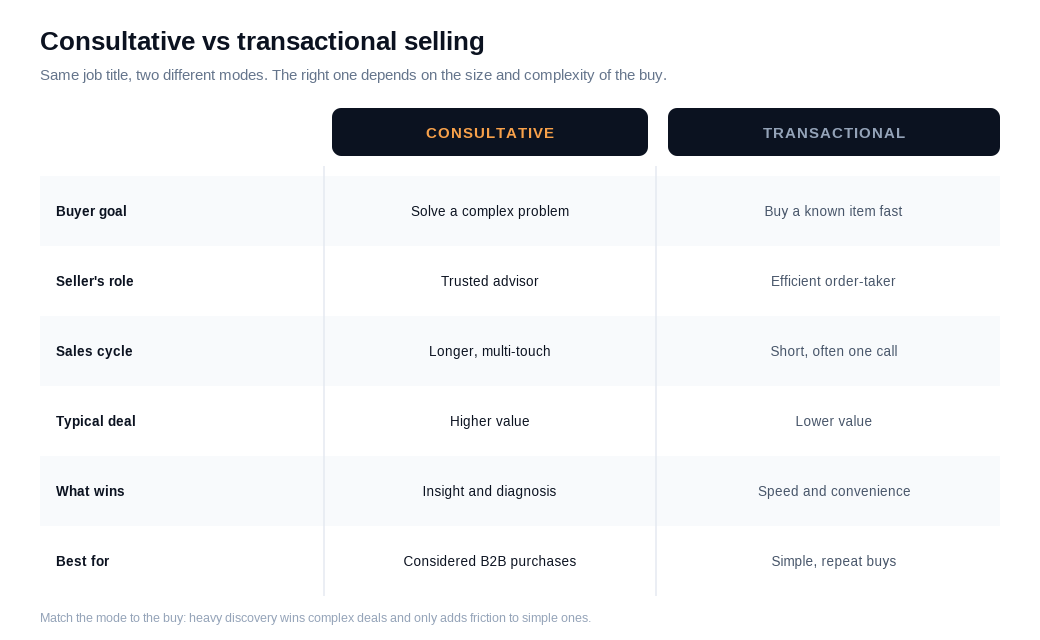
Transactional selling suits simple, low-cost, repeat purchases where the buyer already knows what they want and product knowledge on the seller's side is barely required. Speed and convenience win. Think of buying printer paper or renewing a familiar subscription, where the buyer wants a fast checkout and no discovery call.
Consultative selling suits complex, higher-value purchases with several stakeholders and a real cost of getting it wrong. Here the buyer values a seller who can diagnose the situation, surface risks they had not considered, and tailor a recommendation. RAIN Group's study of 731 major B2B purchases found that sellers who educated buyers with new ideas and perspectives won significantly more often than those who simply responded to stated needs.
The mistake is applying the wrong mode. Run a heavy discovery process on a $20 impulse buy and you lose the sale to friction. Run a transactional pitch on a $200,000 platform decision and you lose it to a competitor who took the time to understand the account.
What does the consultative selling process look like?
The consultative selling process runs in five stages: research the account, connect with relevance, discover the real problem, advise on a fit, and follow through after the sale. Each stage feeds the next, and skipping discovery is the most common way the whole thing collapses.
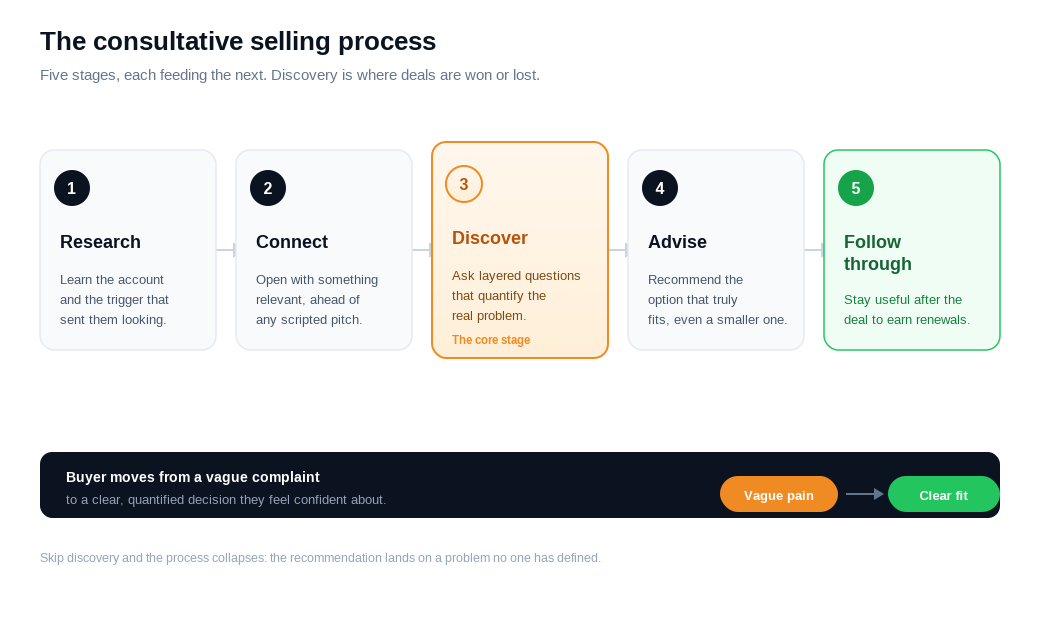
Research means learning enough about the buyer to make the first exchange feel earned. Connect means opening with something relevant to what they engaged with, ahead of any scripted pitch. Discover is the core: a structured set of questions that moves the buyer from a vague complaint to a specific, quantified problem. Advise is where the rep recommends the option that actually fits, including the honest case for a smaller purchase when that is the right answer. Follow through keeps the relationship useful after the contract is signed, which is what turns one deal into a renewal and a referral.
A worked example makes the payoff concrete. Suppose a visitor lands on your comparison page and opens a chat. A transactional rep answers the pricing question and moves on. A consultative rep asks four questions instead: how big is the sales team, how many inbound leads arrive each month, how fast does someone respond today, and what happens to a lead that waits. The buyer reveals an 8-person team, about 200 inbound leads a month, an average response time close to two days, and a hunch that speed matters. The rep helps quantify it. If the team closes fast-handled leads at roughly three times the rate of slow ones, then cutting response time on even half of those 200 leads could add dozens of extra opportunities a month. That number, surfaced by the buyer's own answers, reframes the purchase from a $79 line item into a fix for a five-figure leak, and the recommendation now lands because the buyer sees the problem clearly. Running that kind of discovery live, while the visitor is still on the page, is exactly what a live chat path on a high-intent page makes possible, and it is a core reason teams building an inbound sales motion pair fast response with consultative questioning.
What questions do consultative sellers ask?
Consultative sellers ask layered, open-ended questions that move a buyer from surface symptoms to the underlying business impact, ahead of any yes-or-no questions that merely tee up a pitch. The best-known framework is SPIN, drawn from Neil Rackham's 35,000-call research and still taught today.
SPIN sequences four question types. Situation questions establish the facts, such as how you handle this now. Problem questions surface difficulties, like where that process breaks down. Implication questions draw out the cost of the problem, for example what a delay costs you in lost deals. Need-payoff questions get the buyer to articulate the value of solving it, such as what it would be worth to cut that time in half. The sequence matters because implication and need-payoff questions are what separate top performers from average ones in Rackham's data.
A practical starter set for an inbound conversation might be: what sent you looking for a solution today, what have you tried already, what happens if this stays unsolved, and who else weighs in on the decision. Notice that none of these mention your product. The point of discovery is to earn a diagnosis, and a good diagnosis is what makes any later recommendation credible.
When is consultative selling most effective?
Consultative selling is most effective when the purchase is complex, the deal value is high, the buyer faces real risk in choosing wrong, and the relationship will continue past the first sale. Those four conditions describe most B2B software, professional services, and considered high-ticket purchases.
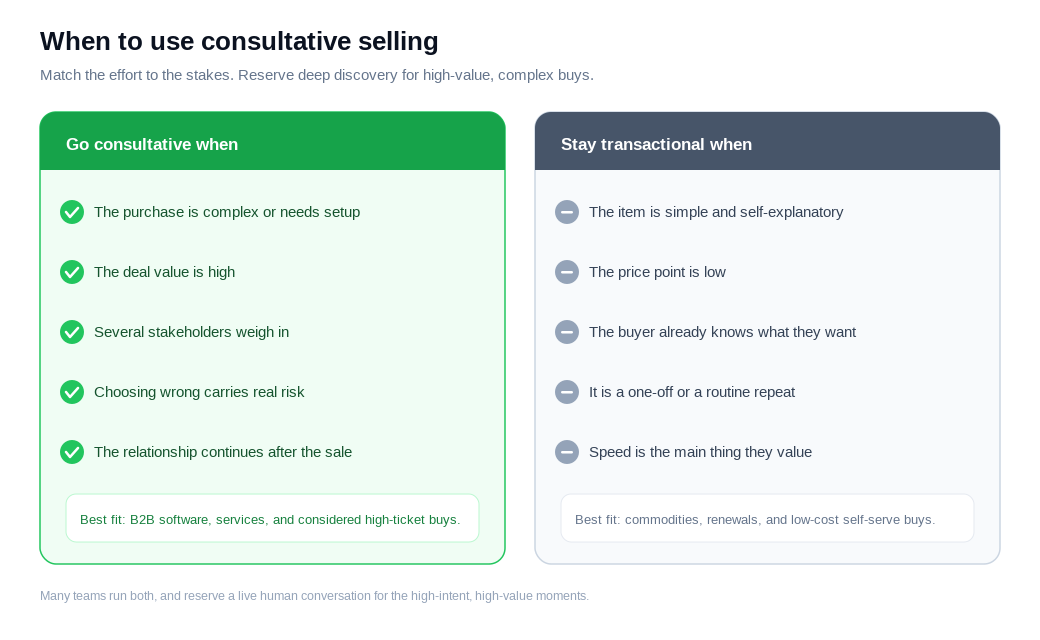
Look for these signals: multiple stakeholders, a long or considered sales cycle, a solution that needs configuration or integration, and a buyer whose success depends on choosing well. When those are present, the seller who diagnoses and advises will out-convert the one who quotes and closes.
The approach loses its edge in the opposite conditions. For a low-price, self-explanatory, one-off purchase, heavy discovery adds friction the buyer resents, and a fast, transactional path serves everyone better. Many teams run both: a light, self-serve motion for simple buys, and a consultative motion reserved for high-intent, high-value moments where a human conversation changes the outcome. The trick is matching the effort to the stakes, and giving your highest-intent visitors a live path to a person, such as live video chat, the moment their questions get consequential.
What are the most common consultative selling mistakes?
The most common consultative selling mistakes are pitching before diagnosing, asking shallow questions, and treating discovery as a checklist rather than a real conversation. Reps often ask a single situation question, hear one pain point, and immediately launch into a demo, skipping the implication questions that would have made the problem feel urgent.
Two other failures show up constantly. The first is fake consulting, where a rep dresses a pitch in question form and the buyer sees through it in seconds. The second is asking questions and then ignoring the answers, steering back to the script no matter what the buyer says. Both destroy the trust the method depends on. The fix is the same in every case: be genuinely curious, quantify the problem in the buyer's terms, and recommend the option that serves them, even when it is smaller than the one you hoped to sell.
Key takeaways
- Consultative selling makes the rep an advisor rather than an order-taker. The rep diagnoses the buyer's real problem first and lets the recommendation follow from it.
- The core principles are research, curiosity, listening, honesty, and follow-through. Salesforce data shows 86% of buyers favor sellers who understand their goals, while most reps never do the work to.
- It differs from transactional selling by goal and time horizon. Consultative fits complex, high-value, relationship-driven deals, and transactional fits simple, fast, low-cost buys.
- Discovery is the whole game. Layered, SPIN-style questions that quantify the cost of a problem are what separate top performers from average reps.
- Match the method to the stakes. Reserve consultative selling for high-complexity, high-value, multi-stakeholder purchases, and keep a lighter path for simple ones.
- Run discovery where intent is highest. A live conversation on a high-intent page lets a rep ask the right questions while the buyer is still deciding.
TAGS

Written by
Daniel SemeckyCo-founder & CEO
Daniel is the co-founder and CEO of Glimpze. He spends his days talking to revenue teams about how to catch high-intent visitors before they bounce, and writes about inbound sales, lead conversion, and building a motion where marketing and sales actually share a number.


