
On this page
- What is a sales cadence?
- Is a sales cadence the same as a sales sequence?
- Why do sales cadences work?
- How many touches and channels should a sales cadence include?
- How long should a sales cadence run?
- How do you build a sales cadence step by step?
- How do you measure sales cadence performance?
- What are the most common sales cadence mistakes?
- Key takeaways
- Sources
Plenty of reps who miss quota can hold a great first conversation. What they struggle to do is come back a fifth, sixth, and seventh time. The Brevet Group's widely cited sales stats put hard numbers on that gap: about 44% of salespeople give up after one follow-up, while roughly 80% of sales that eventually close require at least five. Half the field quits four steps before the average deal is ready to talk.
A sales cadence closes that gap. It is a written schedule of outreach steps, calls, emails, LinkedIn touches, and sometimes video or text, spaced over a set number of days so that following up stops depending on memory or motivation. Build one well and persistence becomes the default instead of the exception.
This guide covers what a sales cadence is, how it differs from a sequence, why cadences work, how many touches and channels to use, how long to run one, how to build a cadence step by step with a worked example, and how to measure whether it is actually booking meetings.
What is a sales cadence?
A sales cadence is a structured, repeatable sequence of outreach touches, spread across channels and spaced over a set period, that a rep follows to reach and engage a specific prospect. Each touch is planned in advance: the channel (call, email, LinkedIn, text, or video), the day it happens, and usually the message or angle.
Think of it as a recipe for follow-up. Instead of deciding each morning who to chase and how, a rep works from a cadence that already says "Day 4, call and leave a voicemail; Day 6, send the case-study email." The prospect still gets personalized messages, but the timing and structure are systematized so nothing slips.
Cadences show up most heavily in outbound prospecting and in inbound sales follow-up, where a form fill, demo request, or content download starts the clock. The same framework applies to both, though the timing differs a lot, which we will get to.
Is a sales cadence the same as a sales sequence?
Mostly yes, with one useful distinction. In everyday use, "cadence" and "sequence" are treated as synonyms, and most sales engagement tools use the words interchangeably. Both describe a scheduled series of touches aimed at one prospect.
When teams do separate the terms, they usually mean this: a sequence is the ordered list of steps (email, then call, then LinkedIn), while cadence emphasizes the rhythm and spacing of those steps over time. A step in a sequence can be fully automated, while a cadence often includes manual tasks like a personalized call. For practical purposes, treat them as the same thing and focus on the two variables that actually move the outcome: how many touches, and how they are spaced.
Why do sales cadences work?
Sales cadences work because buying takes longer and involves more people than a single touch can cover, and because most competitors give up early. Three findings explain the mechanism.
First, reaching anyone takes repetition. RAIN Group's prospecting research found it takes an average of eight touches to secure an initial meeting with a new prospect, and top performers still need around five. A one-and-done email sits statistically closer to zero than to a booked meeting.
Second, the buyer is rarely one person. Gartner's research on the B2B buying journey found that a typical purchase involves six to ten decision makers, each gathering their own information, and that buyers spend only about 5% to 6% of the total buying process with any single sales rep. A cadence gives you more surface area, over more time, to reach more of that group.
Third, almost nobody follows through. With 44% of reps stopping after one follow-up (Brevet), the seller who calmly runs eleven planned touches competes against a field that mostly made one or two. Persistence is a cheap edge because so few sellers apply it.
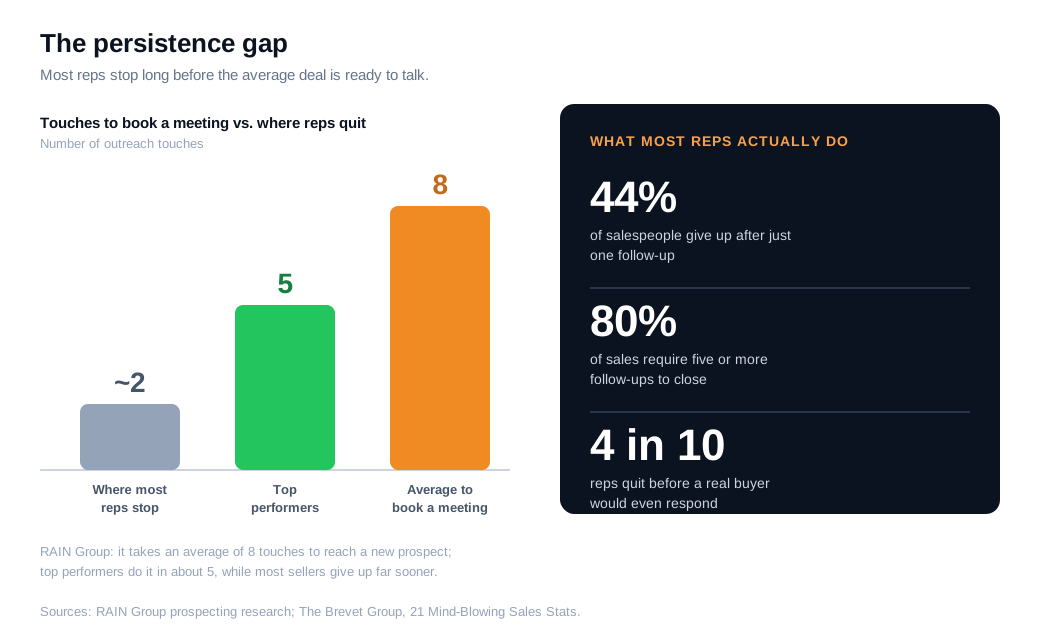
The point is to keep showing up with something useful for as long as a real buyer might take to respond. Spaced, relevant touches do that without tipping over into harassment.
How many touches and channels should a sales cadence include?
Most effective B2B cadences use 8 to 12 touches across three or more channels over roughly two to three weeks. That range shows up consistently across practitioner data and lines up with RAIN Group's eight-touch average, with room on the high end for harder-to-reach buyers.
Channel mix matters more than raw volume. A cadence that reaches the same person by phone, email, and LinkedIn catches them where they actually pay attention, and blended multi-channel cadences reliably outperform email-only sequences. If every touch is an email, you are betting the whole outcome on one inbox that may never get checked.
A practical channel split for cold outbound looks like this:
- Phone: 3 to 4 touches. Calls drive the highest-intent conversations, and voicemails reinforce your emails.
- Email: 3 to 4 touches. Cheap, scalable, and good for delivering proof (a case study, a relevant metric, a short recorded walkthrough).
- LinkedIn: 2 to 3 touches. A profile view, a connection request, and a short message add a face and a second inbox.
- Optional: 1 video or text touch for warm or high-value prospects.
Personalization should scale down as volume scales up. Your first email and first call are worth real research and a trigger (a funding round, a job change, a new product launch). Later touches can lean on templates with a personalized opening line. Personalizing on a trigger event beats generic "I saw your website" research every time.
For warm inbound leads, compress everything. Someone who just requested a demo does not need an eight-touch nurture; they need a reply in minutes. That is a different motion, closer to speed-to-lead than to cold prospecting, and it is where live channels like live chat that escalate to a call outperform any scheduled email cadence.
How long should a sales cadence run?
A cold outbound cadence should run about 14 to 21 business days, and a warm inbound cadence should run days, not weeks. The goal is to cover the window in which a real buyer might notice and respond, without dragging on so long that the messaging goes stale or the outreach reads as pestering.
Spacing inside that window matters as much as total length. The pattern that works is tight at the start, wider at the end. Front-load the first several touches into the first week while the trigger that prompted your outreach is still fresh, then widen the gaps to every three to five days. A common spacing for an eleven-touch cadence is touches on days 1, 2, 4, 6, 9, 12, 15, 18, and 21, with the busiest days near the front.
Timing within the day and week is a smaller lever, and a free one. HubSpot's analysis of sales calls found that midweek (Wednesday and Thursday) and late morning (around 10 a.m. to noon) tend to produce the best connect rates, with Friday the weakest day and the 4 p.m. to 5 p.m. window also strong for reaching decision makers. Use those as defaults, then let your own connect-rate data override them.
When the cadence ends, end it cleanly. A short breakup message ("Should I close your file?") often pulls a surprising number of replies, and it lets you move non-responders into a lighter long-term nurture instead of burning more rep hours on them.
How do you build a sales cadence step by step?
Build a cadence by defining the target, choosing the channels and touch count, writing the messages around a single angle, spacing the touches, and then scheduling it so the steps actually happen. Here is the process with a worked example.
Start with the segment and the trigger. Pick one clearly defined audience (say, VPs of Sales at 50-to-200-person SaaS companies) and the event that justifies your outreach (they just posted three SDR roles). One cadence per segment keeps the messaging coherent.
Set the shape. For this cold segment, use 11 touches over 21 business days across phone, email, and LinkedIn, front-loaded toward the first week.
Write to one angle. Every touch should reinforce a single idea (for example, "you are hiring SDRs to book more meetings, and your own website visitors are a faster source of meetings than more cold calls"). Vary the format, keep the core message steady.
Here is how the worked example lays out:
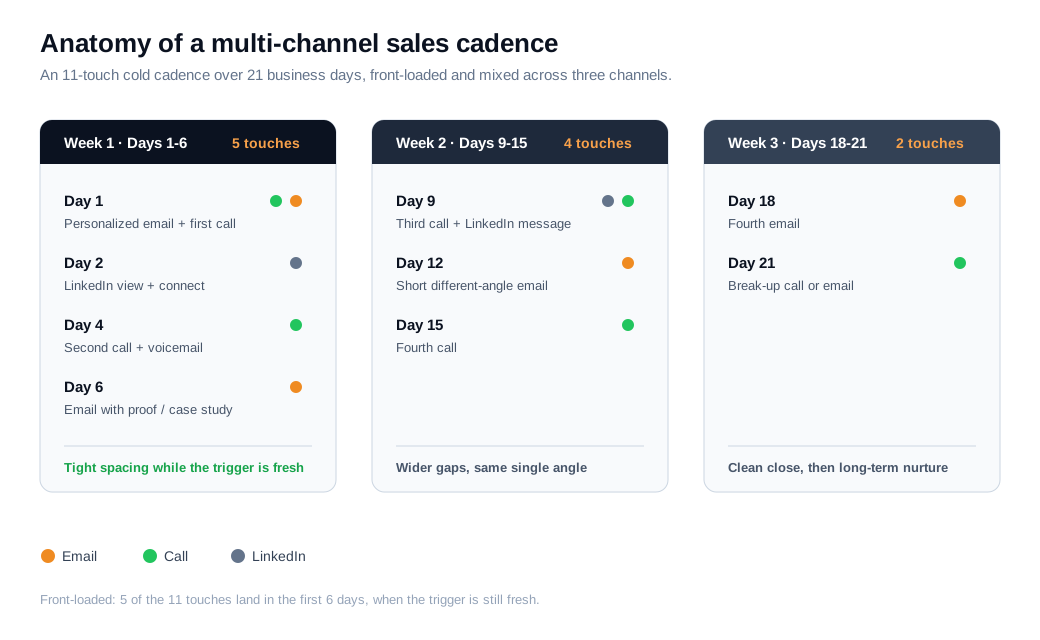
- Day 1: Personalized email plus a first call. (2 touches)
- Day 2: View their LinkedIn profile and send a connection request. (1)
- Day 4: Second call, with a voicemail that references your Day 1 email. (1)
- Day 6: Email with a relevant proof point or short case study. (1)
- Day 9: Third call plus a short LinkedIn message. (2)
- Day 12: A different-angle email, three sentences maximum. (1)
- Day 15: Fourth call. (1)
- Day 18: Fourth email. (1)
- Day 21: A breakup call or email. (1)
That is eleven touches, five of them inside the first six days. Load it into whatever tool your team runs (a sales engagement platform, or even a well-managed CRM with tasks) so each step becomes a dated task rather than a good intention. Then route inbound replies to a rep fast, because a cadence is only as good as your response when it finally works. A guide to lead routing and notifications helps here, so a hot reply never sits in a queue.
How do you measure sales cadence performance?
Measure a sales cadence with four metrics tracked stage by stage: connect rate, reply rate, meeting-booked rate, and pipeline created. Each one isolates a different failure point, so a weak number tells you exactly what to fix instead of leaving you to guess.
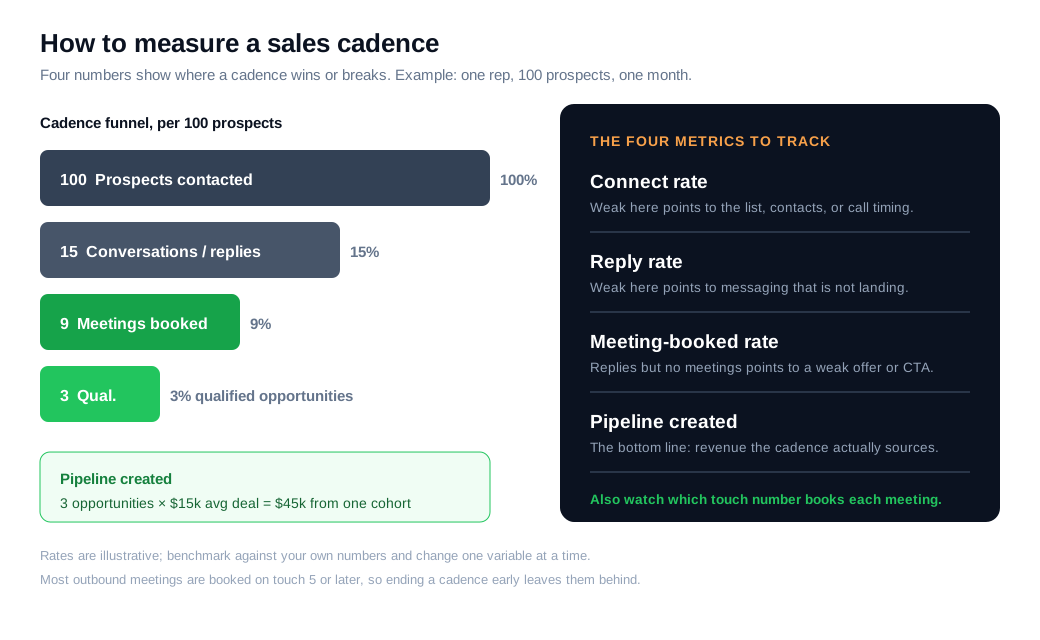
Here is a worked example. Say a rep runs the cadence above against 100 prospects in a month:
- Connect and reply: 15 of the 100 engage in a real conversation (a 15% multi-channel reply rate). If this number is low, the problem is upstream: a bad list, the wrong contacts, or poor call timing.
- Meetings booked: 9 of those turn into a scheduled meeting (a 9% meeting-booked rate). If people reply but do not book, the messaging is working and the offer or call to action is weak.
- Qualified opportunities: 3 of the meetings become real, qualified pipeline. If meetings happen but nothing qualifies, you are targeting the wrong segment.
- Pipeline created: those 3 opportunities at a $15,000 average deal size represent $45,000 in new pipeline from one cohort, which you can weigh against the rep-hours the cadence consumed.
Two supporting numbers are worth watching. Track which touch number produces most of your meetings; if most land on touch five or later, cutting your cadence short leaves meetings on the table. And track reply quality, not only reply rate, since a "no thanks" still counts as a reply. Review these numbers weekly, change one variable at a time (subject line, call script, spacing), and keep the versions that lift the metric you were targeting.
What are the most common sales cadence mistakes?
The most common cadence mistakes are quitting too early, over-relying on one channel, drowning personalization in automation, and running the same cadence for cold and warm leads. Each is easy to fix once you name it.
Quitting early is the big one. If your cadence stops at three or four touches, you are giving up right where the data says meetings start to appear. Match your touch count to the eight-plus that research supports.
Single-channel cadences waste reach. Email-only sequences leave connect rate on the table, because some buyers never read cold email but will answer a call or a LinkedIn note. Mix at least three channels.
Over-automation kills the first touch. A templated "just checking in" fired at a senior buyer reads as spam. Reserve heavy personalization for the first email and first call, where it changes the outcome most.
Finally, keep cold cadences off warm leads. A prospect who filled out a demo form or started a chat wants a fast answer while their intent is high. Dripping eleven touches over three weeks wastes that intent, so save the multi-week cadence for genuinely cold outreach and give warm inbound leads a live reply instead.
Key takeaways
- A sales cadence is a scheduled, multi-channel follow-up plan. It replaces ad-hoc follow-up with a written sequence of dated touches so persistence stops depending on memory.
- Persistence is the edge. It takes about eight touches to book the average meeting, yet 44% of reps quit after one follow-up, so a disciplined cadence competes against a field that mostly stops early.
- Use 8 to 12 touches across three or more channels. Blend phone, email, and LinkedIn; multi-channel cadences beat email-only sequences, and personalization should concentrate on the first touches.
- Run cold cadences 14 to 21 days, front-loaded. Cluster the early touches while the trigger is fresh, widen the later gaps, and end with a clean breakup message.
- Measure connect, reply, meeting-booked, and pipeline. Each metric points to a specific fix, and tracking which touch books meetings stops you ending cadences too soon.
- Match the cadence to the lead temperature. Cold prospects need a multi-week sequence; warm inbound leads need a live reply in minutes.
TAGS

Written by
Daniel SemeckyCo-founder & CEO
Daniel is the co-founder and CEO of Glimpze. He spends his days talking to revenue teams about how to catch high-intent visitors before they bounce, and writes about inbound sales, lead conversion, and building a motion where marketing and sales actually share a number.


