
On this page
A marketing team celebrates 500 MQLs this quarter. Sales works maybe 60 of them, closes a handful, and quietly stops trusting the number. Both teams are staring at the same list of leads and reaching opposite conclusions about whether the quarter went well.
That gap is the MQL versus SQL problem in one picture. An MQL is marketing's bet that a lead is worth a conversation. An SQL is a rep confirming the bet was right. When those two labels are defined loosely, or defined by two teams who never compared notes, pipeline leaks in the space between them and nobody can agree on why.
This guide defines both terms in plain language, lays out the differences that actually matter, shows how a lead earns its way from one stage to the next, gives you benchmark conversion rates to measure against, and takes the "are MQLs dead" debate seriously.
What is a marketing qualified lead (MQL)?
A marketing qualified lead (MQL) is a contact who fits your target profile and has engaged with your marketing enough to be worth passing to sales, but who a rep has not yet vetted. It is marketing's judgment that this person is more likely to become a customer than the average name in the database.
Two things go into that judgment. The first is fit: does the lead look like your ideal customer, by industry, company size, role, and region. The second is behavior: what has the lead actually done. Common MQL actions include downloading a guide or ebook, registering for a webinar, returning to your site several times, or clicking through a run of emails. Most teams turn these into a lead score and set a threshold, so a lead becomes an MQL once it crosses a fixed number of points.
The important word is prediction. An MQL has not told a salesperson they want to buy. They have shown a pattern that, on average, correlates with buying later. That is useful, and it is where the trouble starts. Easy-to-measure actions like a single ebook download are easy to scale and easy to game, and they do not always mean the person is close to a decision. A strong MQL definition weighs high-effort signals such as repeat pricing views far above a one-time content grab. A weak one counts every form fill the same, and floods sales with names that go nowhere.
What is a sales qualified lead (SQL)?
A sales qualified lead (SQL) is a lead a rep has engaged directly and confirmed as a real opportunity, with a genuine need, a budget, and a timeline worth pursuing. Where an MQL is a score, an SQL is a verified fact.
The move from MQL to SQL happens through contact. A rep reaches out, has a conversation, and checks the lead against a qualification framework such as BANT (Budget, Authority, Need, Timeline) or a heavier one for complex deals. The buyer has usually shifted from researching a problem to evaluating a solution, and their actions show it: they request a demo, ask about pricing, read your case studies, or compare you against a named competitor. Those are the behaviors of someone with their wallet within reach.
An SQL earns direct, one-to-one attention because a person has looked at the evidence and decided the deal is worth working. That confirmation is exactly what an MQL lacks. It also explains why the SQL bar sits higher and why far fewer leads clear it. Teams that treat their website as an inbound sales channel try to shorten this step, so that fit and intent get confirmed in a live conversation rather than a scheduled callback.
What is the difference between an MQL and an SQL?
The core difference is certainty and ownership: an MQL is marketing's prediction that a lead might buy, while an SQL is a rep's confirmation that the lead is worth selling to. One is a forecast built from behavior, the other is a verdict built from a conversation.
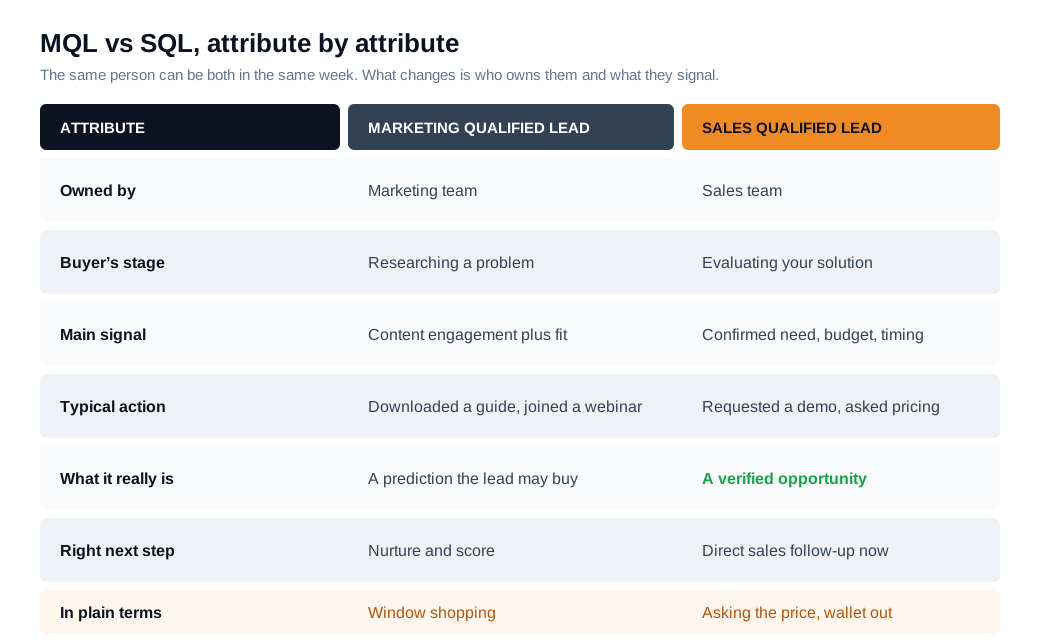
HubSpot puts the distinction in a line that sticks: an MQL is window shopping, and an SQL is asking for the price and checking their wallet, per HubSpot's breakdown of the two terms. The window shopper is curious and open to being convinced. The person asking the price has decided they might actually buy and wants to know what it costs.
Ownership is the other half of the difference. Marketing owns the MQL and is measured on how many it produces and how well they convert. Sales owns the SQL and is measured on what closes. That split is healthy, but it puts a seam right in the middle of your funnel, and the handoff across that seam is where a lot of pipeline quietly disappears.
Where do SALs and PQLs fit in?
Between MQL and SQL, many teams add a sales accepted lead (SAL), and product-led teams add a product qualified lead (PQL). Both exist to plug gaps that a simple two-stage model leaves open.
A sales accepted lead is an MQL that a rep has reviewed and formally agreed to work. At this checkpoint, sales confirms the lead meets the agreed criteria, is reachable, and sits in their territory, then commits to following up inside a set window. The full progression reads Prospect, Lead, MQL, SAL, SQL, per Kubaru's guide to the qualification stages. The SAL step adds accountability. Without it, an MQL can sit untouched in a queue for days while marketing assumes it was worked and sales assumes it was junk.
A product qualified lead is different in kind. It comes from usage, not marketing engagement. Someone signs up for a free trial or a freemium tier, hits a meaningful milestone (invites a teammate, connects an integration, runs the core workflow a few times), and that behavior predicts a paid conversion. PQLs tend to convert better than MQLs because the signal is the product itself rather than a content download. If you run a free plan, a PQL motion often deserves its own scoring track alongside the classic MQL path.
How does a lead move from MQL to SQL?
A lead moves from MQL to SQL when a rep engages it, checks it against your qualification criteria, and confirms a real need, budget, authority, and timing. The mechanics are simple. The discipline is in doing them fast and the same way every time.
Four things have to happen in order. First, sales and marketing agree in writing on what an MQL is and what a rep owes it, usually as a service level agreement that names a response time. Second, the qualified lead routes to the right rep the moment it appears, not the next morning. Instant routing and notifications are what make the handoff fast enough to matter. Third, the rep makes contact, runs light discovery, and applies the framework. Fourth, the lead becomes an SQL, or it gets recycled to nurture with a reason attached.
Speed decides how many MQLs survive that path. The MIT and InsideSales study of web leads found that reaching out within five minutes made a rep 21 times more likely to qualify the lead than waiting 30 minutes. Harvard Business Review's audit of 2,241 companies reached the same conclusion from the other direction: firms that made contact within an hour were nearly seven times as likely to qualify a lead as those that waited even an hour longer, and more than 60 times as likely as those who waited a day, per The Short Life of Online Sales Leads. The catch is that most buyers spend very little time with any one vendor. Gartner estimates B2B buyers spend just 17 percent of their total buying time meeting with all potential suppliers combined, and when they weigh several vendors, any single rep gets 5 to 6 percent, according to Gartner's B2B buying journey research. Miss the window and the MQL keeps buying, just from someone who answered first.
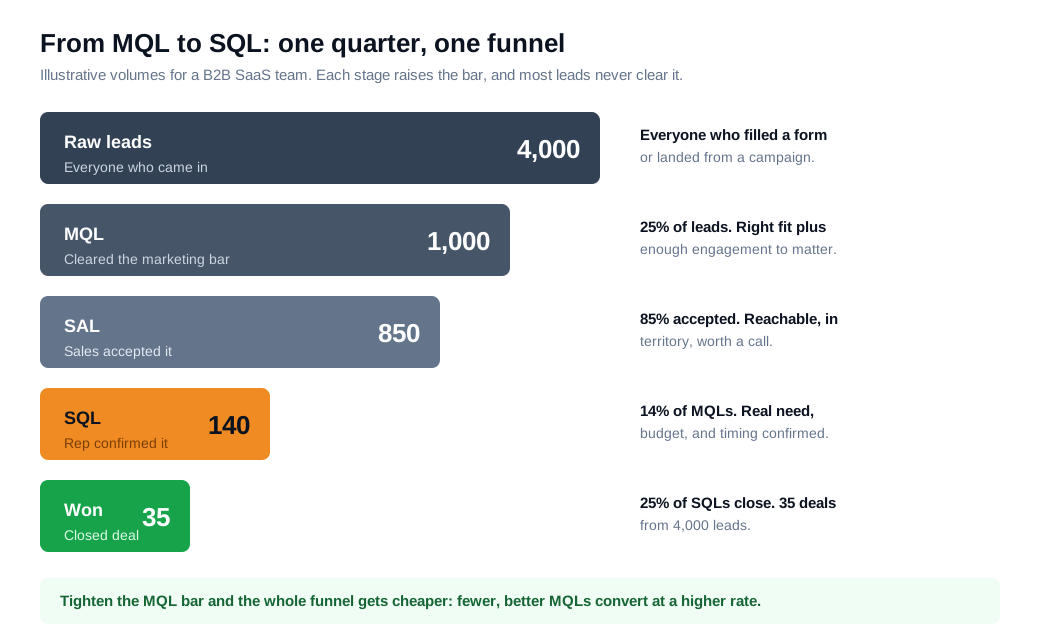
Here is the math on one quarter. Say a B2B SaaS team pulls in 4,000 raw leads and 1,000 clear the MQL bar. Sales accepts 850 of them as workable. At a 14 percent MQL-to-SQL rate, 140 become SQLs, and at a 25 percent close rate, 35 of those turn into customers. Now tighten the MQL definition so only 600 higher-quality leads qualify. If those convert at 22 percent because the bar is stricter, you still get roughly 132 SQLs, from far fewer names, and reps waste a lot less time on leads that were never going to talk. Fewer, better MQLs beat a bigger pile of weak ones almost every time. Some teams shorten the gap between signal and contact even further by putting a real conversation on the page a buyer is already reading, so a high-intent visitor can start a live chat at the moment interest peaks instead of waiting for a callback.
What is a good MQL to SQL conversion rate?
A healthy MQL-to-SQL conversion rate sits in the mid-teens for most B2B teams, with the median landing around 13 to 15 percent and industry ranges running roughly 12 to 21 percent. Anything far below that usually points to an MQL bar set too low, not weak leads.
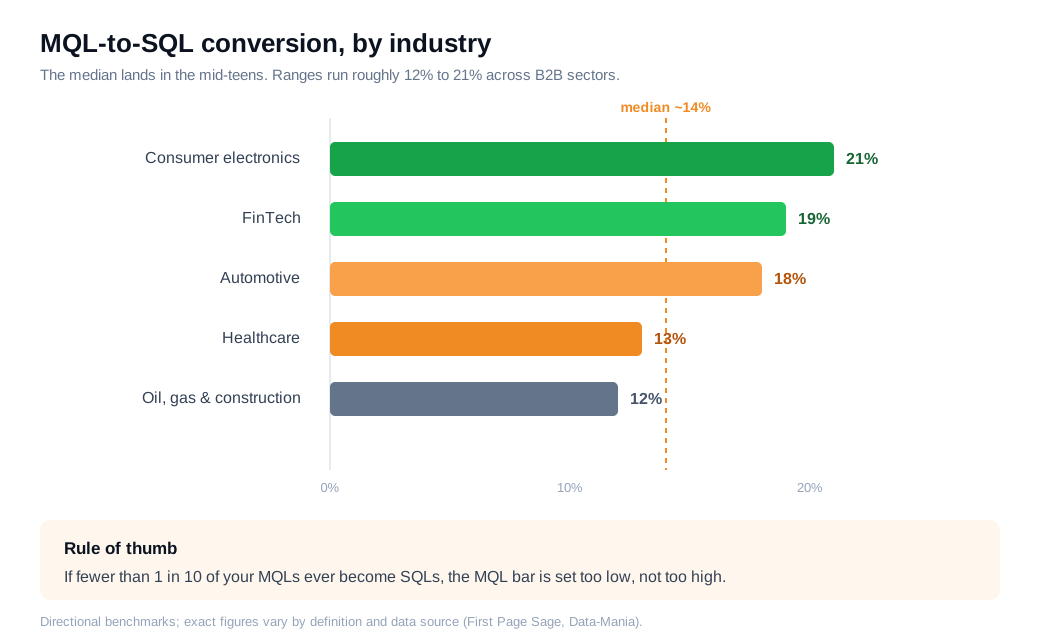
The spread tracks how fast and how clear each buying decision is. Consumer electronics and FinTech sit near the top, around 19 to 21 percent, because purchase cycles are short and intent signals are clean, per First Page Sage's industry benchmarks. Long-cycle, procurement-heavy sectors like oil, gas, and construction sit near the bottom, around 12 percent, where committees and traditional buying drag the rate down. Cross-industry compilations put the typical B2B figure in the same mid-teens band, as Data-Mania's benchmark roundup shows.
Treat these as directional, because the number depends entirely on where you draw your MQL line. The formula is simple: SQLs divided by MQLs over the same period, times 100. If you loosen the MQL definition to inflate volume, the rate falls even though nothing real improved. If you tighten it, the rate rises. The two levers that move conversion honestly are a shared, strict definition of what qualifies and speed of follow-up. A stricter bar and a faster first touch beat any clever scoring tweak.
Are MQLs still useful?
MQLs are still useful, but the classic single-lead MQL is under real pressure, and for good reason. The metric works best in simpler deals, where an individual or a small group decides, cycles are short, and one engaged person can carry the sale. In those cases an MQL is a fair proxy for real interest and a fine trigger for outreach.
The pressure comes from how larger B2B deals actually get made. Forrester has argued for retiring the MQL in favor of buying groups, on the grounds that real purchases are committee decisions, not individual ones. Its Buyers' Journey Survey found that 93 percent of B2B buyers took part in a buying group of two or more people, and 71 percent were in groups of four or more, which is the case Forrester lays out in Saying Goodbye to MQLs. Score one lead in isolation and you miss the other five people quietly shaping the decision. That is why teams increasingly track engagement across a whole account or buying group rather than lighting up sales for one webinar sign-up.
The honest read is that the MQL is a useful signal that got mistaken for a finish line. When it fails, the cause is almost always a weak definition or a sales team that ignores the handoff, rather than the concept itself. Keep the MQL if it fits your motion, agree on it with sales in writing, and treat it as a prompt to start a conversation rather than a trophy to count. The fastest teams close the gap between the signal and the conversation to near zero, using an AI chat assistant to qualify a visitor on a high-intent page in the moment, then handing a genuinely warm lead to a rep. Whatever labels you use, the principle holds: each stage should raise the bar, and a lead should only move forward when it earns the move.
Key takeaways
- An MQL is a prediction, and an SQL is a confirmation. Marketing scores a lead as likely to buy; a rep talks to it and verifies there is a real need, budget, and timeline.
- The handoff is where pipeline leaks. A shared, written definition of what qualifies, plus an SLA on response time, prevents leads from dying in the gap between marketing and sales.
- Speed decides how many MQLs survive. Contact within five minutes makes qualifying 21 times more likely than waiting half an hour, because buyers spend only a sliver of their time with any one vendor.
- A good MQL-to-SQL rate is mid-teens. The median sits near 13 to 15 percent, with industry ranges of roughly 12 to 21 percent; below 10 percent usually means the MQL bar is too low.
- Fewer, better MQLs beat a bigger pile of weak ones. Tightening the definition raises conversion and frees reps from chasing names that were never going to talk.
- MQLs still work, with a caveat. They fit simpler, individual-buyer deals; complex committee deals push teams toward buying groups and account-level engagement.
TAGS

Written by
Daniel SemeckyCo-founder & CEO
Daniel is the co-founder and CEO of Glimpze. He spends his days talking to revenue teams about how to catch high-intent visitors before they bounce, and writes about inbound sales, lead conversion, and building a motion where marketing and sales actually share a number.


