
On this page
- What is conversational advertising?
- How do click-to-message ads work?
- What channels and formats does conversational advertising use?
- How does conversational advertising improve ad conversion?
- What are the pitfalls of conversational advertising?
- How do you measure conversational advertising?
- How do you get started with conversational advertising?
- Key takeaways
- Sources
A prospect sees your ad on Instagram, taps it, and lands on a form asking for name, email, phone, and company size. A large share close the tab before the second field. The intent was real, and the form spent it.
Conversational advertising keeps that intent alive. Instead of dropping a click onto a static page, the ad opens a chat, so the person can ask their actual question and get an answer while they are still paying attention. The click becomes a conversation, and the conversation is where the deal moves forward.
This guide defines conversational advertising, explains how click-to-message ads work, covers the channels and formats behind them, shows how they lift conversion with a worked example, flags the pitfalls, lays out what to measure, and ends with how to get started.
What is conversational advertising?
Conversational advertising is paid advertising where the call to action opens a real-time, two-way conversation rather than sending the click to a form or a landing page. The person taps the ad and arrives in a chat thread, on Messenger, WhatsApp, Instagram, LinkedIn, or a website widget, where a business, an AI assistant, or a handoff between the two answers their question and carries them toward a purchase.
The format changes what the click is for. A traditional display or search ad works hard to earn the click, then hands the visitor a page and hopes they self-serve their way to a form and wait for a callback. A conversational ad treats the click as the opening line of a dialogue. The advertising platform Landbot describes conversational ads as formats that replace the one-way pitch with an interactive exchange, letting the person pick a prefilled reply or type their own question and get a response on the spot.
The defining trait is immediacy. Because the destination is a live thread, the business can answer the buyer's real doubt in the moment it surfaces, instead of collecting a contact detail and following up later. That single change, answering now rather than later, is what most of the results in this guide trace back to.
How do click-to-message ads work?
Click-to-message ads work by attaching a "Send message" action to an ad, so tapping it opens a chat with the business instead of loading a web page. On Meta's platforms these run as click-to-Messenger, click-to-WhatsApp, or click-to-Instagram ads. The advertiser picks the destination inbox, and the person who taps arrives in a conversation that can begin with a greeting and a few prefilled quick replies.
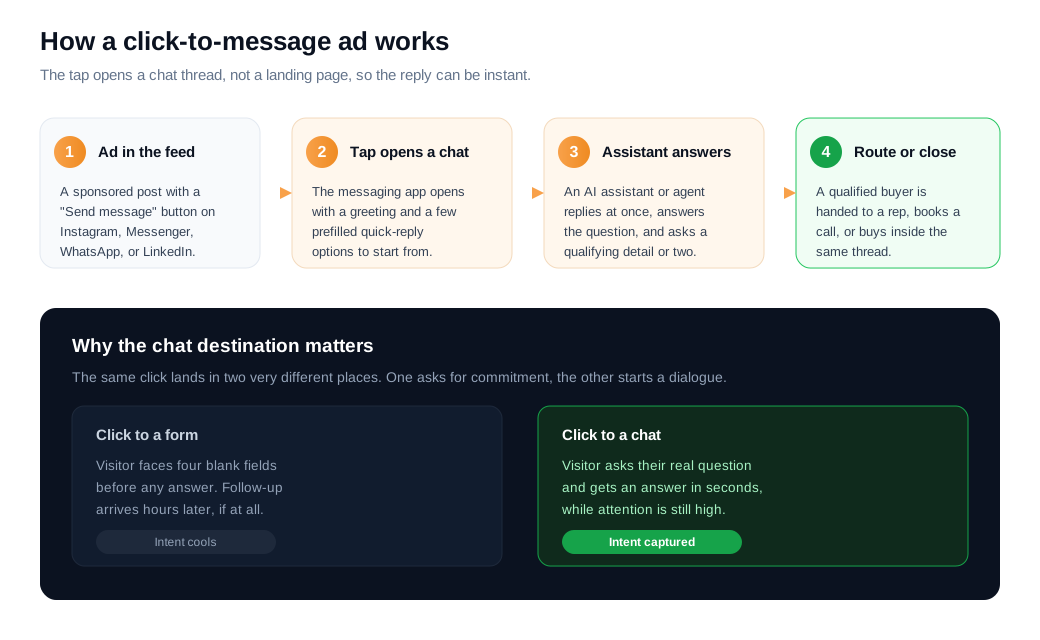
The flow is short. The ad runs in the normal feed. When someone taps it, the messaging app opens with an intro message and quick-reply buttons that suggest where to start. The person can pick an option or type freely, and an automated flow or an AI assistant handles the opening exchange, answers the common questions, and collects a qualifying detail or two before routing a serious buyer to a human. Meta also lets an advertiser send taps to more than one inbox at once, and reports that businesses selecting multiple message destinations saw about 9 percent lower cost per message and 11 percent higher conversion rate than those picking a single destination.
The landing point of a click-to-message ad is functionally the same surface as live chat on your own site, reached from an ad rather than from a page. Billing follows the ad, not the chat: you pay for the impressions or the conversations started through the ad auction, and on WhatsApp the conversation the ad opens is free to the business within Meta's messaging window. The practical work is less about the ad mechanics and more about who, or what, answers the first message.
What channels and formats does conversational advertising use?
Conversational advertising runs across any paid placement that can open a live thread: Meta's click-to-Messenger, click-to-WhatsApp, and click-to-Instagram ads, LinkedIn Conversation Ads, and website ads or retargeting that drop a visitor into on-site chat. Each channel fits a different buyer and stage, and all of them plug into a surface people already use, with Meta reporting more than 600 million conversations between people and businesses on its platforms every day.
Meta messaging ads carry most of the volume. Click-to-Messenger and click-to-Instagram ads suit high-volume consumer and local businesses, where a quick question about availability, price, or fit stands between interest and a sale. Click-to-WhatsApp ads extend the same thread onto a channel buyers already use daily, which suits markets where WhatsApp is the default way people reach a business.
LinkedIn Conversation Ads bring the format to B2B. Rather than a static message, they deliver a branching flow into the member's inbox, with response buttons that lead to different follow-ups so the prospect self-qualifies as they choose a path. LinkedIn bills them per send rather than per click, and the format tends to post high open rates because it lands as a message, not a banner.
Website chat and retargeting close the loop on your own property. A retargeting ad can send a returning visitor straight into your widget, where an AI chat assistant answers instantly and hands off qualified buyers to a person. For a high-consideration purchase, some setups let the visitor jump from that chat to a live video call or screen share to see the product before they commit. The common thread across all of these is continuity: the conversation should carry its context so the buyer never has to repeat themselves.
How does conversational advertising improve ad conversion?
Conversational advertising improves ad conversion by removing the two biggest leaks in a paid funnel: the form that demands commitment before the visitor is ready, and the delay between a lead raising their hand and anyone responding. A chat answers the buyer's real question in the moment, while attention is still high.
Speed is the mechanism most advertisers underrate. Harvard Business Review's study "The Short Life of Online Sales Leads" audited 2,241 US companies and found that firms trying to contact a lead within an hour were nearly seven times as likely to have a meaningful conversation with a decision maker as those that waited just an hour longer, and more than 60 times as likely as companies that waited 24 hours. Yet the average first response in that study was 42 hours, and 23 percent of companies never responded at all. A conversational ad collapses that gap toward zero, because the reply can be immediate.
Here is a simplified worked example to see the mechanics.
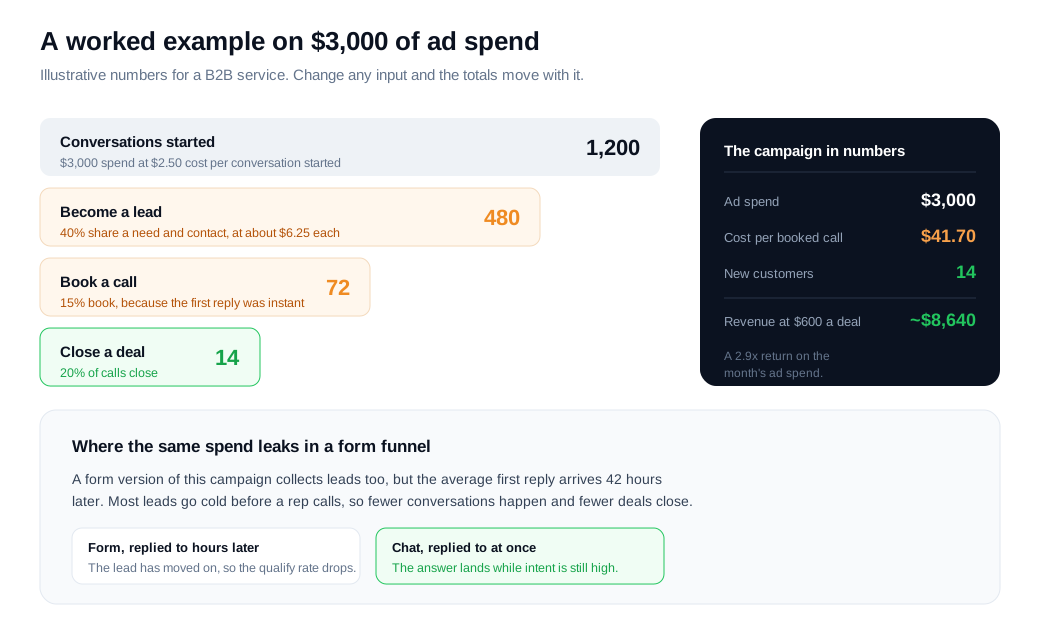
Suppose a B2B service business puts 3,000 dollars a month into a click-to-message campaign. At a 2.50 dollar cost per conversation started, that buys roughly 1,200 conversations. An AI assistant answers each one at once, and 40 percent share enough of a need and a contact to count as a lead, about 480 leads at 6.25 dollars each. Because the first reply is instant and qualified chats route to a rep within minutes, 15 percent book a call, or 72 sales conversations. A 20 percent close rate yields about 14 customers, and at a 600 dollar average deal the campaign returns roughly 8,640 dollars on 3,000 dollars of spend.
Run the same 3,000 dollars through a form version and the leak shows up downstream. The form still collects leads, but the average first reply arrives closer to the 42 hours HBR measured, so most leads have cooled by the time a rep calls. Fewer conversations happen, the qualify rate drops, and the same close rate acts on a smaller base. Change any input and the totals move, but the lever stays the same. The speed and quality of the first reply decide the outcome more than the size of the audience does.
Operator data points the same way. Meta's case study with the fintech company SumUp, which fed conversion data back to the ad platform through its Conversions API, reported an average 16 percent reduction in cost per quality lead and a 28 percent higher rate of turning a lead into a quality lead. Treat any single number as directional, but the shape is consistent: catch the buyer in a live thread and more of the demand you already paid for survives to a sale.
What are the pitfalls of conversational advertising?
Conversational advertising fails the moment the conversation goes unanswered, which is its single biggest risk. An ad that promises a fast chat and then leaves the person waiting converts worse than the form it replaced, because it raised an expectation and broke it in front of the buyer.
A few limits are worth planning around before you shift budget:
- Coverage. Someone or something has to answer during every hour your ads run. That means staffing the inbox, leaning on an AI assistant for the first reply, or setting honest off-hours expectations, so no tap lands in silence.
- Consent and compliance. Messaging channels carry rules on opt-in, data handling, and how long you can keep replying for free. WhatsApp in particular has a defined window, and you need a clean way to capture consent and honor opt-outs.
- Lead quality versus volume. A cheap conversation is not automatically a good one. Low-friction formats can pull in curious taps that never intended to buy, so you have to qualify inside the chat rather than count raw conversations as wins.
- Attribution. A sale that starts in an ad, continues in a chat, and closes on a call is harder to trace than a single form submit. Without outcome data flowing back to the ad platform, you optimize toward the wrong signal.
- Fit. Some low-consideration, self-serve purchases convert fine from a good landing page. Conversational advertising earns its keep where a real question stands between interest and action.
None of these are reasons to avoid the format. They are reasons to launch it deliberately, with the answer and the follow-up ready before the first ad goes live.
How do you measure conversational advertising?
You measure conversational advertising with a funnel of conversation-specific metrics that go beyond clicks and form fills: cost per conversation started, conversation-to-lead rate, first-response time, cost per qualified lead, automation rate, and the downstream close rate and return on ad spend. Each stage tells you where the thread is leaking.
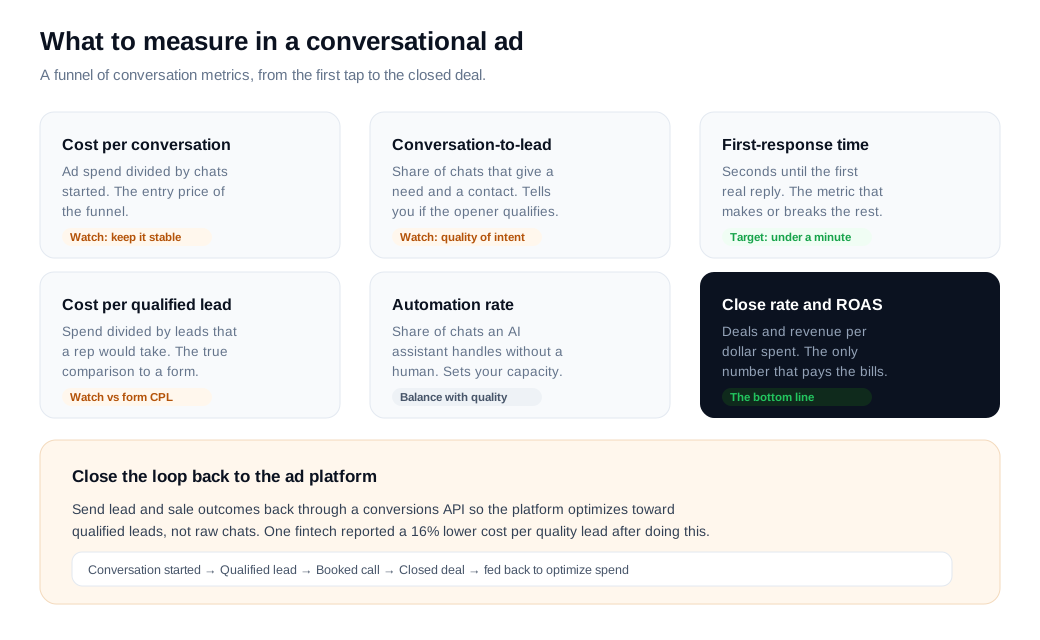
Start at the top with cost per conversation started, the spend divided by the number of chats the ad opened. That is your entry price. Then conversation-to-lead rate, the share of those chats that give you a real need and a way to follow up, which tells you whether the opener is qualifying or just chatting. First-response time sits underneath both and quietly decides them; the HBR finding above is the reason to target a reply in under a minute, which usually means an assistant answers first and a human joins fast.
Two metrics turn the funnel into a business case. Cost per qualified lead is the number to compare directly against your old form funnel, because a chat that produces cheaper qualified leads is the whole point. Close rate and return on ad spend are the bottom line, the deals and revenue per dollar that decide whether the campaign scales. Track automation rate alongside them, the share of chats an AI assistant handles without a person, since that sets how much volume you can run before you need more staff.
The step that ties it together is closing the loop. Feed lead and sale outcomes back to the ad platform through a conversions API, so the algorithm optimizes toward qualified leads and closed deals rather than raw conversations. That is what the SumUp result above came from, and it is also what keeps a cheap-conversation campaign from quietly filling your inbox with taps that never buy. A lead routing and notifications setup that timestamps each handoff makes first-response time and cost per qualified lead measurable rather than anecdotal.
How do you get started with conversational advertising?
You get started with conversational advertising by pointing one campaign's clicks at a chat instead of a form, staffing that chat to reply instantly, and measuring qualified leads rather than raw conversations. It is a change to one setting in your ad and one habit in your follow-up, not a rebuild.
- Switch one high-intent campaign to a message destination. Start with the audience closest to buying, where a quick answer most directly saves a sale, and leave your form running elsewhere as a control.
- Write the opening message and two or three quick replies. Greet the person, answer the obvious first question, and use the quick replies to sort a buyer from a browser in the first exchange.
- Put a fast first responder on it. An AI assistant that answers in seconds, qualifies, and hands off cleanly covers the reply time no human team can hit at ad scale.
- Wire routing and handoff. Send qualified chats straight to a rep and make the human handoff clean, so a high-value buyer never gets stuck with a bot that cannot close. This is the same inbound sales motion you would run on your own site, now fed by the ad.
- Close the measurement loop. Send lead and sale outcomes back to the ad platform so it optimizes on quality, and watch cost per qualified lead against your form funnel.
- Expand once it beats the form. Add channels and audiences only after the first campaign proves it produces cheaper qualified leads, so you scale a result rather than a hunch.
Start narrow, answer fast, and let the qualified-lead cost decide how far to grow it. Conversational advertising rewards a resolved question far more than a clever ad.
Key takeaways
- Conversational advertising opens a chat instead of a form, turning the ad click into a live thread on Messenger, WhatsApp, Instagram, LinkedIn, or your own site where a buyer's real question gets answered on the spot.
- Click-to-message ads change only the click's destination, attaching a "Send message" action to an ordinary ad so the tap lands in an inbox, with an assistant or agent handling the first reply.
- Speed is the mechanism, and it is well documented: HBR found firms replying within an hour were nearly seven times as likely to qualify a lead as those an hour slower, while the average first response was 42 hours.
- A worked example shows the payoff, with a 3,000 dollar campaign producing about 480 leads and 14 deals worth roughly 8,640 dollars, because the reply is instant rather than delayed.
- The biggest risk is silence, so coverage, consent, lead quality, and attribution all need a plan before you shift budget into the format.
- Measure conversations, not clicks, tracking cost per conversation, conversation-to-lead rate, first-response time, and cost per qualified lead, and feed outcomes back to the ad platform to optimize on quality.

Written by
Daniel SemeckyCo-founder & CEO
Daniel is the co-founder and CEO of Glimpze. He spends his days talking to revenue teams about how to catch high-intent visitors before they bounce, and writes about inbound sales, lead conversion, and building a motion where marketing and sales actually share a number.


