
On this page
Two coffee shops sit on the same block, charge the same price, and pour the same beans. One remembers your order, fixes a mistake without an argument, and has a line out the door. The other is fine, and mostly empty. The product is identical. Everything around it feels different, and that difference is what fills one shop and empties the other.
That difference has a name, customer experience, and it has become one of the clearest predictors of which companies grow and which quietly lose ground. When products look alike and prices converge, how a business makes people feel across every interaction is often the last real advantage left.
This post covers what customer experience means, how it differs from customer service and UX, what a good experience actually looks like, how CX ties directly to revenue and retention, the three metrics teams use to measure it, and the concrete moves that improve it.
What is customer experience?
Customer experience, often shortened to CX, is the sum of every interaction a person has with your brand across their entire relationship with you, plus the feelings those interactions leave behind. It runs from the first ad or search result, through the website, the purchase, the product itself, the support desk, the renewal notice, and the offboarding if it comes to that.
Two things make the definition useful. First, it is cumulative. No single touchpoint defines the experience; the perception is built from all of them, and one sharp failure can undo a dozen good moments. Second, it is emotional as much as functional. McKinsey describes CX as a customer's holistic perception across all interactions, which means the story a customer tells themselves about you weighs as heavily as whether the checkout worked.
The practical upshot is that CX is owned by everyone and no one. Marketing sets the expectation, product delivers the core value, billing and support handle the friction, and the customer takes all of it in as one continuous impression of what this company is like to deal with.
What is the difference between CX, customer service, and UX?
The difference is one of scope: customer experience is the whole journey, while customer service and user experience are specific parts inside it. Customer service is the help people get when something goes wrong or they have a question, usually after they have already bought. User experience is how usable and pleasant a single product interaction is, like a checkout flow or a mobile app screen.
Picture them as nested layers. HubSpot frames the relationship as a hierarchy, with UX sitting inside a single product session, customer service inside a support interaction, and CX wrapping around both plus everything else: the pricing page, the sales call, the onboarding email, the invoice, and the way a refund gets handled.
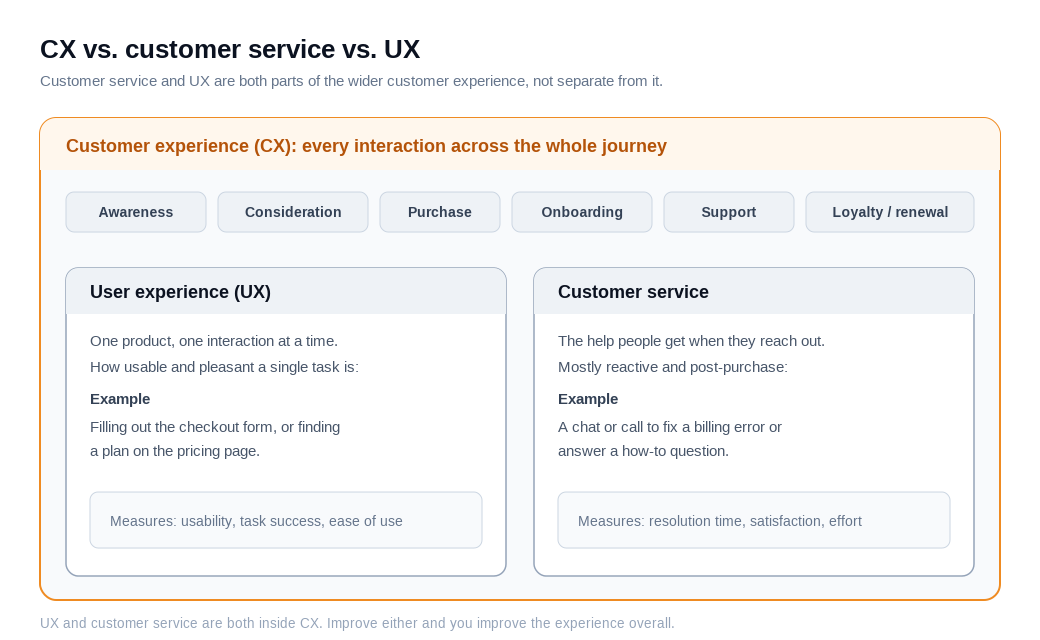
An example makes the boundaries concrete. Say a customer buys project management software. The clean signup form and the drag-and-drop board are UX. The chat where an agent helps them import old tasks is customer service. The full arc, from the search that found the product, through the trial, the purchase, the daily use, the support ticket, and the renewal decision a year later, is customer experience. Fix the checkout form and you improve UX. Train the support team and you improve service. Both feed CX, and CX is what the customer remembers when they decide whether to stay.
The distinction matters because of budget and ownership. Teams that treat CX as the support team's job tend to ignore the touchpoints where most goodwill is won or lost, which sit in sales, onboarding, and product, long before anyone opens a ticket.
What makes a good customer experience?
A good customer experience is fast, easy, consistent across channels, and human when it counts. Customers rarely ask for delight in the abstract. They ask for their problem solved with as little effort as possible, in the channel they already use, by someone or something that seems to understand them.
Speed and ease sit at the top of the list. In PwC's research on customer experience, the qualities buyers said they would pay more for were led by speed, convenience, and knowledgeable, helpful people. The same study found that 73% of consumers name experience as an important factor in their buying decisions, and that customers will pay up to a 16% price premium for a great one.
Consistency is the quiet requirement. A customer who gets a warm sales call, a confusing onboarding, and a slow support queue does not average those into "okay." They remember the worst step. Because the experience is cumulative, the weakest touchpoint tends to set the tone for the entire relationship.
Human contact still carries weight at high-stakes moments. PwC found that most consumers want more human interaction even as automation spreads, especially where a decision or a problem feels important. A chatbot that resolves a password reset is welcome. The same bot standing between a frustrated customer and a real person during a billing dispute is where goodwill leaks out.
How does CX drive revenue and retention?
CX drives revenue through three linked mechanisms: it keeps existing customers longer, it makes them spend more and refer others, and it lets you charge a premium. Each one shows up in hard numbers, and together they compound.
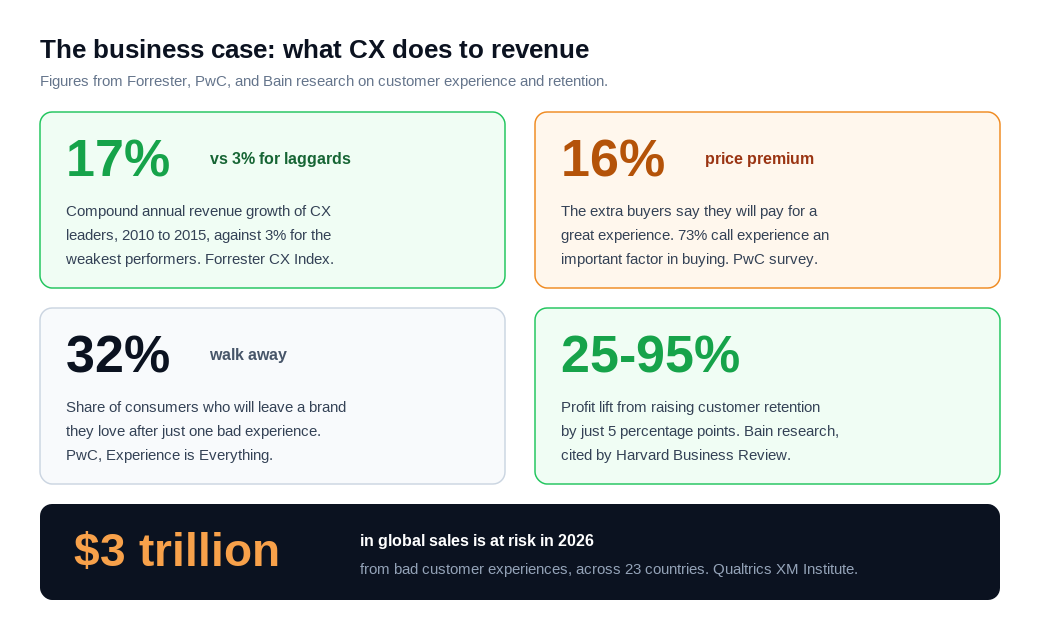
Start with growth. Forrester's CX Index found that customer experience leaders grew revenue far faster than laggards, posting compound annual revenue growth of 17% between 2010 and 2015 against just 3% for the weakest performers. Better experience, measurably faster growth.
Retention is where the effect is quietest and largest. Bain research, widely cited by Harvard Business Review, shows that increasing customer retention by 5% can lift profits by 25% to 95%. The same HBR piece notes that acquiring a new customer costs anywhere from five to twenty-five times more than keeping one you already have. Experience is the main lever on retention, since customers leave over how they were treated at least as often as over the product itself.
The downside is just as concrete. The Qualtrics XM Institute estimates that poor customer experiences put roughly $3 trillion in global sales at risk in 2026 across 23 countries, as unhappy customers cut back or leave. PwC puts a number on that fragility: 32% of consumers say they would walk away from a brand they love after a single bad experience.
Here is a worked example that ties it together. Take a SaaS business with 1,000 customers who each pay $1,200 a year, so $1.2 million in annual recurring revenue. At an 85% annual retention rate, the company carries 850 of those customers into year two. Lift retention to 90%, a five-point gain, and it carries 900. Those 50 saved customers are worth $60,000 in year-two revenue, and because retained customers tend to buy more over time, the gap widens every year the cohort ages. The company did not run a single new ad to earn that money. It kept people it already had by giving them a better experience.
Referrals are the multiplier on top. Customers who have a good experience tell others, which lowers acquisition cost for the next cohort, while customers who have a bad one warn people off. That word of mouth is why the revenue effect of strong CX tends to compound rather than stay flat.
How do you measure customer experience?
You measure customer experience with a small set of survey metrics, most commonly NPS, CSAT, and CES, backed by operational data like retention and resolution time. No single number captures the whole experience, so mature teams triangulate.
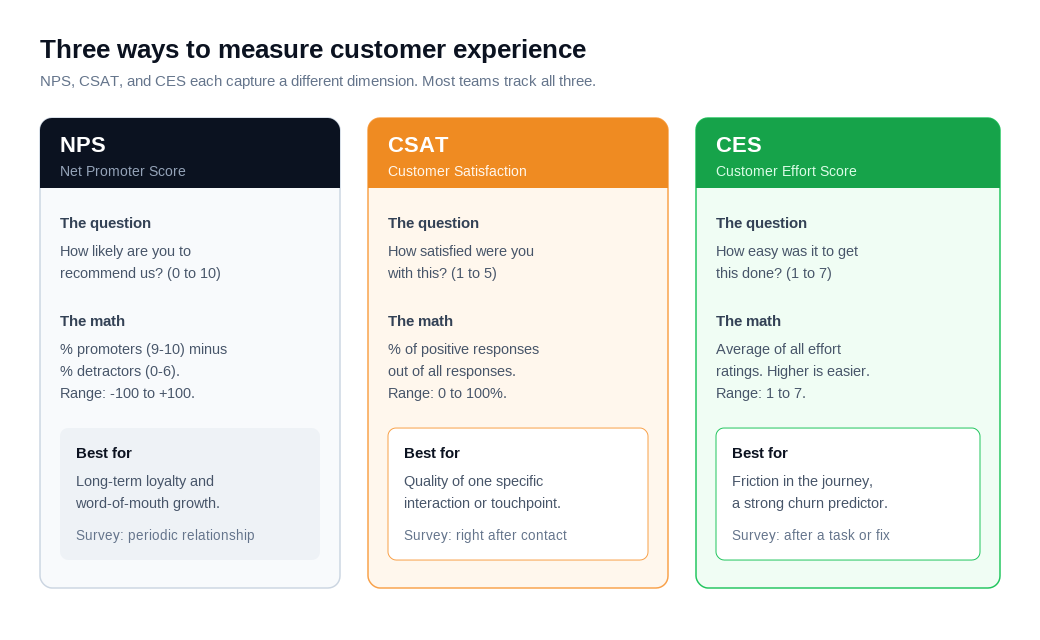
Net Promoter Score (NPS) tracks loyalty. You ask, on a scale of 0 to 10, how likely a customer is to recommend you, then subtract the percentage of detractors (0 to 6) from the percentage of promoters (9 to 10). The result runs from -100 to +100 and works best as a periodic read on the overall relationship.
Customer Satisfaction (CSAT) tracks a single moment. You ask how satisfied someone was with a specific interaction, usually on a 1 to 5 scale, and report the percentage of positive answers. Sent right after a purchase or a support chat, CSAT tells you whether that touchpoint landed.
Customer Effort Score (CES) tracks friction. You ask how easy it was to get something done, and a high-effort experience is one of the strongest predictors that a customer will churn. When people have to work hard to buy from you or get help, they remember it.
The numbers only earn their keep if you close the loop. A survey score with no follow-up is a vanity metric. The teams that get value from measurement route low scores to a person who can act, read the open-text comments for the reason behind the number, and check whether fixes move the score over time. Pair the survey metrics with behavior, such as repeat purchase rate, churn, and average response time, and you get a picture that is hard to argue with.
How do you improve customer experience?
You improve customer experience by mapping the real journey, finding the touchpoints where customers lose time or patience, and fixing the highest-traffic friction first. The work is unglamorous and specific, and it outperforms broad "be more customer-centric" campaigns every time.
A practical sequence works like this:
- Map the journey as it is, not as you wish it were. List every touchpoint from first contact to renewal, then mark where customers commonly get stuck, confused, or delayed. The friction you can name is the friction you can fix.
- Listen where the signal is. Combine survey scores with the open-text comments, support tickets, and session data. The comments usually tell you what the number alone cannot.
- Cut effort at the worst points. Shorten forms, remove steps, clarify copy, and make it obvious how to reach a human. Lower effort tends to show up later as higher retention.
- Answer people while intent is high. A visitor with a question on your pricing page is the most valuable traffic you have, and a contact form that promises a reply within one business day throws that moment away.
- Empower the front line. People solving problems need the authority and the information to fix things on the spot, without escalating every exception.
That fourth point is where experience and revenue meet most directly, and it is worth expanding. When a high-intent visitor has a question, the speed of the answer often decides the sale. Offering live chat at that moment, or escalating to a live video call or screen share when something is easier to show than to type, turns a hesitant visitor into a conversation before the interest cools. This sits at the core of a modern inbound sales motion, and it improves the experience and the conversion rate in the same move.
Two operational details make the difference real. The visitor has to reach the right person quickly, which is a job for lead routing and instant notifications rather than a shared inbox nobody watches. And the change has to be measured, so you can confirm that faster answers actually lift satisfaction and conversion instead of just feeling better. Improve the moments that carry the most weight, measure them honestly, and the experience gets better where it counts.
Key takeaways
- Customer experience is the whole relationship, the cumulative impression left by every interaction from first ad to renewal, and it is emotional as much as functional.
- CX is broader than customer service or UX, which are specific parts inside it, so treating CX as only a support responsibility misses where most goodwill is won or lost.
- The revenue link is measurable, with Forrester finding CX leaders grew revenue at 17% against 3% for laggards, and Bain research showing a 5% retention gain can lift profits by 25% to 95%.
- Bad experiences are expensive, putting an estimated $3 trillion in global sales at risk in 2026, with 32% of consumers willing to leave a brand they love after one bad interaction.
- Measure with more than one number, using NPS for loyalty, CSAT for single interactions, and CES for friction, then close the loop by acting on the low scores.
- Improvement is specific work, mapping the journey, cutting effort at the worst touchpoints, and answering high-intent visitors fast, which lifts experience and revenue together.

Written by
Daniel SemeckyCo-founder & CEO
Daniel is the co-founder and CEO of Glimpze. He spends his days talking to revenue teams about how to catch high-intent visitors before they bounce, and writes about inbound sales, lead conversion, and building a motion where marketing and sales actually share a number.


