
On this page
A SaaS company signs 40 new customers in a quarter and quietly loses 38 old ones. The logo count barely moves, the revenue line looks flat, and the whole team works twice as hard to stand still. Acquisition is doing its job. What happens after the sale has no owner.
Customer lifecycle management is the discipline that gives every stage an owner, a goal, and a metric, from the first ad a stranger sees to the renewal a loyal account signs three years later. It treats the customer relationship as a sequence you can map, measure, and improve, rather than a stack of disconnected campaigns that hand people off and hope.
This post covers what customer lifecycle management is, why it pays off, the stages nearly every model shares, how the lifecycle differs from the customer journey, the actions that belong at each stage, and how to measure whether the lifecycle is healthy with a worked example.
What is customer lifecycle management?
Customer lifecycle management is the practice of tracking, analyzing, and improving each stage of a customer's relationship with a business, from first awareness through long-term loyalty, with the goal of raising customer lifetime value. Zendesk describes it as gathering insight at each stage, assigning metrics to track those stages, and acting on what the metrics say.
Two ideas sit inside that definition. The first is the map, a shared model of the stages a customer passes through, so marketing, sales, and customer success all describe the same relationship the same way instead of arguing over who owns a given account. The second is the operating layer on top of the map, the metrics and plays that turn each stage from a label into work someone is responsible for.
The lifecycle behaves like a loop, not a straight line. A plain funnel ends at the sale and treats everything after it as somebody else's problem. A lifecycle bends the finish back to the start, because a retained customer who expands, refers a peer, and renews is the cheapest growth a company will ever find. HubSpot frames the model that way, with the satisfaction of current customers feeding the next round of acquisition through referrals and reputation.
Why does customer lifecycle management matter?
Customer lifecycle management matters because most of the value in a customer base sits on the far side of the first sale, in retention and expansion, where a small improvement compounds year after year. A company that pours everything into acquisition and neglects the later stages is filling a leaking bucket faster.
The economics are lopsided. Acquiring a new customer costs five to 25 times more than keeping an existing one, and Frederick Reichheld's research at Bain found that raising retention by 5 percent can lift profits by 25 to 95 percent, as Harvard Business Review summarizes. The reason is simple: kept customers buy again, cost less to serve, and often spend more over time.
The odds of the next sale favor the base too. The book Marketing Metrics puts the probability of selling to an existing customer at 60 to 70 percent, against 5 to 20 percent for a cold prospect, a gap reported in Forbes. Expansion revenue from a customer who already trusts you is both likelier to close and cheaper to earn than a brand-new deal.
Without owned stages, none of that value gets captured on purpose. Leads go cold between marketing and sales, new buyers stall in a setup they never finish, and at-risk accounts drift toward cancellation with nobody watching the signal. Lifecycle management exists to make each of those handoffs deliberate.
What are the customer lifecycle stages?
The customer lifecycle has five core stages that nearly every model shares: awareness, acquisition, conversion, retention, and loyalty. Zendesk and Gainsight both use this structure, and while the labels vary between sources, the shape is consistent.
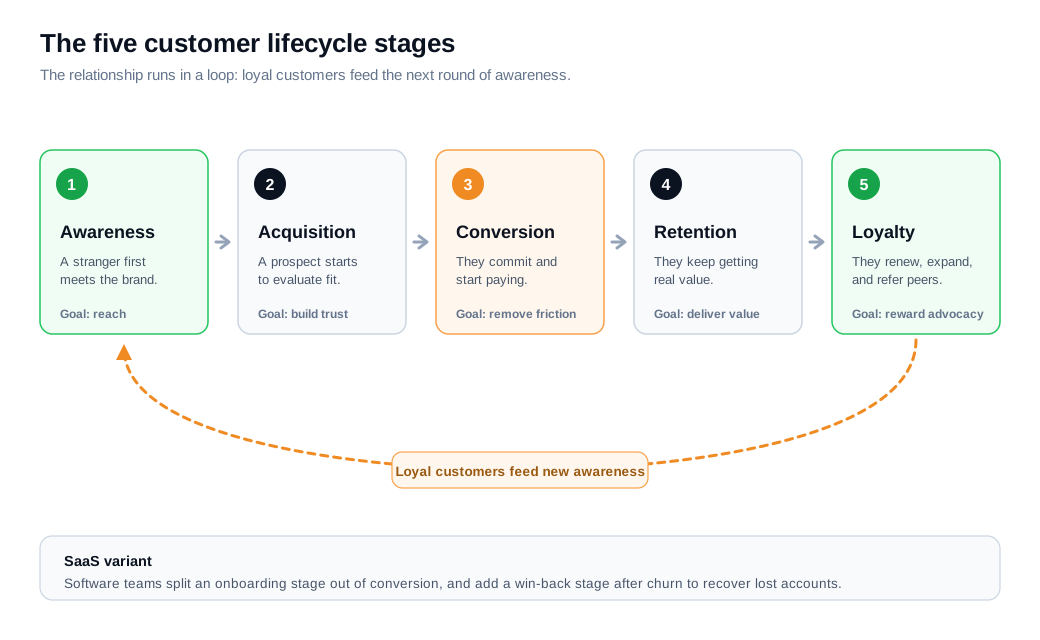
Awareness is the moment a stranger first encounters the brand, through a search result, a social post, a review, or a recommendation from someone they trust. The goal here is reach and a first impression, not a sale.
Acquisition is where an interested prospect starts to evaluate whether you fit their problem. They read the pricing page, book a demo, compare you against two alternatives, and ask the questions that decide the deal.
Conversion is the transaction itself, the point where a prospect commits and becomes a paying customer. It is the pivot of the whole model, though it is nowhere near the end of it.
Retention is the long middle where the customer either gets real value from the product or slowly stops using it. Most of a customer's lifetime revenue is decided here, in whether the product becomes part of their week.
Loyalty is the stage where a satisfied customer renews without a second thought, buys more, and tells peers about you, which pushes new strangers back into awareness and closes the loop. Software teams usually split an onboarding stage out of conversion, since a customer who never finishes setup churns fast, and they add a win-back stage after churn to try to recover the ones who leave.
Customer lifecycle vs customer journey: what's the difference?
The customer lifecycle is the business-level view of the whole relationship, while the customer journey is the individual-level map of the specific touchpoints inside one part of that relationship. The lifecycle labels where a customer sits, as RedTrack lays out, and the journey traces the exact path they walk through a given moment.
An example makes the split concrete. Your lifecycle model might label an account as "onboarding," a stage you measure across every new customer as a cohort activation rate. The journey during that same onboarding window is the individual experience: the welcome email, the setup wizard, the moment of confusion when an integration fails, the relief when the first report finally renders. Same timeframe, different altitude.
You need both. The lifecycle gives leadership the strategic stage architecture and the cohort metrics that forecast retention. Journey maps give the product and support teams the touchpoint detail they need to fix the specific step where customers stall. One tells you which stage is leaking; the other tells you where inside that stage the leak is.
What actions belong at each stage?
The action at each stage should match the customer's goal for that stage: earn attention in awareness, build trust in acquisition, remove friction at conversion, deliver value in retention, and reward advocacy in loyalty. A play that is right for one stage is usually wrong for another, which is why blasting a discount at a stranger who has never heard of you rarely works.
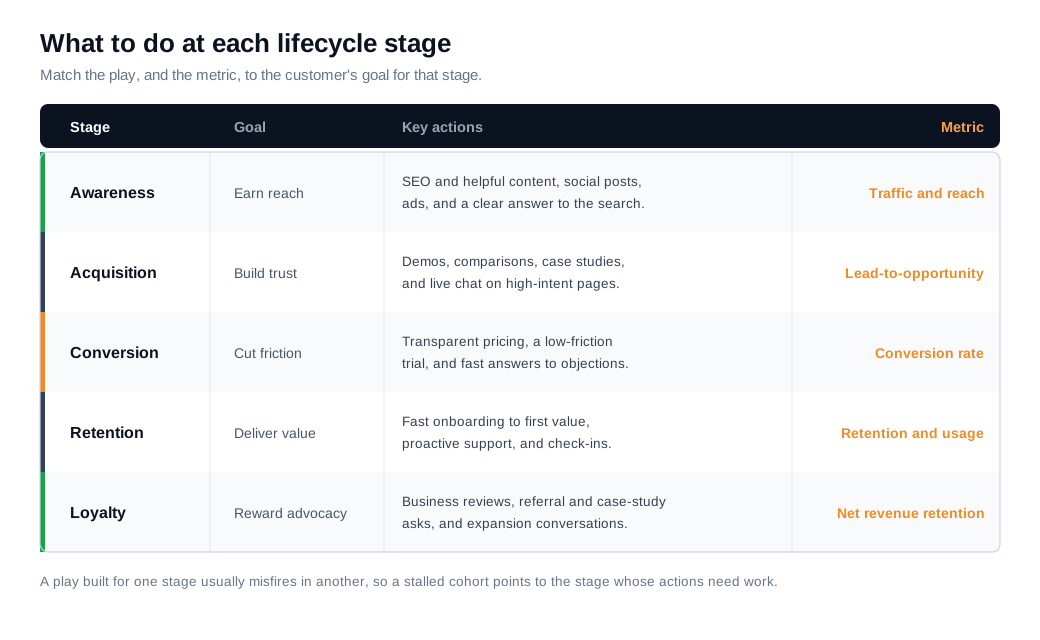
In awareness, the work is educational and broad: search-optimized content, helpful social posts, and a clear answer to the question a prospect typed. You are teaching, not closing, and Optimove notes that the point is to earn a place in the consideration set.
In acquisition, the buyer is comparing options and wants their doubts answered fast. This is where a real-time conversation beats a form and a 24-hour wait, and a tool like live chat on the pricing page lets a rep catch a high-intent visitor while the question is still fresh. Demos, case studies, and side-by-side comparisons do the trust-building here.
At conversion, the job is to remove every reason to hesitate: transparent pricing, a low-friction trial, and quick answers to the last few objections. An AI chat assistant can field the routine setup and billing questions at 2 a.m. so a stalled signup does not wait until morning to get unstuck.
In retention, value delivery is everything, which starts with onboarding that gets a customer to their first real result quickly, then continues with proactive support and regular check-ins. Reaching an account before the renewal date with a proactive outreach nudge, rather than after they have already decided to leave, is often the difference between a save and a goodbye. In loyalty, you run business reviews, ask for referrals and case studies, and open expansion conversations, since a customer getting real value is the one most open to buying more.
How do you measure lifecycle health?
You measure lifecycle health by tracking one or two metrics per stage and watching how cleanly customers move from one stage to the next, rather than staring at a single top-line number that hides where the leak is. A healthy lifecycle shows steady stage-to-stage conversion and expanding revenue from the base; a sick one shows a cohort that stalls at a specific handoff.
The standard measures line up with the stages. Awareness is traffic and reach. Acquisition is lead-to-opportunity rate. Conversion is conversion rate and customer acquisition cost, or CAC. Retention is retention rate, churn, and product usage. Loyalty is net revenue retention, or NRR, plus referral counts. Two ratios tie it together: LTV to CAC, where 3 to 1 is a common healthy benchmark, and NRR, where Gainsight cites the Bessemer scale of 100 percent as good, 110 as better, and 120 as best.
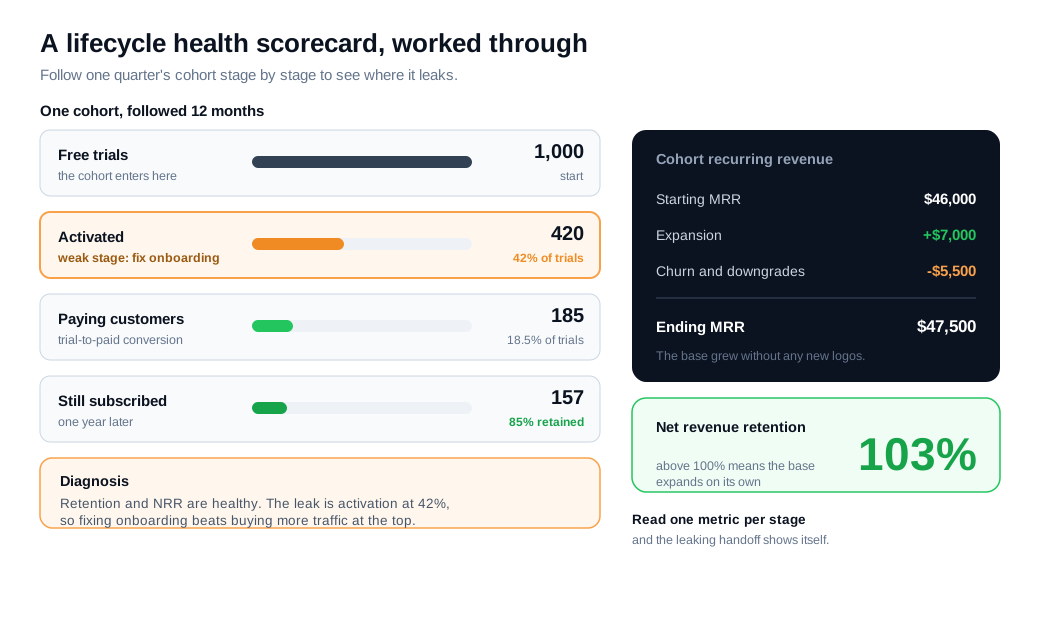
Here is a worked example. Take one quarter's cohort at a SaaS company. It starts with 1,000 free trials. Of those, 420 complete the setup step that predicts success, an activation rate of 42 percent. From the full 1,000, 185 become paying customers, an 18.5 percent trial-to-paid rate. Twelve months later, 157 of those 185 still subscribe, an 85 percent annual retention rate. The cohort's monthly recurring revenue starts at 46,000 dollars, gains 7,000 dollars from upsells, and loses 5,500 dollars to churn and downgrades, ending at 47,500 dollars for a net revenue retention of about 103 percent.
Read that scorecard and the diagnosis is clear. Retention at 85 percent is solid, NRR above 100 percent means the base is growing on its own, and conversion is reasonable. The weak stage is activation at 42 percent, which means more than half of new trials never reach the moment the product proves itself. The highest-leverage fix sits in the middle of the funnel, a better onboarding step, and the numbers point straight to it. More ads at the top would only pour water into the same leak.
That is the payoff of measuring the lifecycle stage by stage. A single revenue figure would have told the team to sell harder. The stage metrics tell them exactly which handoff to repair, which is the difference between working harder and working on the right thing.
Key takeaways
- Customer lifecycle management gives every stage an owner, a goal, and a metric, turning the customer relationship into a loop you can map, measure, and improve instead of a set of disconnected campaigns.
- The value lives after the first sale, where keeping a customer costs five to 25 times less than winning one and a 5 percent lift in retention can raise profits by 25 to 95 percent.
- Five stages recur in nearly every model, awareness, acquisition, conversion, retention, and loyalty, with SaaS teams adding onboarding after conversion and win-back after churn.
- Lifecycle is the business-level stage view; journey is the individual touchpoint map, and you need both, one to find the leaking stage and one to fix the exact step inside it.
- Match the play to the stage, educating in awareness, building trust in acquisition, removing friction at conversion, delivering value in retention, and rewarding advocacy in loyalty.
- Measure one or two metrics per stage and watch the handoffs, because stage-level numbers reveal which step is leaking, as the worked example does by flagging a 42 percent activation rate.

Written by
Nilas MylerCo-founder & CTO, Glimpze
Nilas is the co-founder and CTO of Glimpze, an inbound sales tool that turns high-intent website visitors into live conversations. A former SEO consultant for some of the largest companies in Denmark, he writes about speed-to-lead, inbound sales, and conversion rate optimization — the technical and operational mechanics of turning traffic into pipeline.


