
On this page
- What is a customer success playbook?
- What are the parts of a customer success playbook?
- What playbooks should you build first?
- What triggers a customer success playbook?
- How do you build a customer success playbook step by step?
- Should you automate your customer success playbooks?
- How do you measure customer success playbook success?
- Key takeaways
- Sources
A new customer signs on Tuesday. The account gets a warm kickoff call, a shared setup doc, and a check-in two weeks later. The next customer signs on Wednesday, lands with a different rep, and gets a kickoff call, no setup doc, and a check-in whenever someone remembers. Same product, same price, two experiences, and only one of them renews without a fight.
The gap between those accounts is a playbook. When the steps live in one person's head, quality swings with whoever picks up the account. When they live in a documented play with a trigger and an owner, every customer gets the version that actually works.
This post covers what a customer success playbook is, the parts every good one shares, which plays to build first, what triggers them, how to build one step by step with a worked example, whether to automate, and how to know if a playbook is working.
What is a customer success playbook?
A customer success playbook is a documented, repeatable workflow that defines how a team responds to a specific lifecycle event, from a new account starting onboarding to a health score sliding into a risk band. It captures what a strong customer success manager would do in that moment and writes it down so the whole team can run it the same way, as Zendesk lays out in its guide to playbooks.
The point is consistency at scale. One rep with ten accounts can hold the right moves in memory. A team of eight covering hundreds of accounts cannot, and the quality of a renewal should not depend on which rep happened to own the account. A playbook turns a good instinct into a process that every account receives.
A playbook is narrow on purpose. It handles one situation, like a new customer's first 30 days or a sudden drop in usage, with a defined start and a defined finish. That focus is what makes it usable, since a rep facing a churn signal needs the next three steps, not a 40-page handbook.
What are the parts of a customer success playbook?
Every effective playbook shares five parts: a trigger, an objective, ordered steps, an owner, and exit criteria. Miss any one of them and the play stalls, because a step with no owner gets skipped and a play with no exit runs forever.
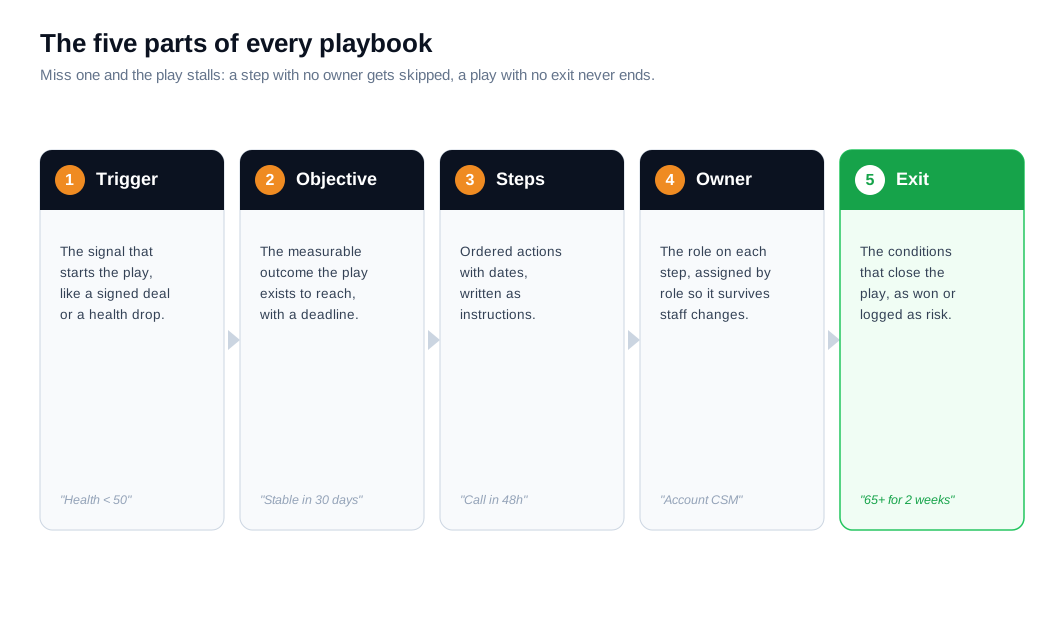
The trigger is the signal that starts the play, such as a signed contract, a renewal 90 days out, or a health score crossing below a set line. The objective is the measurable outcome the play exists to reach, like completing onboarding within 60 days or moving an at-risk account back to stable. The steps are an ordered list of actions, a mix of internal tasks, customer outreach, and data checks, written as instructions rather than suggestions, a structure Onramp stresses in its build guide.
The last two parts are the ones teams forget. The owner is the role responsible for each step, assigned by role rather than by name so the play survives when people change teams. The exit criteria are the specific conditions that close the play, such as onboarding milestones met, a health score recovered for two straight weeks, or a renewal signed and logged. Without a clear exit, a team never learns whether the play succeeded or just quietly ran out of steam.
What playbooks should you build first?
Build three playbooks first: onboarding, churn-risk, and renewal, because those three moments decide most of the revenue a customer base keeps or loses. Onboarding sets whether a customer ever reaches value, churn-risk catches the accounts drifting toward the exit, and renewal turns a due date into a managed conversation, a starting set that ChurnZero recommends for teams standing up their first plays.
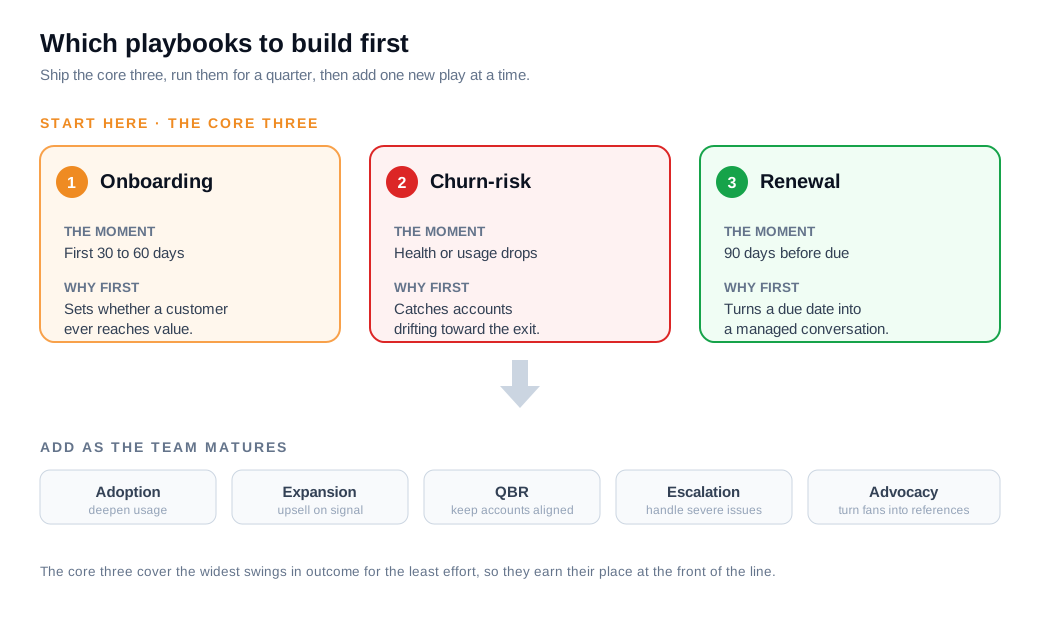
Start there because those three cover the widest swings in outcome for the least effort. A weak onboarding play shows up as slow time to value and early churn. With no churn-risk play, the first sign of trouble is a cancellation email. A missing renewal play means renewals get worked in the last week, when there is no time left to fix a shaky account.
Add the rest as the team matures. Adoption plays push customers deeper into the features that create stickiness. Expansion plays surface upsell and cross-sell when usage signals readiness. Quarterly business review plays keep strategic accounts aligned, escalation plays handle outages and severe tickets, and advocacy plays turn happy customers into references. A practical order is to ship the core three, run them for a quarter, then add one new play at a time so each one gets real attention.
What triggers a customer success playbook?
A playbook is triggered by a defined signal that crosses a threshold, such as a new contract signing, a renewal date approaching, a health score dropping below a set band, or product usage falling under an account's baseline. The trigger is what makes a playbook proactive, since it fires on a condition instead of waiting for a rep to notice, a distinction Planhat draws in its playbook guide.
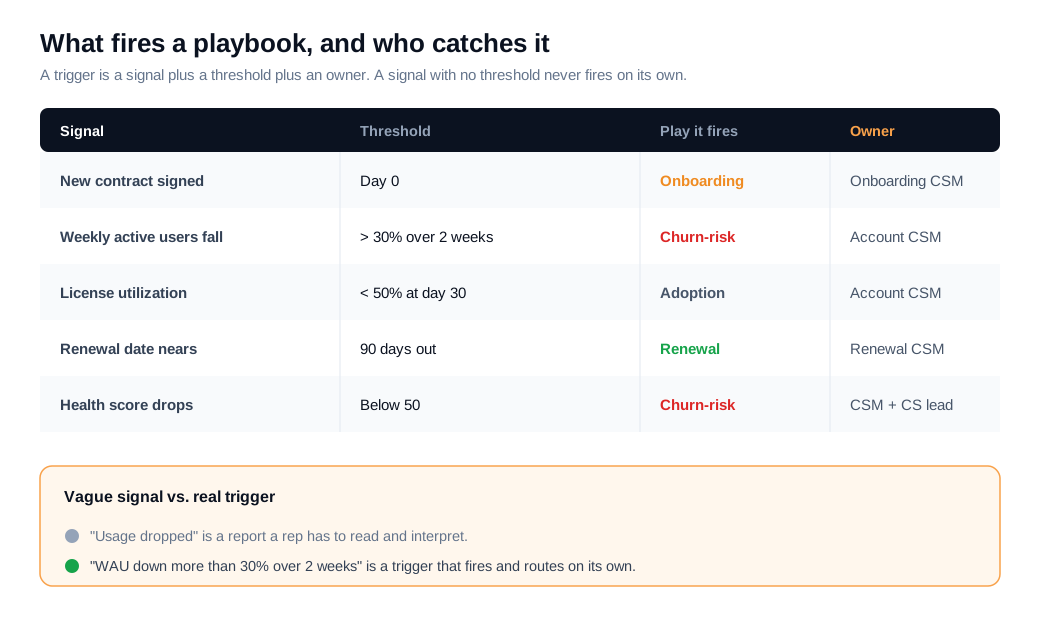
Triggers come in two flavors. Time-based triggers fire on the calendar: day one of onboarding, day 30 for a usage check, 90 days before renewal. Behavior-based triggers fire on what the customer does or stops doing, like weekly active users falling more than 30 percent over two weeks, license utilization under 50 percent after the first month, a support ticket reopened three times, or an executive sponsor going quiet.
The threshold matters as much as the signal. "Usage dropped" is not a trigger. "Weekly active users fell more than 30 percent versus the trailing four-week average" is a trigger, because it is specific enough to fire automatically and route to the right owner. Wiring those alerts into a shared channel, so the right rep gets notified the moment a threshold breaks, is what turns a trigger from a report nobody opens into an action someone takes.
How do you build a customer success playbook step by step?
You build a playbook by mapping the lifecycle moment, defining the trigger and objective, writing the ordered steps with owners, setting exit criteria, then running it for 90 days and refining from what you see. The first version is a hypothesis about what works, and the 90-day run is the test.
Here is a worked churn-risk play. The trigger fires when an account's health score drops below 50, or weekly active users fall more than 30 percent over two weeks, whichever comes first. The objective is to restore the account to stable, defined as a health score of 65 or higher held for two consecutive weeks, within 30 days.
The steps run in order. Within 48 hours, the owning customer success manager reviews the account's usage and support history and reaches out to book a call. A live chat session or a quick screen share often surfaces the real problem faster than a thread of scheduling emails. By day seven, the CSM runs a usage review with the customer and re-onboards the features that went unused. By day 14, if the score has not moved, the play escalates to the customer success lead and loops in the account's executive sponsor. A proactive outreach nudge sent before the customer disengages further keeps the account in the conversation. The owner is the CSM, with the CS lead owning the day-14 escalation.
The exit criteria close the play cleanly. The play succeeds when the health score sits at 65 or higher for two straight weeks, and it exits as a logged renewal risk if the account is still below the line at day 30, which hands leadership a decision rather than a surprise. Run this for a quarter, count how many accounts recovered, and adjust the thresholds and steps that the data says are too loose or too slow, a build-then-refine loop that Pylon walks through in its guide.
Should you automate your customer success playbooks?
Automate the triggers and the busywork, and keep human judgment on the steps that carry real weight. Software should watch the signals, fire the play, create the tasks, and log the activity, since no rep can manually monitor usage across hundreds of accounts. The relationship steps, the diagnostic call and the recovery plan, still belong to a person who can read context a threshold cannot.
Automation is what lets a small team cover a large base. Linking product analytics and CRM fields so triggers activate reliably, with results tracked without manual entry, is the practical core of running playbooks at scale, as Planhat describes in its automation guide. For lower-touch accounts that do not warrant a dedicated CSM, an AI chat assistant can carry the routine onboarding and adoption nudges, so human time concentrates on the accounts where it changes the outcome. Platforms like Gainsight structure this through calls to action that fire a linked playbook when a condition is met, a model documented in its playbooks overview.
The line to hold is simple: automate the trigger and leave the empathy to a person. A play that auto-sends a templated "we noticed your usage dropped" email can do more harm than no play at all, because a frustrated customer reads it as a machine ignoring the actual problem.
How do you measure customer success playbook success?
You measure a playbook two ways: whether the team runs it, and whether it moves the outcome it was built to move. The first is adherence, tracked as completion rate, the share of triggered plays that reach their exit criteria, and step-level adherence, whether reps actually do each step on time. A play that reaches its exit only 40 percent of the time has a delivery problem, and no amount of strategy tuning fixes a play the team keeps abandoning halfway.
The second measure is the outcome. Each play should tie to one metric it is meant to improve: onboarding to time to value, churn-risk to recovery rate, renewal to renewal rate and net revenue retention, as HubSpot frames in its rundown of customer success metrics. Return to the worked churn-risk play. If 40 accounts triggered it last quarter and 26 recovered to stable, that is a 65 percent recovery rate, with an average time to stable of 18 days. Those two numbers show both that the play runs and that it works, and they give you a baseline to beat next quarter.
The stakes behind these numbers are large. Industry benchmarks put median net revenue retention near 106 percent, with the best SaaS companies holding above 130 percent, according to 2026 B2B SaaS benchmark data, and the gap between those two figures is largely a story of who retains and expands their base. The economics reward getting this right, since keeping an existing customer costs far less than winning a new one, and Frederick Reichheld's research at Bain found that lifting retention by 5 percent can raise profits by 25 to 95 percent, as Harvard Business Review summarizes. Playbooks are how a team turns that math into a routine instead of a hope.
One rule keeps the measurement honest. A playbook that everyone marks complete but that never moves its outcome metric is theater, and a playbook that clearly moves the metric but that reps keep skipping needs to be made simpler so they will run it. Watch both numbers together, and let them tell you which plays to keep, cut, or rebuild.
Key takeaways
- A customer success playbook is a documented, repeatable workflow for one lifecycle moment, built so every account gets the version that works instead of whatever the assigned rep remembers to do.
- Every good playbook has five parts, a trigger, an objective, ordered steps, an owner assigned by role, and exit criteria, and the play stalls the moment any one of them is missing.
- Build three plays first, onboarding, churn-risk, and renewal, then add adoption, expansion, QBR, escalation, and advocacy plays one at a time as the team matures.
- A trigger needs a concrete threshold, such as weekly active users falling more than 30 percent over two weeks, so it can fire automatically and route to the right owner.
- Automate the triggers and the busywork, and keep a person on the diagnostic and recovery steps, because a templated "your usage dropped" email can do more harm than no play at all.
- Measure adherence and outcome together, tracking completion rate alongside the metric each play is built to move, since a play marked done that changes nothing is just decoration.

Written by
Nilas MylerCo-founder & CTO, Glimpze
Nilas is the co-founder and CTO of Glimpze, an inbound sales tool that turns high-intent website visitors into live conversations. A former SEO consultant for some of the largest companies in Denmark, he writes about speed-to-lead, inbound sales, and conversion rate optimization — the technical and operational mechanics of turning traffic into pipeline.


