
On this page
A subscription business spends nine months and most of a year's marketing budget to sign 1,000 customers. Twelve months later, 180 of them are gone. The team celebrates the new logos it closed that quarter and never notices that it is refilling a leaking bucket, paying full price to replace customers it had already won.
That leak is a retention problem, and it is the most expensive one most companies never put on a dashboard. Customer retention is the work of keeping the customers you already have, and it usually returns more per dollar than any acquisition campaign. The customer is already yours, already paying, and already inclined to stay if you give them a reason to.
This guide covers what customer retention is, why it matters to the bottom line, how to measure your retention rate, what counts as a good number, what actually makes customers stay, and the specific moves that improve it.
What is customer retention?
Customer retention is the share of customers a business keeps over a given period, along with the practices aimed at keeping them. It is the mirror image of churn: every customer you retain is one who did not cancel, switch to a competitor, or quietly stop buying.
It helps to separate two things a single "retention" number can mean. Logo retention, sometimes called customer retention rate, counts accounts: how many of the customers you had at the start are still with you at the end. Revenue retention counts dollars instead, and it splits into two useful versions.
Gross revenue retention measures how much recurring revenue you hold onto from your existing base, counting cancellations and downgrades but nothing else. Because it only tracks losses, gross revenue retention can never rise above 100%. Net revenue retention adds expansion back in, so upgrades and cross-sells from current customers can push it past 100% when growth from the base outruns the losses.
The distinction matters because a customer who stays but downgrades still counts as retained in a logo number, while the revenue view catches the shrinkage. For a subscription business, watching both keeps you honest about whether you are holding customers, holding revenue, or only one of the two.
Why does customer retention matter?
Customer retention matters because keeping a customer is far cheaper than replacing one, and small gains in retention compound into outsized gains in profit. The economics are lopsided enough that retention is often the highest-return work a growth team can do.
Start with acquisition cost. Winning a new customer runs five to twenty-five times more than keeping an existing one, and the same Harvard Business Review analysis, drawing on Bain and Frederick Reichheld's research, found that raising retention by five percentage points can lift profit anywhere from 25% to 95%. That is the same product and the same customers, with the only change being how many of them stay.
Selling is easier to your own base, too. The book Marketing Metrics puts the probability of selling to an existing customer at 60 to 70%, against just 5 to 20% for a new prospect. Existing customers cost less to reach, convert more often, and carry none of the acquisition overhead you already paid.
There is a compounding effect underneath all of this. A customer's average lifetime is roughly one divided by the churn rate, so cutting churn stretches how long every account keeps paying. Lower churn saves this year's revenue and lengthens the payback window on customers you already spent to acquire, and that gain repeats at every renewal.
Churn works as a tax on growth in the other direction. Lose 20% of your revenue a year and you have to win 20% in new business just to stand still, before a single dollar of real growth counts. Retention decides how much of your acquisition effort turns into net progress instead of replacement.
How do you measure retention rate?
You measure customer retention rate by taking the customers you had at the end of a period, subtracting the new ones you added during it, and dividing by the customers you started with. Multiply by 100 to get a percentage.
Customer retention rate = ((E - N) / S) x 100, where E is customers at the end, N is new customers added, and S is customers at the start.
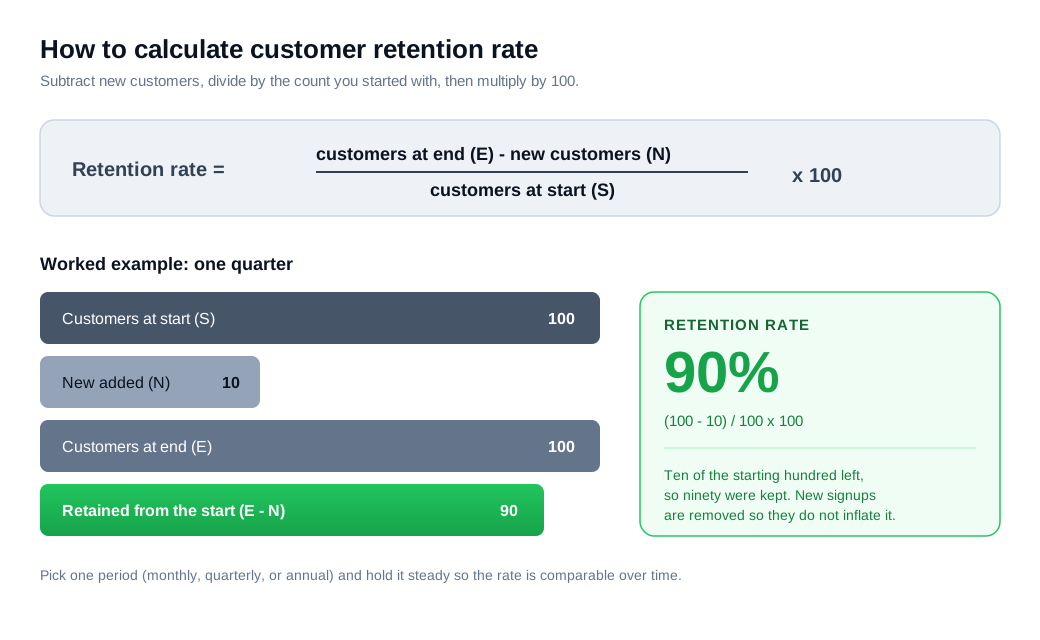
Here is a worked example. You start a quarter with 100 customers, add 10 new ones during it, and finish with 100. It looks like you broke even, but you did not. Subtract the 10 new customers from the 100 you ended with, and only 90 of the original group remain. Divide 90 by the 100 you started with, multiply by 100, and your retention rate is 90%. Subtracting new signups is the step people skip, and skipping it lets fresh growth hide the customers who left.
Two habits make the number trustworthy. Pick one period, monthly, quarterly, or annual, and hold it steady so the figures compare cleanly over time. And track by cohort, grouping customers by when they joined and following that fixed group forward, so a change you shipped last month shows up instead of getting smeared across everyone.
The retention rate is a clean count, but it treats a downgraded customer the same as a fully happy one. That is why revenue retention sits alongside it, and why churn rate, which is simply 100% minus your retention rate for the same cohort, is worth watching next to both. Read together, they tell you whether you are keeping customers, keeping revenue, or leaking one while holding the other.
What is a good customer retention rate?
A good customer retention rate depends heavily on your industry and business model, so the most honest benchmark is your own trend line moving in the right direction. A number that looks strong for one business would signal a crisis in another.
Switching costs set the baseline. Transactional businesses with low switching friction, like retail or hospitality, live with lower retention because customers drift in and out by nature. Contract-based and deeply integrated businesses, like banking or enterprise software, hold customers far longer because leaving is expensive and disruptive. Comparing your rate against an industry you are not in tells you almost nothing.
For subscription and SaaS businesses, net revenue retention is the more revealing benchmark than a raw logo count. A healthy net revenue retention rate sits above 100%, and top performers reach 120% or higher, because expansion from existing customers more than covers the ones who leave. Gross revenue retention, which caps at 100%, shows the size of the pure leak before any expansion papers over it. A company can post a glowing net number while its gross number quietly reveals a churn problem that growth is masking.
The practical move is to pick a definition, hold it steady, segment by cohort and by acquisition channel, and watch whether the line climbs quarter over quarter. Your last quarter is the only competitor whose numbers you can fully trust.
What drives strong retention?
Strong retention comes down to four connected drivers: how fast customers reach value, how reliable their experience is, how engaged they stay, and how personal the relationship feels. Each one reinforces the next, and a weakness in any of them shows up at renewal.
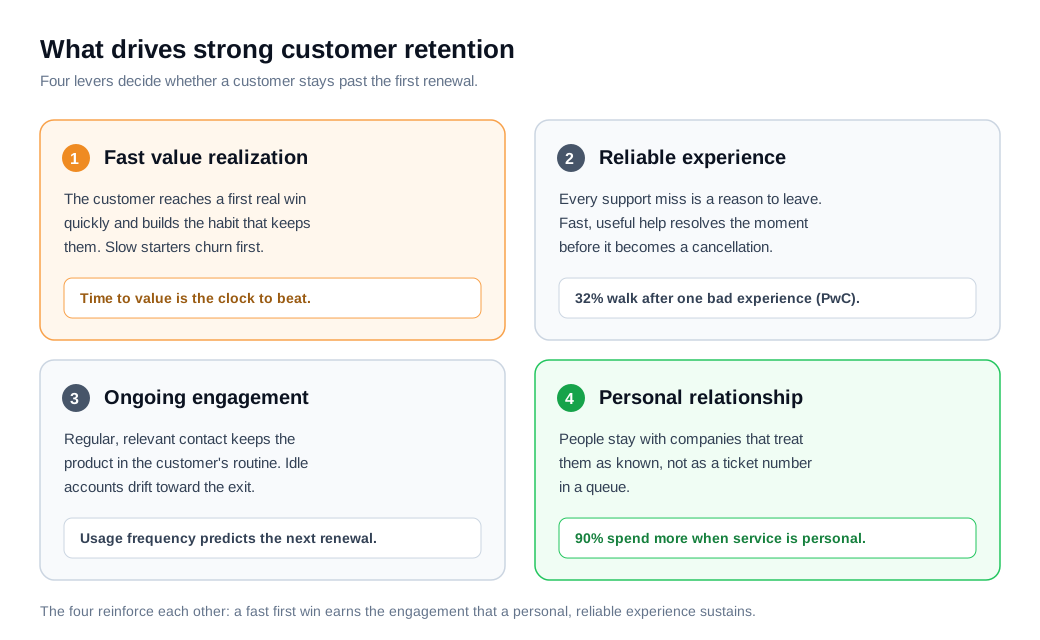
The first driver is fast value realization. A customer who reaches a first real win quickly builds the habit that keeps them, while a slow starter is the one most likely to churn before the product ever proves itself. Getting there fast is largely an onboarding job, and a good welcome message flow that greets each new account and points it at the right first action does a lot of the work.
The second driver is a reliable experience, and customer service sits at its center. The tolerance for failure is thin: PwC's research found that 32% of customers would walk away from a brand they love after a single bad experience, and the same report noted that great experiences command up to a 16% price premium. Resolving a problem fast, ideally in the moment it surfaces, is one of the cheapest retention levers available. A live chat prompt that answers a stuck customer before frustration hardens into a cancellation does exactly that.
The third driver is ongoing engagement. Usage frequency is one of the strongest predictors of the next renewal, because a product woven into someone's weekly routine is one they do not think about canceling. Accounts that go quiet are drifting toward the exit, usually well before anyone notices.
The fourth driver is a personal relationship. People stay with companies that treat them as known rather than as a ticket number in a queue. Zendesk's 2025 CX Trends research reports that 90% of buyers will spend more with companies that personalize the customer experience, and that the businesses best at it see materially higher retention. The four drivers work as a chain: a fast first win earns the engagement that a reliable, personal experience then sustains.
How do you improve customer retention?
You improve customer retention by finding where customers leak out of the relationship, fixing the biggest leak first, and measuring the same cohort forward to confirm the fix worked. The method matters more than any single tactic, because the leaks differ from one business to the next.
Start where customers first go quiet. For most subscription products the earliest leak is a slow or confusing start, so shortening time to first value pays off fastest. Replace the blank first screen with a guided path, and reach accounts that stall on a setup step in the moment they stall rather than a day later. A proactive nudge that fires the instant an account gets stuck catches the customer while they still care.
Next, watch usage signals for accounts already past onboarding. A customer whose logins are trailing off is telling you, weeks ahead of the renewal, that the relationship is cooling. That is the moment for a light-touch check-in or a quick conversation, not a save-the-account scramble the week the contract is up. Close service gaps fast when they appear, and treat every cancellation as a data point by asking, briefly, why the customer left.
A worked example shows the payoff. Take a subscription business with 1,000 customers, each paying $1,200 a year, so $1.2 million in annual recurring revenue. Retention sits at 82%, which means 180 customers leave every year and 820 stay.
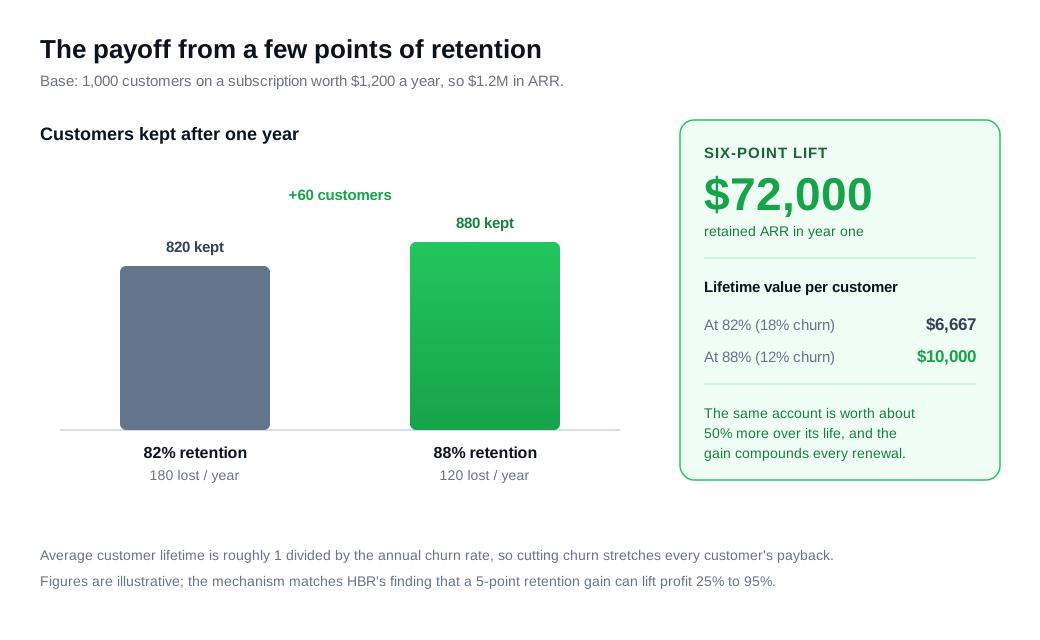
Now the team fixes its biggest leak. They rebuild the first-week experience, add proactive outreach for stalling accounts, and set up a usage-based check-in for customers whose activity dips. Retention climbs six points, from 82% to 88%. That keeps 880 customers instead of 820, so 60 more accounts stay, worth 60 times $1,200, or $72,000 in retained annual recurring revenue from a single year.
The compounding is where it gets large. Cutting annual churn from 18% to 12% stretches the average customer lifetime from roughly 5.6 years to 8.3 years, which lifts lifetime value from about $6,667 to $10,000 per customer. The same account is now worth roughly 50% more over its life, and that gain repeats at every renewal for the whole base. The figures here are illustrative, but the mechanism is the one Harvard Business Review's Bain analysis describes, where a five-point retention gain lifts profit somewhere between 25% and 95%.
The lesson is the method, not the exact numbers. Audit the relationship, find the biggest leak between signup and renewal, fix that one, and measure the cohort. Retention work compounds because every customer you keep keeps paying, quarter after quarter, with none of the cost of winning them again.
Key takeaways
- Retention is the share of customers you keep, measured in logos or dollars. Logo retention counts accounts, gross revenue retention counts revenue held and caps at 100%, and net revenue retention adds expansion so it can pass 100%.
- It matters because keeping beats replacing. Winning a customer costs five to twenty-five times more than keeping one, a five-point retention gain can lift profit 25% to 95%, and you sell to existing customers far more often than to new prospects.
- The formula subtracts new customers so growth cannot hide churn. Retention rate is ((end customers minus new customers) divided by start customers) times 100, tracked by cohort over a fixed period.
- A good rate depends on your model, so trend beats comparison. Sticky, contract-based businesses run high and transactional ones run lower, and for SaaS a net revenue retention above 100% is the more telling benchmark.
- Four drivers decide who stays. Fast value realization, a reliable experience, ongoing engagement, and a personal relationship reinforce each other, and 32% of customers will leave a brand they love after one bad experience.
- You improve it by fixing the biggest leak first. In the worked example, a six-point lift from 82% to 88% kept 60 more customers, worth $72,000 in retained annual revenue and a roughly 50% jump in lifetime value.

Written by
Nilas MylerCo-founder & CTO, Glimpze
Nilas is the co-founder and CTO of Glimpze, an inbound sales tool that turns high-intent website visitors into live conversations. A former SEO consultant for some of the largest companies in Denmark, he writes about speed-to-lead, inbound sales, and conversion rate optimization — the technical and operational mechanics of turning traffic into pipeline.


