
On this page
- What is lead qualification?
- How do you qualify a lead?
- What is the difference between a marketing qualified lead and a sales qualified lead?
- What lead qualification frameworks exist (BANT, MEDDIC, CHAMP, and GPCTBA/C&I)?
- Which lead qualification framework should you use?
- Which intent signals matter most?
- How do you disqualify a lead?
- What does a worked qualification example look like?
- Key takeaways
- Sources
Marketing hands sales 400 leads this quarter. The reps work them roughly in the order they landed, spend the first two weeks on the names that shouted loudest, and close a handful. The rest go cold. Buried in that pile were maybe 30 buyers who were ready to talk the week they arrived and never got a real conversation.
Lead qualification is the filter that surfaces those 30 before a rep burns a month on the other 370. Done well, it tells you who to call now, who to keep warm, and who to let go. Done badly, it hides good-fit buyers under bad ones and quietly teaches your reps to distrust every lead marketing sends over.
This guide defines lead qualification, walks through the process step by step, compares the four frameworks people argue about (BANT, MEDDIC, CHAMP, and GPCTBA/C&I), ranks the intent signals worth acting on, shows how to disqualify without second-guessing, and finishes with a worked example you can copy.
What is lead qualification?
Lead qualification is the process of judging how likely a lead is to become a paying customer, so your team can rank them and spend time where it converts. It answers two questions before a rep invests real effort: is this the kind of buyer we serve, and are they showing signs of wanting to buy.
Those two questions map to fit and intent. Fit is who the lead is: company size, industry, role, budget range, region, the traits your best customers share. Intent is what the lead does: the pages they read, the assets they download, the demo they request, the questions they ask. A lead needs both to be worth a conversation. A perfect-fit company that has done nothing on your site is not ready, and a burst of activity from someone outside your market rarely turns into revenue.
Qualification also sets the language a sales and marketing team share. A lead that clears the marketing bar becomes a marketing qualified lead (MQL). One a rep has spoken to and confirmed as a genuine opportunity becomes a sales qualified lead (SQL). Getting those definitions in writing is the unglamorous work that makes everything downstream possible.
How do you qualify a lead?
You qualify a lead by checking it against your ideal customer profile, reading its intent signals, and confirming the gaps with a few direct questions, then routing it based on what you find. The steps are simple, and the discipline is in doing them the same way every time.
Start with the ideal customer profile (ICP). Build it from your actual best customers, not your wish list: pull the firmographics your closed-won accounts share, such as industry, employee count, revenue band, region, and tech stack. A lead that matches the ICP is worth attention. One that misses on the non-negotiables (wrong region, far too small, no budget for your category) can be filtered before a rep ever looks.
Then read the behavior. Score the intent signals the lead has thrown off and weigh the strong ones (a demo request, repeat pricing views) far above the weak ones (a single blog visit). Where the record has holes, ask. This is where a framework earns its place: a short set of questions about budget, authority, need, and timing turns a hunch into a decision you can defend.
Speed matters here more than most teams admit. Gartner's research on the modern buying journey found that B2B buyers spend only 17 percent of their total buying time meeting with potential suppliers, and when they are weighing several vendors, any one rep gets a sliver of that, per Gartner's B2B buying journey analysis. By the time a lead raises a hand, the buying group (Gartner puts the typical complex deal at six to ten decision makers) has usually done most of its homework. Qualification cannot take a week. The fastest teams qualify light and fast, then get a person in front of high-fit, high-intent buyers while the interest is still live, which is the premise behind treating your site as an inbound sales channel rather than a form that drops leads into a queue. Instant routing and notifications that alert the right rep the moment a qualified lead appears are what make that fast response possible.
What is the difference between a marketing qualified lead and a sales qualified lead?
A marketing qualified lead (MQL) fits your profile and has engaged enough to be worth sales attention, while a sales qualified lead (SQL) is one a rep has actually spoken with and confirmed as a real opportunity. The MQL is a prediction. The SQL is a verified fact.
The handoff between them is where a lot of pipeline leaks. An MQL passed to sales too early frustrates reps who find no budget and no timeline behind the engagement. Benchmarks bear out how steep the drop is: across industries the median MQL-to-SQL conversion rate sits around 13 percent, with B2B SaaS commonly landing in the high teens to low twenties, according to benchmark data compiled by Data-Mania. Most MQLs never become SQLs, which is normal and is exactly why the second gate exists.
Product-led teams add a third label, the product qualified lead (PQL), for someone who has used a free trial or freemium tier and hit a usage signal that predicts a paid conversion. Whatever the labels, the principle holds: each stage should raise the bar, and a lead should only move forward when it earns the move.
What lead qualification frameworks exist (BANT, MEDDIC, CHAMP, and GPCTBA/C&I)?
The four frameworks people argue about are BANT, MEDDIC, CHAMP, and GPCTBA/C&I, and each one is a checklist of what to confirm before you call a lead qualified. They differ in what they lead with and how much they ask.
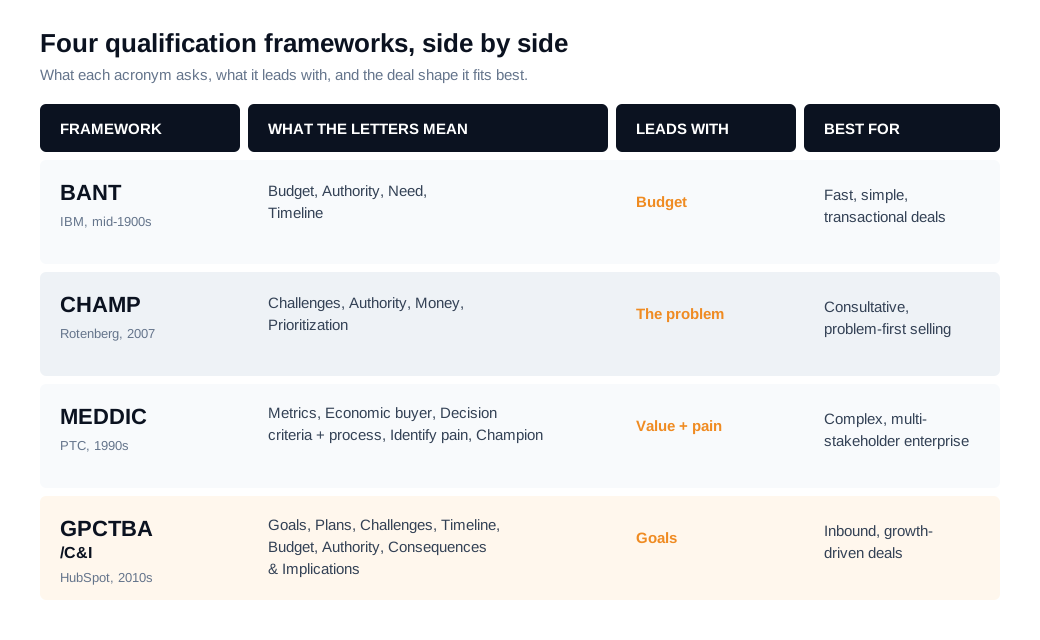
BANT (Budget, Authority, Need, Timeline) is the oldest and simplest, created at IBM decades ago. It leads with money and works well for shorter, transactional deals with a clear budget owner. Its weakness is that opening with budget can end a conversation before you have shown any value.
CHAMP (Challenges, Authority, Money, Prioritization) reorders BANT to lead with the prospect's problem instead of their budget. That makes it a better fit for consultative selling, where you earn the right to talk about money by first proving you understand the challenge.
MEDDIC (Metrics, Economic buyer, Decision criteria, Decision process, Identify pain, Champion) is the heavyweight, built at Parametric Technology in the 1990s for complex enterprise deals. It asks you to quantify the value, find the person who controls the money, map how the decision gets made, and recruit an internal champion. It demands more discovery, and it pays off when a deal has many stakeholders and a long approval chain.
GPCTBA/C&I (Goals, Plans, Challenges, Timeline, Budget, Authority, Consequences and Implications) is HubSpot's framework for inbound, consultative selling. It starts from the buyer's goals and plans, then layers on the negative consequences of inaction and the positive implications of success to build urgency, as laid out in HubSpot's own qualification playbook. It is thorough, and it suits deals where your product ties directly to a measurable business result.
Which lead qualification framework should you use?
Use the lightest framework that still protects you from wasting time, and match it to your deal complexity and sales cycle. There is no prize for using the most elaborate one.
For fast, single-decision-maker deals, BANT or a light CHAMP is usually enough to triage a lead in a few minutes. SDRs qualifying inbound volume tend to live here. For complex, multi-stakeholder deals with legal, security, and finance in the room, MEDDIC or GPCTBA/C&I give an account executive the structure to work a longer cycle without losing the thread. Many teams run both: a quick filter at the top to decide who gets a rep, and a deeper framework once a deal is live. The framework you apply consistently beats the perfect framework you apply now and then.
Which intent signals matter most?
The intent signals that matter most are the high-effort, bottom-of-funnel actions that only a real buyer takes: a demo or meeting request, repeat visits to your pricing page, and return sessions over several days. The more effort a signal takes and the closer it sits to a buying decision, the more it predicts a deal.
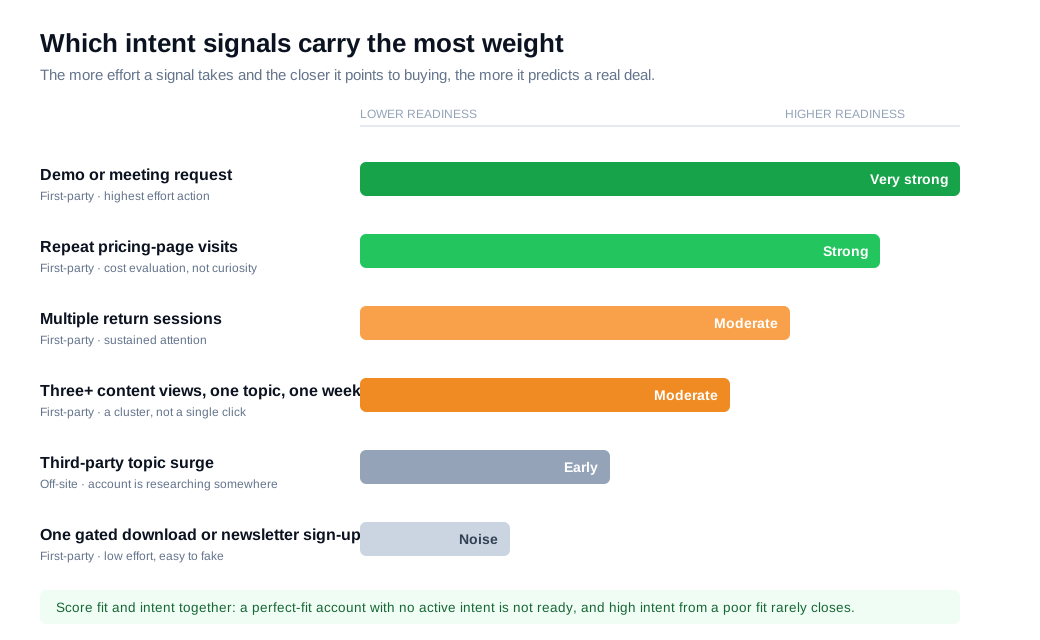
A demo or meeting request is the strongest first-party signal you can get, because someone chose to spend their time talking to you. Repeat pricing-page visits come next: a single view is curiosity, but three views across a week is cost evaluation. Return sessions and a cluster of content views on one topic in a short window point the same way, since sustained attention is hard to fake. A visit to your comparison or integration pages is a quiet tell that a buyer is in the shortlisting stage.
Weaker signals still count, but only as supporting evidence. A single gated download, a newsletter sign-up, or one email open is low-effort and easy to trigger by accident. Third-party intent data, which flags when an account is researching your category on review sites and elsewhere, is an early hint that a company is in-market before they ever touch your site. Treat it as a reason to reach out, not proof of readiness.
Two rules keep signals honest. Read them together with fit, because high intent from a poor-fit account rarely closes. And act on them fast, since the value of a signal decays by the hour. Some teams put an AI chat assistant on high-intent pages so the moment a visitor lingers on pricing, they get an instant, qualifying conversation instead of a form, and a strong signal turns into a live exchange while it is still warm.
How do you disqualify a lead?
You disqualify a lead by naming the criteria that make a deal unwinnable, checking every lead against them early, and closing out the ones that fail before a rep sinks hours into them. Disqualifying is a core sales skill, and the strongest reps do it faster and more often than average ones.
The common red flags are worth writing down. No budget anywhere near your pricing, paired with an unwillingness to discuss it. No path to a decision maker, so you are stuck with an influencer who cannot say yes. A timeline so distant that keeping the relationship warm costs more than it returns, or so urgent you cannot deliver in time. A need your product does not actually solve. Silence, where engagement drops to zero after early interest. Any one of these, confirmed, is a reason to stop.
Disqualify early and quickly. If it takes a 30-minute discovery call to learn there is no budget, you asked the budget question too late. Aim to surface the deal-breakers in the first few minutes of contact, or from the lead's own data before contact. That is why disqualifying questions belong at the top of a call and not the end.
Disqualifying a lead does not mean deleting it forever. A poor-fit lead today can become a good-fit lead next quarter after a funding round or a reorg, so route disqualified leads to a nurture track or recycle them to marketing rather than throwing them away. Do it politely, leave the door open, and free the reps to spend the reclaimed hours on deals that can actually close.
What does a worked qualification example look like?
Here is a worked example using a simple fit-and-intent model scored 0 to 100 on each axis, with one rule: a lead needs 60 or above on both to become an SQL. Below that, strong fit with weak intent goes to nurture, and a lead weak on both gets disqualified.
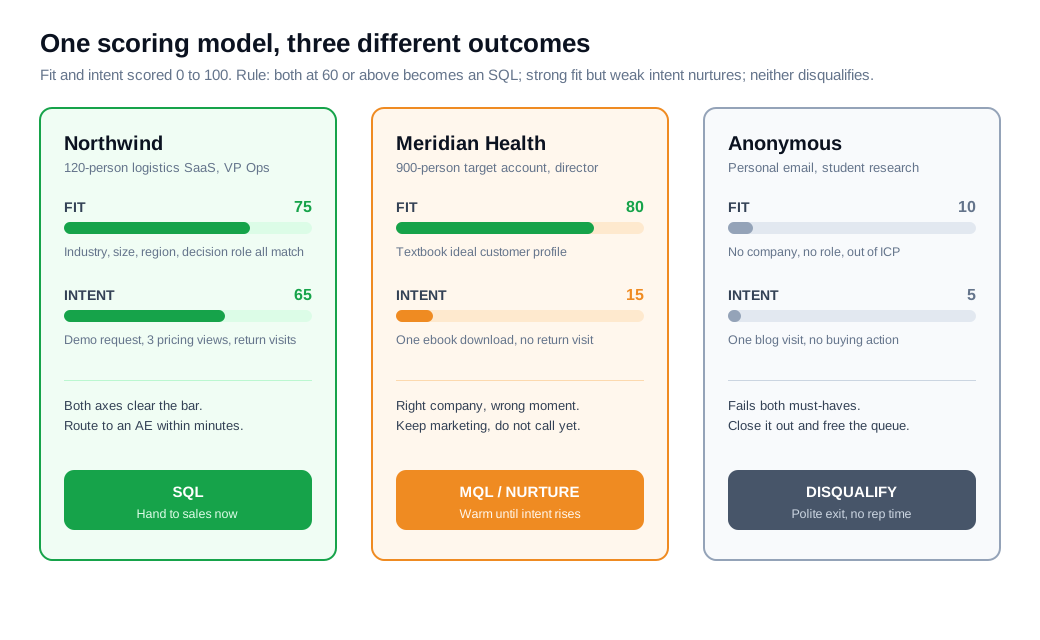
Take three inbound leads that arrive the same afternoon. Northwind is a VP of operations at a 120-person logistics SaaS company. On fit she scores 75: right industry, right size, right region, and a decision-making role. On intent she scores 65: she requested a demo, viewed pricing three times, and came back twice in a week. Both axes clear 60, so Northwind is an SQL and routes to an account executive within minutes.
Meridian Health is a director at a 900-person target account, a textbook ICP that scores 80 on fit. Their only action was a single ebook download with no return visit, so intent sits at 15. Right company, wrong moment. Meridian stays an MQL on a nurture track, and nobody calls until a real buying signal appears. Calling now would waste a rep and annoy a genuinely good future customer.
The third lead came in through a personal email address doing what looks like student research. Fit is 10 (no company, no role, outside the ICP) and intent is 5 (one blog visit, no buying action). It fails both must-haves, so it gets a polite close and no rep time. The reclaimed hours go to leads like Northwind. Same afternoon, same inbox, three correct and very different decisions, and not one of them made on gut feel.
Key takeaways
- Lead qualification ranks leads by fit and intent so reps spend time where deals close. Fit is who the lead is; intent is what they do; a lead needs both to be worth a conversation.
- The process is ICP, then signals, then a few confirming questions, then a fast route. Do it the same way every time, and qualify light rather than slow, because buyers spend only a sliver of their time with any one rep.
- MQL and SQL are two separate gates. An MQL is a prediction that a rep verifies into an SQL, and the median MQL-to-SQL rate near 13 percent shows why the second gate matters.
- Match the framework to the deal. BANT and CHAMP triage simple deals fast; MEDDIC and GPCTBA/C&I structure complex, multi-stakeholder ones; consistency beats sophistication.
- Weigh high-effort intent signals highest, and always read them with fit. A demo request or repeat pricing visits predict a deal; a single download does not, and high intent from a poor fit rarely converts.
- Disqualify early, often, and politely. Name the deal-breakers, surface them in the first minutes, and recycle poor-fit leads to nurture instead of deleting them.
TAGS

Written by
Daniel SemeckyCo-founder & CEO
Daniel is the co-founder and CEO of Glimpze. He spends his days talking to revenue teams about how to catch high-intent visitors before they bounce, and writes about inbound sales, lead conversion, and building a motion where marketing and sales actually share a number.


