
On this page
A prospect fills out your demo form at 2:14 p.m. They have three tabs open, and two of them belong to your competitors. Right now they are as interested as they are ever going to be.
What happens in the next five minutes shapes most of the deal, and for the average B2B team, nothing happens for the next two days.
That gap is exactly what lead response time measures. It is one of the few sales numbers with decades of hard research behind it, and the pattern has held steady from the first studies in 2007 to the benchmark reports published this year.
Reach a fresh lead fast and you are far more likely to talk to them, qualify them, and close them. Wait too long and the same lead is worth a fraction of what it was when it arrived.
This guide defines lead response time and how to measure it, sets out what a good number looks like, explains why the five-minute window carries so much weight, walks through what the research actually found, names the things that slow most teams down, and lays out concrete ways to answer faster.
What is lead response time?
Lead response time is the elapsed time between a lead reaching out and your first real response to them. The clock starts the moment the lead arrives, a form fill, a chat message, an inbound email, or a call, and it stops at first human contact. An automated "we got your message" receipt does not stop the clock, because it does not move the conversation forward.
Measure it as a median rather than a mean. For each lead, subtract the lead-created timestamp from the timestamp of your first genuine reply, then take the median across all leads for the period.
The median matters because a handful of leads that sat untouched over a long weekend will drag a mean far away from the typical experience. If your median is 4 minutes but your mean is 9 hours, most leads are answered fast and a slow tail is quietly bleeding revenue. That gap tells you where to look.
You will hear "speed to lead" used as a synonym, and the two point at the same thing. Lead response time is the measured number. Speed to lead is the operating discipline of keeping that number low.
Break the metric down by source and by hour too, because a lead from a high-intent pricing page deserves a tighter target than a gated ebook download, and your response time at 8 a.m. on a Tuesday probably looks nothing like your response time at 6 p.m. on a Friday.
What is a good lead response time?
A good lead response time is under five minutes for a high-intent inbound lead, and the strongest teams answer in under a minute. Five minutes is the threshold nearly every study points to as the line where results change sharply, which is why it gets its own name: the five-minute rule.
The bands below are a reasonable way to grade yourself:
- Under one minute is elite, and usually requires automation or a live channel.
- Under five minutes is the target for any lead that raised its hand with real intent.
- Under an hour is acceptable for lower-intent leads but already costs you contact rate.
- Past a day is effectively cold, and past 24 hours you are often paying to generate a lead you then let expire.
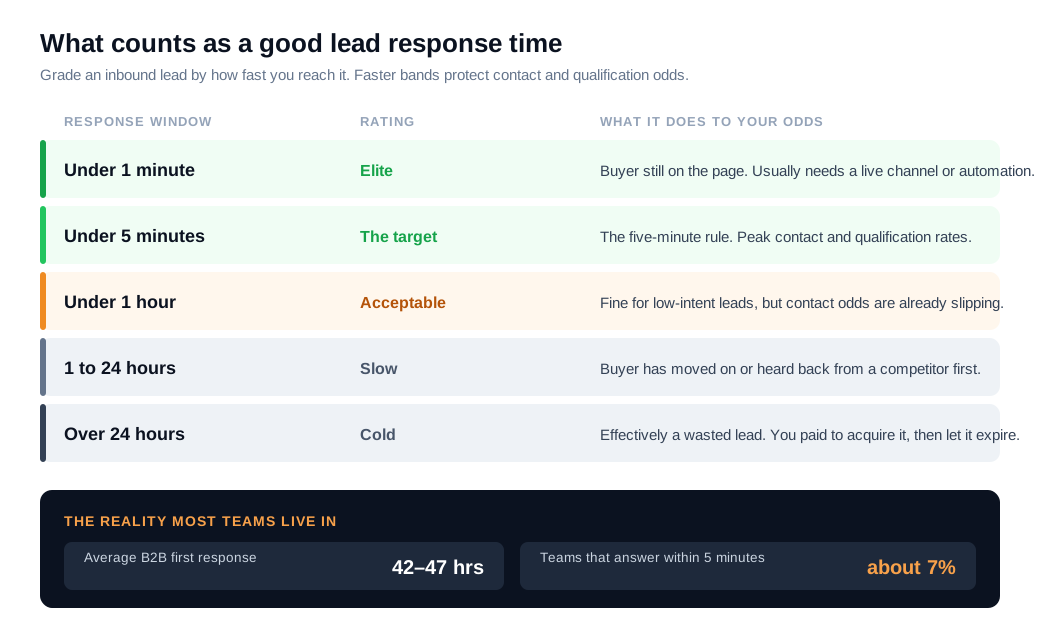
The uncomfortable part is how far typical performance sits from the target. When Drift submitted leads to 433 B2B companies, only 7 percent responded within five minutes, and more than half never responded within five business days.
Independent audits keep landing in the same place: the average B2B first response runs somewhere between 42 and 47 hours, which is close to two full business days for a lead that was ready to talk the minute it arrived. The target is demanding, and that is precisely why hitting it is an advantage rather than table stakes.
Why does the five-minute window matter so much?
The five-minute window matters because it is the short span where the buyer is still on your site, still focused on the problem, and has not yet heard back from anyone else.
Reach them then and you are talking to someone in an active buying mindset. Reach them an hour later and you are interrupting a meeting, a commute, or a decision they have already started making with a competitor.
The numbers behind this are stark. The Lead Response Management study led by Dr. James Oldroyd, which analyzed more than 15,000 leads across 100-plus companies, found that calling a lead within five minutes rather than 30 minutes made you about 100 times more likely to make contact and about 21 times more likely to qualify the lead.
The decay is fast even inside that window: the odds of qualifying a lead drop roughly fourfold between the five-minute and ten-minute marks. Minutes, not hours, are the unit that matters here.
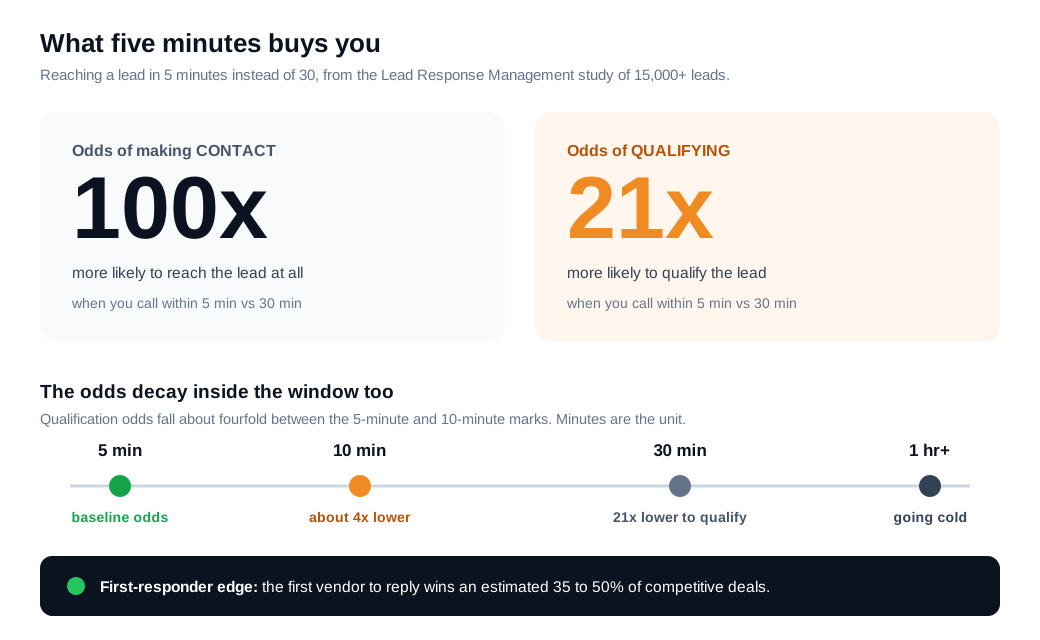
There is a competitive edge on top of the psychology. In markets where several vendors sell something similar, the first company to respond tends to win an outsized share of the deals, with industry estimates putting the first responder's share of closed sales in the range of 35 to 50 percent.
Two things drive that edge. You catch the buyer while they are warm, and you become the vendor who framed the conversation before anyone else showed up.
What does the research show about response time and conversion?
The research shows a steep, repeatable decline in outcomes as response time grows, and it shows that most companies are slow. The most useful studies are the ones that submitted real leads to real companies and measured what actually happened, because that method removes the self-reporting bias you get when teams estimate their own speed.
The landmark reference is the 2011 Harvard Business Review article "The Short Life of Online Sales Leads," in which James Oldroyd, Kristina McElheran, and David Elkington audited 2,241 US companies with test web leads.
Among companies that responded within 30 days, the average first response took 42 hours. Only 37 percent responded within an hour, 24 percent took more than a day, and 23 percent never responded at all. Firms that made contact within the first hour were about seven times more likely to have a meaningful conversation with a decision-maker than those who waited an hour longer, and 60 times more likely than those who waited 24 hours or more.
More recent audits tell the same story with fresh data. A Workato study of 114 B2B companies found that personalized email replies took an average of nearly 12 hours and phone responses averaged more than 14 hours. Just one of the 114 companies sent a personalized email within five minutes, and not a single one called within five minutes.
The same study found that companies using automated lead routing responded in about 3.5 hours on average, compared with roughly 13 hours for companies without it, which points directly at the fix.
A worked example makes the stakes concrete. Say you generate 500 inbound leads a month and your sales-accepted-to-closed rate is 6 percent when you respond within five minutes. Research consistently shows contact and qualification rates falling by more than half once you slip past the 30-minute mark, so a team sitting at a multi-hour median might realistically convert closer to 3 percent on the same leads.
That is 30 deals a month versus 15, from the same traffic and the same ad spend. The leads did not get worse. The response did.
Two honest caveats belong here. Some of the sharpest multipliers come from vendor platforms measuring their own customer base rather than from randomized trials, so treat the exact figures as direction rather than a promise. And part of any speed-to-conversion gap is selection, since the teams fast enough to answer in minutes tend to be well-run in other ways too. Even with both caveats, the direction of every credible study points the same way.
What slows most teams down?
Most teams are slow because a lead has to travel through several manual steps before a human ever sees it, and every step adds delay. The lead almost never sits in front of a person the moment it arrives.
The classic pattern starts with the form-and-wait model. A visitor fills out a contact form, sees a "we will be in touch" page, and lands in a CRM queue.
From there the lead often waits to be assigned, whether by a round-robin rule, a manual territory check, or a rep who happens to notice it. Then it waits again for that rep to work their way to it, because most reps batch lead follow-up into a couple of blocks a day instead of reacting in real time. Add leads that arrive in the evening or over the weekend, when nobody is watching the queue, and the hours stack up fast.
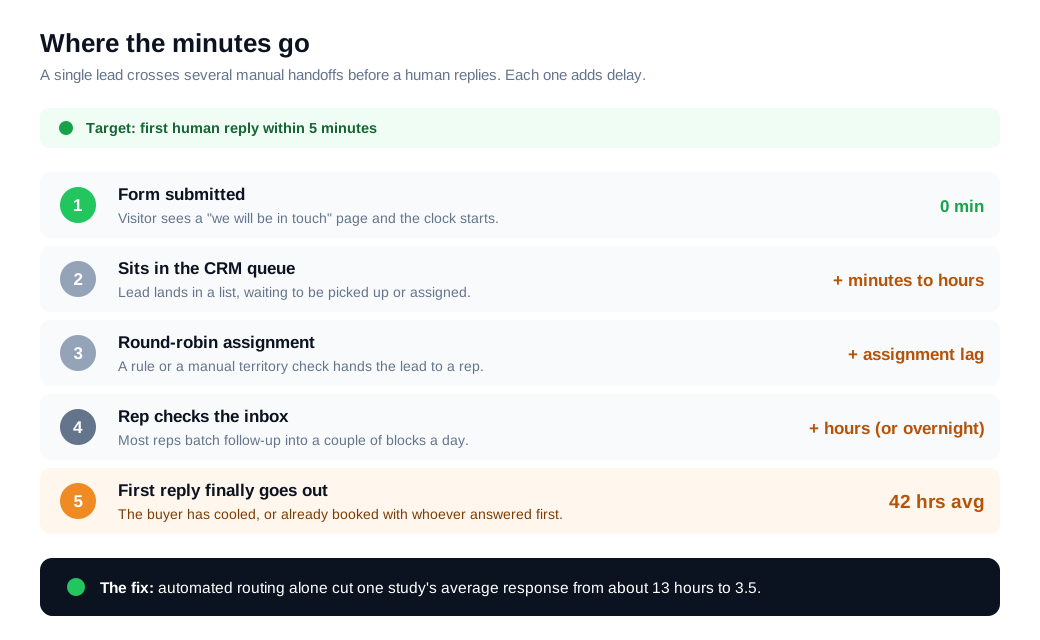
Notifications are the quiet failure point. If a new lead does not ping a human somewhere they actually look, it depends on someone remembering to refresh a list.
The Workato finding that automated routing cut average response time from about 13 hours to about 3.5 hours is really a story about removing those handoffs. The delay was never the selling. It was the waiting in between: the assignment lag, the inbox that gets checked twice a day, and the after-hours gap where a hot lead cools to room temperature before Monday.
How do you respond to leads faster?
Respond faster by shortening the path from lead to human: set a clear target, route the lead instantly, notify someone in real time, and engage buyers while they are still on the page. Each step attacks a different source of delay, and they compound.
Start by setting and measuring a first-response SLA. Pick a number, five minutes for high-intent inbound is the defensible default, and put it on a dashboard next to your median. A target nobody measures is a wish. Once the number is visible, the slow tail becomes obvious and fixable.
Then remove the assignment lag. Automated routing sends each lead to the right rep by territory, product, or account owner the instant it arrives, and instant routing and notifications that ping the owner in Slack or on their phone mean a lead never waits for someone to refresh a list. This is the single change with the biggest payoff, because it deletes the hours that pile up between arrival and first human eyes.
The bigger leap is catching the buyer before they ever leave. A form followed by a callback is still a wait, however short. Offering live chat on your high-intent pages lets a rep answer in the moment interest peaks, and for a serious buyer, moving that thread into a live video or screen-share call turns a warm visitor into a real conversation without a scheduling round trip.
That is the whole idea behind treating your website as an inbound sales channel rather than a lead-collection form. The fastest possible response time is zero, when the conversation starts while the buyer is still reading.
Cover the gaps you cannot staff. An AI chat assistant can give an instant first response after hours, answer common questions, and capture the lead's context so a human can pick up warm the next morning, which keeps your effective response time low even when the office is dark.
Most of these tools, Glimpze included, offer a free tier, so you can baseline your current median and test whether real-time engagement moves it before you spend anything. Whatever stack you choose, the order is the same: make the number visible, cut the handoffs, and meet buyers where they already are.
Key takeaways
- Lead response time is the minutes between a lead arriving and your first human reply, measured as a median. Automated receipts do not stop the clock, and the slow tail is where revenue leaks.
- Under five minutes is the target, under one minute is elite. Yet the average B2B first response runs 42 to 47 hours, and only about 7 percent of teams answer within five minutes.
- The five-minute window is where the buyer is still on your site and has not heard back from anyone else. Reaching a lead in five minutes rather than 30 makes you roughly 21 times more likely to qualify them.
- Every real-lead audit finds the same steep decline. Contacting a lead within the first hour makes a meaningful conversation about seven times more likely than waiting even one hour longer, per the 2,241-company HBR study.
- Delay comes from manual handoffs, not from selling. Forms, CRM queues, round-robin assignment, batched follow-up, and after-hours gaps stack the hours up before a human ever sees the lead.
- Speed comes from a measured SLA, instant routing and notifications, and real-time engagement. Automated routing alone cut one study's average response from about 13 hours to 3.5, and live channels can push it toward zero.
TAGS

Written by
Daniel SemeckyCo-founder & CEO
Daniel is the co-founder and CEO of Glimpze. He spends his days talking to revenue teams about how to catch high-intent visitors before they bounce, and writes about inbound sales, lead conversion, and building a motion where marketing and sales actually share a number.


