
On this page
A procurement lead at a 400-person company opens your pricing page at 9 p.m., reads your security documentation, compares you against two competitors, and closes the tab. No form filled, no email left. You will never know they were there. They did almost all of the work of buying without you.
That is the shape of a B2B purchase now, and it is why the old playbook of "capture the lead, follow up tomorrow" leaves so much on the table. Conversational marketing is the attempt to be useful in the exact moment a buyer raises a hand, over live chat, an AI assistant, or a video call, rather than after they have moved on. The B2B version has to account for buying committees, long cycles, and contracts big enough that getting the moment right actually matters.
This playbook covers what conversational marketing means in B2B, why it fits the way business buyers behave, how to run conversations across a months-long cycle, how to qualify and route committee buyers, how to measure the impact on pipeline, and the mistakes that quietly sink most rollouts.
What is conversational marketing for B2B?
Conversational marketing for B2B is the practice of using real-time, two-way conversations to engage business buyers on your site the moment they show interest, instead of routing every inquiry through a form and a next-day follow-up. The medium is a live chat widget, an AI assistant, or a video call, and the goal is to move a deal forward while the buyer is still paying attention.
The channels do different jobs. A live chat widget on your high-intent pages lets a person answer a buying question in seconds. An AI chat assistant covers qualification, routine product questions, and off-hours traffic when no rep is online. When a question is easier to show than to type, a live video call or screen share lets a rep walk a technical buyer through a workflow without scheduling a separate meeting. Most B2B teams run all three, with chat as the anchor.
What changes in B2B is the buyer, not the tooling. A consumer buys alone in minutes. A business buyer is one voice in a committee, evaluating over weeks or months, with a legal and security review waiting at the end. So a B2B conversation rarely closes anything on the first message. Its job is to learn who you are talking to and where the deal sits, deliver a useful answer, and set up the next step without forcing a demo too early.
Why does conversational marketing fit B2B?
Conversational marketing fits B2B because the modern business buyer does most of their evaluation alone, spends very little time with any single vendor, and quietly rewards the one that answers a real question fast. The channel exists to win the narrow window when a self-directed buyer finally engages.
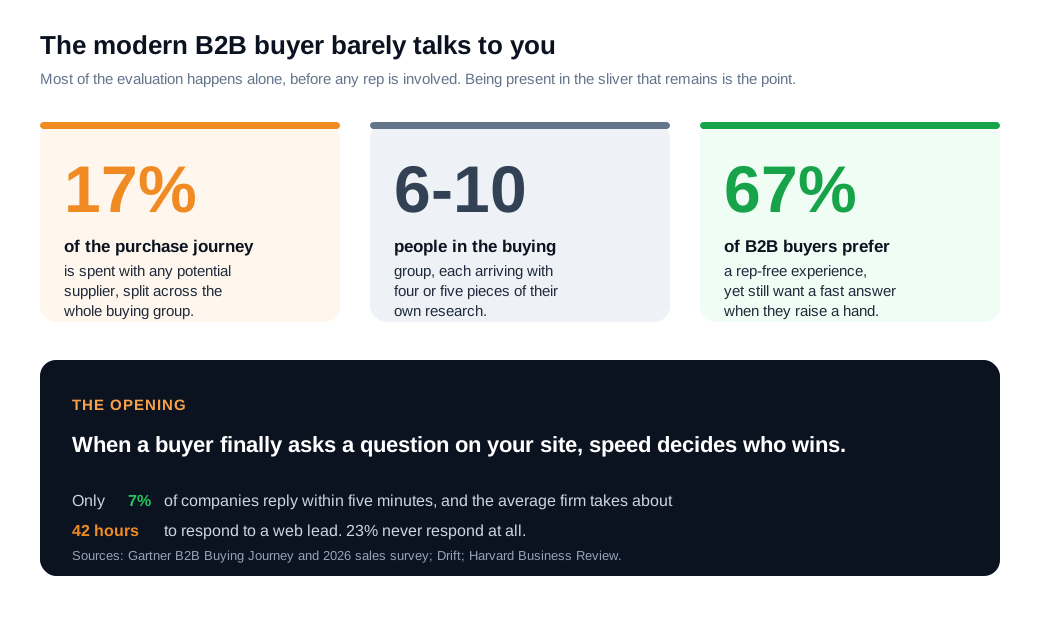
The numbers explain the fit. Gartner's research on the B2B buying journey found that buyers spend just 17 percent of their total purchase time meeting with any potential supplier, and when they are comparing several vendors, any single rep may get as little as 5 to 6 percent of that time. The buying group itself runs six to ten people, each arriving with their own independent research. A 2026 Gartner sales survey found 67 percent of B2B buyers prefer a rep-free buying experience, up from 61 percent the year before, with 83 percent wanting to self-serve at least part of the process.
That preference for self-service is precisely what makes conversational marketing work here. A buyer who wants to research on their own terms still hits moments where a fast, specific answer would save them an hour, a question about SSO, a pricing edge case, a compliance requirement. The vendor that answers in the chat window right then earns disproportionate trust, because almost nobody else does. Harvard Business Review's audit of 2,241 companies found the average firm took about 42 hours to respond to a web lead, and 23 percent never responded at all. Drift's research put the share of companies replying within five minutes at just 7 percent. Show up in the window everyone else ignores, and you are already ahead of most of the shortlist.
How do you handle long sales cycles in chat?
You handle long B2B sales cycles in chat by treating each conversation as one touch in a months-long relationship, capturing context and booking the next step rather than trying to close on the first message. The mistake is treating a chat like a checkout when it is really the start of a slow, committee-driven evaluation.
The cycle really is long. B2B deals routinely run several months, and the length tracks committee size directly. One 2025 benchmark of B2B sales teams found the average number of decision-makers had climbed to 6.8, from 5.4 in 2020, and past 11 on deals above 50,000 dollars in annual contract value. Every extra stakeholder adds review and delay. A conversation that pushes for a signature on day one is fighting that reality instead of working with it.
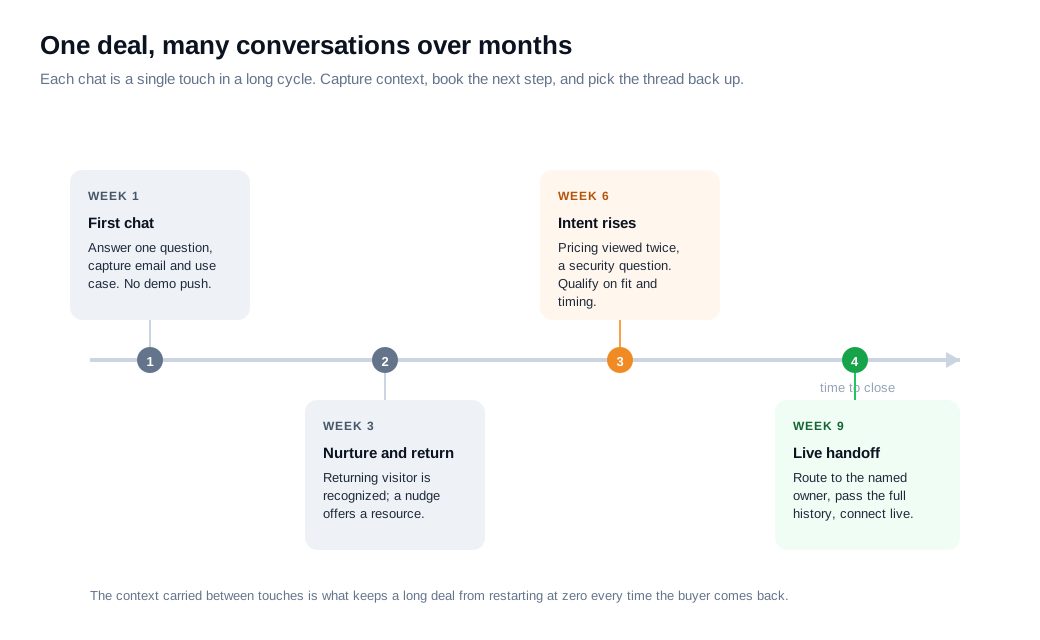
So calibrate the ask to the stage. On an early visit, answer the question, offer a useful resource, and capture an email and the use case for a nurture track. Do not open with "book a demo." Later, when the same account returns and views pricing twice, that rising intent is your cue to qualify on fit and timing and to escalate. This is where proactive prompts earn their keep, and the guide to proactive outreach nudges covers how to set thresholds so a prompt fires on real intent instead of firing on everyone.
The load-bearing piece is memory. If your tool recognizes a returning visitor and carries the earlier conversation forward, a long deal keeps its thread instead of restarting at zero every time. Consider a mid-market buyer who chats in week one about integrations, downloads a security overview in week three, returns to pricing in week six, and asks for a walkthrough in week nine. Handled as four disconnected chats, a rep re-qualifies from scratch each time. Handled as one continuous record, the week-nine conversation opens with the rep already knowing the team size, the use case, and the objection, and the deal moves. Treating your site as an inbound sales surface, not a form that files leads for later, is what makes that continuity possible.
How do you qualify and route B2B chats?
You qualify B2B chats by reading fit and intent together with two or three conversational questions, then routing by segment to a named owner in seconds rather than dropping the lead in a shared queue. Qualification decides whether a conversation is worth a rep's time. Routing decides whether the right rep hears about it before the interest cools.
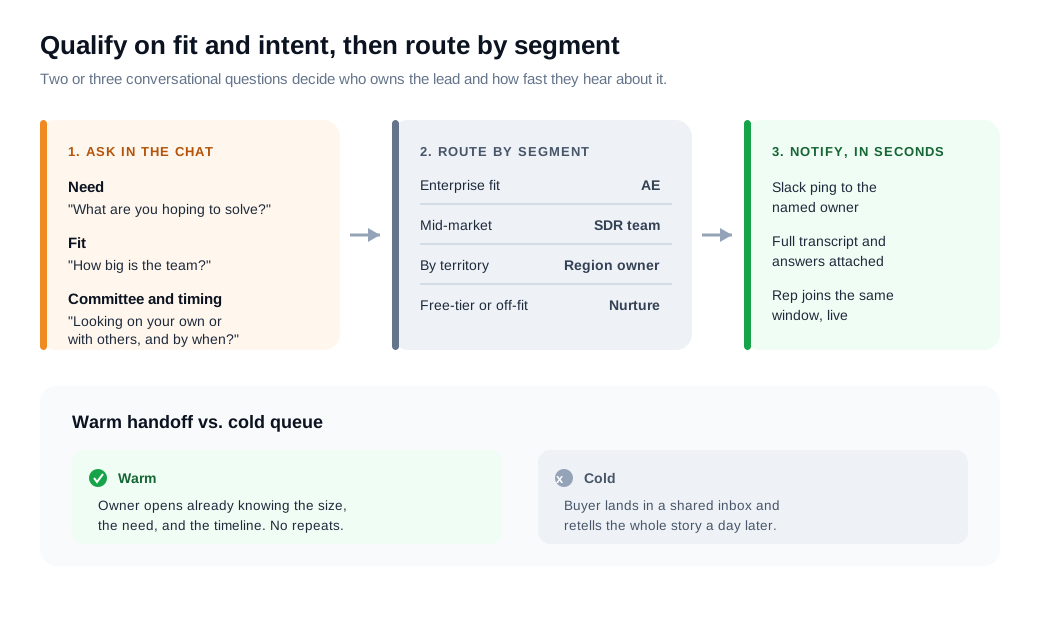
Keep qualification short and conversational. Two inputs drive every call: fit is who the buyer is (company size, industry, role, region), and intent is what they are doing (the pages they read, the questions they ask). Lead with the buyer's problem, "what are you hoping to solve?", then add a fit question about team size and a light one that surfaces the committee and the timeline, such as "are you looking into this on your own or with others, and roughly when do you need it solved?" That last question matters more in B2B than anywhere else, because knowing you are talking to one of eight stakeholders changes how you handle the deal. Stop asking the moment you know enough to route.
Routing is where speed either pays off or evaporates. Decide in advance who owns which lead, enterprise fit to an account executive, mid-market to an SDR pod, by territory to a region owner, off-fit or free-tier to a nurture track, and make the assignment automatic. Then make the alert loud and fast. A Slack ping to the named owner the moment a lead qualifies is what turns a five-minute service-level agreement into a real one, and setting that up is the job of your routing and notifications configuration. Pass the full transcript with the alert, so the rep opens already knowing the size, the need, and the timeline, and the buyer never repeats a word. A cold handoff, where the rep asks "how can I help?" after the buyer already explained everything, is where good B2B conversations quietly die.
How do you measure B2B chat impact?
Measure B2B chat impact on the metrics that connect a conversation to revenue: qualified conversations, meetings booked, pipeline influenced, sales cycle length, and win rate, all tied back to the CRM so a chat can be traced to a deal. Raw chat volume tells you almost nothing, and in B2B it can actively mislead, because one qualified enterprise conversation can outweigh a hundred low-intent ones.
Read the metrics as a ladder. Conversations started shows whether your triggers fire on the right accounts. Qualified conversations shows whether the flow separates buyers from browsers. Meetings booked and pipeline influenced are the numbers a revenue team cares about, and they only exist if your chat tool is wired into the CRM through your integrations so a conversation can be attributed to an opportunity. ZoomInfo's guidance on chatbot metrics makes the same point: the KPIs that prove impact are the ones that connect to meetings booked, leads captured, and chat-influenced pipeline, which requires CRM integration and attribution to see at all.
A worked example makes the shape concrete. Say your site draws 20,000 visitors a month, and about 5 percent of them (1,000 people) reach a high-intent page such as pricing, the demo request, or your security page. Proactive prompts on those pages engage 10 percent, which is 100 conversations. The assistant and your reps qualify them, and 35 percent clear the bar, giving 35 qualified conversations. Reps book 45 percent of those into meetings, or about 16 meetings a month. B2B deals do not close the same week, so track the cohort forward: if 30 percent of those meetings become opportunities and a quarter of those opportunities close over the next two quarters at an 18,000 dollar contract value, that is roughly 1 to 2 new customers per monthly cohort and on the order of 20,000 dollars in new annual recurring revenue traced to conversations you would not otherwise have had.
Two B2B-specific numbers are worth watching alongside the ladder. Sales cycle length tells you whether conversations are compressing the timeline between first touch and opportunity. And lead quality, the share of routed leads that reps accept, guards against a chatbot that books meetings nobody wanted, since a lead with the wrong routing or no ICP match costs a rep an afternoon and teaches sales to ignore the channel.
What mistakes should B2B teams avoid?
The most common B2B mistakes are pushing a demo booking on the first message, staffing chat only during marketing hours, ignoring the buying committee, and reporting chat volume instead of pipeline. Each one is easy to make and expensive to leave in place.
Pushing for a demo too early is the classic error. A buyer three weeks into a six-month evaluation is not ready to sit through a sales call, and the ask reads as tone-deaf. Lead with the answer they came for, and let the demo request surface when their behavior says intent is high.
Staffing only nine-to-five loses the after-hours evaluators, since much of that self-directed research happens at night and on weekends. An assistant that qualifies and captures context off-hours, then queues a warm handoff for morning, closes that gap without asking reps to work at midnight. Ignoring the committee is subtler: if your flow assumes the person in the chat is the sole decision-maker, you miss the chance to ask who else is involved and to arm your champion for the internal sell. And reporting chat volume flatters a program that is not producing pipeline. Count qualified conversations, meetings, and influenced pipeline, and the channel stays honest as it grows.
Key takeaways
- B2B conversational marketing is a real-time answer, not a form. It uses live chat, an AI assistant, or video to engage a buyer the moment they show interest, so the deal moves while attention is high.
- It fits because buyers self-serve. They spend only about 17 percent of their time with suppliers and most prefer a rep-free experience, so the vendor that answers a real question fast wins outsized trust.
- Treat every chat as one touch in a long cycle. Capture context, book the next step, and carry the thread forward, because B2B deals run months and involve six to ten decision-makers.
- Qualify on fit and intent, then route by segment. Ask two or three conversational questions, surface the committee and timeline, and ping a named owner in seconds with the full transcript.
- Measure pipeline, not chatter. Track qualified conversations, meetings booked, and influenced pipeline through the CRM, and watch cycle length and lead-acceptance rate as B2B-specific guardrails.
- Avoid the four rollout killers: demoing too early, staffing only office hours, ignoring the buying committee, and reporting volume instead of revenue.

Written by
Daniel SemeckyCo-founder & CEO
Daniel is the co-founder and CEO of Glimpze. He spends his days talking to revenue teams about how to catch high-intent visitors before they bounce, and writes about inbound sales, lead conversion, and building a motion where marketing and sales actually share a number.


