
On this page
A visitor spends six minutes on your pricing page, opens the plan comparison twice, and then leaves. Your marketing did its job. It spent budget to bring a qualified buyer to the exact page where they decide, and then the page went quiet and offered a form that promises a reply "within one business day."
A conversational marketing strategy is the plan for what happens in that moment. It decides which visitors get a prompt, what the prompt says, who or what answers, and how fast a real person gets involved when the deal is worth it. Built well, it turns attention you already paid for into conversations and pipeline. Built carelessly, it bolts a chat bubble onto your site that nobody staffs and everyone ignores.
This guide covers what a strategy includes, how to map conversations to the funnel, how to choose channels and triggers, when to lean on bots versus humans, how to measure the results, and the mistakes that quietly sink most rollouts.
What does a conversational marketing strategy include?
A conversational marketing strategy is a documented plan that defines who you talk to, on which pages and channels, what each conversation is meant to accomplish, who or what handles it, and how you measure whether it moves revenue. Everything else is tactics.
Most teams skip the document and jump straight to installing a widget, which is why so many chat programs stall. A working strategy has six parts, and each one answers a question a rep would ask before starting a conversation.
- Goals tied to revenue. Start with one or two measurable outcomes: more qualified meetings, faster response times, higher conversion on high-intent pages. Vanity counts like total chats do not belong here.
- Audience segments. Define who is worth a conversation. A 12-person startup and a 5,000-seat enterprise need different openers, different questions, and different routing.
- Channels. Decide where the conversations live: website chat, an AI assistant, live video, messaging apps, or a mix.
- Triggers. Set the rules for when a prompt fires, based on the page and the visitor's behavior, so a conversation only opens when it is worth having.
- Conversation flows. Write the openers and the two or three qualifying questions that separate a buyer from a browser.
- Bot and human split with routing. Decide what an assistant handles alone and when a person takes over, then wire the handoff so hot leads reach the right rep fast.
You do not need all six perfect before you launch. You need them written down so the program has a shape you can measure and improve, rather than a widget that grows by accident.
How do you map conversations to the funnel?
You map conversations to the funnel by matching the goal of each conversation to where the visitor sits in their journey, so a first-time blog reader gets a light, helpful prompt and a pricing-page visitor gets a qualify-and-book prompt. The same opener on every page is the fastest way to waste the channel.
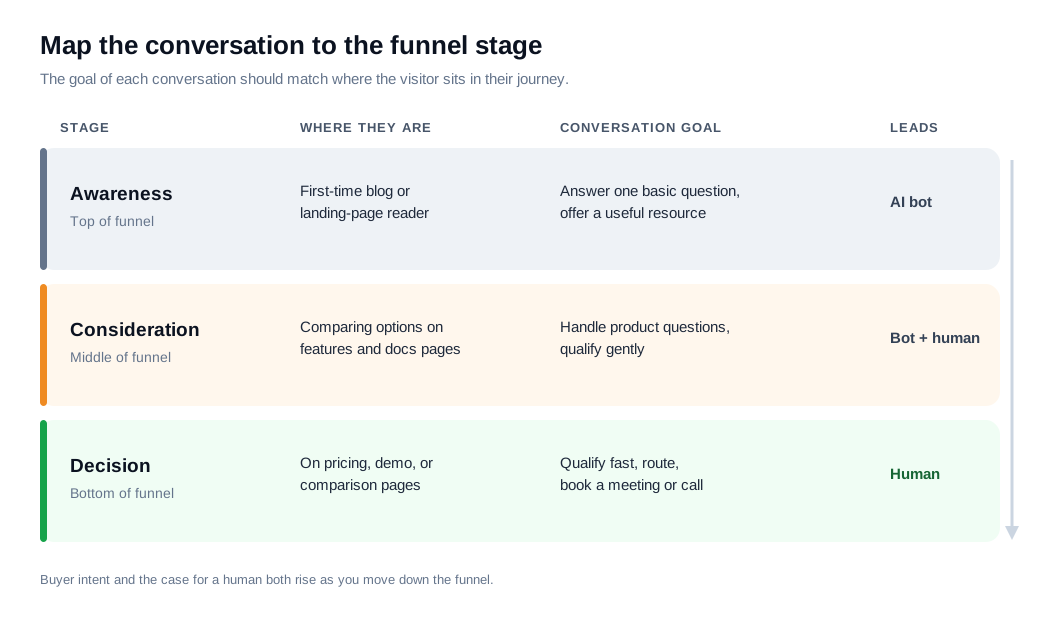
At the top of the funnel, in the awareness stage, the visitor is reading a blog post or a landing page and has low buying intent. The conversation should answer one question, point to a useful resource, and stay out of the way. Asking a first-time reader to book a demo reads as pushy and gets ignored. An AI assistant handles this stage well because the questions are predictable and the stakes are low.
In the middle, during consideration, the visitor is comparing options on your features, docs, or integrations pages. Now the conversation can do more work: answer specific product questions, surface a comparison, and gently qualify by asking about team size or use case. This is where a bot and a human share the load, with the assistant carrying the routine questions and a rep stepping in when the exchange gets substantive.
At the bottom, in the decision stage, the visitor is on pricing, the demo request, or a comparison page. Intent is high and time matters. The job here is to qualify fast, route to the right rep, and either book a meeting or start a live conversation on the spot. This stage should reach a human quickly, because a good-fit buyer on a pricing page is the most expensive traffic you have.
How do you choose channels and triggers?
Choose channels by where your buyers already are and how fast they expect an answer, and choose triggers by combining page intent with visitor behavior so a prompt only fires when a conversation is worth having. Channels decide the medium. Triggers decide the moment.
For most B2B teams, website chat is the anchor. A live chat widget on high-intent pages lets a person answer a buying question in seconds, and an AI chat assistant covers qualification and off-hours traffic. When a question is hard to resolve in text, some tools let a hot visitor jump to a live video call or screen share without leaving the page, which shortens the path on complex products. Messaging channels like SMS and WhatsApp extend the same idea for reorders, re-engagement, and consumer-facing sales. Twilio's research on customer engagement has found that a large majority of consumers want to message businesses the way they text a friend, so the channel matters even when the buyer is not on your site.
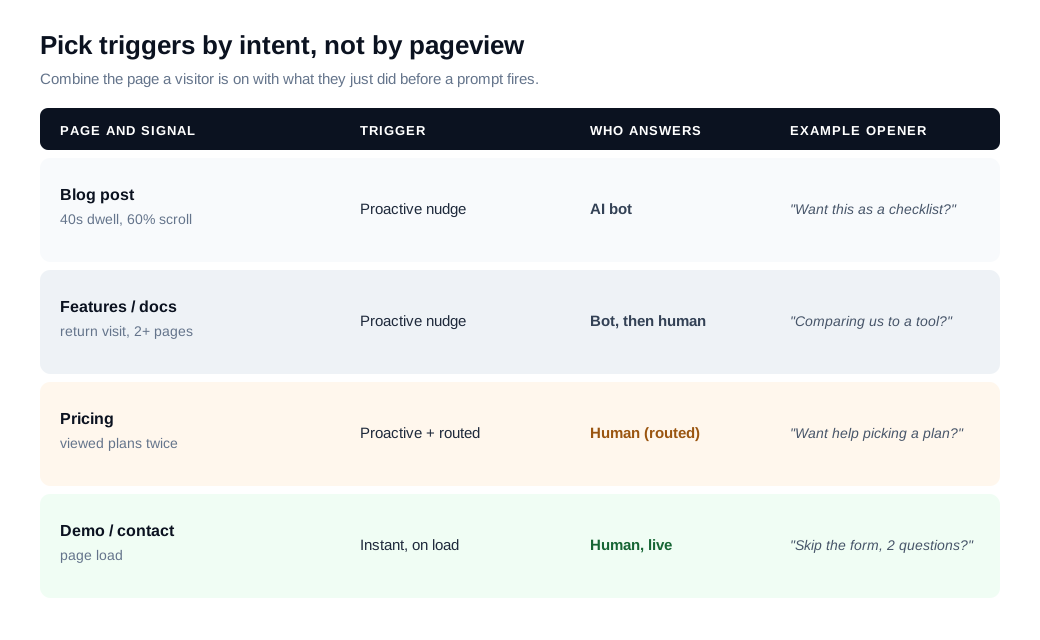
Triggers are where discipline pays off. A prompt on every page at three seconds annoys people and trains them to close the bubble. Better triggers combine three signals. Page intent tells you the visitor is on pricing, demo, or a comparison. Behavior tells you they lingered, scrolled deep, returned for a second visit, or viewed the plans twice. Firmographics, if you have visitor enrichment, tell you the account is a fit. When those line up, a proactive prompt lands as helpful rather than intrusive. The rest of the time, a quiet reactive widget that waits to be clicked is the safer default. The guide to proactive outreach nudges covers how to set these thresholds without over-triggering.
When do you use bots vs humans?
Use bots for speed, coverage, and qualification at scale, and use humans for high-intent buyers, complex questions, and any moment that carries emotion or real deal value, with a clean handoff between the two. The strongest setup puts a bot on the front line and a person one step behind it.
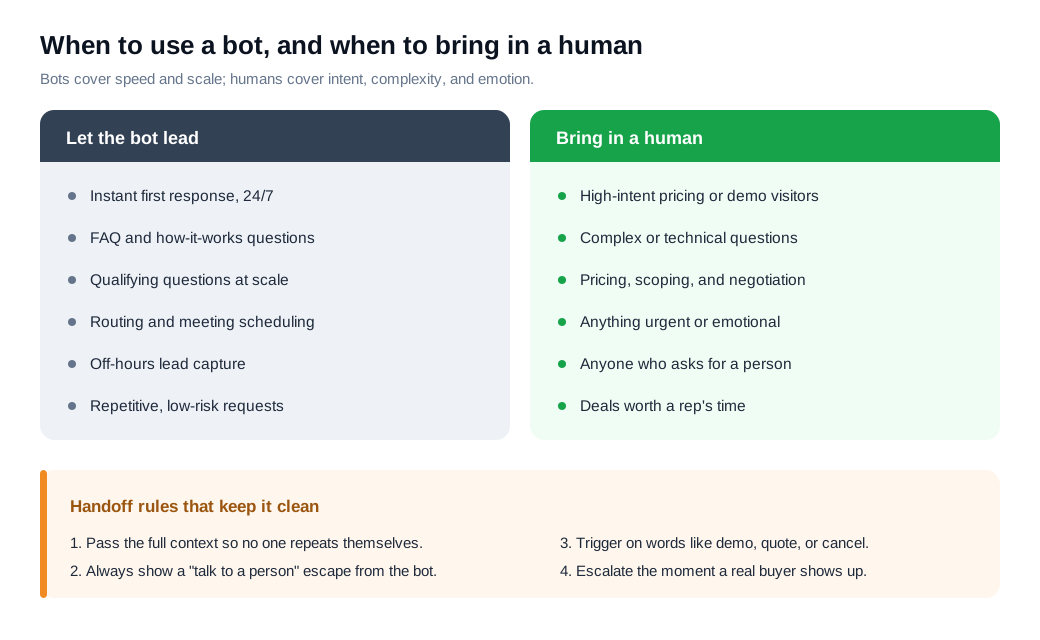
Bots earn their place on three jobs: instant first response, round-the-clock coverage, and repetitive qualification. An assistant can greet a visitor at 11 p.m., answer a shipping or setup question, ask the two things a rep needs to know, and hold the lead until morning. Buyers accept this for simple, fast interactions. The direction of travel supports it too. Gartner has reported that 85 percent of customer service leaders planned to explore or pilot a customer-facing conversational generative AI tool in 2025, and predicts that by 2028 at least 70 percent of customers will use a conversational AI interface to start a service interaction.
Humans earn their place when the money or the emotion rises. A visitor on the pricing page, a technical question that a script cannot answer, a scoping or negotiation conversation, or anyone who is frustrated or in a hurry should reach a person quickly. The handoff is where most programs break. Three rules keep it clean. Pass the full context so the buyer never repeats what they told the bot. Always show a visible way to reach a human, because people trust a bot more when they know they will not get stuck. And escalate on clear signals: words like demo, quote, or cancel, a returning high-intent visitor, or a direct request for a person. Pair the assistant with instant routing and notifications so the moment a lead qualifies, the right rep is pinged in Slack rather than left in a queue.
How do you handle qualification and routing?
Qualification and routing are the two mechanics that decide whether a conversation becomes pipeline, so treat them as design work rather than an afterthought. Qualification separates buyers from browsers. Routing gets the buyer to the right person before their interest cools.
Keep qualification short. Every extra question loses people, so ask only what a rep genuinely needs before a real discussion: role, team size, use case, and timing. Three questions is usually enough to tell a good-fit buyer from a tire-kicker. Write the questions to sound like a helpful person, not a form, and let the assistant ask them in the flow of the conversation rather than as a wall of fields.
Routing turns a qualified conversation into a booked meeting. Decide in advance who gets which lead, by territory, company size, product line, or round-robin, and make the assignment automatic. Then make the alert loud and fast. Speed is the whole point of conversational marketing, and it tracks a well-documented pattern. The MIT and InsideSales.com Lead Response Management study, which analyzed more than 15,000 leads, found that a lead contacted within five minutes rather than thirty was about 21 times more likely to qualify. A separate Harvard Business Review audit of 2,241 U.S. companies found the average firm took roughly 42 hours to respond to a web lead, and 23 percent never responded at all. Conversational marketing exists to close that gap, and it only works if the routing actually reaches a human during the window that matters.
How do you measure the results?
Measure a conversational marketing strategy on the metrics that sit between a conversation and revenue: conversations started, engagement rate, qualified conversations, meetings booked, pipeline influenced, and win rate. Total chat volume tells you almost nothing on its own.
Read the metrics as a ladder. Conversations started shows whether your triggers are firing on the right people. Engagement rate, the share of prompts that get a reply, shows whether the openers are relevant. Qualified conversations shows whether the flow is doing its job. Meetings booked and pipeline influenced are the numbers a revenue team actually cares about, and they require your chat tool to be wired into the CRM through your integrations so a conversation can be traced to a deal.
A worked example makes the shape concrete. Suppose your site draws 12,000 visitors a month, and 6 percent of them (720 people) reach a high-intent page like pricing or demo. Proactive prompts on those pages engage 12 percent, which is about 86 conversations. The assistant qualifies them, and 45 percent clear the bar, giving roughly 39 qualified conversations. Reps respond fast and book 40 percent into meetings, or about 16 meetings a month from traffic you already had. At a 25 percent close rate and a 7,200 dollar annual contract value, that is roughly 4 new customers and about 29,000 dollars in new annual recurring revenue a month. Change any input and the total moves, but the lever stays the same: catch more of the people who were already interested.
Compare that against the baseline it replaces. A standard web form on the same 720 high-intent visitors might convert 2 to 3 percent into leads, and then lose most of them to the 42-hour response lag. The conversation wins because it happens now, while the visitor is still on the page.
What mistakes should you avoid?
The most common mistakes are launching a widget nobody staffs, asking for personal information too early, reusing one generic opener everywhere, and treating conversation volume as the goal. Each one is easy to make and expensive to leave in place.
An unstaffed widget is the worst of them. A chat bubble that promises a fast reply and then goes silent converts worse than no widget at all, because it breaks a promise you made on the page. Cover your peak traffic with real people, let an assistant or an offline form handle the rest, and be honest about your hours.
Asking for an email or phone number before you have helped is the next trap. Research on conversational flows suggests a large share of visitors abandon the conversation when a bot demands personal details up front. Lead with value, qualify in the middle, and collect contact information only once the person has a reason to give it.
The rest follow from the sections above. Do not run the same prompt on your blog and your pricing page. Do not trap people in a bot with no way to reach a human. And do not report success by counting chats when the number that matters is meetings booked and pipeline influenced. If you are building this into a broader inbound sales motion, the discipline of measuring pipeline is what keeps the channel honest as it grows.
Key takeaways
- A conversational marketing strategy is a written plan, not a widget. It defines goals, audience, channels, triggers, conversation flows, and the bot-and-human split before anything goes live.
- Match the conversation to the funnel stage. Light and bot-led at the top, qualifying in the middle, human-led and fast at the decision stage where intent is highest.
- Trigger on intent, not on pageviews. Combine the page, the visitor's behavior, and firmographics so a proactive prompt only fires when a conversation is worth having.
- Bots cover speed and scale; humans cover value and emotion. Put an assistant on the front line, escalate on clear signals, and pass full context so no one repeats themselves.
- Speed is the whole point. A lead contacted within five minutes is about 21 times more likely to qualify, yet the average company takes around 42 hours, so routing has to reach a human fast.
- Measure the ladder to revenue. Track conversations, engagement, qualified conversations, meetings, and pipeline influenced, and ignore raw chat volume.

Written by
Daniel SemeckyCo-founder & CEO
Daniel is the co-founder and CEO of Glimpze. He spends his days talking to revenue teams about how to catch high-intent visitors before they bounce, and writes about inbound sales, lead conversion, and building a motion where marketing and sales actually share a number.


