
On this page
- What is conversational marketing?
- What is conversational sales?
- What are the key differences between conversational marketing and conversational sales?
- Where do conversational marketing and conversational sales overlap?
- How do you hand off from marketing to sales?
- How do you measure conversational marketing versus conversational sales?
- Do you need both conversational marketing and conversational sales?
- Key takeaways
- Sources
A visitor lands on your pricing page at 4 p.m. on a Tuesday. A chat prompt opens, asks what they are comparing, and learns they run a 50-person team evaluating three vendors this quarter. Thirty seconds later a sales rep is in the same window answering a question about onboarding. Two different jobs just happened in one thread, and most companies only have a name for one of them.
The first job, starting the conversation and figuring out who is worth talking to, is conversational marketing. The second, guiding a qualified buyer toward a decision, is conversational sales. They share a widget and a moment, but they answer to different teams, chase different numbers, and break in different ways. Treating them as one thing is how good conversations stall at the handoff.
This guide defines each one, lays out the key differences, shows where they overlap, and walks through how to hand a live conversation from marketing to sales without dropping the lead. It ends with how to measure both and whether you need them at the same time.
What is conversational marketing?
Conversational marketing is a strategy that engages website visitors and prospects through real-time, two-way conversations instead of static forms and delayed follow-up. Its job sits at the top of the funnel: catch attention while it is fresh, start a relevant exchange, and figure out who is worth a deeper conversation.
The work is mostly engagement and qualification. A prompt opens on a high-intent page, an assistant or a rep asks a few questions, and the visitor moves from anonymous traffic to a known, scored lead. Marketing owns this layer because it sits where campaigns land. The ad, the search result, or the content piece brings the visitor, and conversational marketing decides whether that visit becomes a conversation instead of a bounce.
It also leans more proactive than its siblings. Heymarket, which groups these strategies into one family, notes that conversational sales and support are almost entirely inbound, while conversational marketing puts more emphasis on outgoing messages that encourage leads to interact. A well-timed nudge on the pricing page is a marketing move, and so is an AI chat assistant that greets a returning visitor by referencing the plan they looked at last week. That kind of nudge is a form of proactive outreach, triggered by behavior rather than waiting for the buyer to speak first.
The category was largely defined by Drift, which coined the term and framed the goal as a loop: engage the visitor, understand who they are, and recommend a next step. Everything conversational marketing does feeds that loop, and success is measured in conversations started and qualified leads produced, not in deals closed.
What is conversational sales?
Conversational sales is an inbound strategy that answers a qualified buyer's questions in real time and guides them toward a purchase that fits. It picks up where conversational marketing leaves off, at the consideration and decision stages, and its job is to move interest into a closed deal.
Where marketing starts conversations at scale, sales carries the serious ones to a decision. A rep, or an AI assistant briefed to act like one, answers product questions, handles objections, works out fit, and books or runs the meeting. The channel is the same live thread, but the intent has shifted: this person has raised their hand, and the goal is to help them buy.
Heymarket describes conversational sales as an inbound messaging strategy focused on giving authentic responses to inbound lead questions through the channels buyers already use. Drift frames it as turning lead qualification into a data-driven process, using real-time buyer intent to spot ready-to-buy leads so sales can close faster. Both point at the same thing: fewer, higher-value conversations aimed at revenue.
This is where speed stops being a marketing nicety and becomes a sales number. The Lead Response Management study run at MIT with InsideSales.com found that contacting a web lead within five minutes rather than thirty made it 21 times more likely to qualify. Conversational sales exists to act inside that window, as part of the inbound sales motion, while the buyer is still in the chat.
What are the key differences between conversational marketing and conversational sales?
The key difference is job and stage: conversational marketing starts and qualifies conversations at the top of the funnel, while conversational sales closes the qualified ones lower down. Everything else, from who owns it to what it measures, follows from that split.
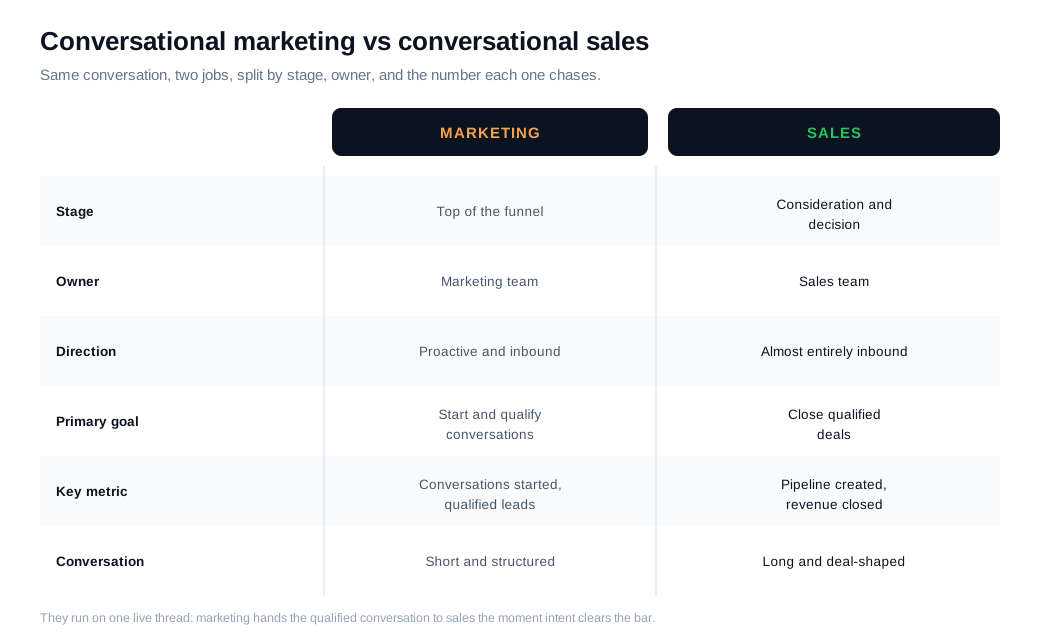
Ownership. Marketing runs the conversational marketing layer because it lives where campaigns and content deliver traffic. Sales runs the conversational sales layer because it involves qualified, high-intent buyers who need a person to help them decide.
Direction. Conversational marketing is willing to reach out first, with proactive prompts and nudges designed to start interactions. Conversational sales stays almost entirely inbound, responding to buyers who have already engaged.
Goal and metric. Marketing optimizes for the volume and quality of conversations: sessions engaged, leads qualified, meetings booked. Sales optimizes for outcomes: pipeline created, deals advanced, revenue closed. A conversational marketing program can look healthy on conversation count and still fail if none of those conversations turn into deals, which is exactly why the handoff matters.
Depth. A marketing conversation is short and structured, a few questions to sort fit. A sales conversation is longer and open-ended, shaped by the specific deal in front of the rep.
Where do conversational marketing and conversational sales overlap?
They overlap in the moment, the channel, and the goal: both are real-time, two-way conversations on the same live surface, aimed at the same buyer, working toward the same revenue. Heymarket groups them, along with conversational support, into one family it calls conversational customer engagement, and all three prioritize person-to-person connection over broadcast.
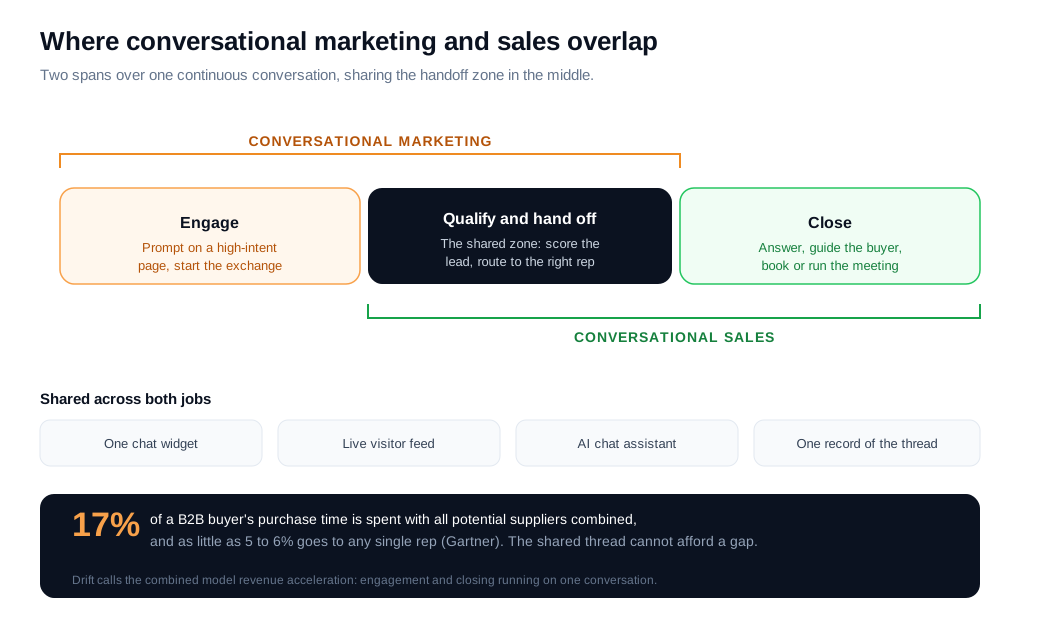
The clearest overlap is the tooling. A single chat widget, a shared visitor feed, and one record of the conversation serve both jobs. The assistant that qualifies a lead for marketing is the same assistant that briefs the rep for sales. When a marketing conversation gets serious, it does not restart somewhere else; it deepens in place.
Drift built its later strategy on this overlap, calling it revenue acceleration: a model that combines conversational marketing and conversational sales so the two teams work the same conversation instead of trading leads across a wall. The premise is that when engagement (marketing's job) and closing (sales' job) run on one continuous thread, the time it takes to convince a buyer drops.
The overlap is strategic too, because both depend on speed. Gartner's research on the B2B buying journey found that buyers spend only 17 percent of their total purchase time meeting with potential suppliers, and when they compare several vendors at once, as little as 5 to 6 percent of their time goes to any single sales rep. Marketing and sales are competing for slices of the same thin window, so a fumbled handoff between them wastes the scarcest resource either team has.
How do you hand off from marketing to sales?
You hand off from marketing to sales by qualifying the lead inside the conversation, then routing it to the right rep the instant it clears the bar, ideally without the buyer ever leaving the thread. In a conversational setup the handoff is a live transfer, not a form dropped into a queue.
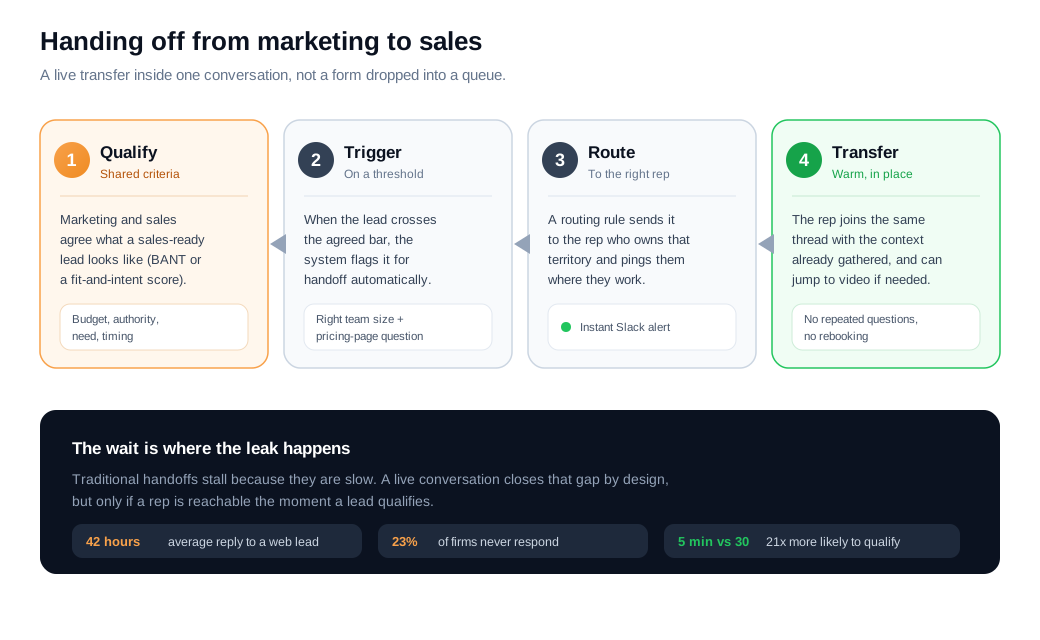
The mechanics come down to four moves.
- Qualify against shared criteria. Marketing and sales agree in advance on what a sales-ready lead looks like, using a framework like BANT (budget, authority, need, timing) or a combined fit-and-intent score. The conversational layer asks the two or three questions that separate a buyer from a browser.
- Trigger on a threshold. When the lead crosses the agreed bar (right company size, an active buying timeline, a pricing-page question), the system flags it for handoff instead of leaving the judgment to chance.
- Route to the right person. A routing and notifications rule sends the lead to the rep who owns that territory, segment, or product, and pings them where they work, usually Slack, so nobody has to watch a queue.
- Warm-transfer in place. The rep joins the same conversation with the context already gathered. If text is not enough, they can escalate to a live video call or screen share without making the buyer repeat themselves or rebook.
The failure mode is the wait. Traditional handoffs leak because they are slow. A Harvard Business Review audit of 2,241 U.S. companies found the average firm took about 42 hours to respond to a web lead, and 23 percent never responded at all. A live conversation closes that gap by design, but only if a rep is actually reachable when the threshold trips.
Here is a worked example. Say a B2B site draws 8,000 visitors a month, and a live chat prompt on high-intent pages engages 5 percent of them, or 400 conversations. The conversational marketing layer qualifies 30 percent of those into 120 sales-ready leads. With an instant handoff and a reachable rep, sales books 45 percent of them into meetings, so 54 meetings a month. At a 25 percent close rate and an 8,000 dollar annual contract value, that works out to about 13 new customers and roughly 108,000 dollars in new annual recurring revenue.
Now break the handoff. If reps are not reachable in the moment and the booked rate on those same 120 leads falls to 15 percent, you get 18 meetings instead of 54, which is around four new customers and closer to 36,000 dollars. Same traffic, same conversations, same qualified leads. The 72,000 dollar gap is the handoff.
How do you measure conversational marketing versus conversational sales?
You measure them on different lines of the same funnel: conversational marketing on the volume and quality of conversations it creates, conversational sales on the deals those conversations become. Using one team's metric to grade the other is a common way to misread what is working.
Conversational marketing metrics sit early. Conversations started, engagement rate on high-intent pages, leads qualified, and meetings booked tell you whether the top of the funnel is producing enough good conversations to be worth a rep's time.
Conversational sales metrics sit late. Pipeline created, meeting-to-opportunity rate, average deal size, and close rate on conversation-sourced deals tell you whether the serious conversations actually convert.
The number that ties them together is speed. Both teams should watch time to first response and time to handoff, because the qualify rate collapses as those minutes stretch. If marketing is producing plenty of qualified leads but sales close rates stay weak, the leak is often in the minutes between the two teams, not inside either team's own work.
Do you need both conversational marketing and conversational sales?
Most companies with a real sales motion need both, but you rarely build them at once or in the same order. The right starting point depends on where your revenue leaks today.
If you have traffic that never turns into conversations, start with conversational marketing. Put a prompt on your highest-intent pages, qualify with a short flow, and get comfortable turning anonymous visits into named leads. There is no point routing leads to sales if the top of the funnel is not producing any.
If you already generate plenty of qualified leads but they stall or go cold, start with conversational sales. Fix the handoff, make a rep reachable in the moment, and shorten the path from qualified lead to booked meeting. Adding more conversations on top of a broken handoff just creates more leads to lose.
For a small team, the same person or the same AI chat assistant often runs both jobs, qualifying and closing in one thread. As you grow, the roles separate, and the discipline shifts from doing both yourself to handing off cleanly between two teams. Tools that keep marketing and sales on one shared conversation, from a customizable widget to smart routing, make that separation less painful. Glimpze is built around that single-thread model, and it offers a free plan so you can test the motion before committing budget.
Key takeaways
- Conversational marketing starts and qualifies conversations at the top of the funnel, owned by marketing and measured in conversations and qualified leads.
- Conversational sales closes the qualified ones, owned by sales, working the consideration and decision stages, and measured in pipeline and revenue.
- The biggest differences are job, owner, and metric, with marketing leaning proactive and sales staying almost entirely inbound.
- They overlap in the moment, the channel, and the goal, running on one live thread that Drift and others call revenue acceleration.
- The handoff is where pipeline leaks or holds. Qualify against shared criteria, trigger on a threshold, route instantly, and warm-transfer in the same conversation.
- Start with whichever end is leaking, marketing if traffic never converts, sales if qualified leads stall, and keep both on one shared conversation.

Written by
Daniel SemeckyCo-founder & CEO
Daniel is the co-founder and CEO of Glimpze. He spends his days talking to revenue teams about how to catch high-intent visitors before they bounce, and writes about inbound sales, lead conversion, and building a motion where marketing and sales actually share a number.


