On this page
Gartner's research on the B2B buying journey contains one of the most uncomfortable numbers in sales, and the strongest case I know for conversational sales: when buyers compare multiple suppliers, any single sales rep gets roughly 5 to 6% of the buyer's total buying time. The other 95% happens without you. Independent research, internal meetings, spreadsheet comparisons, second opinions. And 77% of those same buyers describe their purchase as very complex or difficult.
Hold those two findings next to each other and the conclusion writes itself. Buyers are drowning in information, they want help deciding, and at exactly the moment they reach out for that help, most sales processes hand them a five-field form and a promise that someone will "get back to them shortly."
Conversational sales exists to fix that mismatch. In this guide I'll define what it actually is, separate it from its marketing sibling, look at what the data says, and lay out a practical playbook for building the motion on your own site.
What is conversational sales?
Conversational sales is a sales motion where deals start and advance through real-time, two-way conversations with buyers, on channels they already use: website chat, messaging, and live video. Instead of pushing prospects through forms, sequences, and scheduled callbacks, you let a buyer open a conversation the moment their interest peaks, usually right on your website, and you sell by helping them decide.
Four traits define the motion:
- The buyer starts it. Conversational sales is an inbound motion: you respond to demand that already exists rather than manufacturing it with outreach.
- It happens in real time. The conversation takes place while the buyer is on the page, with the question still fresh, instead of days later on a calendar.
- It runs on dialogue. Both sides ask questions. The rep's job is diagnosis first, pitch second.
- Context carries. A good conversational setup knows which page the visitor is on, what they've looked at, and what they've already told you, so nobody repeats themselves.
David Cancel, the founder of Drift and the person who did more than anyone to build a category around this idea, put the underlying logic bluntly in an interview with Salesflare: "No one's going to be able to sell anything until they have a conversation." For years, he argued, sales and marketing systems were focused on "putting hurdles between you, the prospect, and the salesperson." Conversational sales is the practice of removing those hurdles.
Conversational sales vs traditional sales
In a traditional inbound funnel, the conversation sits at the very end of a qualification pipeline. A visitor fills out a form (the median landing page converts about 2.35% of visitors, per WordStream's benchmark study), marketing scores the lead, routing assigns an owner, and a rep eventually proposes a call for later in the week. The design made sense in its era: sales time was expensive, so the machine existed to protect reps from unqualified leads.
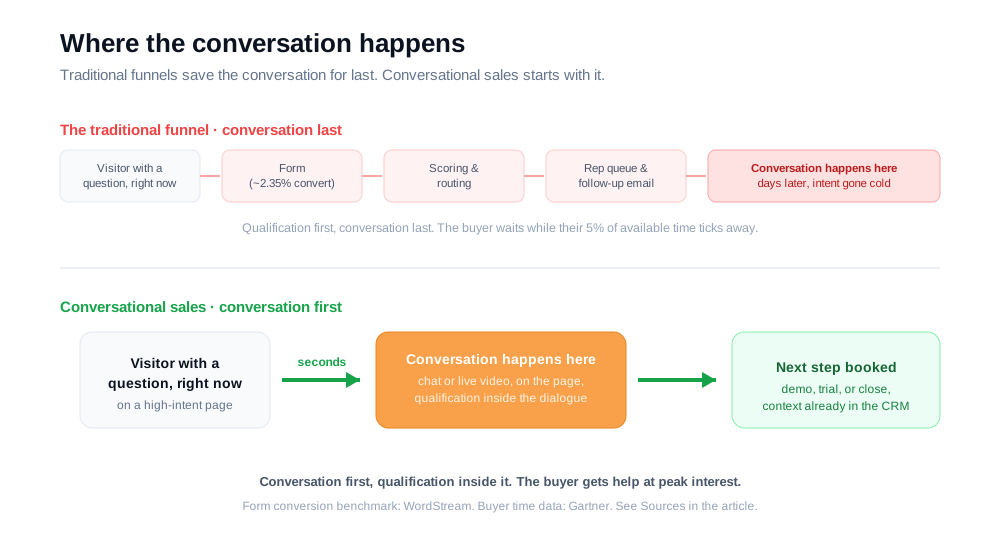
Conversational sales inverts the order. The conversation comes first, and qualification happens inside it. That inversion matters for two reasons, both visible in the Gartner data:
- Your minutes are scarce. If you only get 5% of the buyer's time, spending the first touch on "what's your company size?" is a waste of the rarest resource you have. A live conversation can qualify and help simultaneously.
- Buyers reward whoever makes buying easier. With 77% of buyers calling the purchase complex or difficult, the supplier who answers the actual question in the actual moment relieves that difficulty. The supplier who routes them into a sequence adds to it.
There's also a decay problem. Buyer intent has a short shelf life, and every hour between the question and the answer costs you conversions. I've written a full breakdown of that evidence in our guide to speed to lead; the short version is that the odds of qualifying a lead fall roughly 10x after the first five minutes.
Conversational sales vs conversational marketing
The two terms get used interchangeably, but they cover different stages of the same funnel.
Conversational marketing uses real-time conversations to generate and engage demand. Think proactive chat prompts on a campaign landing page, a bot that answers content questions, or a greeting targeted at first-time visitors. Its output is engaged leads, and its metrics look like marketing metrics: engagement, captured contacts, qualified leads.
Conversational sales picks up where interest already exists and converts it. Its job is qualifying live, handling objections, giving demos, and booking or closing the next step. Its metrics look like sales metrics: meetings, pipeline, revenue.
There's a third sibling, conversational support, which serves existing customers. The three share one infrastructure (the chat widget, the routing, the conversation history), and the best implementations make the seams invisible: the same thread that started as a marketing greeting escalates into a sales conversation without the buyer noticing a handoff.
If you remember one distinction, make it this: conversational marketing starts conversations, conversational sales finishes them.
What the data says about conversational sales
The strongest evidence for the motion comes from research on how buyers want to buy, rather than from any vendor's case studies.
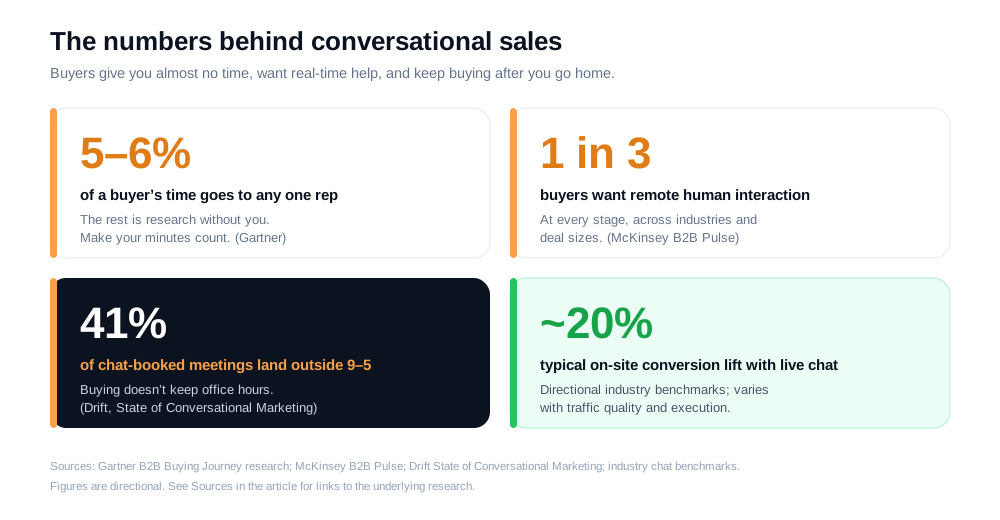
McKinsey's B2B Pulse research finds a "rule of thirds" that holds across geographies, industries, and deal sizes: at any given stage of the journey, about one third of buyers prefer in-person interaction, one third prefer remote human interaction (video, chat, phone), and one third prefer digital self-serve. Buyers also use an average of ten channels across their journey, and a majority of B2B decision makers say they would abandon a purchase or switch suppliers after a poor omnichannel experience. A real-time human channel on your website serves the middle third directly, at the exact stage where they want it.
Timing data points the same direction. Drift's State of Conversational Marketing report found that 41% of meetings booked through website conversations were booked outside of 9-to-5 hours, and 39% of all conversations happened outside business hours. Buying doesn't keep office hours, and a conversational channel (with AI covering the night shift) captures the intent your contact form politely defers to the next morning.
On conversion itself, industry benchmarks consistently find that visitors who chat convert at a multiple of those who don't, and that adding live chat lifts on-site conversion by around 20%. Treat those numbers as directional rather than guaranteed: most come from chat vendors, and results vary with traffic quality and execution. The pattern across sources, though, is consistent and points one way.
How to do conversational sales: a six-step playbook
You don't need to rip out your funnel to start. Here's the sequence I'd follow, in order of leverage.
1. Concentrate on your high-intent pages
Conversational sales works because it catches intent at its peak, so deploy it where intent actually peaks: pricing pages, demo pages, comparison pages, and active trials. A chat prompt on every blog post trains your team to ignore the channel and trains visitors to ignore the widget. Scarcity keeps the signal clean.
2. Give buyers a door instead of a form
On those high-intent pages, the primary call to action should open a conversation now, with escalation paths that match the stakes: chat for quick questions, live video with screen-share for serious evaluations. This is the product problem we built Glimpze around: a buyer reading your pricing page can connect with a rep in seconds, on the page, ask their real question, and leave with the next step already booked. Keep a form as the fallback for off-hours, never as the front door.
3. Treat speed as part of the offer
A conversational channel with a ten-minute response time is a form with extra steps. Decide who answers, route by who is available right now rather than by territory, and hold the team to a response standard measured in seconds. The speed-to-lead evidence is unambiguous about how fast the window closes.
4. Run every conversation like a discovery call
Selling conversationally still means selling well, and here the data is unusually specific. Gong's analysis of hundreds of thousands of recorded sales conversations found that top performers listen more than they talk (a roughly 43:57 talk-to-listen ratio), that winning discovery conversations involve 11 to 14 targeted questions exploring three or four business problems in depth, and that interactivity itself predicts wins: frequent back-and-forth beats long monologues, even with an identical talk ratio.
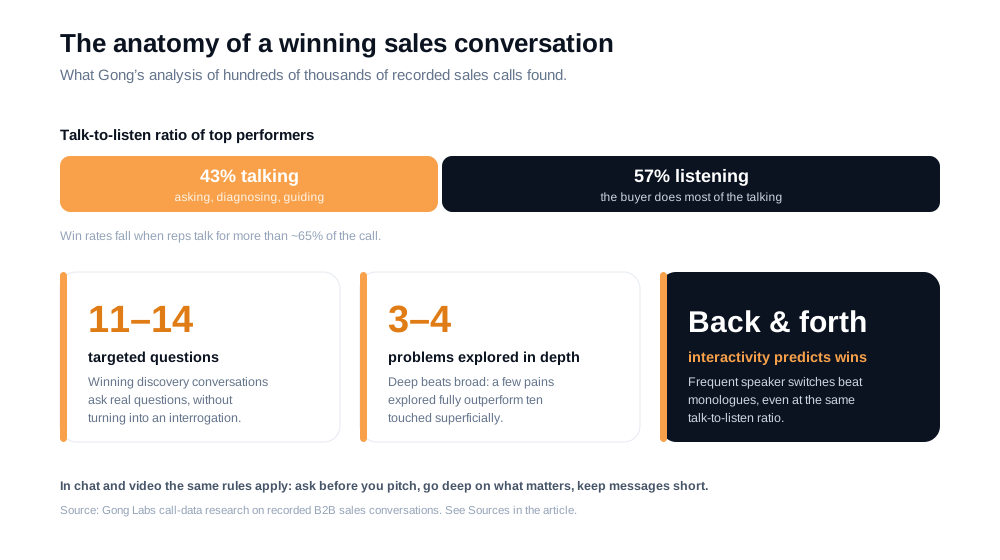
Translate that to chat and video: ask before you pitch, go deep on the few problems that matter instead of shallow on ten, and keep your messages short enough that the buyer stays in the exchange.
5. Use AI for coverage, people for conversion
AI belongs in this motion, on the layer where it's genuinely better than people: answering instantly at 3 a.m., qualifying with a couple of questions, routing to the right rep, and handling the documentation lookups that would otherwise interrupt a human's day. Given how much buying happens outside business hours, that coverage is real pipeline. But route qualified, high-intent buyers to a person as fast as you can. The rule of thirds says a third of your buyers specifically want a human in real time, and those buyers are disproportionately the ones ready to spend.
6. Capture everything and measure it like a channel
Every conversation should land in your CRM as structured context: the page, the questions, the objection, the timeline. Then measure the motion the way you'd measure any channel: conversations started, conversation-to-meeting rate, conversation-to-pipeline, and revenue per conversation. Those numbers tell you which pages, prompts, and reps convert, and they make the case for expanding the motion with data instead of anecdotes.
Conversational sales FAQs
Is conversational sales the same as live chat?
No. Live chat is a channel; conversational sales is the motion you run through it. A chat widget that collects an email address and promises a reply "within one business day" is a contact form wearing a costume. The motion requires real-time response, qualification inside the conversation, and a path to a human who can advance the deal, whether that happens over chat, video, or messaging.
Does conversational sales work outside of B2B SaaS?
Yes. The approach was pioneered in B2C, where conversational commerce over messaging apps is standard in much of the world. It delivers the most value wherever the purchase carries enough consideration that buyers have questions: software, financial services, education, high-ticket e-commerce, and professional services all qualify.
Do you need AI chatbots to do conversational sales?
No. The essentials are a real-time channel on your high-intent pages and humans who respond fast. AI extends the motion by covering off-hours and filtering low-intent traffic, and it makes the economics work at scale, but teams close deals conversationally with nothing more than a well-staffed chat and video setup.
How do you measure conversational sales?
Track it like a pipeline channel: conversations started on high-intent pages, response time, conversation-to-meeting rate, conversation-to-pipeline, and revenue per conversation. Compare those against your form-based funnel on the same pages, and the business case usually settles itself within a quarter.
Key takeaways
- Conversational sales means selling through real-time, two-way conversations on your website and messaging channels, with the buyer initiating and qualification happening inside the dialogue.
- The buyer math demands it. Buyers give any one rep about 5% of their buying time and find purchases complex; the supplier who helps in the moment wins a scarce advantage.
- Marketing starts conversations, sales finishes them. Same infrastructure, different funnel stage, different metrics.
- Run conversations like discovery calls. Listen more than you talk, ask 11 to 14 real questions, go deep on a few problems, and keep the exchange interactive.
- AI covers, humans convert. Let automation handle off-hours and qualification, and get high-intent buyers to a person in seconds, starting on your pricing page.
TAGS

Written by
Nilas MylerCo-founder & CTO, Glimpze
Nilas is the co-founder and CTO of Glimpze, an inbound sales tool that turns high-intent website visitors into live conversations. A former SEO consultant for some of the largest companies in Denmark, he writes about speed-to-lead, inbound sales, and conversion rate optimization — the technical and operational mechanics of turning traffic into pipeline.


